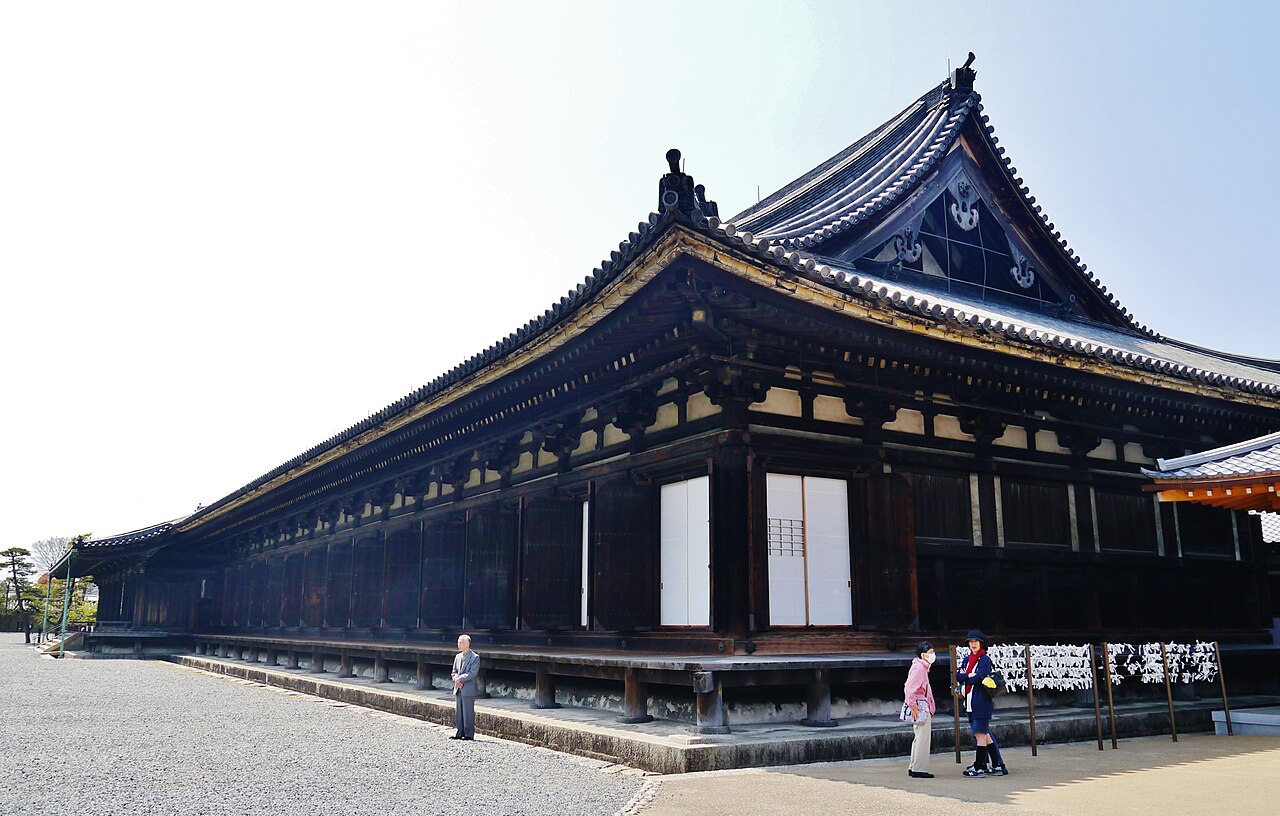
Standing in the main hall of Sanjusangendo, visitors face a seated thousand-armed Kannon together with one thousand and one standing thousand-armed Kannon statues. The temple was built on palace grounds, burned down, and was soon rebuilt by Retired Emperor Go-Saga. The reasons to come have names: the one thousand and one standing Kannon, the seated thousand-armed Kannon, and Fujin and Raijin.
The Main Hall: Standing Among One Thousand and One Kannon
One thousand and one standing Kannon are lined up in this hall of thirty-three bays, with the seated thousand-armed Kannon at the centre.
Standing before the stepped platform, visitors see life-size standing Kannon statues lined up in ten rows from front to back. Each standing statue has eleven faces on its head and forty hands at its sides. The standing statues are carved out of cypress and covered with gold leaf. All of the standing statues are National Treasures.
Facing the centre, visitors look at the seated thousand-armed Kannon, flanked left and right by the standing statues. It is made of cypress wood in the joined-wood technique, with crystal eyes set in and lacquer and gold leaf over the whole body. Forty-two arms represent the thousand arms. The statue has a lotus pedestal and a boat-shaped halo with openwork of cloud and jewel-tree designs.
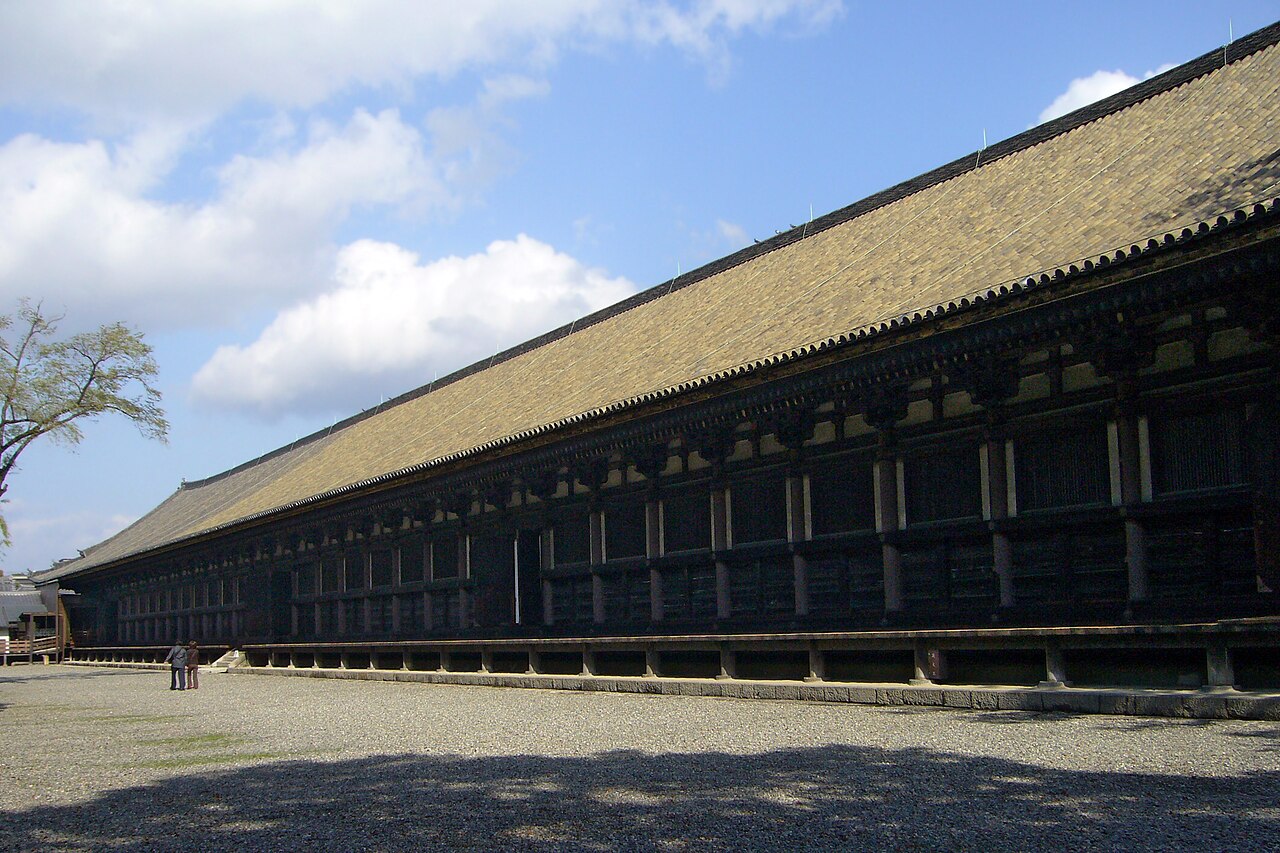
Walking along the building, visitors follow a National Treasure that is long from north to south. Its inner sanctuary has thirty-three bays between the pillars, the source of the hall's common name. Touch-panel monitors behind the passageway allow searching of all the Buddhist statues enshrined here. Shoes come off inside, and shoe lockers are provided at the entrance.
Fujin, Raijin and the Twenty-Eight Guardian Deities: Looking Up From Bent Knees
Between the rows of Kannon and the single figures, Fujin, Raijin and the twenty-eight guardian deities are the ones to look up at.
Looking up at Fujin and Raijin from a posture with bent knees, visitors see the ceiling rafters look like lightning. Fujin, also called Vayu, is said to ride the sky in a multi-horse chariot, and Raijin is said to be the water god Varuna. In Buddhism these gods are believed to protect the Buddhist law and regulate wind and rain.
Looking at the twenty-eight guardian deities, visitors see statues with intense expressions. The deities originate in ancient India and are said to follow the thousand-armed Kannon and protect Buddhism. Daizuratao, one of the Shitenno, is said to live east of Mount Sumeru and guard the Buddhist realm. The arrangement of these statues was returned to its original state, based on Kamakura-period woodblock prints and research.
The Garden, the Nandaimon and the Taikobei: Walking the Grounds
For timber and tile instead of statues, the grounds hold the Nandaimon, once the south gate of Hokoji's Daibutsuden, and the Taikobei.
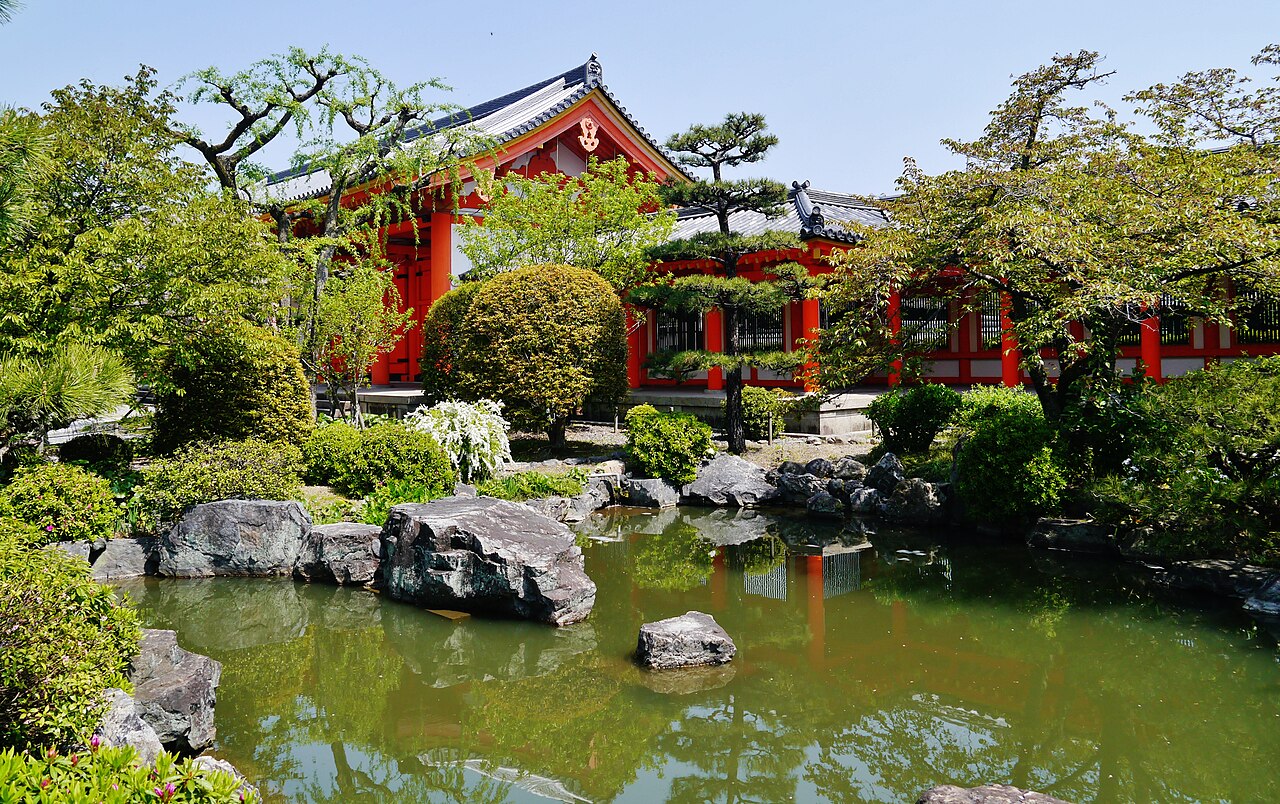
Strolling the grounds, visitors follow a pond-circuit style garden. The garden was recreated as closely as possible to its former appearance, based on historical records. Seasonal flowers and a green garden space are there to see.
Passing the Nandaimon and the Taikobei, visitors see two Important Cultural Properties. The Nandaimon was built as the south gate of Hokoji's Daibutsuden, which Toyotomi Hideyoshi vowed to build in imitation of Todaiji. It is an eight-legged gate with three bays, one door and a gabled roof. Eaves tiles in the Taiko paulownia pattern give the Taikobei its name.
The Yonaki Spring and the Jizo: Prayers for Crying Children
A visit made for a child who cries at night has its own stop: the Yonaki spring, its Jizo and the red apron.
Stopping at the Yonaki (night crying) spring, visitors meet a name taken from sound: water welling up in the quiet of night resembles sobbing. The Jizo in the front garden has long been regarded as curing night crying, and a child is put to sleep with its red apron under the pillow. The temple writes the child's name on the apron, offers prayers and posts it.
Sitting In: Sutra Recitation, a Lecture and Evening Worship
If the aim is to take part and not just to look, the monthly Buddhist culture lecture, the worship sutra recitation in the main hall and the Butsumyoe worship are the ways in.
Joining the Buddhist culture lecture is possible every month, with lecturers invited to speak on themes such as religion, culture and history. On the lecture day a worship sutra recitation takes place in the main hall, and sutra books are lent out. The lecture itself is held at the Myohoin main residence.
Reciting the names of the thousand-armed Kannon statues is what participants do in the Butsumyoe worship. They also perform standing bows. The worship takes place inside Sanjusangendo after regular visiting has ended.
Rituals Through the Year: Willow Water, Archery and Fire
The named rituals here are Yanagi no Okaji, Omato, the Kuzei Inari fire ritual and Shushoe.
Receiving dharma water is what worshippers do at Yanagi no Okaji. The water is prayed over to Kannon and poured on worshippers with a willow branch. The willow is regarded as a sacred tree. The Omato archery tournament is held on the same day as Yanagi no Okaji.
Watching the Kuzei Inari fire ritual, visitors see ascetics dressed as yamabushi perform a saito goma. The ritual includes memorial rites for old talismans and a prayer service burning wishes written on goma sticks. Visitors may bring used talismans and amulets to the event. Sanjusangendo also holds the Shushoe service at the start of the new year.
Putting the Sections Together: A Route Through the Temple
Moving between the hall and the grounds, visitors find slopes on the viewing passages indoors and on the paths outside, and wheelchairs are available to borrow. The main hall could come first, with the standing Kannon and then Fujin and Raijin. The garden, the Nandaimon and the Taikobei could follow outside, with the Yonaki spring last. You can compare places to stay in Kyoto before you book.
Getting to Sanjusangendo, Hours and Fees
New to rural buses and one-man trains? See how to ride them, step by step.
Times and fees below are as listed.
| Item | Details (as listed) |
|---|---|
| Walking from Kyoto Station | about eighteen minutes on foot |
| Keihan Railway | about a seven-minute walk from Shichijo Station exit two |
| City Bus from Kyoto Station | routes one hundred, two hundred six and two hundred eight take about ten minutes |
| Admission hours, April first to November fifteenth | eight thirty to five |
| Admission hours, November sixteenth to March thirty-first | nine to four; reception ends thirty minutes before closing |
| Admission | adults six hundred yen; junior and senior high school four hundred; elementary school three hundred |
| Parking | about fifty cars; groups of twenty-five or more pay the group rate |
Thinking of staying overnight?
Compare places to stay near Kyoto →
Disclosure: This post may contain affiliate links. If you book through them, we may earn a commission at no extra cost to you.