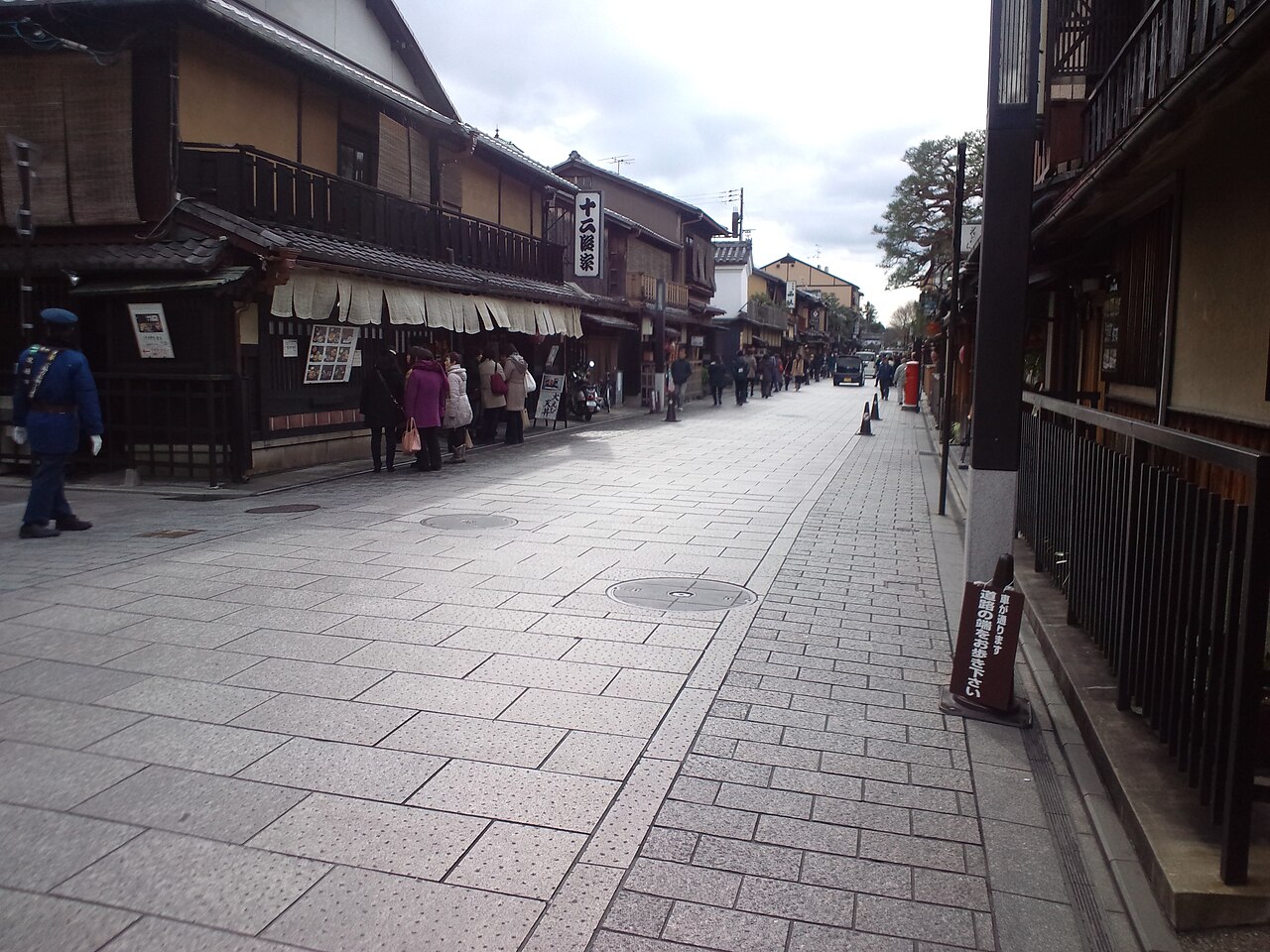
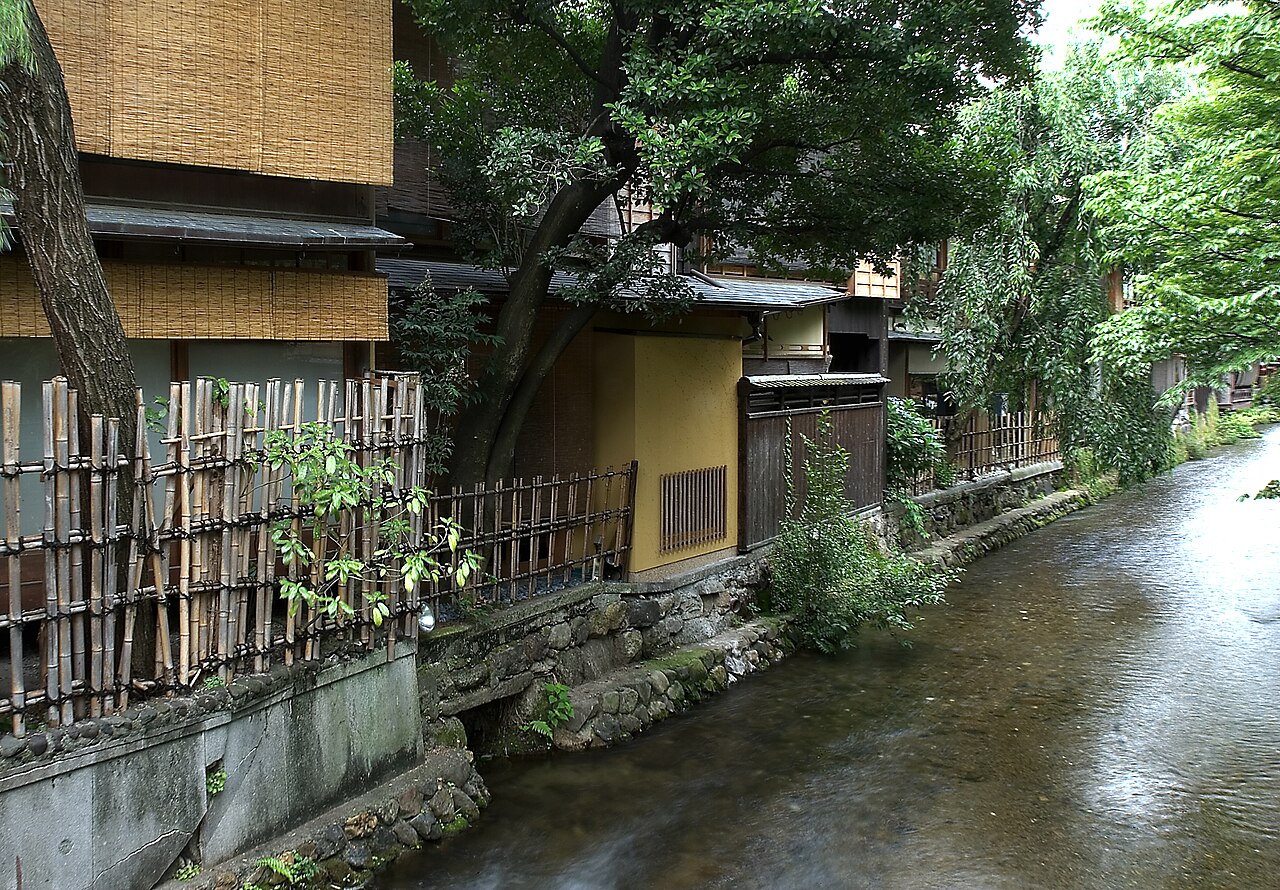
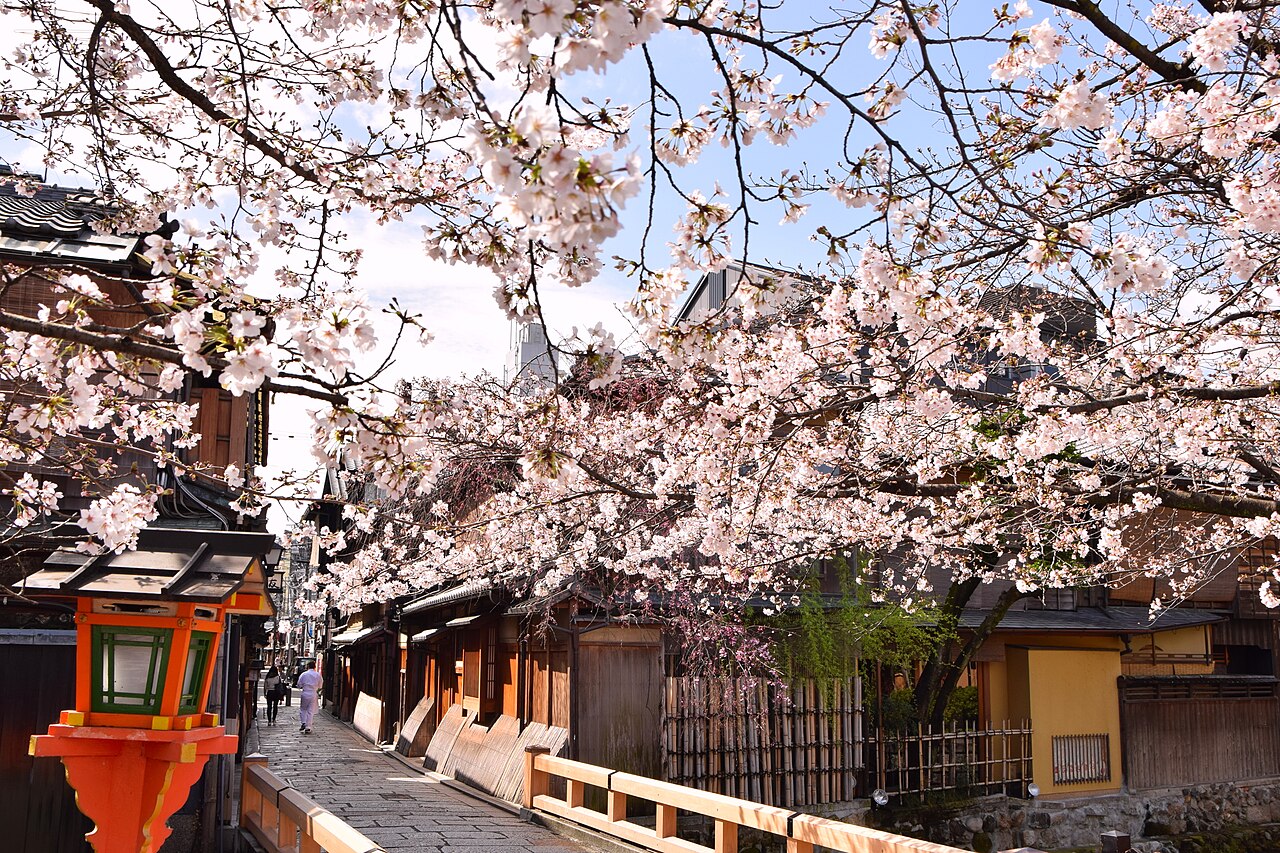
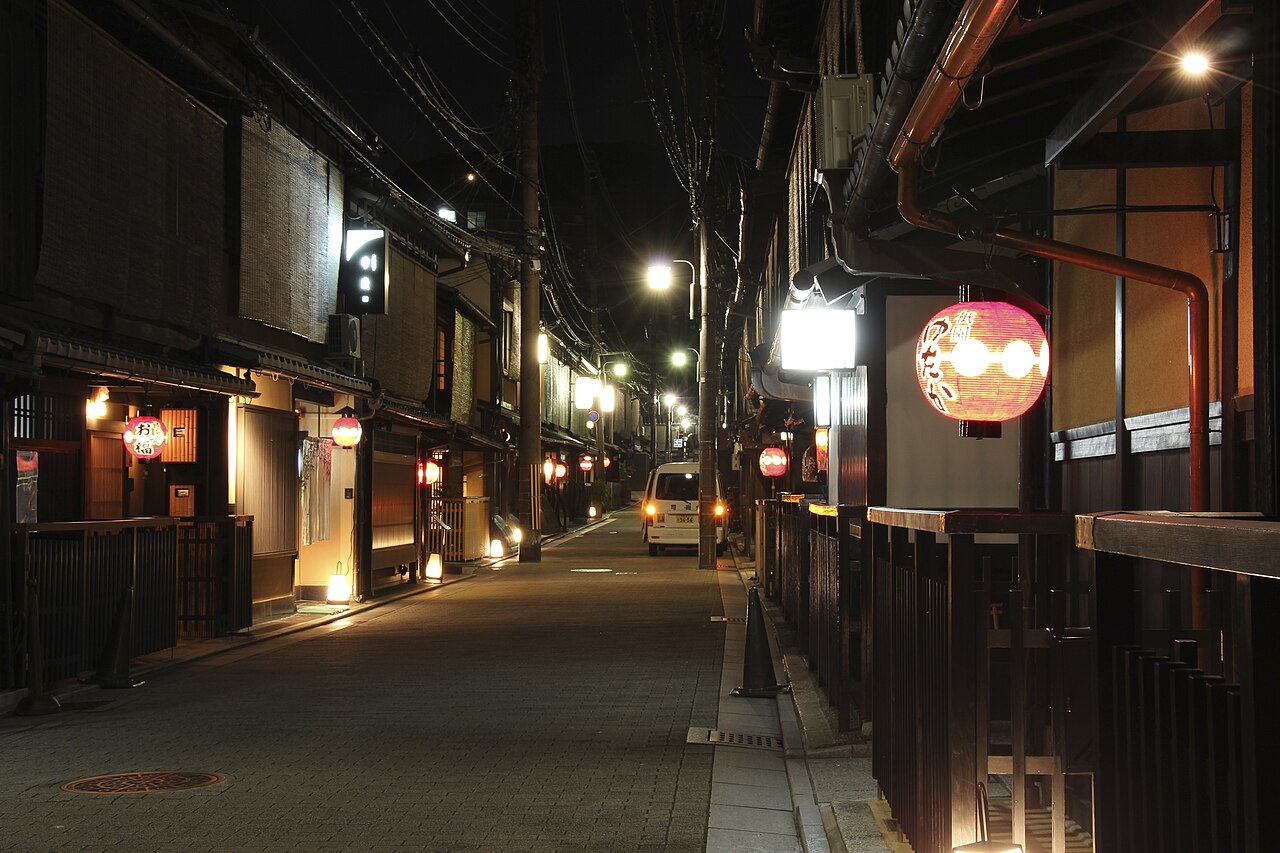
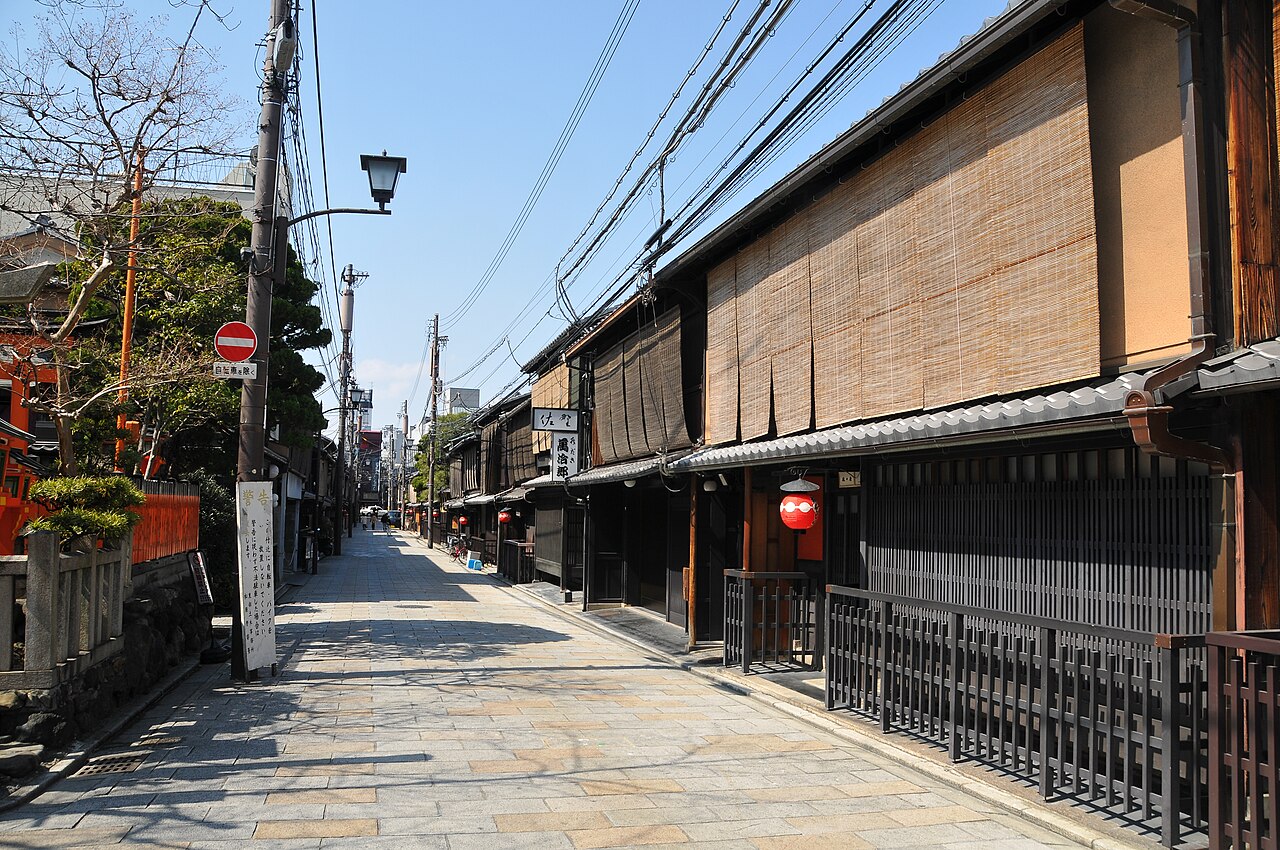
Gion is the area where two hanamachi districts are located, and Gionmachi originated as the town in front of the gate of Yasaka Shrine. Teahouses and ryotei line the stone-paved streets of Gionmachi, designated as an Important Preservation District for Groups of Traditional Buildings. Visitors can walk from the Shirakawa-suji path where willows sway across Tatsumi Bridge to Hanamikoji.
Gion District: Hanamikoji, the Shirakawa Canal and the Miyako Odori
Along the Shirakawa stream flowing through Gion and Shinbashi stands a poem monument to the poet Yoshii Isamu. Gion Corner presents a Kyo-mai dance by maiko, kyogen comedy, chanoyu tea ceremony and ikebana in one stage performance.
A maiko's long-hemmed furisode is called ohikizuri. The darari-no-obi, about five point four metres long, is tied only by Kyoto maiko. The change from maiko to geiko is called erikae, and the geiko then wears a white collar.
The Miyako Odori is a performance of new Kyomai Inoue school dances, passed down only in Gionmachi since its founding in Meiji five. It runs for about an hour without a single curtain drop, through eight scenes that trace the seasons from spring to the following spring.
Gion Kobu holds the Miyako Odori in spring and the Onshukai in autumn as its two main performances. The Onshukai began as a recital where geiko and maiko showed the results of their practice and were assessed by their teachers.
Yasaka Shrine: Main Hall, Lantern-Lit Stage and the Shrines for Beauty and Good Matches
Yasaka Shrine stands at the east end of Shijo-dori, the main street of Kyoto. Its main hall, a national treasure, is generally called Gion-zukuri, a style that covers the formerly separate main hall and worship hall with one roof.
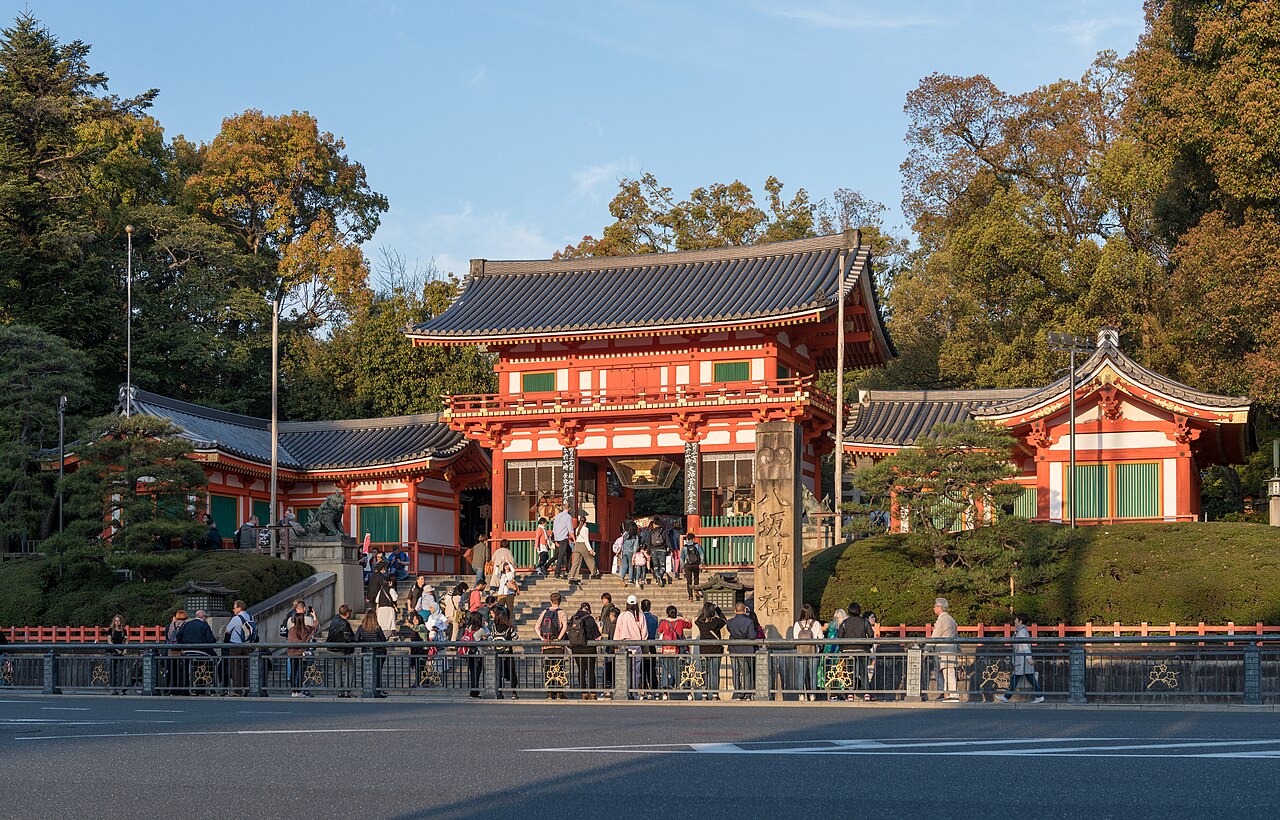
Weddings and dedicated dances are held at the Buden, where the many lanterns dedicated by teahouses and restaurants of the geisha districts are lit at night. Across the shrine, brass bells ring frequently, and the loud claps of people finishing their prayers can be heard.
The deity of Utsukushigozensha is revered as a god of beauty, and putting two or three drops of the Biyosui water that wells up beside the shrine building on the skin is said to make body and mind beautiful. The Okuninushi shrine enshrines Okuninushi, known as a god of matchmaking.
The Gion Festival, Gion Ebisu and Setsubun at Yasaka Shrine
The events of the Gion Festival are held at Yasaka Shrine and in the parishioner district over one month. At the Yoimiyasai, the lights of the precincts are put out and the divine spirit is transferred to the mikoshi in pure darkness.
At the Mikoshi Arai-shiki, one of the three mikoshi is carried with torches lighting the front and back of the procession to the Shijo Ohashi bridge, where the mikoshi is purified. The festival includes a time when the yama and hoko floats can be viewed after dark, with lanterns lit and Gion-bayashi playing.
At the Setsubun festival, maiko dedicate a dance on the shrine's dance hall stage and scatter beans.
At the Gion Ebisu festival, the Fuku-sasa given out in front of the shrine building is decorated with auspicious items such as oval and rectangular gold coins, sea bream and rice bales. In front of the Kitamuki Ebisu shrine building, Sanja-mairi stamp paper is handed out.
Kenninji: Twin Dragons, Zen Gardens and Morning Zazen
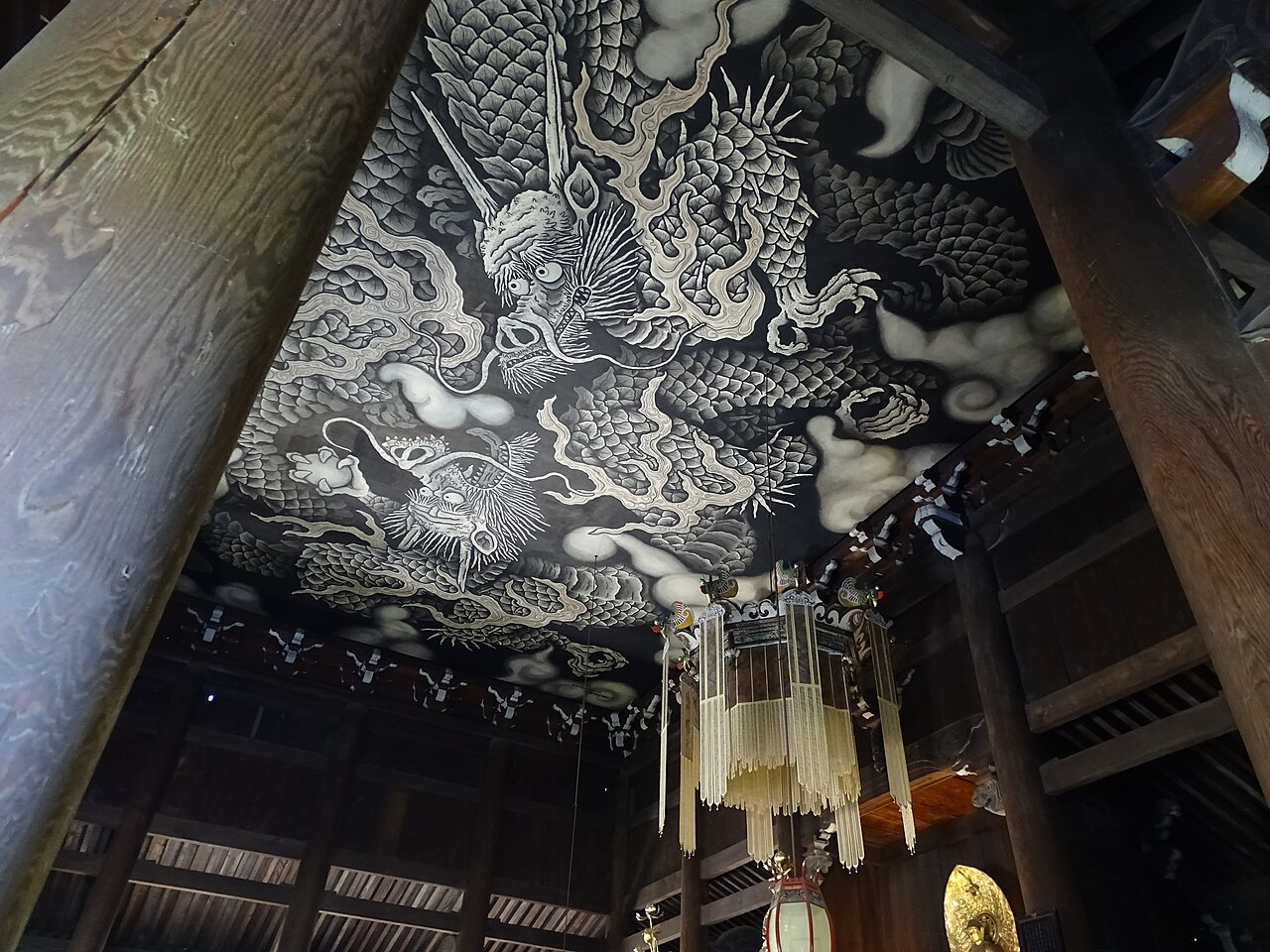
Kenninji was founded in twelve hundred and two, when the shogun Minamoto no Yoriie donated the temple grounds, with Eisai Zenji as founding priest. On the ceiling of its Dharma Hall two dragons are painted, their mouths in the a-form and the un-form, and the a-form dragon holds a jewel in its hand.
Gold leaf covers the whole surface of the Wind and Thunder Gods screens. The garden in the main hall courtyard has Sanzon stones in the centre, a zazen stone to the east and maple trees around it.
Kenninji's founder brought back tea seeds from Song China. A stone tea monument stands in the temple garden, with a tea garden on its east side where tea picking is held every May.
For individuals, Kenninji holds a zazen and Dharma talk gathering every month on the second Sunday at half past seven in the morning.
Maruyama Park, Chion-in, Kodai-ji and Shoren-in East of Gion
Maruyama Park lies next to Yasaka-jinja Shrine and contains stroll gardens, rest houses, small orchards and Japanese restaurants. Chion-in Temple began as a modest hut occupied by the priest Honen, founder of the Jodo (Pure Land) sect of Buddhism.
Kodai-ji Temple's walking garden features large stones and trees placed on a hilly landscape among temple buildings, tea houses and a bamboo grove. At Shoren-in Temple, visitors can sit and sip green tea while contemplating the first of the temple's four gardens.
Kiyomizu-dera has its own guide.
Getting to Gion
New to rural buses and one-man trains? See how to ride them, step by step.
| Route | Item | Detail |
|---|---|---|
| Kyoto City Bus from Kyoto Station | Routes | Routes eighty-six, one hundred and six, and two hundred and six run to Gion |
| Kyoto City Bus from JR Kyoto Station | Stop | Route one hundred and route two hundred and six stop at Gion, right next to Yasaka Shrine |
| Subway from Kyoto Station | Time | About fifteen minutes to Higashiyama Station |
| Keihan Gion-Shijo Station | To Yasaka Shrine | About a five-minute walk |
| Keihan Gion-Shijo Station | To Kenninji | A seven-minute walk |
| Keihan Gion-Shijo Station, exit six | To Gion Kobu Kaburenjo | About an eight-minute walk |
| Hankyu Kyoto-Kawaramachi Station | To Yasaka Shrine | About an eight-minute walk |
| Hankyu Kawaramachi Station | To Kenninji | A ten-minute walk |
| Shijo Kawaramachi intersection | To Yasaka Shrine | About thirteen minutes on foot |
If you would rather stay overnight, places to stay in Kyoto is a place to start.
Hours and Fees
| Place | Item | Time or fee |
|---|---|---|
| Yasaka Shrine | Grounds | Can be visited twenty-four hours |
| Yasaka Shrine | Shrine office reception | Nine in the morning to five in the afternoon |
| Yasaka Shrine | Reception for prayer rites | Nine in the morning to four in the afternoon |
| Kenninji | Visiting hours | Ten in the morning to half past four in the afternoon (last admission); gate closes at five in the afternoon |
| Kenninji | Admission | Eight hundred yen for general visitors; five hundred yen for students |
| Kenninji | Zazen and Dharma talk gathering | Half past seven to half past nine in the morning; free |
| Kenninji | Sutra copying | Three thousand yen, with a goshuin and a Kenninji original clear file |
| Gion Festival | Period | July first to July thirty-first |
| Gion Festival | Yamahoko processions | July seventeenth and July twenty-fourth |
| Gion Ebisu festival | Dates and times | January ninth and tenth, ten in the morning to six in the afternoon |
| Yasaka Shrine | Setsubun bean-throwing | February second and third, at the Buden |
Fees and hours were checked against official sources between 19 November 2026 and 21 November 2026.
Thinking of staying overnight?
Compare places to stay near Kyoto →
Disclosure: This post may contain affiliate links. If you book through them, we may earn a commission at no extra cost to you.