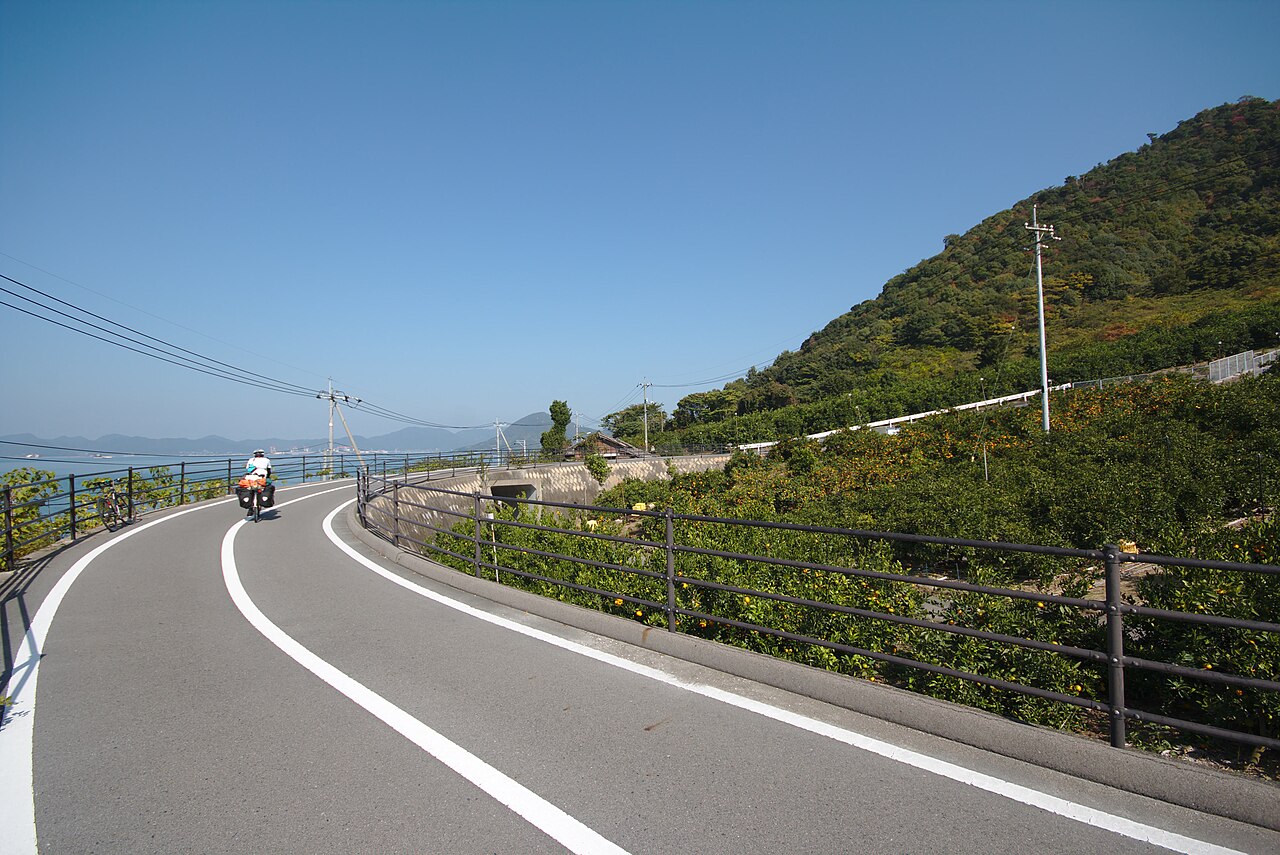
The Innoshima Bridge has two levels, a roadway above and a path for pedestrians and light vehicles below. Clapping hands directly beneath the main tower of the Tatara Bridge produces a sound that echoes upward toward the sky.
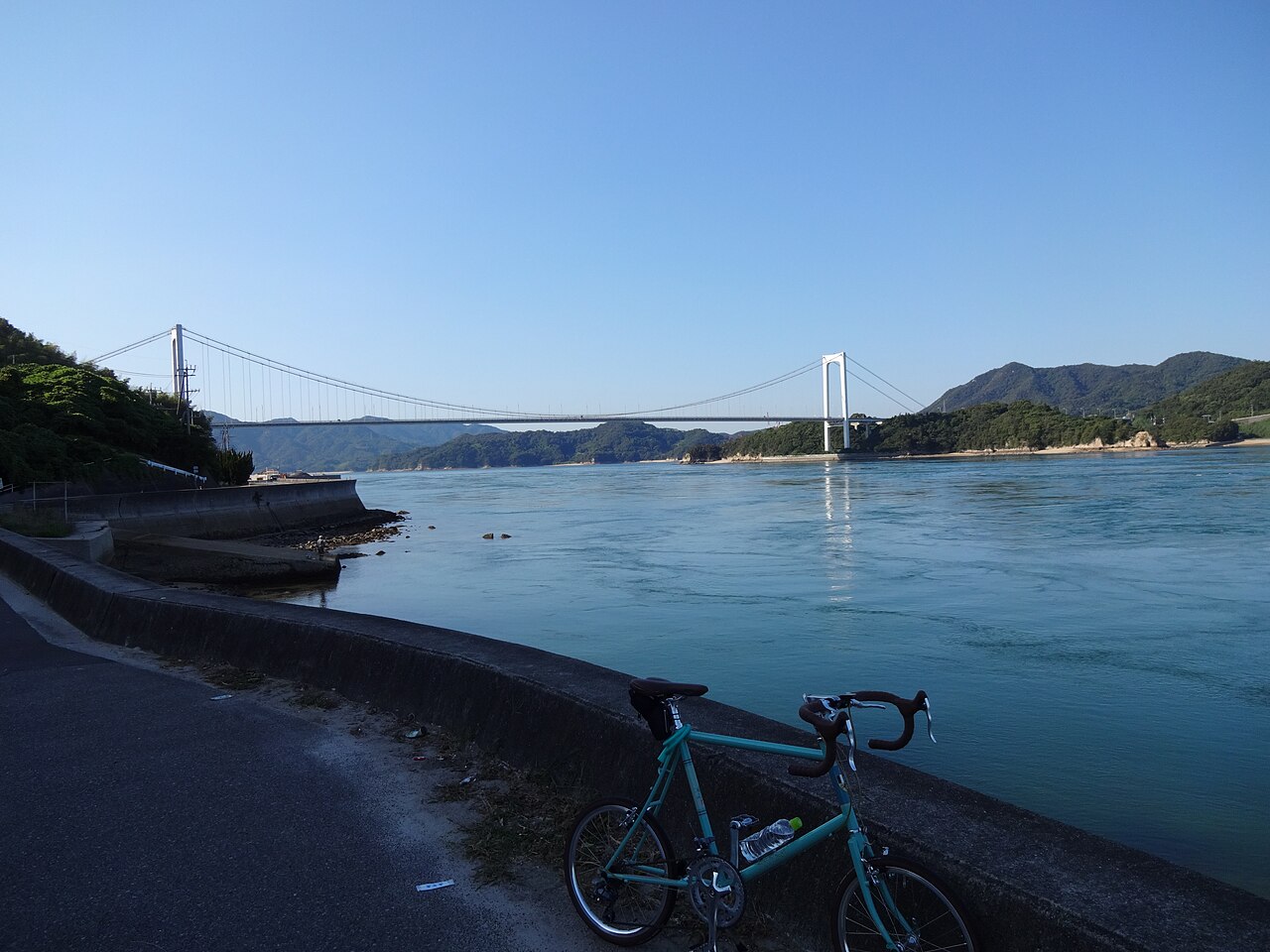
Whirlpools can be seen from the Kurushima Kaikyo Bridge. The Shimanami Kaido is about sixty kilometres long, or about seventy kilometres by bicycle.
Shin-Onomichi to Tatara Bridge: Lit-Up Towers, Echoes and a Bridge Like a Harp
Lit up on weekends, the Shin-Onomichi Bridge shows against the Onomichi Strait. It is a cable-stayed bridge connecting Onomichi and Mukaishima, at the Honshu-side starting point.
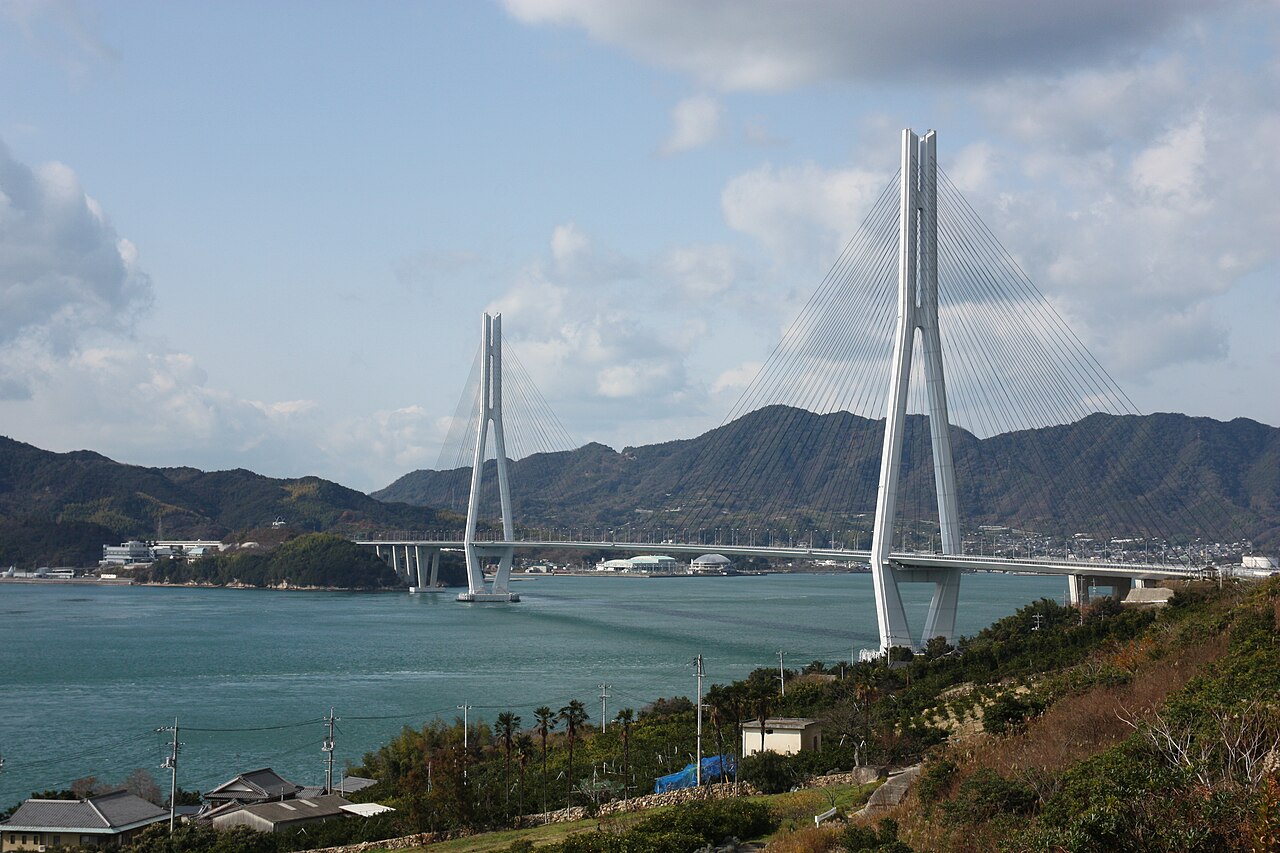
The graceful form of the Tatara Bridge is described as resembling a giant harp or a bird spreading its wings. Connecting Omishima and Ikuchijima, it is the fourth bridge from the Onomichi side, a cable-stayed bridge spanning the border between Hiroshima and Ehime prefectures.
Omishima, Hakata-Oshima and Kurushima Kaikyo Bridges: Arches, Whirlpools and Night Lighting
Painted light grey, the Omishima Bridge stands out against the blue sea. From the bridge, the fast-flowing current and the Seto Inland Sea scenery are in view.
The Hakata-Oshima Bridges combine two different forms, a girder bridge and a suspension bridge, into a single bridge. Visitors can walk down to an island via a promenade.
On some days the Kurushima Kaikyo Bridge is lit up for a night view. Small motorbike lanes and a cycle and pedestrian path run on both sides, with the Seto Inland Sea and the Kurushima Strait in view.
Visitors can walk the pedestrian path down to Umashima and see the bridge up close.
Viewpoints Above the Sea: Kareiyama, Osumi and Itoyama
The Kareiyama observation deck sits at the summit of Kareiyama, with a design described as evoking a fortress. From the deck, the Hakata-Oshima Bridges, the Noshima castle ruins and the Seto Inland Sea are in view, and seasonal flowers such as cherry blossoms can be seen in spring.
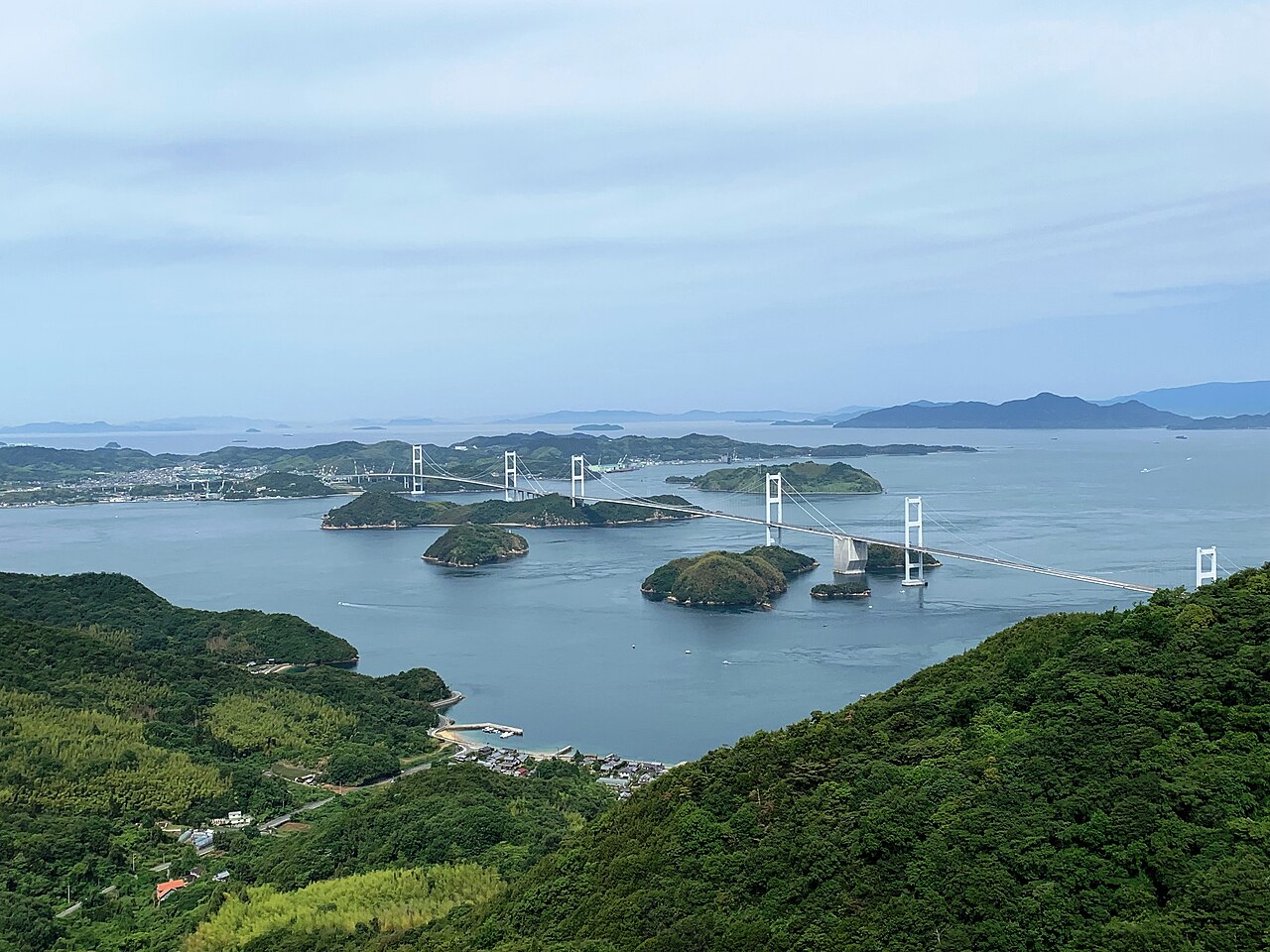
From the mast-shaped observation deck at Osumi seaside park, the Saronada Sea and the Kurushima Strait can be seen. From late October to early November, yellow tsuwabuki flowers and white nojigiku flowers sway in the sea breeze.
At Itoyama Park and Kurushima Strait Observatory, the Kurushima Strait and the Kurushima Kaikyo Bridge lie directly in front of visitors, with scattered islands.
Windows run along the whole sea side of a cafe near the cycling terminal at Itoyama, with the strait below and the bridge visible at nearly the same eye level to the left. On warm days, visitors can sit on the deck and watch the ships passing by.
Tidal Currents and Pirate Waters: Noshima, the Kurushima Strait and Murakami Suigun
The tidal current flows like a river and forms whirlpools, reaching up to eight knots, about fifteen kilometres per hour. Around Noshima the tidal currents are always strong, up to ten knots at spring tide.
The Noshima castle ruins, a nationally designated historic site, sit on an island about seven hundred twenty metres in circumference off the coast of Oshima. Traces of a large pier and breakwater show on the reef between Noshima and Kojima Taizakijima, and numerous round pillar post holes at low tide.
The observation boat sails under the Kurushima Kaikyo Bridge, around Kurushima, Kojima and Umajima, and on to the shipyards at Hashihama. The first floor of the Murakami Suigun Museum has goods sales, a cafe corner and a library of reference materials on pirates.
Remains of gun emplacements, barracks, a command tower and ammunition depots survive on an island in the Kurushima Strait, about four kilometres in circumference, where the former Japanese army built a fortress.
Temples, Paintings and Pilgrim Hospitality: Senkoji, Oyamazumi Shrine and the Island Pilgrimage
The bell sound of Senkoji's bell tower was selected as one of the one hundred Soundscapes of Japan. The stage-style main hall looks over the townscape of Onomichi, and the grounds contain a group of boulders of various shapes.
The Hirayama Ikuo Museum of Art displays works from the painter's childhood and large Silk Road works. At Oyamazumi Shrine, the main hall, worship hall and Hokyointo stone pagoda are designated as Important Cultural Properties, and a contemporary Japanese-painting museum stands next to the shrine.
During the festival period, island residents set up o-settai stations at temples and along roads and serve food and drink to pilgrims.
Seafood, Salt and Sweets: Ikiiki-kan, Hakata no Shio and Imabari Flavours
Michi-no-Eki Yoshiumi Ikiiki-kan offers seafood barbecue and shichirin grilling using fresh seafood from its tank. Vegetables, fresh fish and specialty products from the town are sold as souvenirs.
At a seafood restaurant, visitors choose seafood from a fish tank for the specialty seafood barbecue. The menu has seafood bowls, sashimi set meals and fish dishes raised in the strong tidal currents of a strait.
Visitors can tour the manufacturing process of Hakata no Shio salt, and the on-site shop sells products made with it. Sumaki is a traditional Imabari kamaboko, a fish paste steamed with wheat straw attached. Lamrin is an Imabari confection of fine-textured castella sponge soaked with rum syrup.
Getting to the Shimanami Kaido
New to rural buses and one-man trains? See how to ride them, step by step.
| From | To | How | Time |
|---|---|---|---|
| JR Onomichi Station | Ropeway Sanroku Station | On foot | About fifteen minutes |
| Pier in Onomichi | Setoda | High-speed boat | About forty minutes |
| Innoshima Ohama PA (downbound) | Innoshima Bridge | Promenade on foot | About five minutes |
For a night before or after the ride, a booking site lists places to stay in Onomichi.
Hours and Fees
| Place or service | Hours | Fees |
|---|---|---|
| Rental bicycles | Rented per day | Cross bike three thousand yen; city cycle one thousand yen; electric-assist bicycle four thousand yen; E-bike eight thousand yen; tandem bicycle four thousand yen; kids bike one thousand yen (tax included) |
| Hirayama Ikuo Museum of Art | Nine in the morning to five in the afternoon; admission until half past four | General visitors one thousand two hundred yen; high school and university students five hundred yen; elementary and junior high school students three hundred yen |
| Murakami Suigun Museum | Nine in the morning to five in the afternoon; admission until half past four | General visitors three hundred ten yen; students one hundred sixty yen; free for high school students and younger, or those under eighteen |
| Kurushima Strait rapids observation boat | Course of approximately forty-five minutes. | General (junior high school students and older) one thousand five hundred yen; elementary school students one thousand yen |
| Noshima tidal current experience boat | Departs every hour on the hour from nine in the morning, last departure at three in the afternoon; about forty minutes; closed on Mondays (the next day if Monday is a public holiday). | Adults (junior high school students and older) one thousand five hundred yen; elementary school students seven hundred yen |
| Itoyama Park and Kurushima Strait Observatory | Nine in the morning to six in the evening; nine in the morning to five in the afternoon from December to February | Not stated |
Fees and hours were checked against official sources on 20 November 2026.
Thinking of staying overnight?
Compare places to stay near Onomichi →
Disclosure: This post may contain affiliate links. If you book through them, we may earn a commission at no extra cost to you.