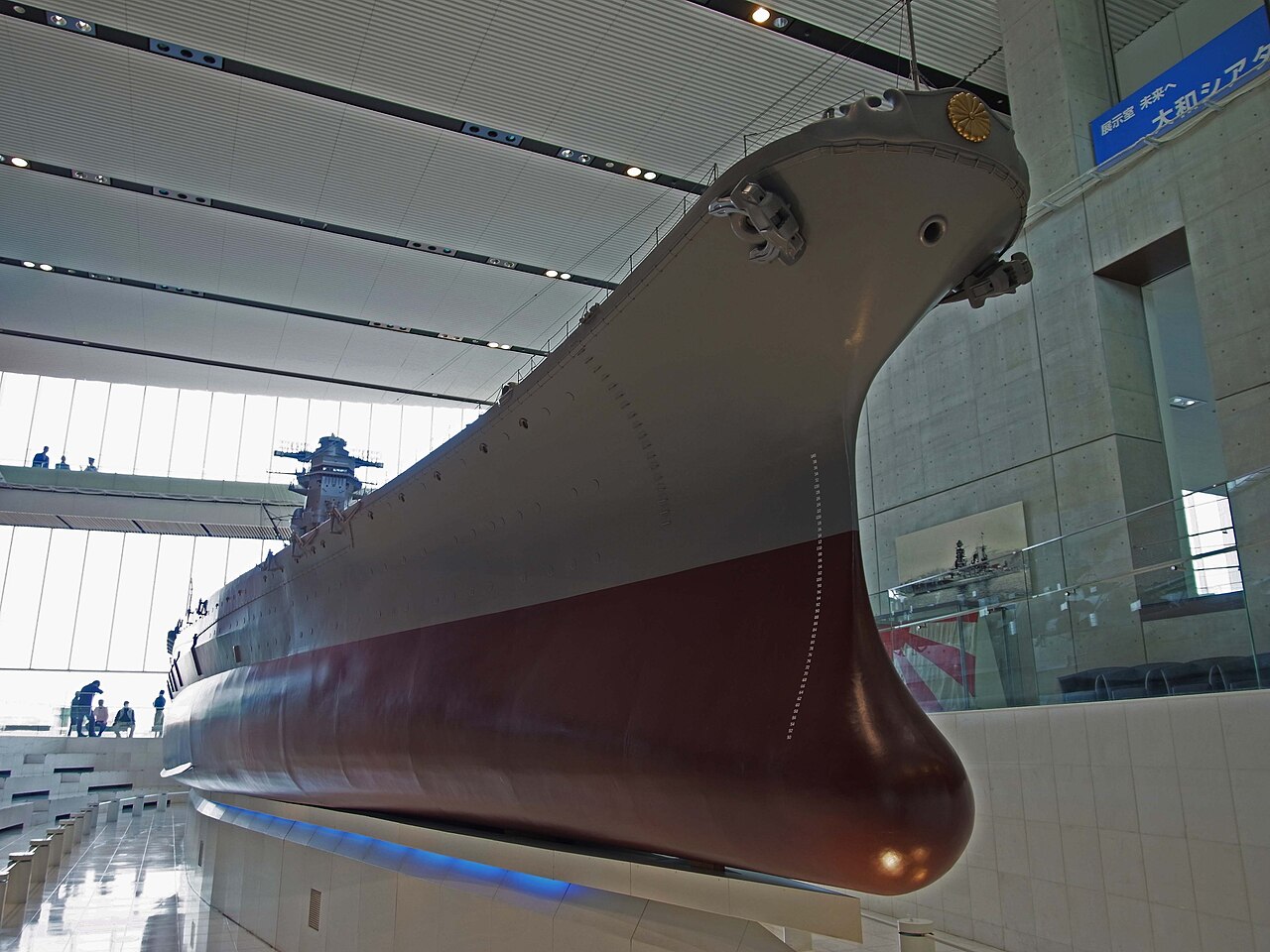
Kure in Hiroshima is the port city where the battleship Yamato was built, and the story is one you can walk through: a one-tenth model of the ship in the Yamato Museum, submarines moored in front of visitors at Alley Karasukojima, and a real submarine to enter at the JMSDF Kure Museum (Tetsu-no-Kujira-kan). Beyond the harbour, the Ondo strait with its red arch bridge, the lights from Mt. Haigamine and a street of food stalls add the Seto Inland Sea and Kure's own dishes. Begin at the Yamato Museum with the battleship model, move on to Alley Karasukojima, the submarine hall and Rekishi no Mieru Oka, take in the Ondo strait and the city lights from Mt. Haigamine, and finish among the food stalls of Kuramoto-dori after dark.
Yamato Museum and the Battleship Model
The Yamato Museum sets a model of the battleship Yamato at the centre of its hall, built at one-tenth scale from bow to stern. Around it stand other large exhibits, among them a Zero fighter and a human torpedo.
The hall with the large windows looks straight out onto the shipbuilding facilities where the battleship Yamato was built, with the present-day port of Kure beyond them, so the model indoors and the place where the real ship took shape sit a window apart.
Start with the model and walk its full length before turning to the windows, because the yard outside means more once the shape and size of the ship are fresh in mind. If your time in Kure is short, hold onto the model and the view through the windows, and treat the Zero fighter and the human torpedo as a briefer second stop.
Alley Karasukojima and the Moored Submarines
Alley Karasukojima puts visitors at the edge of Kure Bay with submarines and escort ships of the Japan Maritime Self-Defense Force Kure base moored right in front of them. The name joins a small island called Karasukojima, reclaimed in the Taisho era as a torpedo-firing ground, with the English word alley, and the small path you walk today is surrounded by green and brick colour.
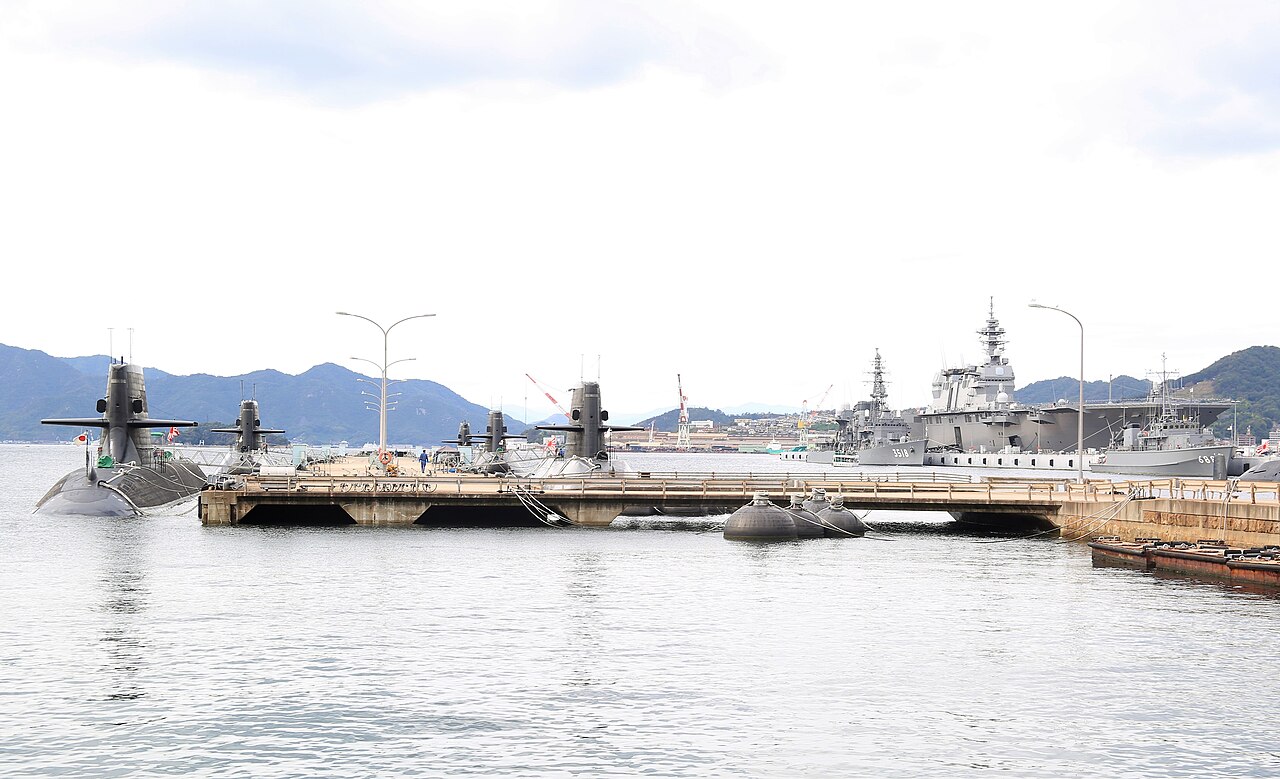
Around the alley stand brick buildings of the former naval arsenal, and the battleship Yamato was built secretly at a dock nearby. The Meiji-era granite seawall still stands in its original condition, the British-made crane set up for loading torpedoes remains at its south end, and the submarines of today lie moored beside these older works.
At sunrise and sunset the flags of the ships are raised and lowered to a bugle that sounds across the port, in the evening at the moment the setting sun turns the sea orange. If you can choose your time, come for the evening lowering, when flags, bugle and orange water arrive together.
The Submarine Hall and Rekishi no Mieru Oka
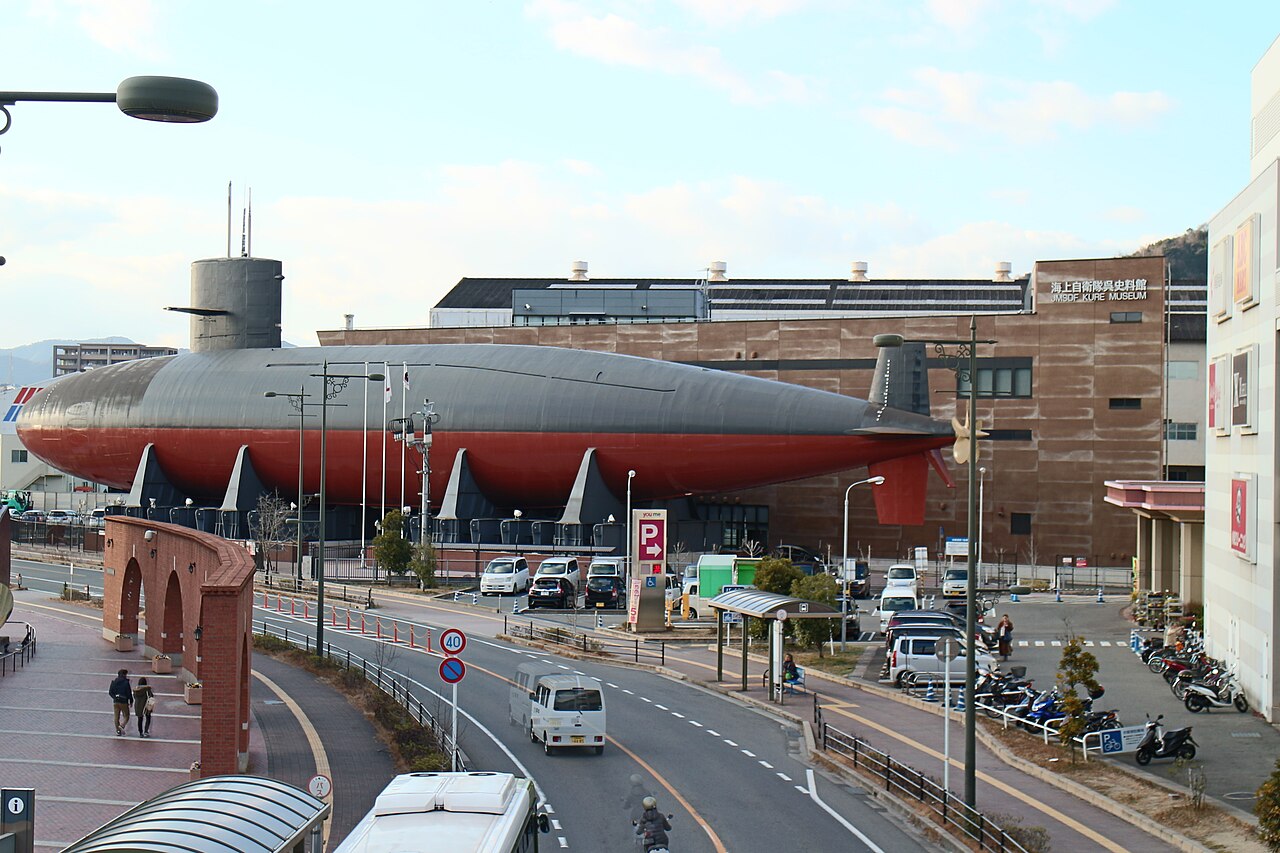
The JMSDF Kure Museum (Tetsu-no-Kujira-kan) lets visitors walk through the interior of the submarine Akishio, a vessel the Self-Defense Force actually operated, so the passages underfoot are those of a working ship. The exhibits continue with a reproduction of a minesweeper and mines, and there is a cafe and a shop with Self-Defense Force goods.
Rekishi no Mieru Oka looks out over the site of the dock where the battleship Yamato was built, and a tower there modelled on the bridge of the Yamato gives that site a point of reference in the real yard.
The hill also takes in former naval facilities such as the Kure District Headquarters of the Self-Defense Force, in the former Kure Naval District building, and the remains of the arsenal-era factory complex, and a former naval welfare building nearby can now be viewed from the outside. Walk the inside of the Akishio first and go up to the hill afterwards, because the dock site means more once you have stood inside one of the fleet's own hulls.
Ondo Strait and the Takakarasudai Lookout
The Ondo strait is a narrow channel between the Honshu side and Kurahashi Island, said to have been cut through by Taira no Kiyomori, and from Ondo-no-Seto Park the strait and the red arch bridge Ondo Ohashi come together in a single view.
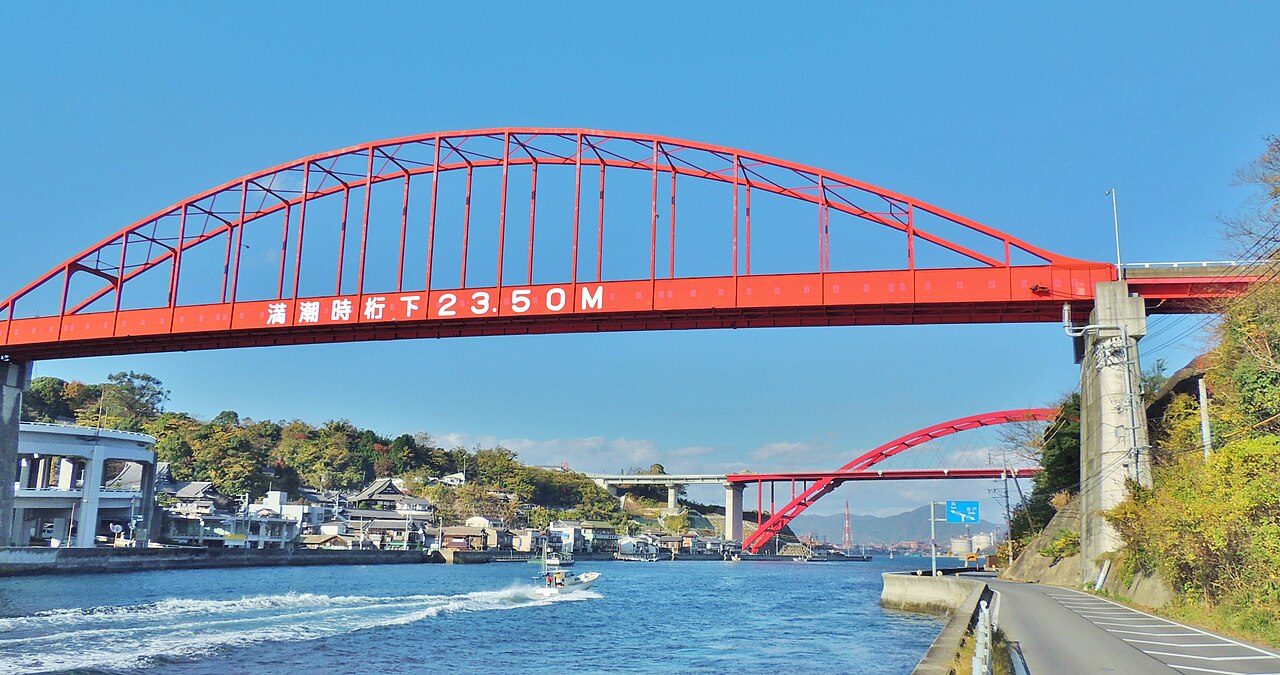
In spring the park turns into a flower site: the cherry trees come into bloom from late March to early April, and the azaleas follow from late April to early May. Either bloom frames the bridge and the water.
Takakarasudai is a lookout where, on a clear day, the mountains of Shikoku can be seen. Cherry trees, azaleas and notable trees from across Japan are planted around it, which makes it a cherry-blossom spot in spring, and the remains of a battery that once mounted howitzers still stand on the site. Treat the two as separate views: the park for the bridge and the channel at close range, the lookout for the long line of Shikoku.
Mt. Haigamine by Day and Night
Mt. Haigamine after dark turns Kure into a spread of gem-like town lights, with ships swaying in the port below and moonlight over it all.
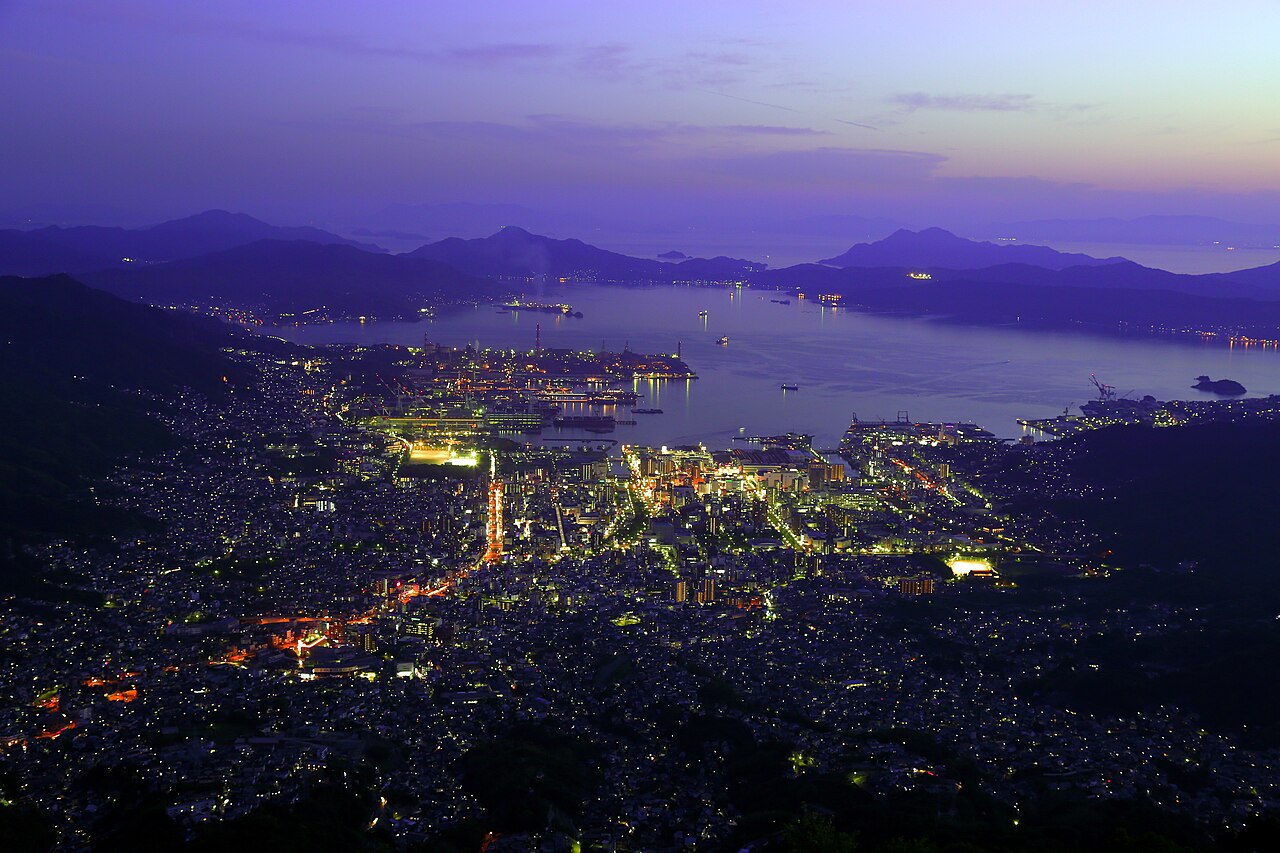
In daytime the same summit shows the far islands of the Seto Inland Sea all at once, and the view runs a full circle, so that to the south the mountain slope, the city of Kure and the inland sea come into one sweep.
The mountain stands high above the inland sea and draws cyclists who ride it as a hill climb, while the round white weather radar at its summit is a landmark that can be picked out from the city below. If you can reach the summit twice, go once by day for the islands and once after dark for the lights, since the two views share a spot but not a subject.
Kuramoto-dori, Kaiji Curry and Kure Reimen
Kuramoto-dori after dark fills with food stalls and their red lanterns add colour to the street. The menus run from standard dishes such as ramen and oden to creative cooking. By day the street shows azaleas in spring and ginkgo in autumn against its brick-style sidewalk, and the Nakadori shopping street nearby has Kure sweets among its shops.
Many units of the Self-Defense Force have curry for lunch on Fridays, said to be so that crews keep track of the day of the week on long voyages. Kure Kaiji Curry carries that habit ashore, reproduced faithfully from recipes taught by the ships' cooks and found at restaurants in Kure.
Kure reimen is the other dish to look for: flat noodles with a firm bite in a spicy, sweet-and-sour chicken-bone broth, topped with cucumber, chashu, boiled egg and shrimp. With one evening in Kure, keep the stalls for the end of the day. If the lanterns and the oden tempt you to linger, browse places to stay in Kure and give the evening its full length.
Getting to Kure
| Leg | How | Time and estimate |
|---|---|---|
| Hiroshima Station to Kure Station | JR Kure Line, rapid service | About 32 minutes |
| Kure Station to the Yamato Museum | On foot | About 5 minutes |
| Kure Station to the JMSDF Kure Museum (Tetsu-no-Kujira-kan) | On foot | About 5 minutes |
| Kure Station to the Irifuneyama Memorial Museum | On foot | About 13 minutes |
| Kure Station to Kuramoto-dori | On foot | About 10 minutes |
| Kure IC (Hiroshima-Kure Road) to Ondo-no-Seto Park | By car | About 25 minutes |
New to rural buses and one-man trains? See how to ride them, step by step.
Hours and Fees
| Place | What | Hours or fee |
|---|---|---|
| Yamato Museum | Hours | 9:00-18:00 (exhibition rooms until 17:30) |
| JMSDF Kure Museum (Tetsu-no-Kujira-kan) | Hours | 10:00-18:00 (exhibition room until 17:30) |
| Irifuneyama Memorial Museum | Hours | 9:00-17:00 (admission until 16:30) |
| JMSDF Kure Museum and Irifuneyama Memorial Museum | Closed | Tuesdays (the following day if Tuesday is a holiday) and December 29 to January 3 |
| Alley Karasukojima | Parking lot | 8:00-20:00; free, 28 standard cars |
| Ondo-no-Seto Park | Parking lot | Free, about 190 cars |
General admission to the Yamato Museum is one thousand yen. At the Irifuneyama Memorial Museum, adults pay two hundred fifty yen.
Where to stay
Places to stay near Kure, Hiroshima, Japan →
Disclosure: This post may contain affiliate links. If you book through them, we may earn a commission at no extra cost to you.