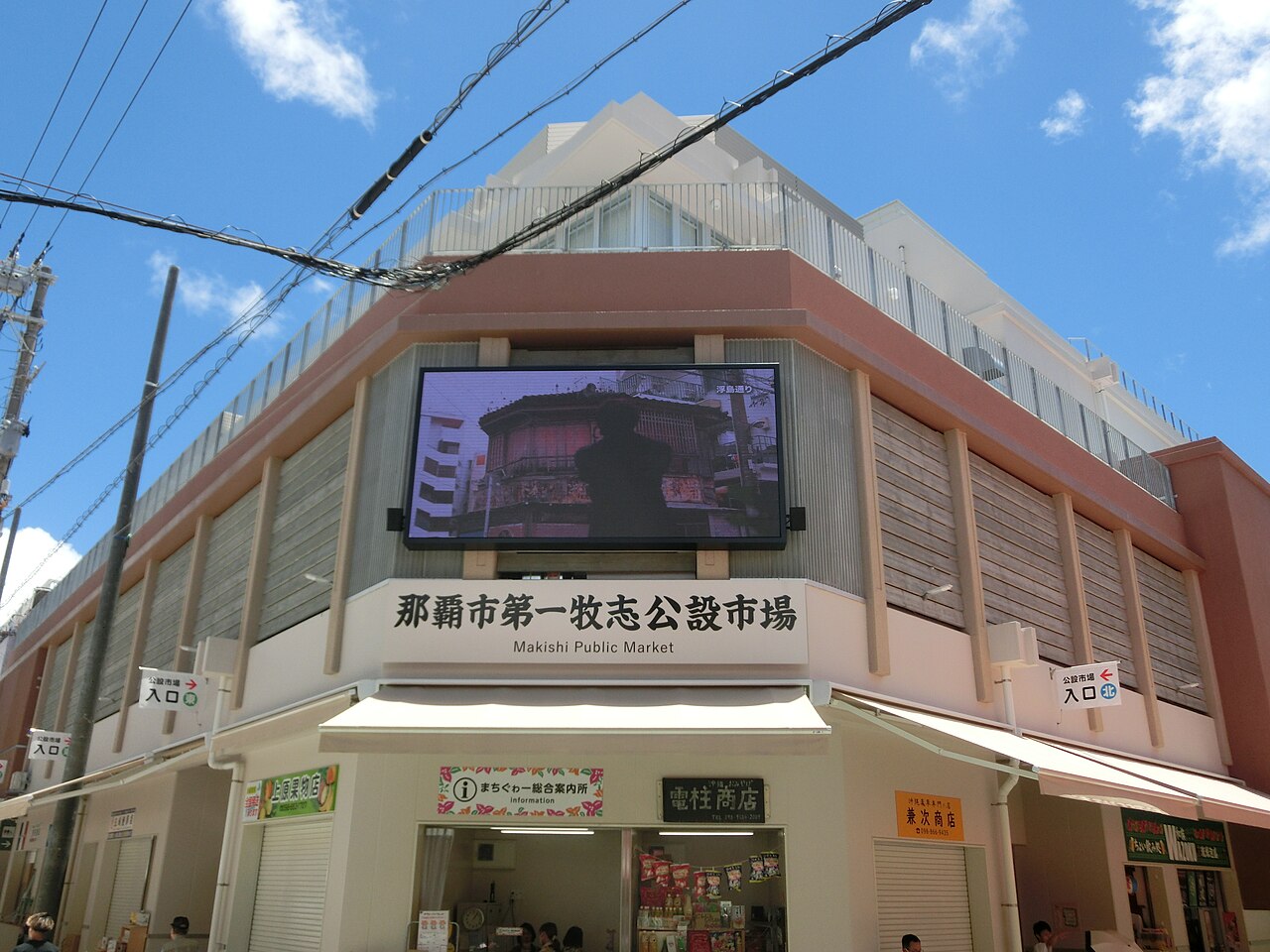
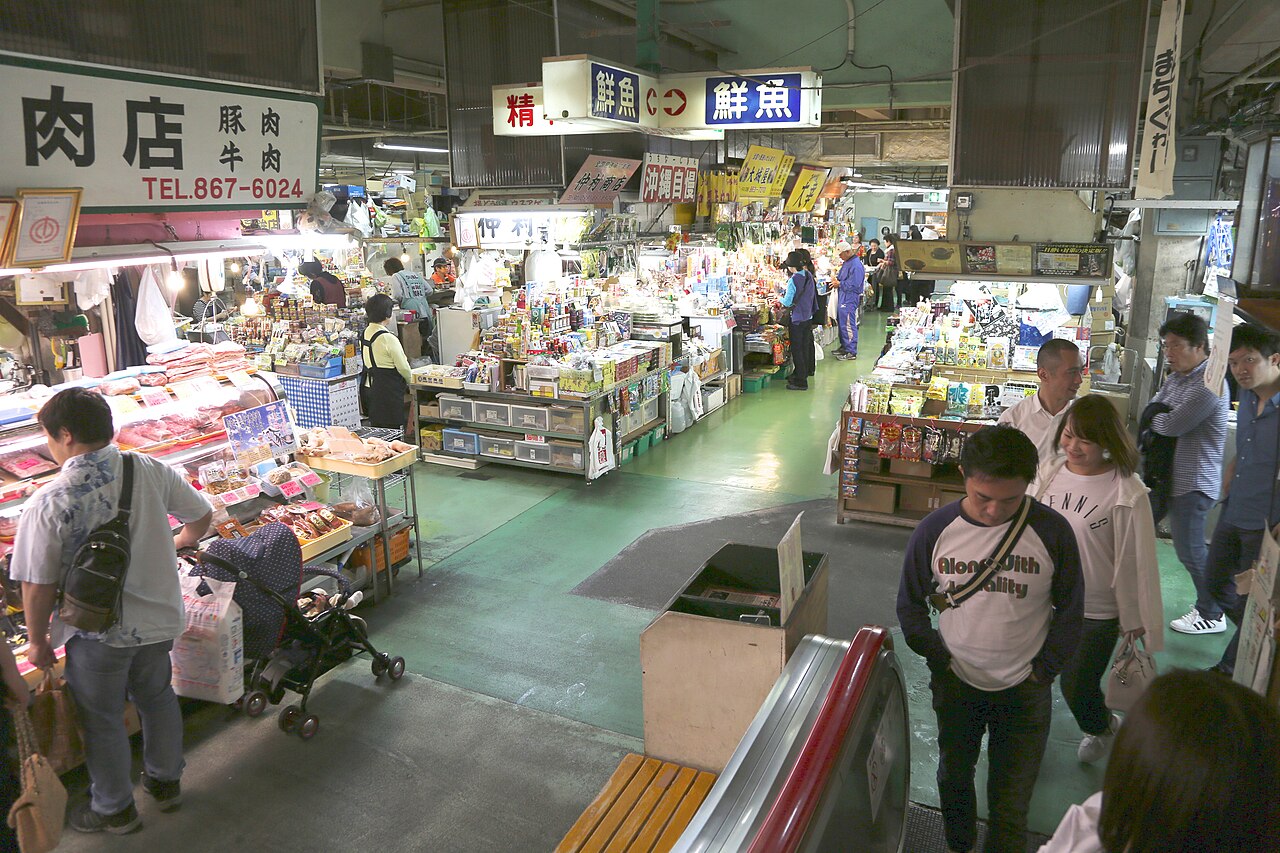
At Makishi Public Market, food bought at a shop downstairs is cooked upstairs, and Nishime Fresh Fish Shop stocks live king crab, sea urchin and spiny lobster as seasonal ingredients. In Tsuboya, a gently sloping stone pavement leads up from the entrance of the Arakaki house, whose grounds still hold a red-tile main house, a workshop, a climbing kiln and stone walls. At Fukushuen, visitors walk at half the usual speed through a Fuzhou-style garden that is a faithful reproduction made with materials from Fuzhou.
Mochiage Dining at Makishi Public Market
At Makishi Public Market, mochiage means that food bought at a first-floor shop is cooked on the second floor. Visitors to Makishi Public Market buy ingredients they have seen in the shops and taste them as Okinawan cuisine. The market began the service on the model of eateries in Asia such as Singapore, with first-floor purchases cooked and eaten in a second-floor restaurant.
At a second-floor noodle restaurant, diners can pour jushi over the noodles to make boroboro jushi and eat it that way. The restaurant, inside Makishi Public Market, is a noodle restaurant specializing in Okinawan fresh noodles. It serves a three-stage prepared soup that is meant to set off the fresh noodles.
The soup at the restaurant is a savory soup made from a house blend of pork and bonito. The toppings are made with time taken, and the meat is prepared with traditional awamori and brown sugar, which suits both the noodles and island liquor.
Solo visitors to Makishi Public Market can order from the many half-size dishes that Adan offers. In the restaurant section on the second floor, Adan's main items are bone soup, mozuku tempura, Okinawa soba and chanpuru. Shabu-shabu and seafood dishes at Adan are made with the market's fresh ingredients, alongside Okinawan dishes.
Visitors choosing seafood downstairs find fresh fish, shellfish, sea urchin, spiny lobster and king crab among the main products of Nishime Fresh Fish Shop. Diners at another second-floor restaurant can eat a sashimi boat platter or seafood bowls, and the restaurant also serves shrimp and crab as seafood dishes.
Walking Tsuboya Yachimun Street and the Arakaki House
At the Arakaki house, visitors go up a gently sloping stone pavement from the entrance to a hedge set directly ahead. On the Shisa-mai guided tour, a curator explains who made the shisa figures around Tsuboya and tells their history and special episodes. Before the war, the area around the Tsuboya pottery district, the center of Okinawan yachimun kilns, was a quiet rural landscape.
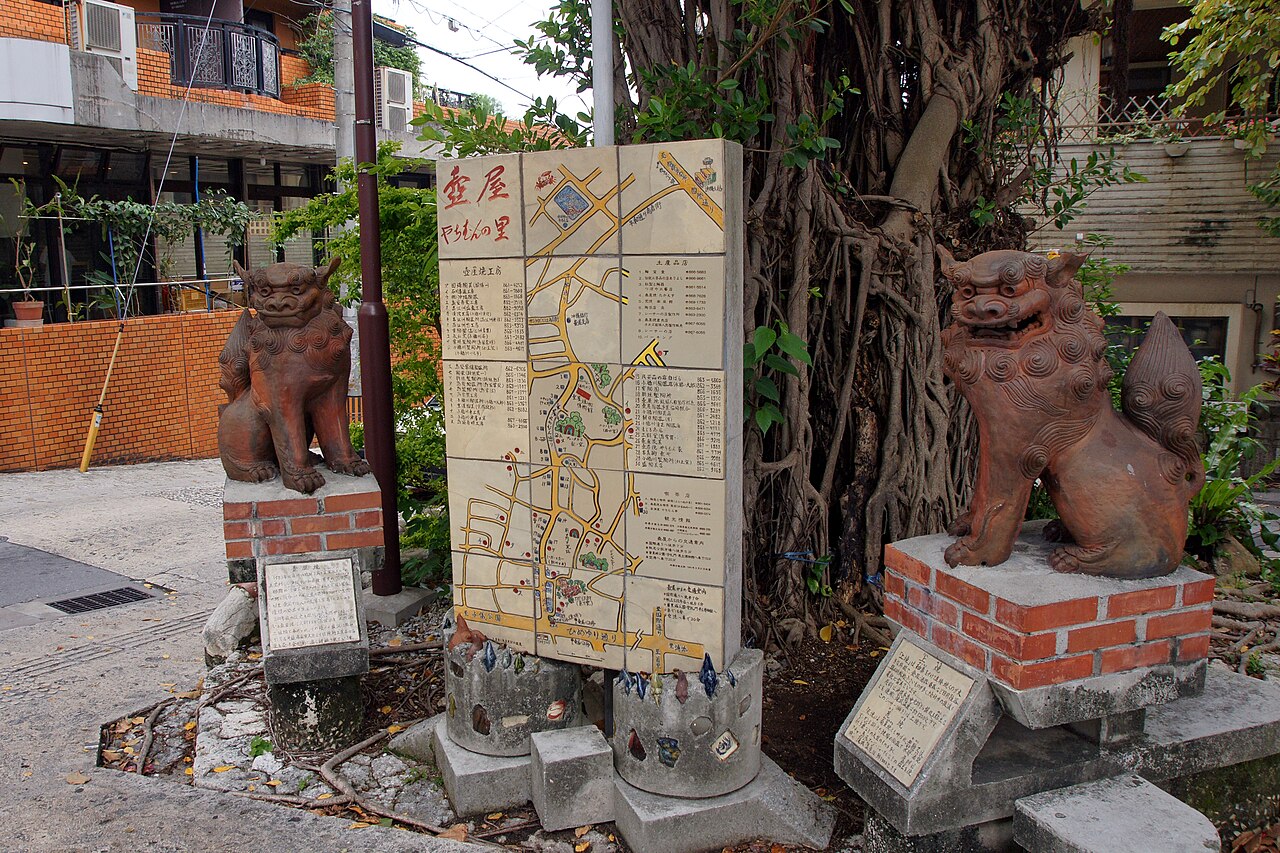
The Arakaki house is a potter's residence in Tsuboya, where the family ran a pottery business. Tsuboya suffered little war damage and retains traditional stone-walled old alleys and cultural properties, which form a street scene together with scattered pottery workshops and shops. The Arakaki house faces south, with stone walls built along the south and west sides that face the street.
At the gate, a detached building stands on the east side, and the workshop on the west side has a head-only shisa set on its roof. The climbing kiln of the Arakaki house is about twenty-three metres long and about four metres wide. A red-tile roof covers the whole kiln except the smoke outlet at the top.
Strolling Fukushuen Garden and Kuninda Terrace
In Fukushuen, visitors walk at half the usual speed and sometimes stop, look up and look back. Fukushuen's shapes are calculated down to very fine details, and looking closely at unremarkable forms brings a new discovery each time. Fukushuen opened to mark the tenth anniversary of the sister-city agreement between Fuzhou in Fujian Province and Naha and the seventieth anniversary of Naha's municipal status.
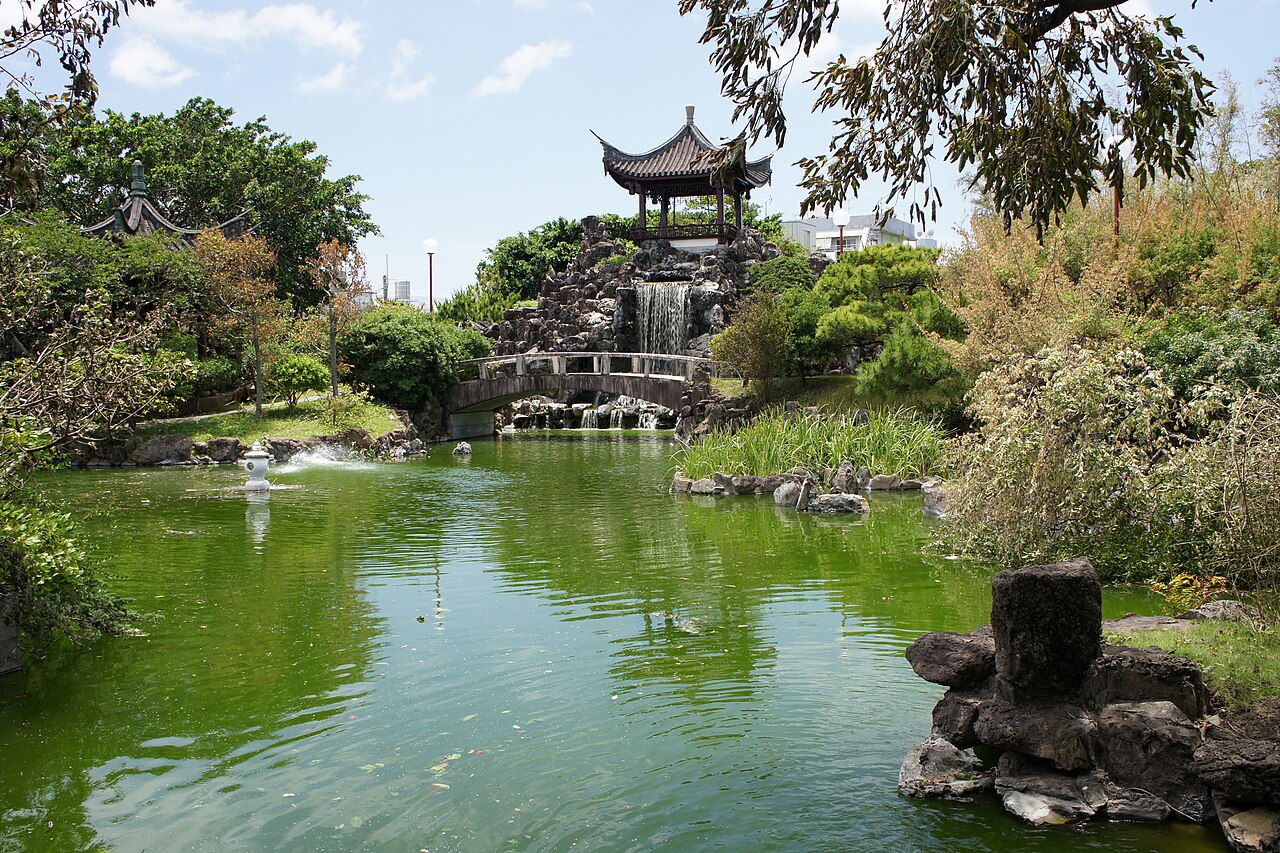
The whole of Fukushuen is a photo spot with many shooting points, for a serious camera or an ordinary smartphone. Colour, form, insect voices, wind moving the trees and the distant sound of the city are parts of the work. The faint sound of the city bustle reaches the garden from time to time as background music.
The scenery in Fukushuen changes with the time of day, and neighbours visit the garden to stroll while business people walk there. Tourists take photos in the garden, and students talk there after school and pass by in the morning and evening. Fukushuen suddenly appears in an urban area where tourism and business coexist with daily life, near a business district and hotels.
At Kuninda Terrace, the rest space is a place where a fresh breeze passes through. Kuninda Terrace also has a history exhibition booth, and visitors can go there to learn the history of Ryukyu and Kuninda.
Kuninda Terrace is a complex that combines exhibits on the history and culture of the Ryukyus and Kume village with restaurants and an exchange room. Kuninda Terrace itself is a hill-like building in which Fukushuen and the rooftop garden are gently connected.
Getting to Makishi Public Market, Tsuboya and Fukushuen
New to rural buses and one-man trains? See how to ride them, step by step.
| From | How | Time |
|---|---|---|
| Makishi Station to the market | On foot | About nine minutes |
| Miebashi Station to the market | On foot | About ten minutes |
| The market to the Arakaki house | On foot | About ten minutes |
| Tsuboya bus stop to Arakaki house | On foot | About one minute |
| Nearest bus stop to Fukushuen | On foot | About five minutes |
To stay overnight in Naha, browse places to stay in Naha.
Hours and Fees
| Place | Item | Time or fee |
|---|---|---|
| Makishi Public Market | Hours | Eight hundred to twenty-two hundred |
| Makishi Public Market | Cooking last order | Nineteen forty-five |
| Makishi Public Market | Dining floor last order | Twenty hundred |
| Makishi Public Market | Closed | Fourth Sunday, except December |
| Makishi Public Market | Closed | January first to third |
| Fukushuen | Garden hours | Nine hundred to twenty-one hundred |
| Fukushuen | Closed | Wednesday, next day after holiday |
| Fukushuen | Daytime session | Nine hundred to eighteen hundred |
| Fukushuen | Daytime adult | Two hundred yen |
| Fukushuen | Night session | Eighteen hundred to twenty-one hundred |
| Fukushuen | Night adult | Three hundred yen |
| Tsuboya Pottery Museum | Temporary closure | Through March, twenty twenty-seven |
| Tsuboya Pottery Museum | Usual hours | Ten hundred to eighteen hundred |
| Tsuboya Pottery Museum | Usual closed day | Mondays |
| Arakaki house | Viewing time, open days | Thirteen hundred to seventeen hundred |
| Arakaki house | Year-end closure | December twenty-eighth to January fourth |
Fees and hours were checked against official sources on 13 November 2026.
Thinking of staying overnight?
Compare places to stay near Naha, Okinawa →
Disclosure: This post may contain affiliate links. If you book through them, we may earn a commission at no extra cost to you.