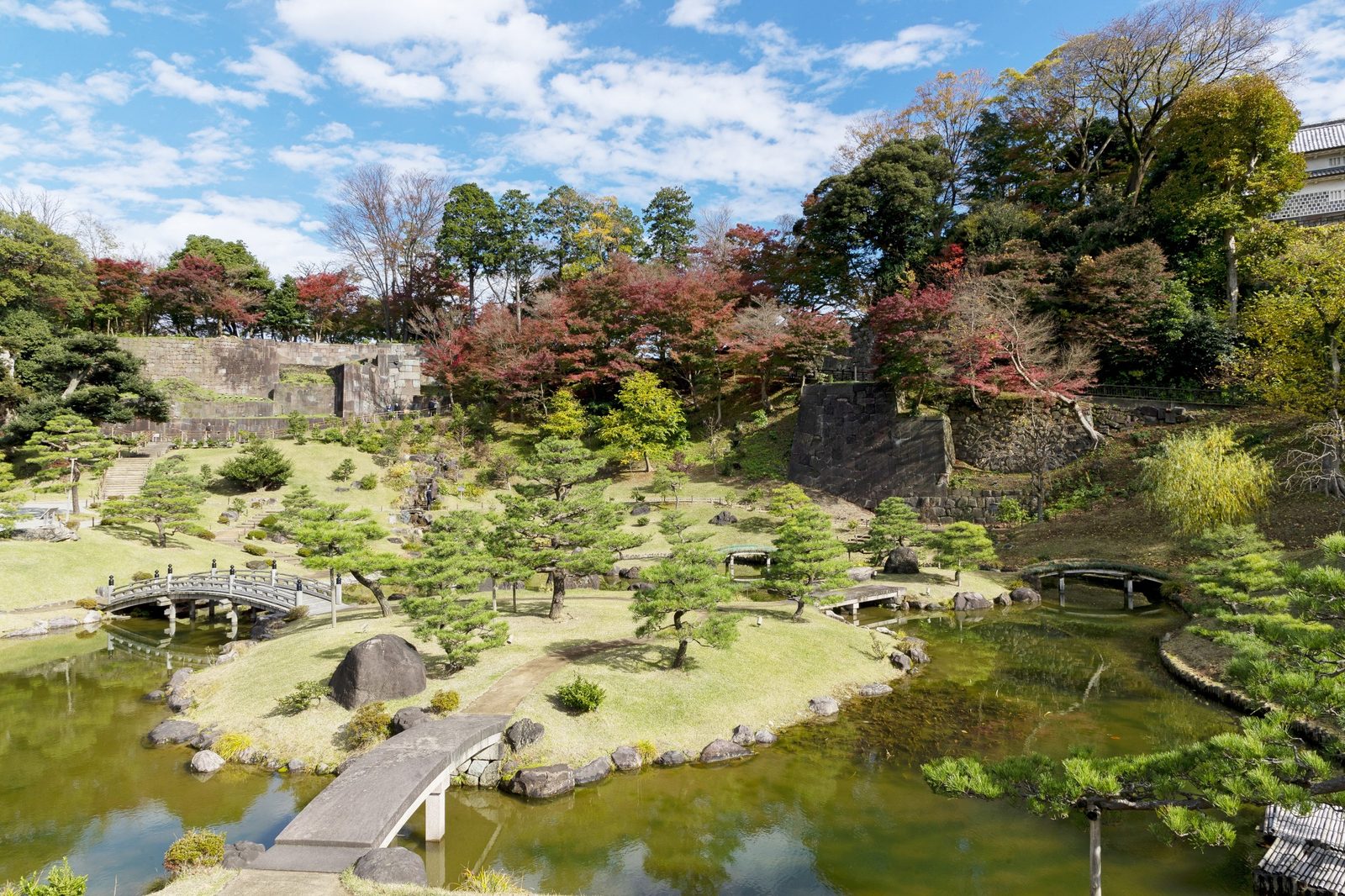
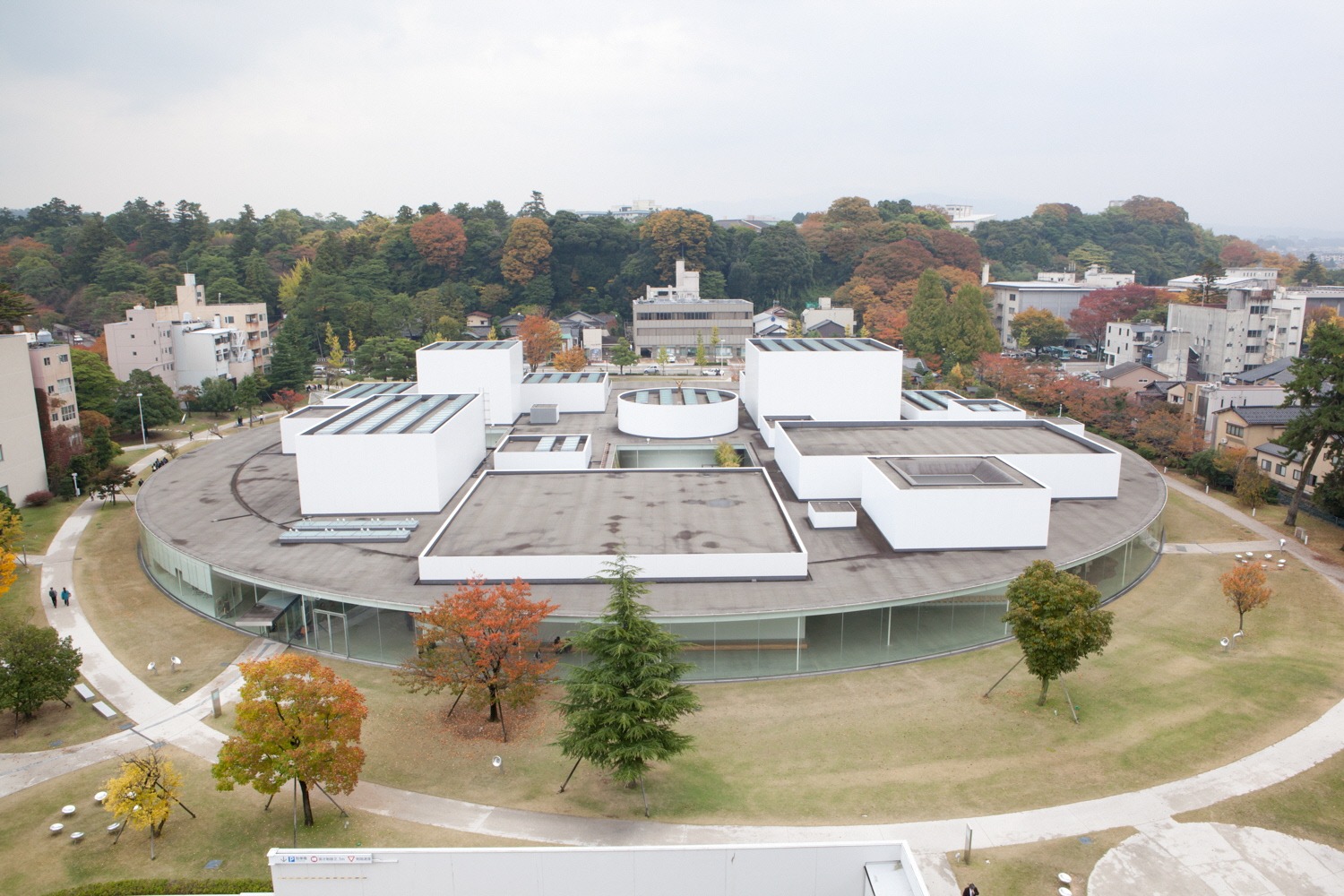
Inside Omicho Market, the seafood-bowl shop serves heaped seafood bowls made with selected fish caught that morning. Islands of different sizes are placed in the pond of the Gyokusen-inmaru Garden, and the sense of distance and closeness to the water changes depending on where one views from. At the Twenty-first Century Museum of Contemporary Art, Kanazawa, the Colour activity house is a spiral-shaped pavilion formed by walls of cyan, magenta and yellow glass arranged around a single point.
Omicho Market Seafood Bowls, Oden and Oysters
The Ippuku Yokocho food court inside Omicho Market lets visitors order single items from each shop, such as Kanazawa oden and sushi. An oden shop there serves mainly ingredients made by the tofu shops and kamaboko shops inside the market. A seafood shop in the food court serves fresh seafood raw or grilled, and also as sashimi and tempura.
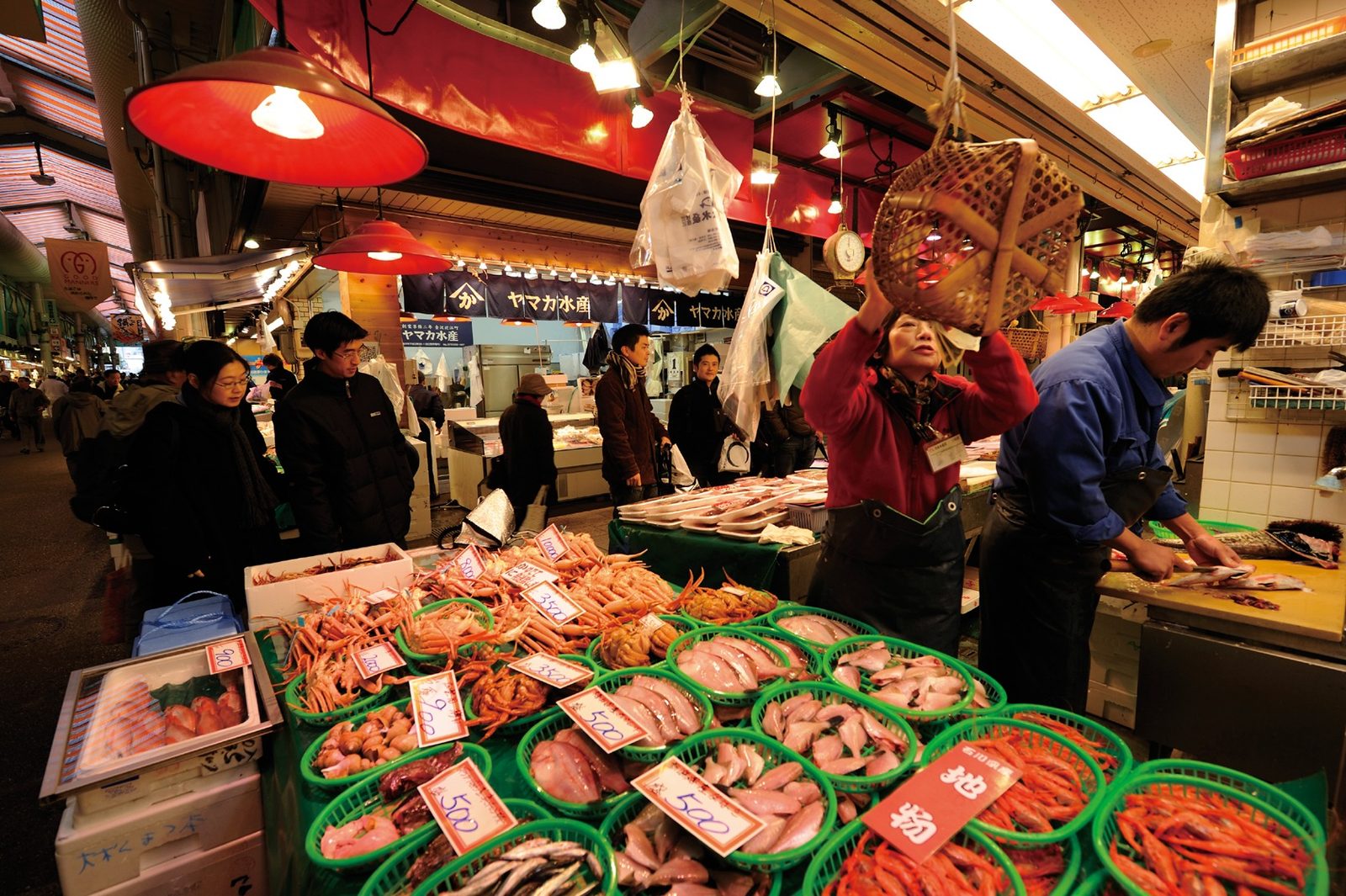
At the seafood-bowl shop, a bowl comes topped with items such as tuna, crab, sweet shrimp and sea urchin. The same shop offers mini bowls as well as tendon and unadon for people who do not like raw fish. The seafood-bowl shop also serves Ishikawa local sake with its seasonal recommended side dishes.
The conveyor-belt sushi shop is inside Omicho Market, and its sushi is made by veteran craftsmen. The fish is bought fresh at the market every morning, and the shop is particular about its toppings and rice as well as the soy sauce. The conveyor-belt sushi shop has table seats, so families with children can enter easily.
Omicho Doteya is a standing-drink shop inside Omicho Market that carries on a traditional Ishikawa taste. At Omicho Doteya, visitors can drink sake and draft beer as well as highballs while standing up. The shop's signature dish is simmered slowly by craftsmen who prepare it each day, and the miso has a history of one hundred and eight years.
Hyakumangoku Udon uses freshly made, additive-free handmade udon that is made at a factory inside the market. The slightly rounded, thick fresh udon is served kamaage-style, with a smooth and chewy texture. The broth is made with kelp and dried bonito and finished as a refined, gentle soy-sauce flavour.
Kawaki Shoten announces that the crab season is arriving and that the true-oyster season has arrived. Kawaki Shoten says its true oyster, in season in autumn, is plump with flesh, with a rich savoury taste and a scent of the sea. Grilled eel skewers are also available at Kawaki Shoten for visitors to eat on the spot.
Kanazawa Castle Park Gates and Nagaya
Inside the Hishi-yagura, the Gojikken Nagaya and the Hashizume-mon Tsuzuki-yagura, visitors can see the structure and design of the buildings and exhibits about the craftsmen's skills. A doorway connects the Tsuzuki-yagura with the Nino-mon, so visitors can enter from the Tsuzuki-yagura side and view the interior of the Nino-mon. The Gojikken Nagaya is a two-story Tamon-yagura that connects the Hishi-yagura and the Hashizume-mon Tsuzuki-yagura.
Ishikawa-mon, the rear gate of the castle, is a masugata gate with a front gate, a yagura gate and taiko walls. Its roofs are lead-tiled, its white plaster walls have namako-kabe around the lower part, and its corner pillars are wrapped in iron plate. A masugata is a square space enclosed by walls or tamon-yagura, named for its shape resembling a measuring box.
On the south side of the Ishikawa-mon masugata, the surface of the split wall stones is chiselled, and large engraved marks can be seen. From the west to the north side, the joining faces of the stones are worked so they fit without gaps. The Nino-mon has a guardhouse, and its floor is laid with Tomuro stone, as in front of the palace entrance.
With the restoration of Kahoku-mon and Hashizume-mon, all three of the Sanmigomon are in place, and the late-Edo-period scenery of the Sannomaru area has returned. The Ishikawa-mon that stands in Kanazawa Castle Park today is designated a national Important Cultural Property.
Gyokusen-inmaru Garden and the Imori Moat
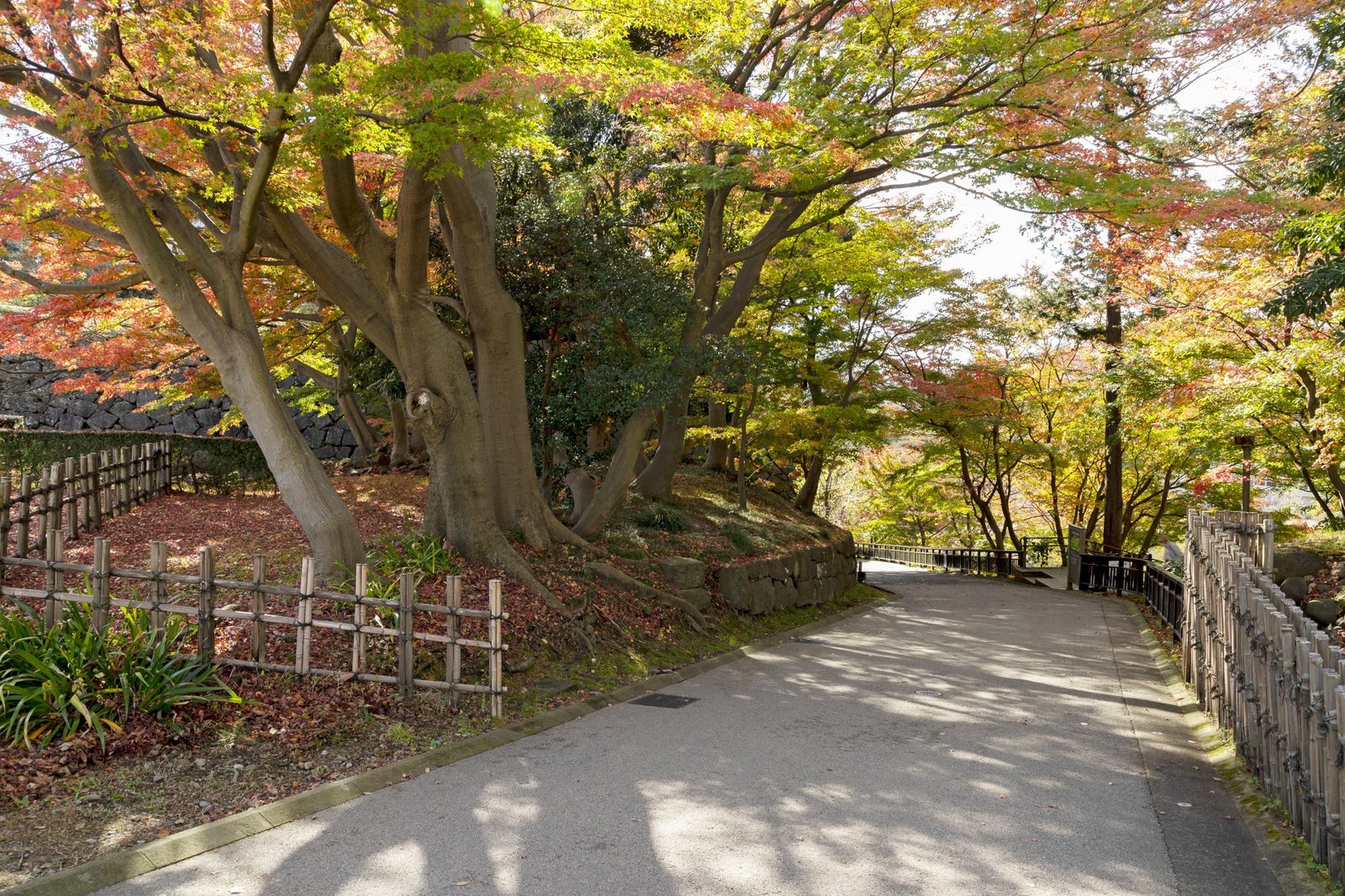
A path runs around the pond in the Gyokusen-inmaru Garden, and visitors can view the garden from various points along it. The garden planting is mainly pine trees raised within Ishikawa Prefecture, following old pictorial maps. The stone walls facing the garden keep their Edo-period appearance, with an outer design worked in shape and colour.
The garden's shikishi-tanzaku stacked-stone wall is a stone wall with a waterfall built into its upper part. At the waterfall mouth, a V-shaped spout of black stone is set, and square shikishi-shaped stones and rectangular tanzaku-shaped Tomuro stone are laid at staggered levels. Excavation confirmed the remains of a waterfall flowing down the slope in four steps, recreated on a mound built to protect them.
In the Japanese-style room at Gyokusen-an, visitors can taste matcha and original seasonal fresh wagashi. Gyokusen-an is a rest house from which the whole garden can be seen, and it has an information desk and a rest area.
Part of the Tatsumi irrigation channel water that passed through Kenrokuen is let into the restored Imori moat, about one and a half metres deep. The moat's banks were earthen slopes at a relatively gentle gradient, and a stone wall platform stood at the southeast end. Lit-up castle structures, stone walls and the garden are shown during the night opening at Kanazawa Castle Park.
Swimming Pool at the Twenty-first Century Museum, Kanazawa
At the Twenty-first Century Museum of Contemporary Art, Kanazawa, visitors can go inside the water-blue space beneath the glass of Swimming Pool. The work by Leandro Erlich is made of concrete, glass and water, and the pool is a thin layer of water over transparent glass.
Looking down at the rippled pool from the deck, it looks as if it is deeply filled with water. Swimming Pool offers the view of looking down to find a person in the water and the view looking up at the water surface from inside.
At the Colour activity house, the areas of light mix together depending on where the viewer stands and how the viewer moves. People passing between the panes of glass, and people crossing the plaza reflected in the glass, produce a new sight in a familiar town. A light source stands at the centre, and from sunset to dawn it glows like a coloured lighthouse.
In another work, on entering the space, the gaze turns naturally toward the square-cut piece of sky in the central part of the square ceiling. In this space, visitors are encouraged to perceive light that changes continuously from morning to night through the seasons.
Getting Around Kanazawa Castle Park and Omicho Market
| Route | Item | Detail |
|---|---|---|
| Castle Town Kanazawa loop bus | Fare per ride, adult | Two hundred twenty yen |
| Castle Town Kanazawa loop bus | One-day free ticket, adult | Eight hundred yen |
| Castle Town Kanazawa loop bus | Starts at | Kanazawa Station East Gate |
To stay overnight in Kanazawa, browse places to stay in Kanazawa.
Hours and Fees
| Place | Item | Time or fee |
|---|---|---|
| Kanazawa Castle Park | Hours, October sixteenth to February end | Eight hundred to seventeen hundred |
| Kanazawa Castle Park | Hours, March first to October fifteenth | Seven hundred to eighteen hundred |
| Kanazawa Castle Park | Night opening | Saturdays and seasonal outing periods |
| Hishi-yagura and Gojikken Nagaya | Hours | Nine hundred to sixteen thirty |
| Hishi-yagura and Gojikken Nagaya | Last admission | Sixteen hundred |
| Hishi-yagura and Gojikken Nagaya | Adult, individual | Three hundred twenty yen |
| Hishi-yagura and Gojikken Nagaya | Child, individual | One hundred yen |
| Gyokusen-an | Tea service, first session | Nine hundred to twelve hundred |
| Gyokusen-an | Tea service, second session | Thirteen hundred to sixteen thirty |
| Gyokusen-an | Matcha with wagashi | One thousand yen |
| Gyokusen-an | Closed | December twenty-ninth to January third |
| Contemporary Art Museum exchange zone | Hours | Nine hundred to twenty-two hundred |
| Contemporary Art Museum exhibition zone | Closed | Mondays, year-end and New Year |
| Contemporary Art Museum | Fully closed | December twenty-ninth to January first |
| Contemporary Art Museum exhibition | General admission | One thousand two hundred yen |
| Contemporary Art Museum collection exhibition | General admission | Four hundred fifty yen |
| Contemporary Art Museum tickets | Same-day sale starts | Nine thirty |
| Seafood-bowl shop | Hours, weekdays | Eleven hundred to fifteen thirty |
| Seafood-bowl shop | Hours, Saturday, Sunday, public holidays | Ten thirty to fifteen thirty |
| Omicho Doteya | Hours | Nine hundred to nineteen hundred |
| Omicho Doteya | Closing days | Irregular |
| Omicho Doteya | Signature dish, two pieces | Five hundred yen |
| Omicho Doteya | Karaage, small and large | Eight hundred, one thousand yen |
| Omicho Doteya | Alcoholic drinks, each | Five hundred yen |
Fees and hours were checked against official sources on 14 November 2026.
Thinking of staying overnight?
Compare places to stay near Kanazawa →
Disclosure: This post may contain affiliate links. If you book through them, we may earn a commission at no extra cost to you.