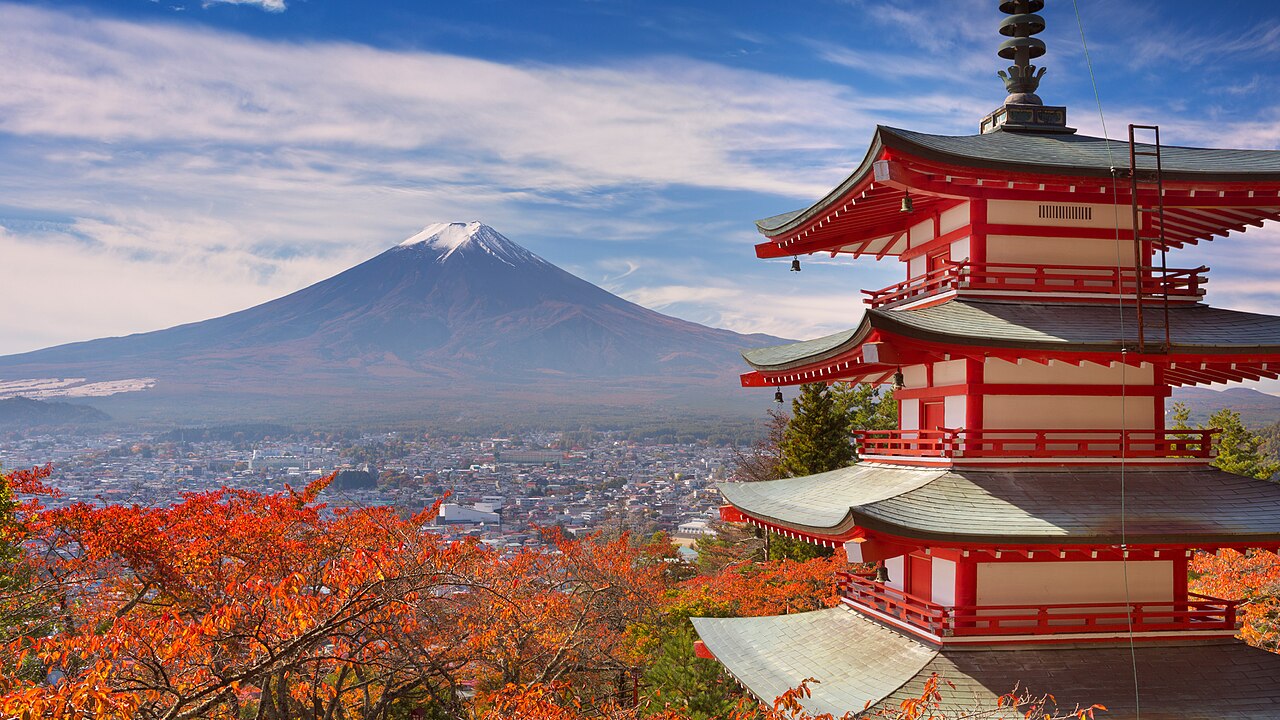
From the plaza of Arakura Fuji Sengen Shrine, the stone steps of the Sakuya-hime staircase climb to the Chureito Pagoda, built to commemorate the war dead of Fujiyoshida, and to an observation deck that looks over the townscape and the symmetrical form of Mt. Fuji. On the course that leads on from the park through forest, putting the head into the hollow of the Gongon stone produces a droning sound. The staircase, the deck and the shrine fit into the same walk, and anyone who wants to keep walking afterward can follow the forest trail toward Mt. Arakura.
Climbing the Stone Staircase to the Chureito Pagoda and Its Observation Deck
Either the Sakuya-hime steps or the slope road ends at the deck with the pagoda, so walkers who would rather skip the staircase can take the slope.
Heading to the right from the shrine grounds brings the Sakuya-hime steps into view. The stone staircase is named after the deity enshrined at the Sengen shrine, and it continues up to the pagoda. The park spreads from the foot to the middle of the slope of Mt. Arakura, and the deck is set at the top of the steps.
Taking the slope road instead of the staircase is the other way up. The road rises on a gentle slope, and both routes arrive at the same deck. Partway up, the stone steps also connect to a walking path into Arakurayama Sengen Park, which lets a climber change over from the staircase to the path.
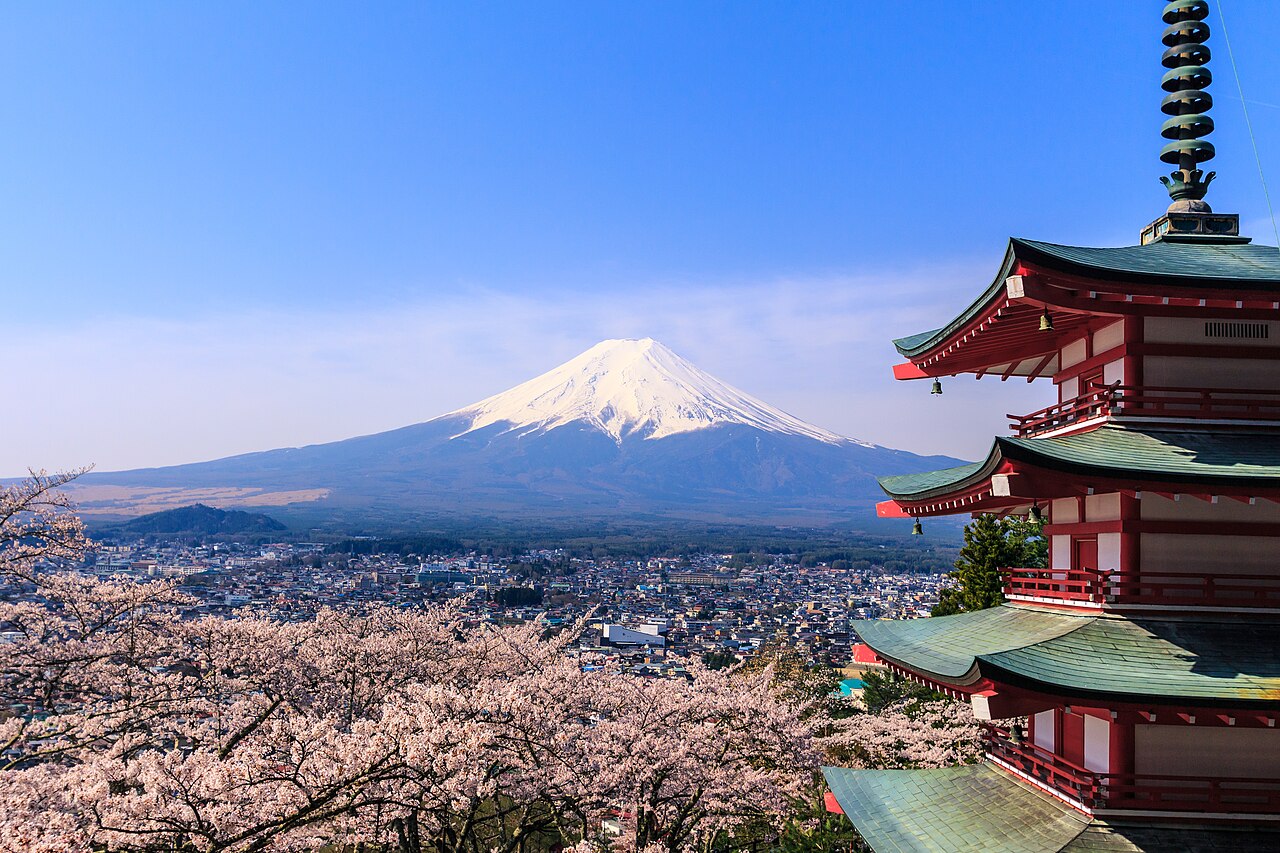
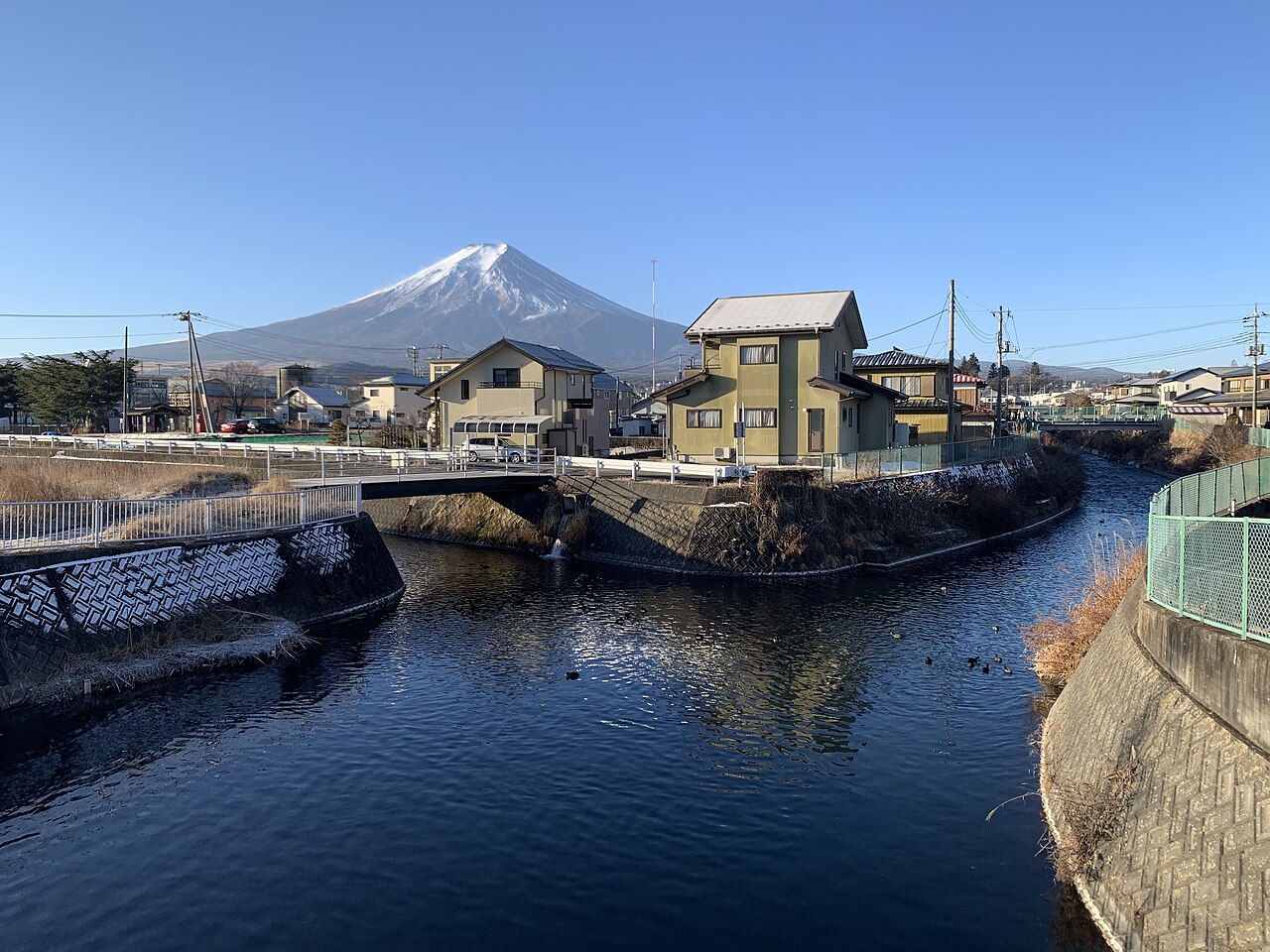
Looking out from the observation deck takes in the Fujiyoshida townscape and the symmetrical form of Mt. Fuji. When the deck is crowded, visitors rotate through in groups, each group staying for a short spell before the next comes in. Eating and drinking, tripods and occupying a fixed spot are prohibited there.
Visiting in autumn means timing the trip against the leaves, whose usual peak runs from late October to mid-November. In spring, a large stand of Somei-Yoshino cherry trees blooms in the park with the pagoda and Mt. Fuji in view. From December, mornings and evenings around Fujiyoshida stay close to freezing or colder, and frost forms often. Lights are lit along the approach to the shrine at the park entrance.
Walking the Shrine Approach from Shimoyoshida to the Torii and Plaza
For anyone arriving on foot from Shimoyoshida Station, the way toward the shrine plaza runs along a colored block pavement, over a level crossing and under the expressway overpass.
Drinking a freshly ground coffee while watching trains is possible before the walk, at a café attached to the station building. From there, walkers follow a road paved with colored blocks for part of the way. Cars use the same pavement, and care is needed when they pass. The road then curves gently to the right.
Passing over the level crossing, the route turns left and continues straight along the road beside the railway. That road curves right, and walkers follow it to a dead end, where the Chuo Expressway overpass comes into view ahead. Next comes a left turn onto the side road, then a right turn at the crossing under the overpass. Beyond the overpass, the route reaches another crossing and continues straight.
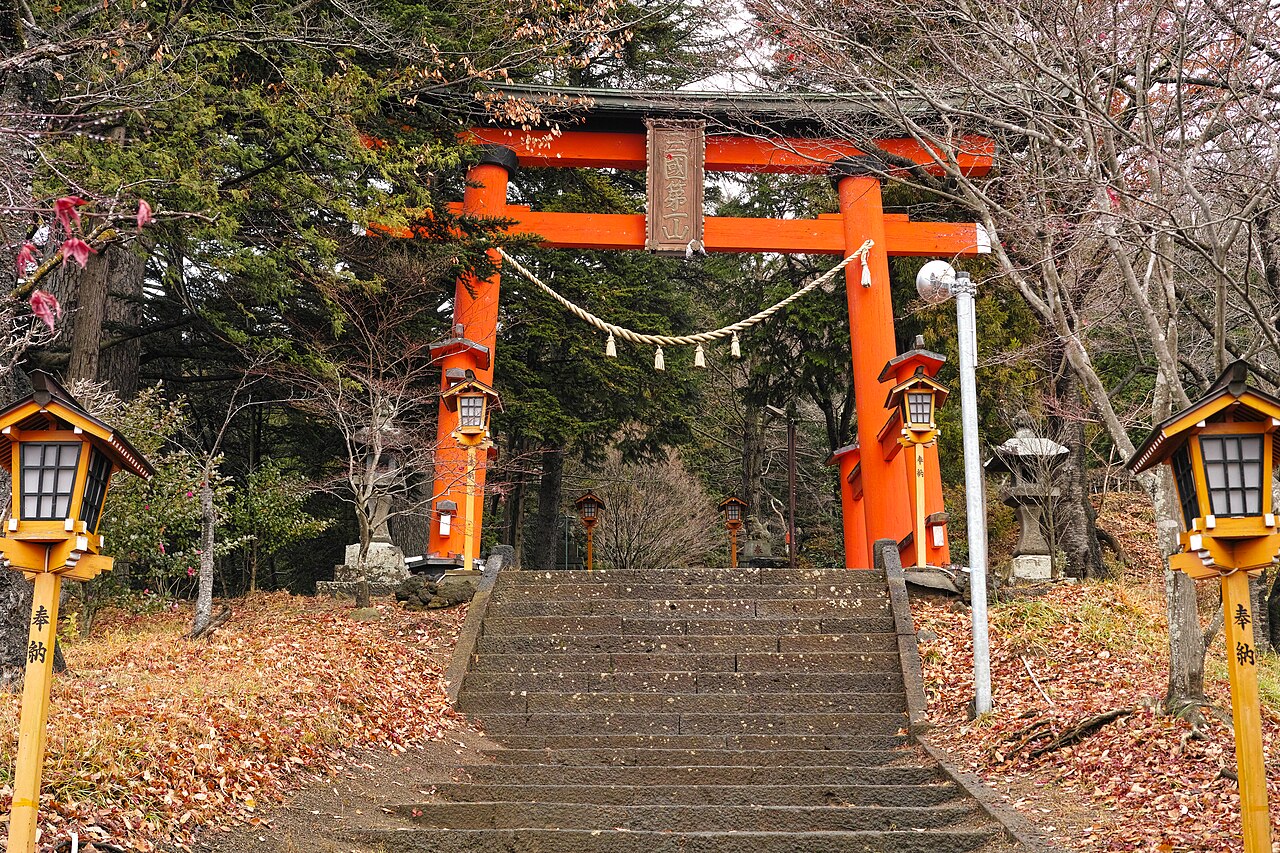
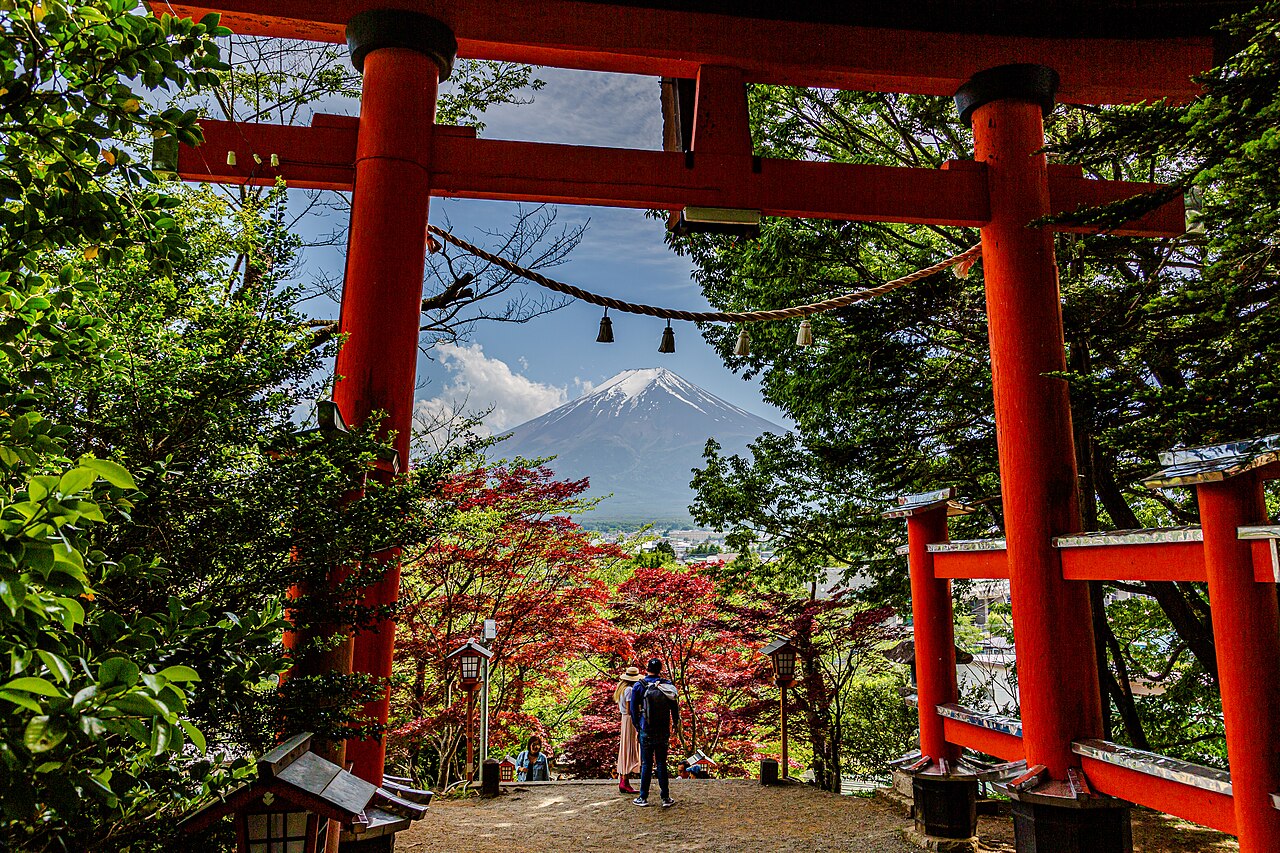
Passing through the big torii of the shrine approach leads onto the stairs, since the path beyond the main approach consists of steps. The approach stairs have wide steps, while those at the torii have a narrower stride and call for care. At the top, the route arrives at the shrine plaza, with the hand-cleansing basin on the left and the Kagura Stage on the right. The shrine, which stands halfway up Mt. Arakura, was founded as the tutelary shrine of its home district.
Starting from the expressway stop at Shimoyoshida instead, walkers go down the stairs near the stop and turn right. The route follows the side road, turns right at an intersection, runs straight through the tunnel under the expressway and turns left at the dead end just after it. Further along, the signboard for Arakurayama Sengen Park comes into view, and the route turns right there and crosses a bridge.
Following the Forest Trail Past the Gongon Stone Toward Mt. Arakura
Walkers with energy left after the deck are the ones suited to the course that carries on from the park, which stays in forest until past the summit of Mt. Arakura.
Following the course out of the park, walkers begin on its early part, which has a gentle slope and is easy to walk. Sunlight filters through the trees as the path passes through the forest here. The trail then continues under tree cover all the way to the summit and beyond it.
Putting the head into the hollow in the middle of the Gongon stone produces a droning sound. A strange sound resonates from inside the rock, in the words of the course page. Trying it means leaning in toward the hollow, then listening before carrying on along the trail.
Stopping for a rest on the trail cools the body easily, as does strong wind, so warm layers such as an inner down jacket or a fleece are advised. Gloves protect the hands when touching rocks and branches. Partway up the mountain, a viewing point is set at an angle that looks down toward Mt. Fuji.
Collecting Goshuin, Amulets and Omikuji at Arakura Fuji Sengen Shrine
The choice at the shrine lies between the regular goshuin or its monthly version, the autumn-limited spread and paper-cut designs, and an amulet such as the one depicting Mt. Fuji, a pagoda and cherry blossoms.
Receiving a goshuin here means, for the time being, being handed a pre-written paper copy, a measure taken to ease crowding. The regular goshuin is the one prepared throughout the year. The monthly goshuin changes the month name at the upper right and the design at the lower right every month.
Looking through the goshuin listed as autumn-limited, visitors find a double-page spread, which is pasted across facing pages, and a paper-cut goshuin made as a paper cutting. The designs of both change with each season. A separate goshuin belongs to the subsidiary shrine next to the main hall, whose deity is a god of textiles, long worshipped as a god who forms good connections.
Drawing an omikuji brings an amulet sticker with it, depicting a symbol of the shrine. The sticker comes in several designs, and each omikuji includes a sticker from the set. The wish-fulfilment amulet comes in pink, navy and red, while a drawstring-pouch amulet depicting Mt. Fuji comes in pink, blue and green. The shrine is also among a group of shrines at the foot of Mt. Fuji that distribute a token of the visit.
Getting to Chureito Pagoda, Parking and Lighting Hours
New to rural buses and one-man trains? See how to ride them, step by step.
Rooms in Fujiyoshida are listed in places to stay in Fujiyoshida.
| Item | Details (as listed) |
|---|---|
| On foot from Shimoyoshida Station | about twenty-five minutes to the pagoda; about five minutes to the shrine |
| From central Tokyo | about one and a half hours to Fujiyoshida by highway bus or train |
| By car | about fifteen minutes from Kawaguchiko IC on the Chuo Expressway |
| Park | free entry, twenty-four hours |
| Evening lighting | in December, from sixteen hundred to twenty-one fifty; the times may change |
| Paid parking | four paid lots; the first holds eighty-eight cars at fifteen hundred yen per six hours; the second holds thirty-eight at one thousand yen |
| Shrine | nine in the morning to four in the afternoon |
Thinking of staying overnight?
Compare places to stay near Fujiyoshida, Yamanashi, Japan →
Disclosure: This post may contain affiliate links. If you book through them, we may earn a commission at no extra cost to you.