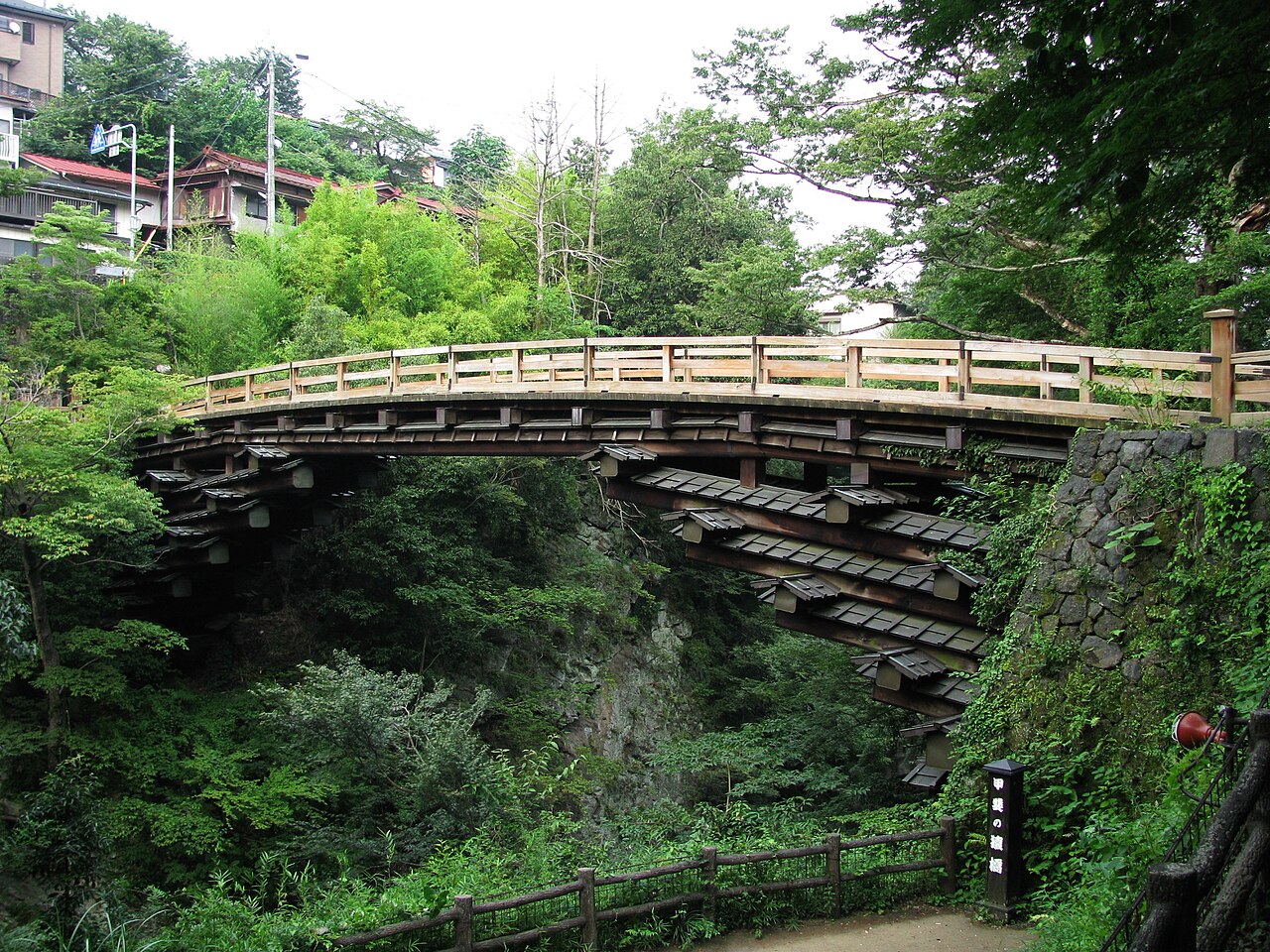
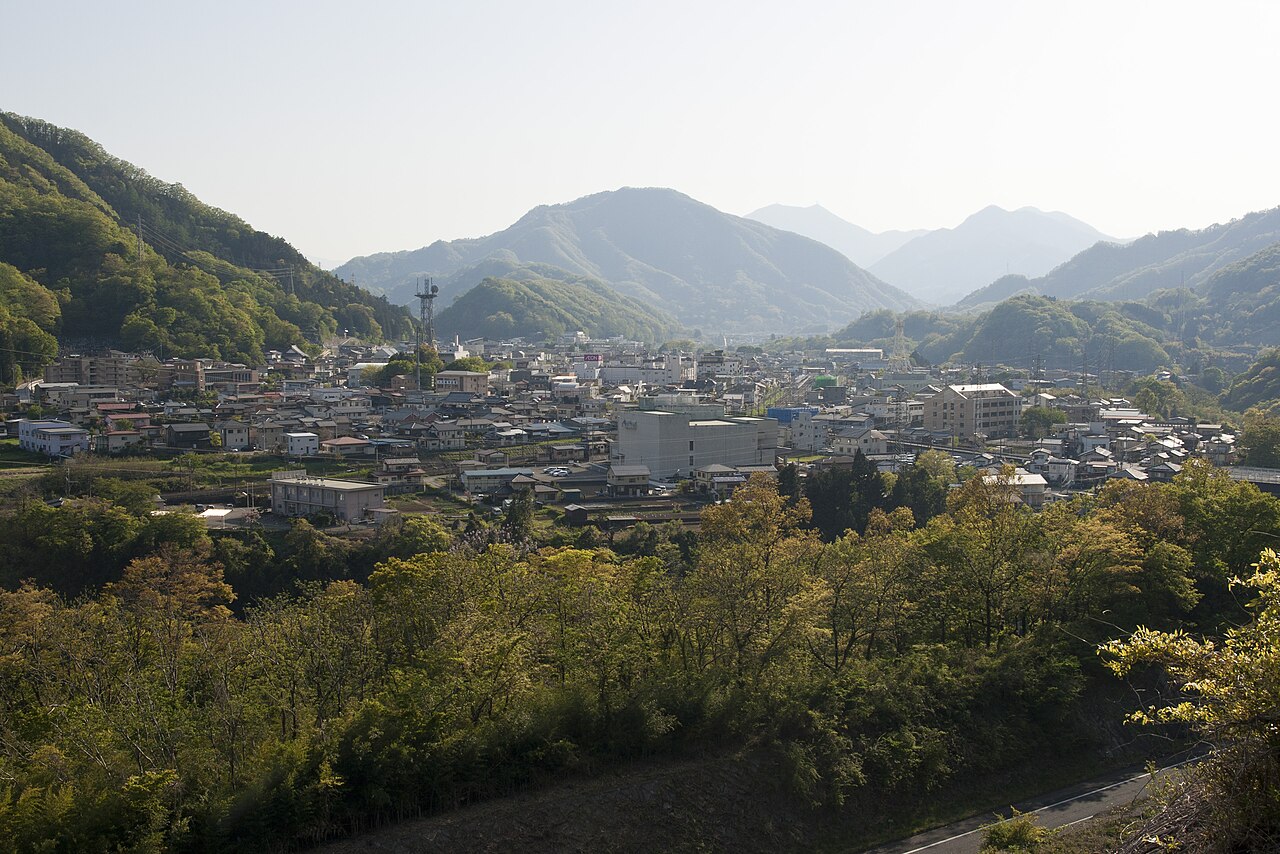
Otsuki, an old Koshu Kaido post town in Yamanashi, is where Saruhashi, one of Japan's three marvelous bridges, crosses the Katsura River high above the water. A viewpoint near the summit of Iwadonosan sets Mt Fuji beyond the Otsuki townscape. Below the bridge, a promenade lines up some three thousand hydrangea plants in full bloom.
Saruhashi, the Bridge Without Piers
Saruhashi, a national place of scenic beauty, carries you across the Katsura River high above the water, with no pier beneath you. Instead, four layers of cantilevered beams project from the rock on both banks, reach little by little toward the middle of the valley, and carry the girder on top.
The legend says monkeys crossing in a chain to the far bank gave a garden master from Baekje the hint you now see in beams that reach across without a pier. Hiroshige left a work depicting Saruhashi, and the bridge he drew, rebuilt from historic records, is the one you take in with the gorge from the newer bridges across from it. At the foot of the bridge stands a shrine, and local tradition says it enshrines the monkey that inspired the bridge.
A promenade descends to a flat path from which you look down on the Katsura River, lined on both sides by some three thousand hydrangea plants in full bloom. If the timber framework is what you came for, walk the promenade first and keep the depth of the gorge in mind on the deck above the four layers of beams.
The Katsura Gorge and the Yatsuzawa Aqueduct
Yatsuzawa shows you a water-channel hydroelectric plant built roughly parallel to the Katsura River: a reinforced-concrete single-arch aqueduct bridge, with red brick facilities still around it.
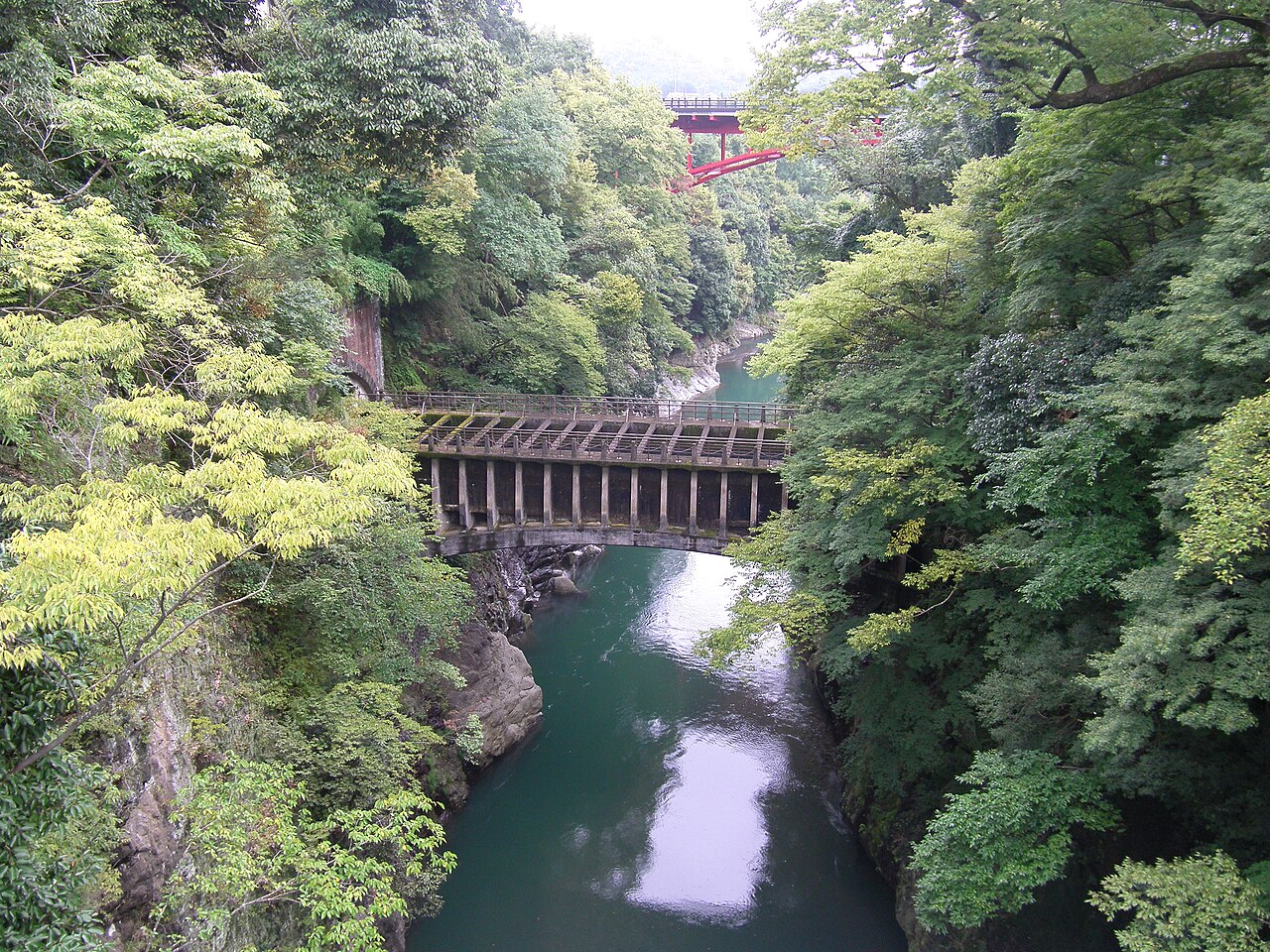
In autumn the Katsura River gorge turns red and yellow, and since the aqueduct is a working power facility you look at it from nearby and stay out of the restricted areas. If industrial heritage interests you as much as scenery, give this stop priority over the climb to Iwadonosan: arch, brick and coloured gorge come without rocky sections.
Post-Town Houses and the Sasago Tunnel
The Hoshino family house in Shimo-Hanasaki shows you what a honjin was, the lodging kept for daimyo and the shogunate's officers in this post town on the old Koshu Kaido, in its long eaves, second-floor balustrade and heavy timber construction.
At the Midou honjin, daimyo parties on sankin-kotai journeys stayed, and just inside the doorway the thick main pillar and the palanquin that carried a daimyo still stand. Part of the building is an exhibition space about Yamamoto Shugoro, and a red post box from its years as the Hatsukari post office marks it along Route Twenty.
The Sasago Tunnel, linking Otsuki with the Koshu side, once carried the main route over Sasago Pass, and its portal has a stone-like arch, pillar shapes on both sides and bracket-like ornament above, more building than tunnel mouth. The tunnel runs on in reinforced concrete, and the trees around the pass turn yellow and red in the same weeks as the gorge below Saruhashi.
Iwadonosan and the Mountains Around Otsuki
Iwadonosan asks you to climb to where a mountain castle stood in the Sengoku period, and near the summit a viewpoint sets Mt Fuji beyond the Otsuki townscape. One course on the mountain has rocky sections, chain sections and rope sections.
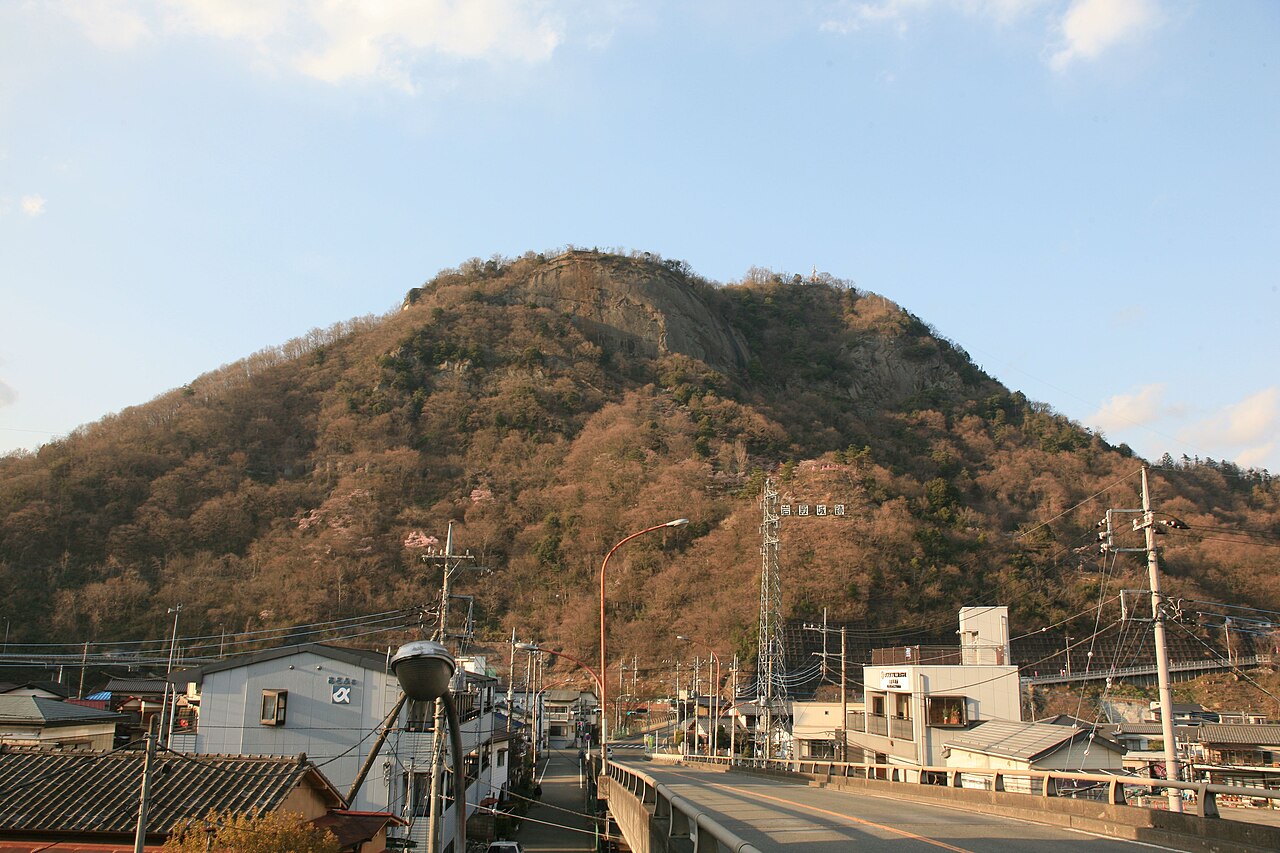
Gozenyama, one of the Shurei Fugaku twelve views of Mt Fuji, has a summit with views east, south and west over the Otsuki cityscape and the surrounding mountains, and stone pillars marking the stages of the climb remain on its trail. Momokurasan, also among the twelve views and rated for beginners, has a relatively wide summit with benches and Mt Fuji beyond the Doshi mountains, Shakushiyama and Mitsutoge. For a wide summit to sit on, choose Momokurasan; for views to three sides, Gozenyama; for Iwadonosan, be ready for the rocky and chain sections.
Iwadonosan is regarded as the dwelling of a demon, and a cave remains there today; seen from inside it, the view out is said to look like the shape of Mt Fuji. A mountain here is said to be where the large peach of the Momotaro story floated down, and the grounds of a shrine hold red-coloured soil that a legend says was dyed by the demon's blood. If those summit views are what you want to linger over, look for places to stay in Otsuki rather than hurrying back down.
Zazen, Sutra Copying and the River
A temple in Otsuki offers zazen and sutra copying in grounds with a large camphor tree said to be over three hundred years old, and its main hall has thick central pillars and beams. Beyond the stone-pillar gate stand a statue of Jizo, the main hall and a bell tower, and after the sitting or the copying come matcha and a Japanese sweet matched to the time of year.
The river and gorge are also used for rafting, boarding a rubber boat with a guide and paddling down together, and for shower climbing, walking up a stream toward its source, wading, swimming in natural pools and climbing over cascades and rocky stretches.
River tubing puts each person on a large tube made for river descents, one at a time, taking in the scenery on calm stretches and getting splashed where the current is stronger, with a deep gorge, rock walls and clear water close at hand and a life jacket and helmet on. Pick the tube for the gorge at water level, rafting for going down as a boatload, and the temple when pillars and camphor tree appeal more than the river.
Senbei, Baked Sweets and Soba
A confectioner near the bridge bakes a rice cracker from wheat flour, lightly sweet with a rich sansho flavour; the dough is baked in three layers for a distinctive hardness, and the scent of sansho spreads with every bite. A soba restaurant near the bridge serves the Chuji soba set meal, soba with six kinds of tempura, two small side dishes, yam, condiments and dipping sauce, and warm soba too.
Morich, a local baked sweet, comes in plain, black grape and Shine Muscat, with a soft, moist madeleine-style dough gently scented by a hidden white bean paste. The grape versions carry large raisins from grapes bought at a vineyard in Koshu City, soaked in rum and liqueur for a Western-confectionery note.
A pastry shop in Otsuki sells baked sweets and cakes centred on French pastry with house-roasted coffee, and has table and counter seats for eating what you have just bought. Its pithiviers is baked pie dough with an almond flavour, and its speculoos, a spiced cookie from Belgium, is shaped as a crescent moon as a nod to Otsuki. For eating, the bridge is the stop to plan around, with the soba restaurant and the confectioner both close by.
Getting to Otsuki
| Leg | How | Time and estimate |
|---|---|---|
| Shinjuku to Otsuki | JR Chuo Line limited express (Kaiji or Azusa) | About 1 hour |
| Kofu to Otsuki | JR Chuo Line limited express (Kaiji or Azusa) | About 30 minutes |
| Kofu to Otsuki | JR Chuo Line local train | About 1 hour |
| Otsuki to the Fujikyu line stops toward Mt Fuji | Fujikaiyu limited express fee within the Fujikyu line | 600 yen (400 yen in parentheses) |
| Otsuki to the university stop on the Fujikyu line | Fujikaiyu limited express fee | 400 yen (300 yen in parentheses) |
| Fujikyu line | Special car (car 1), bought separately | 900 yen |
| Fujikyu line | Reserved seat car (car 2), bought separately | 200 yen |
| Saruhashi Station north exit to the river-tubing meeting point | On foot | About 3 minutes |
On the Fujikyu line, child fares and limited express charges are half the adult amount.
New to rural buses and one-man trains? See how to ride them, step by step.
Hours and Fees
| Place | What | Hours or fee |
|---|---|---|
| Temple with zazen and sutra copying | Experience fee | 2,000 yen per person for zazen; 2,000 yen per person for sutra copying |
| Soba restaurant and cafe near the bridge | Hours in the extended season (October to the first week of December) | Dining room 11:00-15:00; cafe 11:00-16:30 |
| Soba restaurant and cafe near the bridge | Hours outside the extended season | Dining room 11:00-14:30; cafe 11:00-16:00 |
| Souvenir shop run by the tourism association | Hours | 9:00-17:00 |
| Eigetsu Seika shop | Hours | 10:00-17:00 |
| Morich baked sweets | Price of the plain version | 300 yen |
| TOMIYA (the pastry shop) and the rafting base | Walk from the nearest station | TOMIYA about 7 minutes on foot from Otsuki Station; rafting base about 7 minutes on foot from Yanagawa Station |
| River tubing | Session start times | 9:00 and 13:00 as a guide |
The soba restaurant is closed Mondays, opening on national holidays and closing the following day, and in winter it closes Monday and Tuesday as well as over the New Year holidays. The black grape and Shine Muscat Morich are three hundred and fifty yen each.
Where to stay
Places to stay near Otsuki, Yamanashi, Japan →
Disclosure: This post may contain affiliate links. If you book through them, we may earn a commission at no extra cost to you.