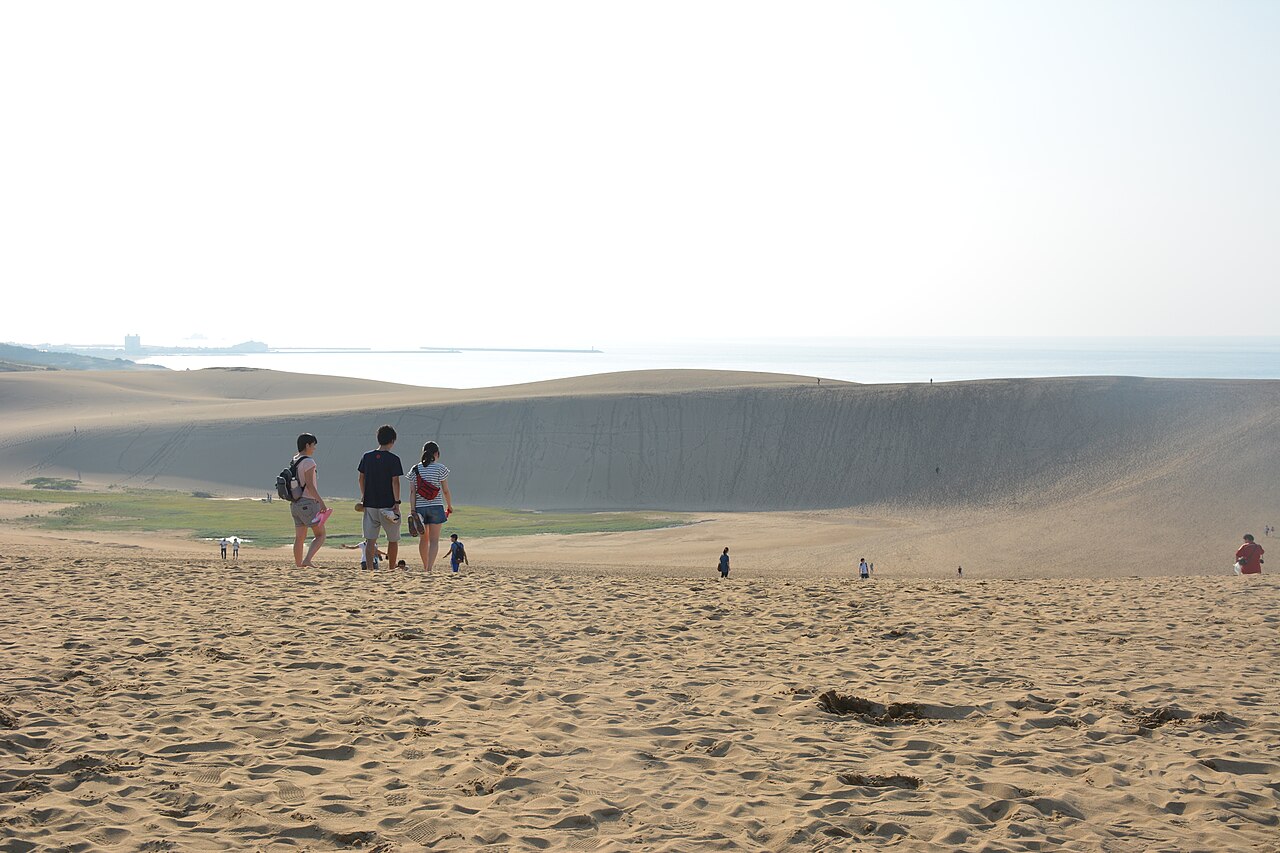
Tottori Sand Dunes are a place to watch sand at work. Wind ripples run across the surface, and sand curtains, sand pillars and bowl-shaped hollows give the dunes landforms of their own. At dusk, once the bustle has quieted, the sand turns a deep madder-red. On a summer night, lying back on the sand in the sea breeze, you can watch the Milky Way flow overhead while the fishing-boat lights grow in number.
Walking the Dunes: Ripples, Sand Curtains and the Sea Wind
The sand underfoot began as granite and other rock of the Chugoku mountains, weathered down into grains, and a strong wind off the Sea of Japan carried it inland to build the dunes. Look down as you walk and those dune landforms show themselves: wind ripples, sand curtains, sand pillars and bowl-shaped hollows. The sand is very fine, fine enough to work its way into shoes and socks.
Even where the surface is dry, dig a little and damp sand comes up soon after. There is no shade on the dunes, since nothing blocks the sun, and no toilets inside them; the Oasis building has toilets, vending machines, tables and benches. A chairlift also runs from Sakyu Center Miharashi-no-oka to the dunes entrance in about five minutes one way.
Keeping the sand bare has taken work. After the Second World War a windbreak forest was planted to stop the sand moving, secure farmland and protect settlements; with the sand still, plants spread and turned the dunes into grassland. Later, part of that protection forest was cut down to restore the dunes' original landscape, and every summer volunteers weed the dunes in the early morning and evening.
Dusk, Fishing Lights and the Milky Way
Once the bustle has quieted, the sand changes colour, turning a deep madder-red at dusk. At twilight in summer the dunes are described as burning in the golden colour of the setting sun. Then darkness comes, and in the pitch-black night the fishing lights begin to appear.
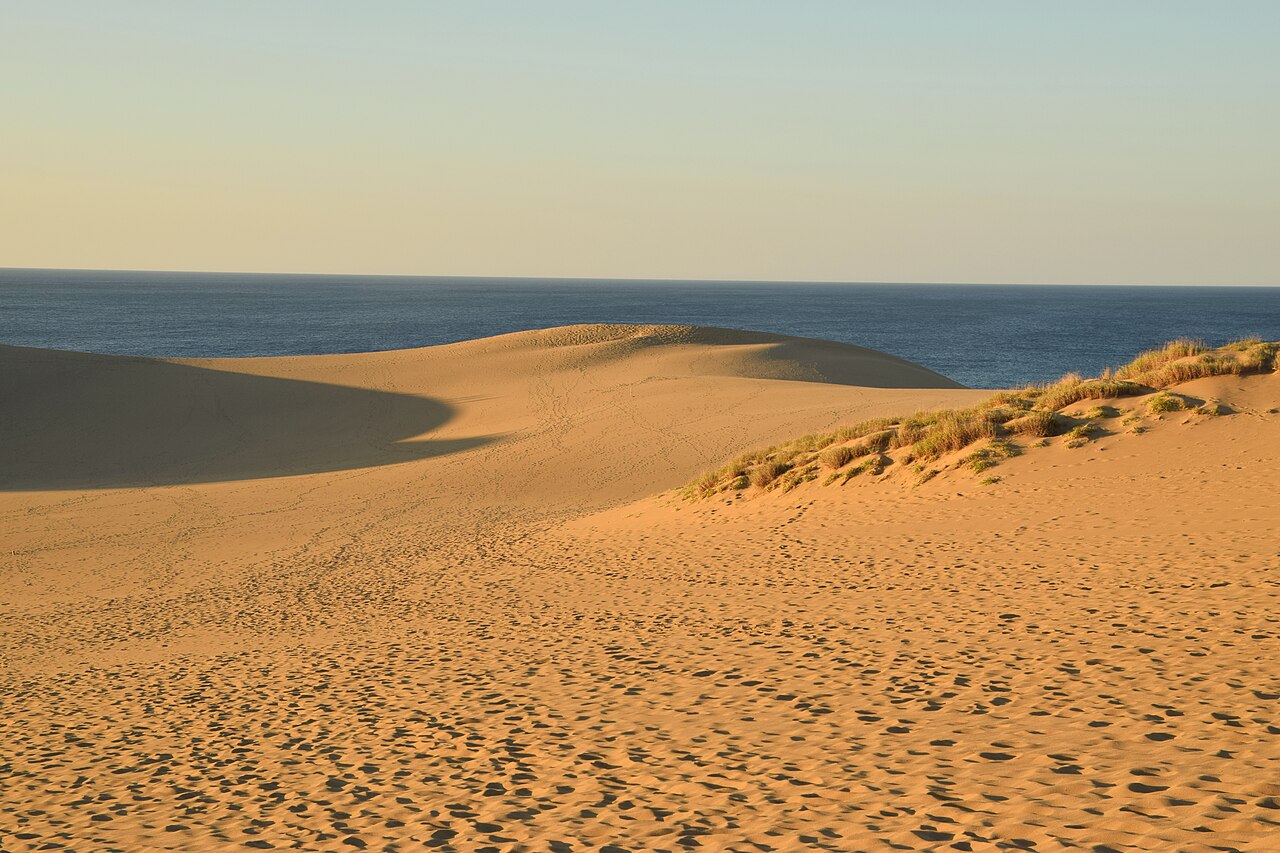
Lie back on the sand on a summer night and the sea breeze is pleasant, the Milky Way flows across the night sky, and the fishing-boat lights grow in number. For a guided way onto the dunes after dark, the Mystery Night Walk is held from late April to the end of September.
Four Seasons on the Sand
In winter the whole area is covered in snow, and it sometimes turns into a white-silver world overnight. Strong winds blow in from the Sea of Japan, and a north-west wind dominates the dunes. Listen and the season has its own sound: wind blowing across the sand, the roar of the sea, and the mournful cry of black-tailed gulls.
Below Umanose, the ridge, an oasis holds water and reflects the dark sky; in summer the oasis dries up and its form disappears. Spring arrives on the air as the sweet fragrance of Nise-acacia drifts over the dunes, and beautiful wind ripples cover the whole of the sand.
Pale pink flowers add colour to the expanse of sand in spring, a carpet of blossom that begins at the shoreline and spreads inland. Autumn moves the colour to the fields: from October to November the wide rakkyo fields turn reddish-purple, and Hamabenogiku, a pale purple flower that blooms only near the coast, comes into flower.
Camels, the Quiet West Side and Tanega-ike Pond
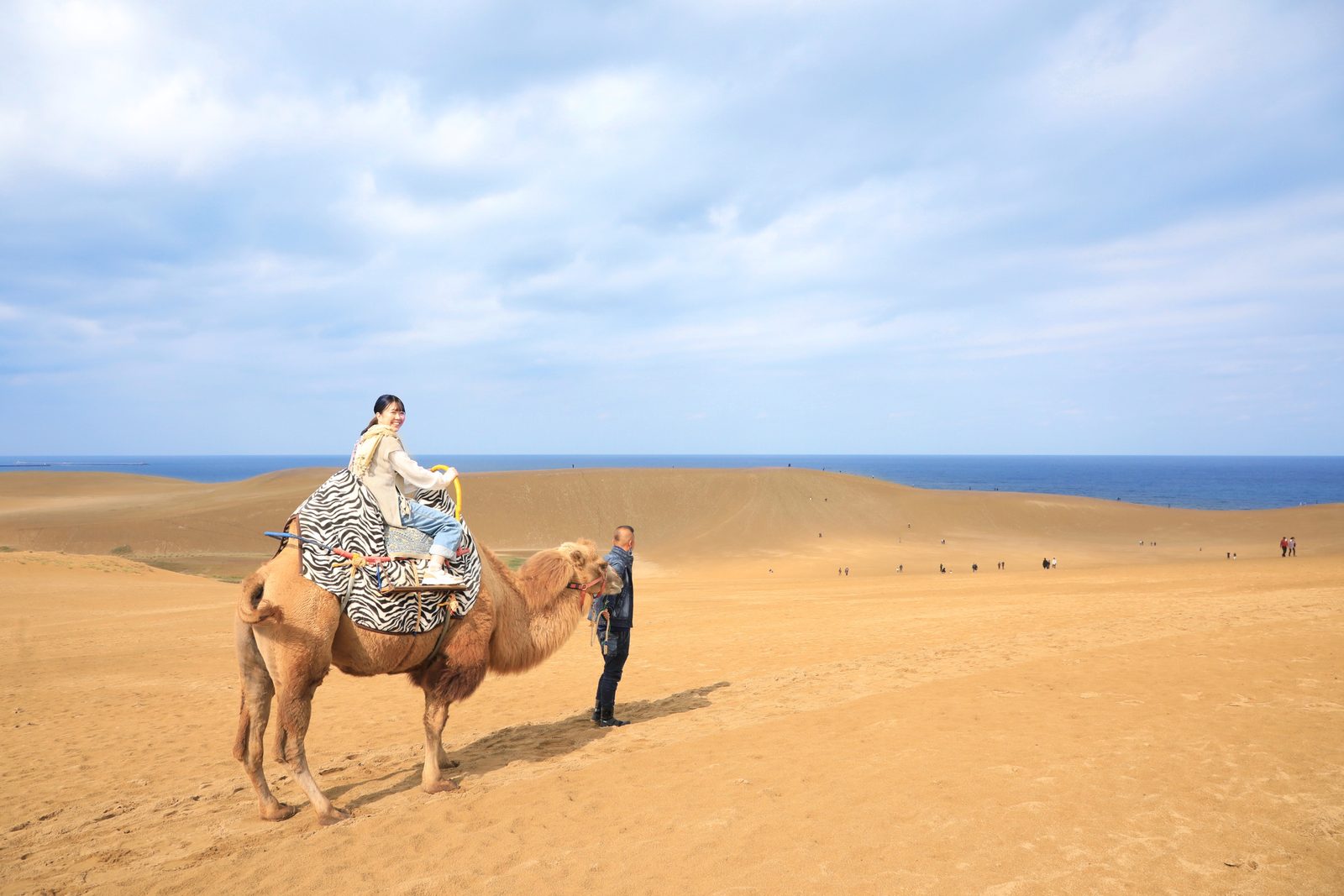
You can ride a living camel and walk around the surrounding area on its back. The ride keeps to the vicinity of the boarding area; Umanose is a special protected area and the camels do not enter it.
The western side of the dunes has fewer visitors than the east, and the dunes' history and literary song monuments are concentrated there. Many animals and plants live on this side and wind ripples can be seen, though on the western-side guided course plants and insects may not be found, depending on the dunes' condition. An older marker, the Ichiri pine, was planted in the Edo period to mean one ri from the castle.
Tanega-ike is a pond formed when the sand of the dunes dammed the water, and water lily flowers decorate its tree-ringed surface. The water level is stable and the pond calm, so visitors can take a quiet kayak tour at this oasis of the dunes. The tour follows the year, with fresh greenery in spring, water lilies in summer, a search for mamizu jellyfish in autumn and migratory birds in winter, on a route between the trees described as a jungle cruise.
The Sand Museum, the Uradome Coast and Local Flavours
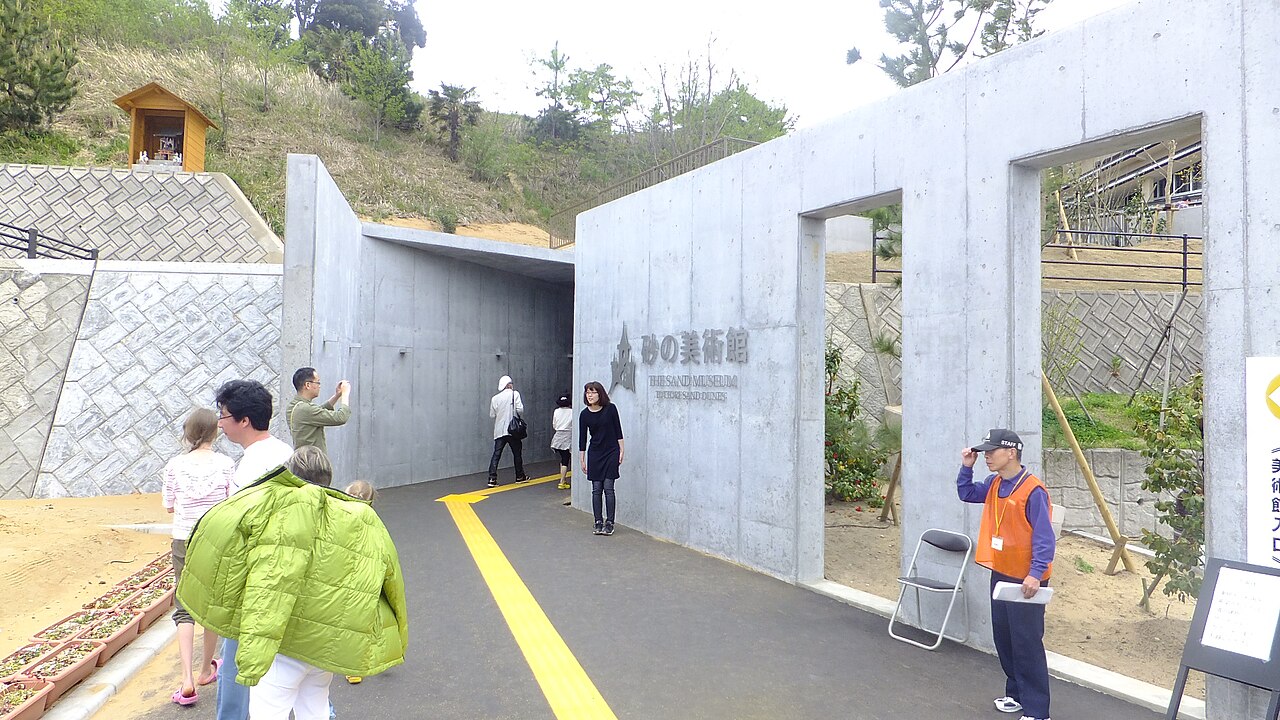
The Sand Museum changes the theme of its sand sculptures each exhibition period, so the works on show can be seen only in that year. From the glass-walled windows on the third floor and from the outdoor plaza you can look back across the Tottori Sand Dunes. After sunset, visitors can see the sand sculptures lit up.
The Uradome Coast, within the San'in Kaigan Geopark, is described as a grand sea-eroded landscape shaped by the rough waves of the Sea of Japan, with sea caves, caverns and white-sand beaches. A promenade along the coastline lets you view the sea up close from land, and the coast shows a different face depending on the time of day. A sightseeing boat goes among the islands, with clear water, sea caves and rock formations up close, and a SUP program passes through five caves.
Local flavours are worth a stop: a pear gelato, a seafood rice bowl that comes with rakkyo, or a Sakai-minato salmon rice bowl. Rakkyo, the crop that carries the dunes' name, grew into large-scale production in the early Taisho period, once an industrial cooperative was founded and sprinkler irrigation introduced. Pickled rakkyo came later, when the agricultural cooperative took up processing to steady prices; JA Tottori Inaba registered the trademark, and the crop is now a Geographical Indication as Tottori Sakyu / Fukube Sakyu Rakkyo.
Getting to Tottori Sand Dunes and the Uradome Coast
New to rural buses and one-man trains? See how to ride them, step by step.
| How | Detail |
|---|---|
| Route bus, JR Tottori Station to Tottori Sand Dunes | about 22 minutes |
| Route bus, one-way fare | 380 yen |
| Loop Kirin Jishi Bus, JR Tottori Station to Tottori Sand Dunes (Saturdays, Sundays and holidays only) | about 20 minutes |
| Loop Kirin Jishi Bus, single ride | 400 yen |
| Loop Kirin Jishi Bus, one-day pass | 700 yen |
| Taxi, JR Tottori Station to Tottori Sand Dunes | about 15 minutes |
| Taxi fare | about 2,900 yen |
| Airport bus, Tottori Airport to JR Tottori Station | about 20 minutes |
| Airport bus fare | 480 yen |
| Rental bicycle, JR Tottori Station to Tottori Sand Dunes | about 60 minutes |
| Where to rent | Tottori Station Kokashita second bicycle parking, about a 1-minute walk east of the north exit |
| Car, Tottori Sand Dunes to the Uradome Coast | about 15 minutes |
| Car, JR Tottori Station to the Uradome Coast | about 30 minutes |
Hours and Fees
| What | Fare or time | Note |
|---|---|---|
| Sand Museum, adult admission (individual) | 800 yen | |
| Sand Museum, elementary, junior high and high school students (individual) | 400 yen | |
| Sand Museum, business hours | 9:00 to 18:00, last admission 17:30 | |
| Sand Museum sub-gate (observation deck parking lot side) | 10:00 to 15:00, Monday to Friday | |
| Chairlift, running time | 9:30 to 16:00 | may change with season, weather or maintenance |
| Chairlift, adult round trip | 500 yen | |
| Chairlift, adult one way | 300 yen | |
| Chairlift, child round trip | 300 yen | |
| Chairlift, child one way | 200 yen | |
| Camel riding | 10:00 to 16:00 | closed in bad weather |
| Mystery Night Walk, adult (high school and older) | 4,000 yen | |
| Mystery Night Walk, junior high / elementary students | 3,500 yen / 3,000 yen | |
| Mystery Night Walk, season | April 25 to September 30 | |
| Mystery Night Walk, departure from June 1 to July 31 | 18:45 | |
| Western-side guided course | 2,000 yen per person (up to 4); 10,000 yen per group (5 or more) | high school students and younger free |
| Uradome Coast island-tour sightseeing boat | 1,400 yen adult, 700 yen child | |
| Seafood rice bowl with rakkyo | 1,300 yen | |
| Sakai-minato salmon rice bowl | 1,500 yen |
Fees and hours were checked against official sources between 26 September 2026 and 28 October 2026.
For a day with the arrangements made, there are day tours of Tottori Sand Dunes. Those planning around dusk on the sand, the fishing lights or the Mystery Night Walk can compare places to stay near Tottori Sand Dunes.
Thinking of staying overnight?
Compare places to stay near Tottori →
Disclosure: This post may contain affiliate links. If you book through them, we may earn a commission at no extra cost to you.