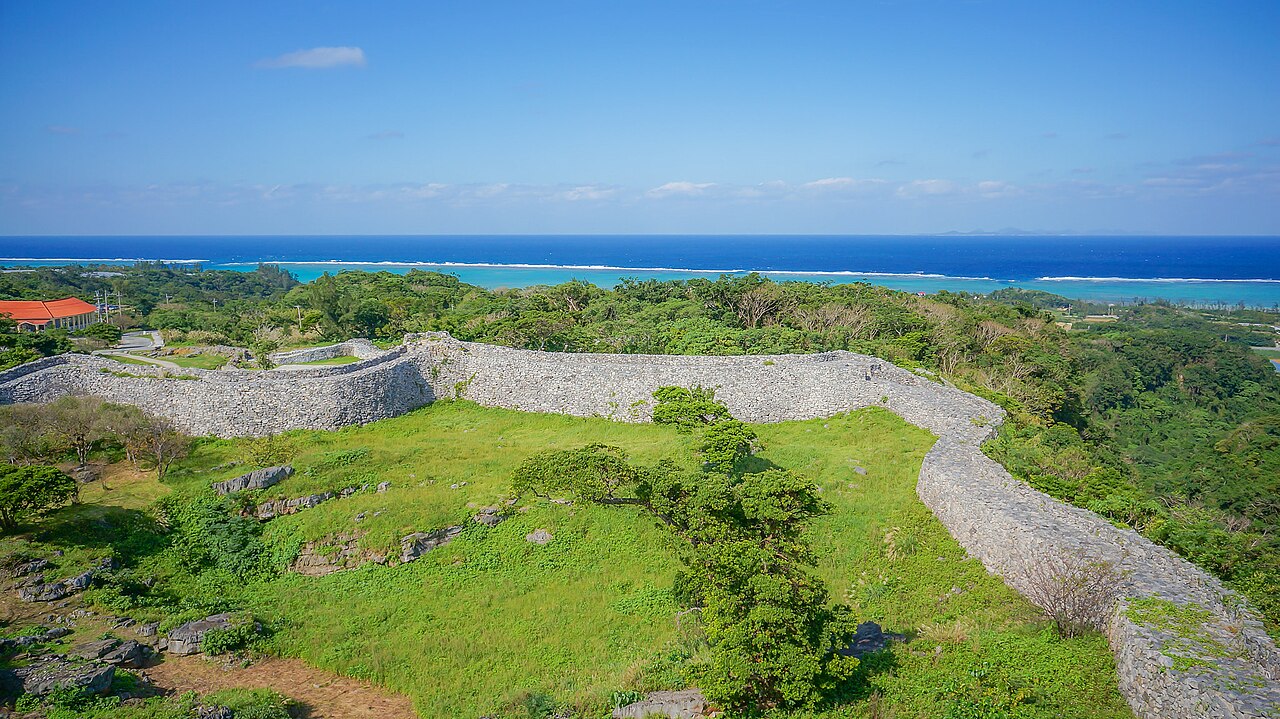
Nakijin Castle Ruins is a historic gusuku on the Motobu Peninsula in northern Okinawa Main Island, set about a hundred metres up and ringed by sturdy castle walls. This was the royal castle site of the Hokuzan kingdom, which governed the northern part of the main island, and the ruins are now listed as a UNESCO World Heritage Site together with the Shuri Castle ruins and others, as part of the Gusuku and Related Properties of the Kingdom of Ryukyu. The reason to come is the walk itself: an outer wall that winds along the ridge, a narrow old road through a valley of bedrock, and an inner enclosure from which the sea can be seen in full view. Below the castle, fukugi-lined village lanes, a bridge over a blue-gradient sea and an old farmhouse soba restaurant fill out the day.
Inside the Castle: Walls, Gates and the Old Road
The walk starts at the Heiro Gate, the main gate, whose present form was restored during the Ryukyu Government era. Turn right after passing through it and you are on the old road, which climbs through a winding valley of large bedrock and was kept narrow and steep for defensive reasons, so take it slowly. The outer wall is described as a relatively low stone wall that winds on and on.
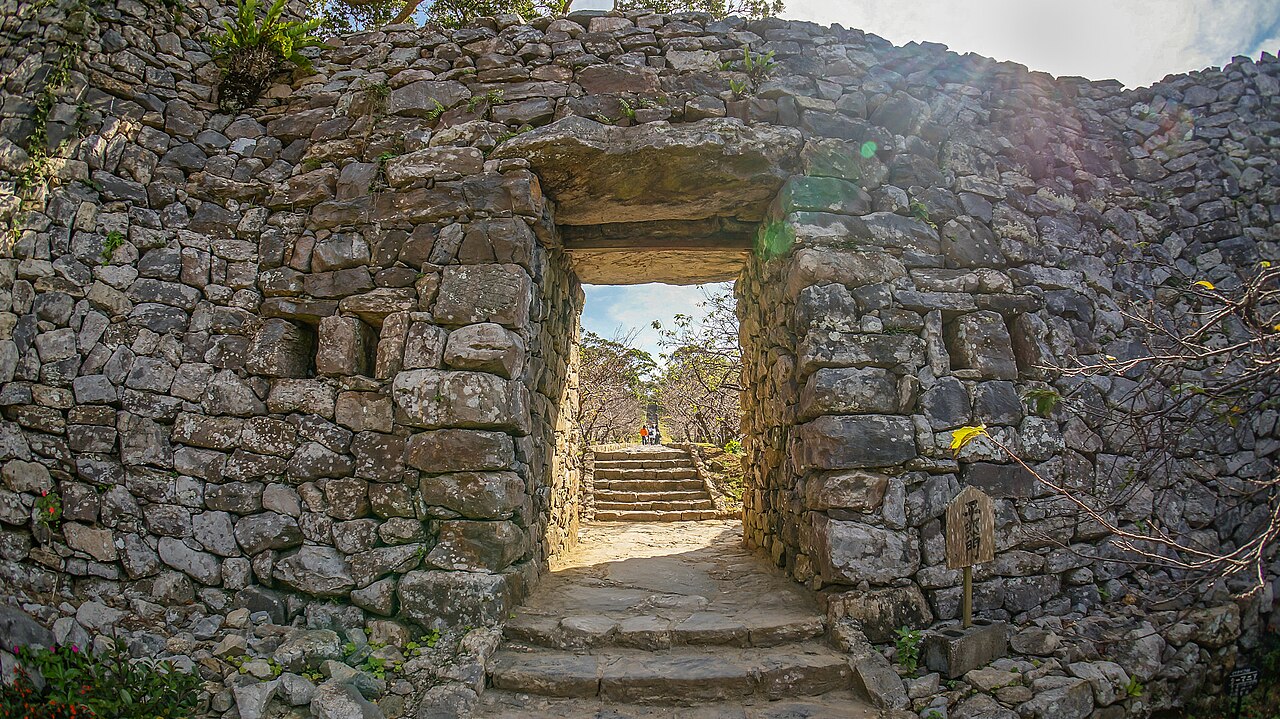
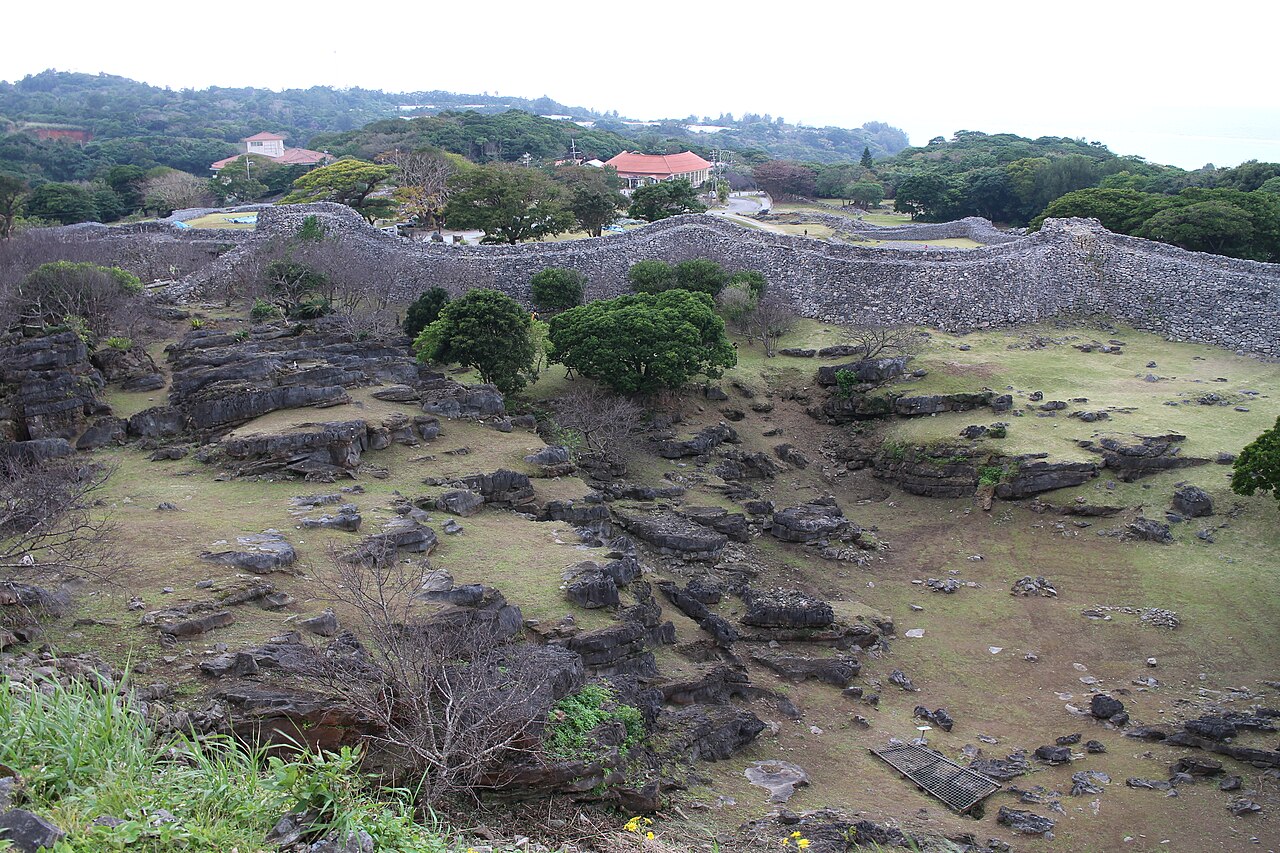
Beyond the gate the grounds open into several named spaces. Ushimi is handed down as the place where horses were kept and soldiers and horses were trained in preparation for war, while at Kazafu the valley has natural stone exposed, forming a landscape of its own. Umya is an important open space that was used for events, and the main hall, north hall and south hall are thought to have been arranged around it. Excavation of the main enclosure confirmed the changes over time from the construction of the castle to its abandonment.
Save Uchibaru for last. It is said to have been the living place of the court women who served at the castle, and from its north side the sea can be seen in full view. To the west of the ruins stands Kubanoutaki, a hill of Paleozoic to Mesozoic limestone.
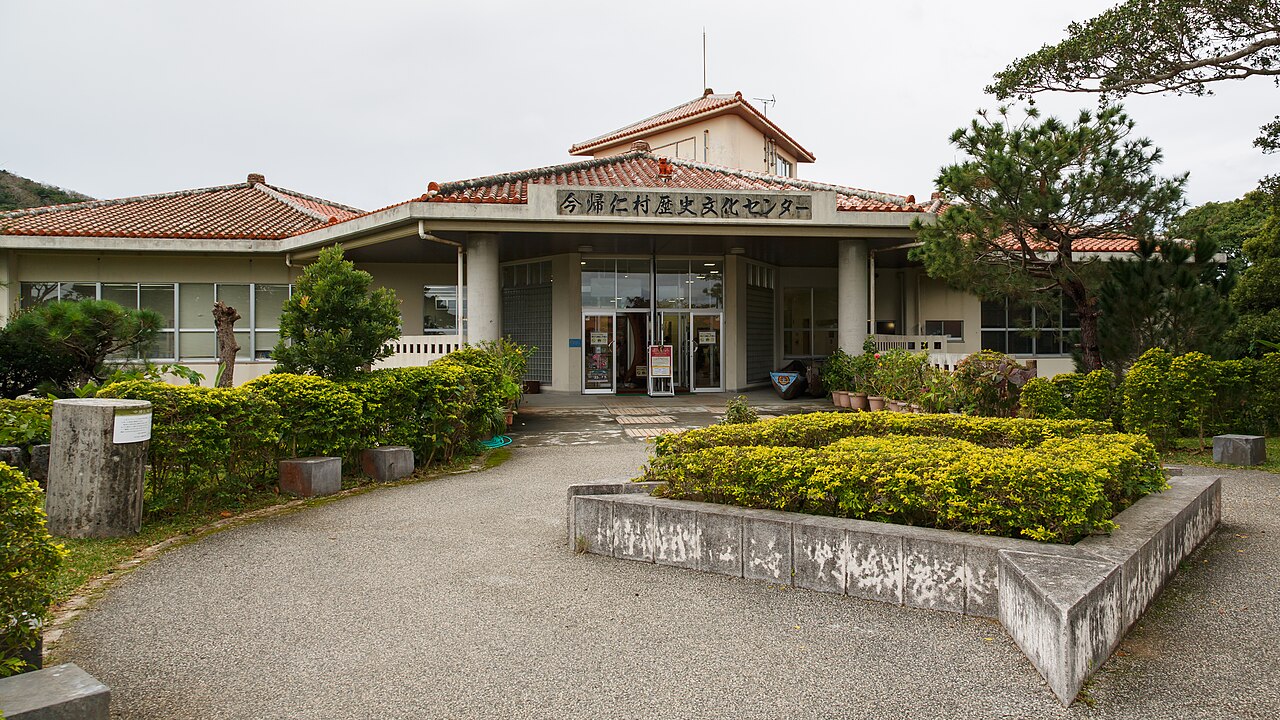
Two indoor stops frame the walk. The Nakijin Village History and Culture Center displays a replica of the national treasure gold-fitted sword, and the Gusuku Exchange Center holds information, pamphlets and exhibits related to Nakijin Village and can be used as a rest area. From its windows the two-tone Nakijin blue can be seen, and in cherry blossom season the deep pink of the kanhizakura.
Walking the Approach Path with a Volunteer Guide
A volunteer guide puts names to the walls and opens up the Hanta road. This is the original approach path up to Nakijin Gusuku in the Ryukyu period, and visitors can climb a mountain path surrounded by deep trees. The trekking course along the Hanta road includes natural limestone slopes, the site of a noro residence in the woods, and stone-piled ruins.
Two further courses reach beyond the walls. One goes to Unten Port, which had a bansho, a government office, when sea routes were central, and also visits the Taihoku tomb and the Hyakuaji tomb. The Nakijin pilgrimage course starts from the worship sites inside Nakijin Castle and visits worship sites around the village, partly by car, over about three hours.
If you have only an afternoon, walk the castle itself and keep the Hanta road for a second visit; the pilgrimage course is a half-day on its own.
Imadomari Village and the Night Sky
Imadomari is a castle-town-like village at the climbing entrance of Nakijin Castle, worth a slow loop on foot before or after the ruins. Its districts, laid out with feng shui thinking, are surrounded by lanes lined with fukugi trees. The trees carry the story: the two villages that formed the castle town moved as whole villages to their present location in the seventeenth century, and because the new site was close to the sea, fukugi trees were planted as a windbreak against north winds and typhoons. They remain today as rows of fukugi trees, and the whole settlement area has been selected as a nationally designated Important Cultural Landscape.
Stay until dark if you can. Nakijin Village has little light pollution, so faint stars that are hard to see in cities are clearly visible, and in Okinawa all twenty-one first-magnitude stars can theoretically be seen. Three major meteor showers are listed for observation here: the Perseids in August, the Geminids in December and the Quadrantids in January.
Bridges, Beaches and Sea Views
Kouri Bridge connects Yagaji Island in Nago City with Kouri Island, and the sea around it shows a blue gradient. Leave the rental car at the free car park of the Kouri Bridge south lookout on Yagaji Island and walk out onto the bridge, where the sparkling sea surface can be seen directly below. Walking back partway is recommended, since crossing the whole bridge takes twenty minutes or more. Warumi Ohashi, an arch bridge connecting Amesoko in Nakijin Village with Yagaji Island, has a lookout from which Kouri Bridge and Kouri Island can be seen in the distance.
Tokei Beach, on the north side of Kouri Island, is described as a quiet beach with round-holed strange rocks scattered about. A small peninsula divides it into an east beach and a west beach, and the round-holed rocks cluster mainly around the peninsula. The east beach faces slightly northeast, with Hedo Cape visible offshore, while the west beach, described as shaped like a bay between rocky hills, faces almost due north towards Izena Island and Iheya Island. It is a snorkelling spot, but there are no lifeguards.
Kouri Island is small enough to circle by car, so the bridge walk, Tokei Beach and the Heart Rock on Tiinu Beach on the north side of the island fit into one loop.
Soba, Agu Pork and Hands-On Stops
Lunch belongs to Nakijin soba. One restaurant is described as an old farmhouse soba restaurant in a corner of a traditional village, surrounded by fukugi trees, and it serves homemade chewy noodles in a light broth made from Agu pork and bonito, topped with a choice of soft cartilage soki or salted pork belly.
Another restaurant uses Agu pork from Nakijin village in all of its dishes and serves Nakijin Agu shabu-shabu and yakiniku style. Its combined course runs from small side dishes through charcoal-grilled meat and shabu-shabu to a closing rice porridge and dessert, the sauces and condiments are all homemade according to the restaurant, and on some days there are live sanshin performances.
Okinawa's fishermen dive with an underwater spear gun for free-diving fishing that is normally done only at night, and on the fishermen's boat tour all participants do a fishing activity after the free-diving fishing. Visitors can also try making accessories and photo frames from shell craft.
Getting to Nakijin Castle Ruins
New to rural buses and one-man trains? See how to ride them, step by step.
The ruins are a short drive from both the aquarium and Kouri Island.
| From | To | Time and way |
|---|---|---|
| Naha Airport | Nakijin Castle Ruins | by car, about 110 km, about 2 hours 45 minutes |
| Naha Airport | Nakijin Gusuku-ato Iriguchi bus stop | Yanbaru Express Bus, about 2 hours 30 minutes |
| Nakijin Gusuku-ato Iriguchi bus stop | Nakijin Castle Ruins | on foot, about 15 minutes |
| The aquarium | Nakijin Castle Ruins | by car, about 10 minutes |
| Bus stop in front of the aquarium | Nakijin Castle Ruins | by bus, about 10 minutes |
| Bus stop in front of the aquarium | Nakijin Castle Ruins | by taxi, around 2,000 yen |
| Kouri Island | Nakijin Castle Ruins | by car, about 20 minutes |
Hours and Fees
| What | Time or fee | Note |
|---|---|---|
| Castle ruins, January to April and September to December | 8:00 to 18:00 | last entry 17:30 |
| Castle ruins, May to August (summer extended period) | 8:00 to 19:00 | last entry 18:30 |
| Admission, individual | adults 1,000 yen; junior and senior high school 500 yen; elementary school and under free of charge | fees revised from 1 September 2025 (Reiwa 7) |
| Admission, groups of 10 or more | adults 800 yen, children 400 yen | |
| Parking at the ruins | free of charge | about 320 cars |
| Time needed | about 30 minutes inside the castle ruins, on foot only | about 15 minutes more at the History and Culture Center |
| Free guided tour | about 60 minutes | |
| MR experience THE BATTLE OF NAKIJIN | 500 yen per person | target age 14 and over |
| Nakijin Village History and Culture Center | 9:00 to 17:00 | last admission 16:30 |
| History and Culture Center closed | every Monday; 29 to 31 December; 1 to 3 January | if the Monday is a national holiday or Irei no Hi, it is open that day and closed the next day |
Fees and hours were checked against official sources between 15 October 2026 and 28 October 2026.
If you would rather have the day arranged for you, look at tours that include Nakijin Castle Ruins.
Compare options
See partner pricing and availability →
Disclosure: This post may contain affiliate links. If you book through them, we may earn a commission at no extra cost to you.