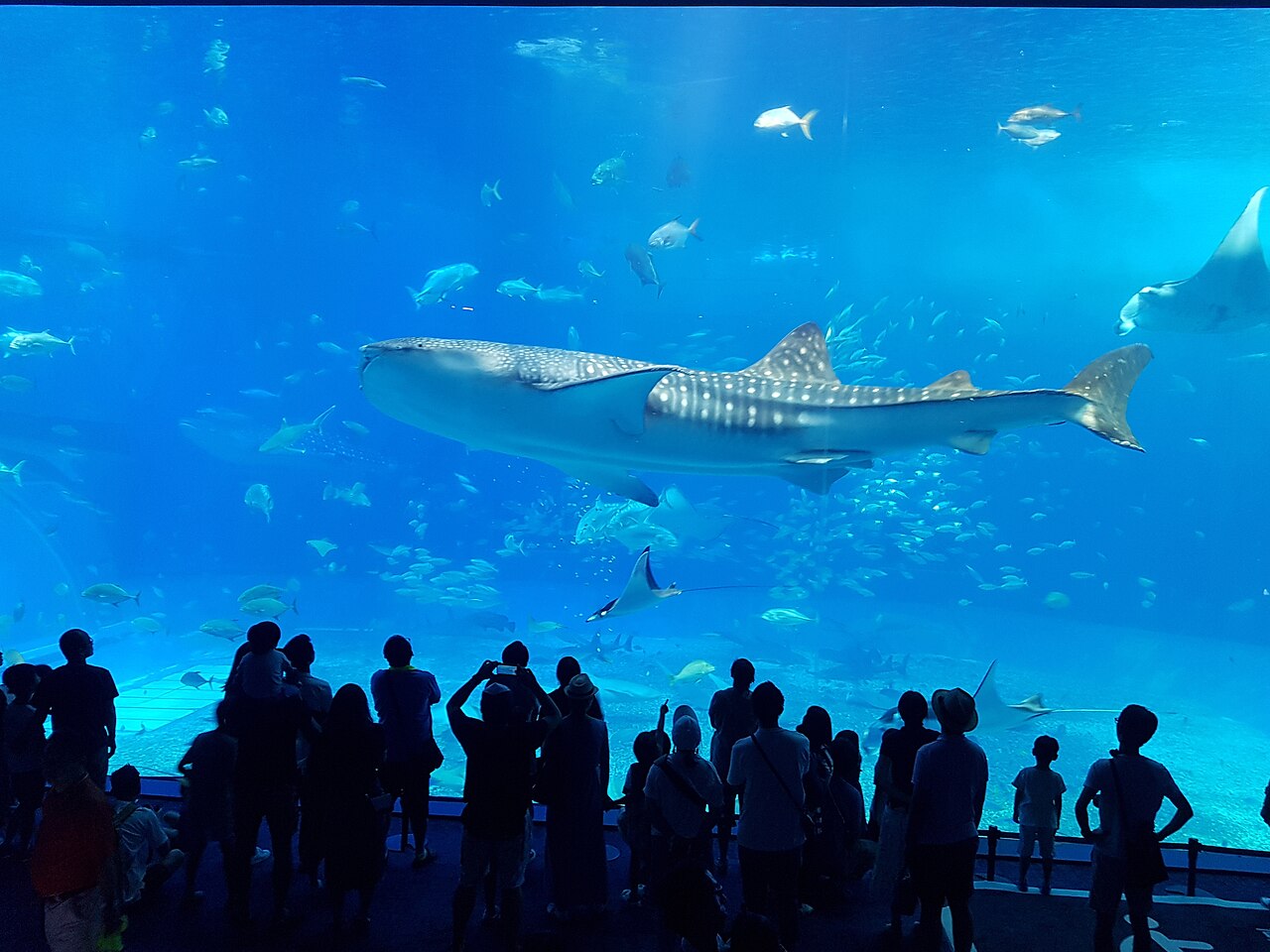
Sit in front of the Kuroshio Sea tank at Okinawa Churaumi Aquarium and whale sharks and manta rays swim past together in groups. The same tank can be seen from several directions, including a giant acrylic panel at the front. Outside the aquarium, Okigondo and southern bottlenose dolphins perform a show against a backdrop of blue sea. At the northern end of Ocean Expo Park, Emerald Beach sets white coral sand against an emerald green sea.
Visitors who want sea animals, a beach and a village wrapped in Fukugi trees can pair the aquarium with the animal facilities around it, Emerald Beach and the Bise area near Ocean Expo Park.
Kuroshio Sea: Whale Sharks, Manta Rays and the Giant Tank at Churaumi Aquarium
Take one of the dedicated seats at the Kuroshio Sea and you see the big tank from the front. Whale sharks and manta rays swim together in groups here. The front view through the giant acrylic panel is one of several, so the seats work well as a starting point before the other angles.
Look up through the acrylic panel ceiling of the Aqua Room and whale sharks and manta rays swim above you as well as in front. The room shows the same animals from below and from various angles, which makes it worth a second look after the front seats.
Look through the viewing window of the Churaumi Theater and the same tank appears from its middle layer, so the fish are seen at a different angle than from the front. The theater also screens high-definition video about creatures living from Okinawa's coast out to the ocean beyond, and about the relationship between Okinawa's people and the sea.
Sit at the aquarium's cafe and the seats look onto the big tank where whale sharks and manta rays swim. A restaurant with a view over the East China Sea serves a lunch buffet made with Okinawan ingredients, with dishes, desserts and soft drinks. The two give a choice between a meal facing the tank and a meal facing the sea.
Coral Sea, Tropical Fish Sea, the Deep Sea and the Shark Research Lab
Look down on the Coral Sea tank from directly above, where colorful corals and tropical fish are lit by natural sunlight. The tank has no roof, so Okinawa's strong sunlight comes straight in. Seawater flows in continuously from the sea in front of the aquarium, which makes large-scale coral rearing possible. Keepers modelled the scene on reefs they saw while diving in the sea of Motobu town.
Follow the tropical fish tank from its shallow rocky area, where strong light enters, across a sandy area to a dim cave. The parts are all connected, so the fish come in order, as if you were going deeper into the sea. Schools of colorful snappers swim here, some red-bodied and some yellow with blue lines. Columns of light sometimes sway in the water.
Look slowly through the glass of the Deep Sea Journey at about one hundred thirty kinds of deep-sea creatures. Most were collected from deep water around Okinawa, and many have unusual forms. One exhibit holds light-emitting fish and fluorescent fish that glow like stars in the sea. The Deep Sea Exploration Room presents the aquarium's own deep-sea collection and the research behind it.
Look at live sharks swimming in the tank of the Shark Research Lab, shown together with a large collection of specimens. One specimen is a great white shark fetus. The lab also shows an artificial uterus device, which recreates the uterine environment of sharks to raise fetuses and is filled with a specially adjusted liquid that differs from seawater.
Okichan Theater, Dolphin Lagoon, Sea Turtles and Manatees Outside the Aquarium
Watch Okigondo and southern bottlenose dolphins perform at the Okichan Theater with the blue sea as a backdrop. The show makes use of the animals' motor abilities. The theater is one of four facilities around the aquarium, together with the Dolphin Lagoon, the Sea Turtle House and the Manatee House, where dolphins, sea turtles, manatees and other marine animals can be seen.
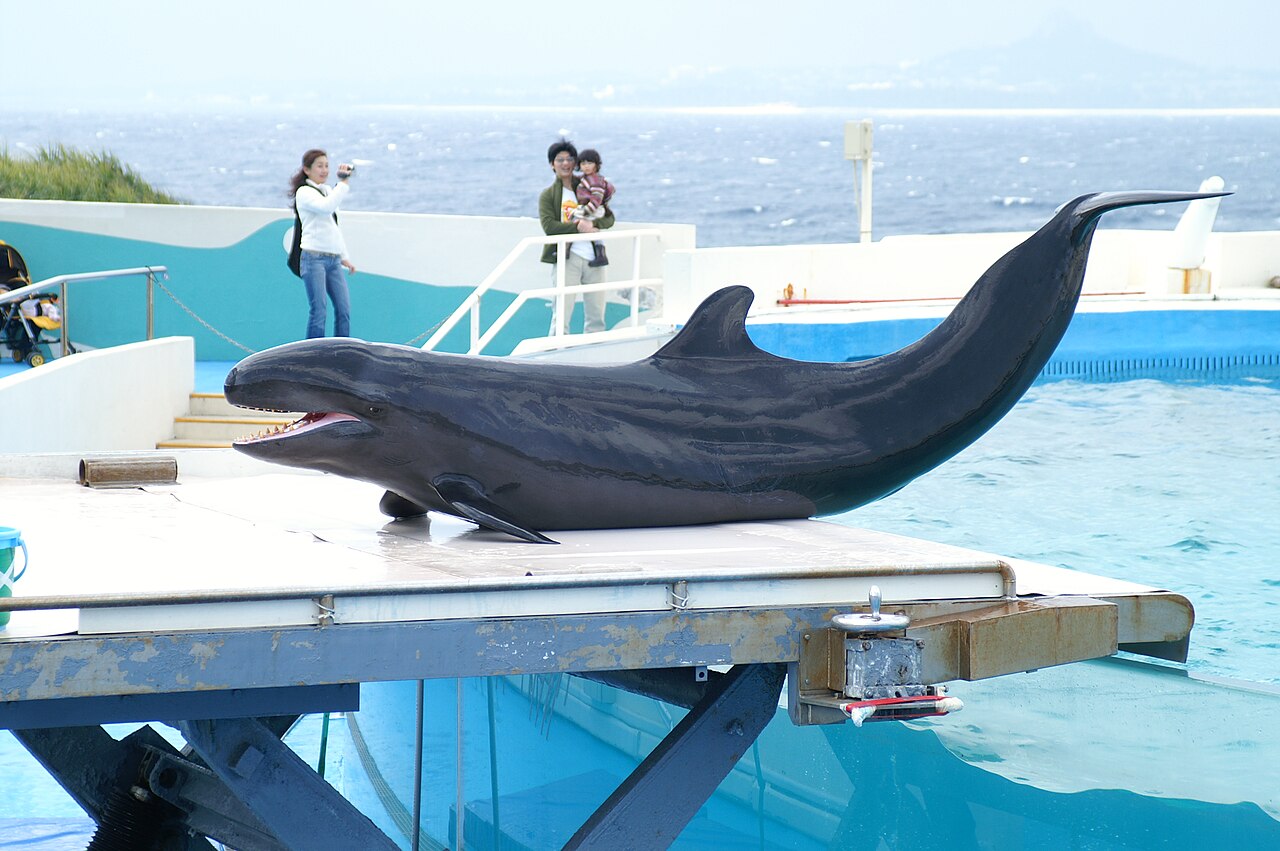
See dolphins up close at the Dolphin Lagoon, which receives visitors every day. Seawater may splash on people around the pool, depending on how the animals move. The lagoon pairs well with the theater: one offers a show, the other a close look at the animals.
Watch the manatees underwater from the viewing room on the basement floor of the Manatee House. The American manatees here, the model for the mermaid legend, were born in Mexico and donated by the Mexican government. Viewing is from the basement floor only, in consideration of a mother and calf, and visitors are asked to watch with care because manatees are sensitive to sound and light.
See sea turtles from two levels at the Sea Turtle House, which keeps five sea turtle species. From above the water you look at a sand pit for egg laying and at turtles swimming at the surface. From the basement viewing room you see them from the side as they swim underwater. Panels present survey results on sea turtle ecology, and a feeding session is held every day.
Emerald Beach, the Ie Island View and the Fukugi Lanes of Bise
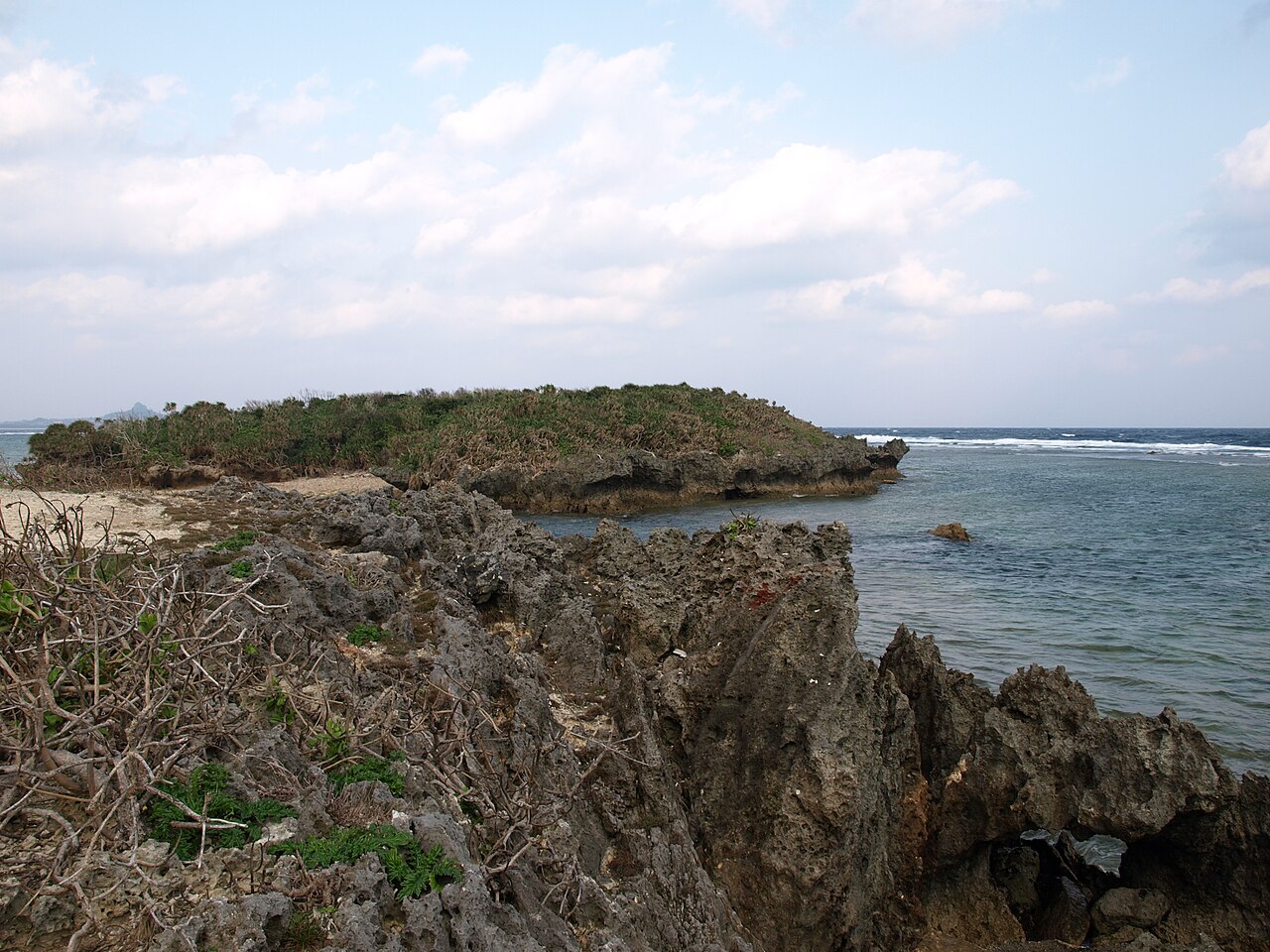
Look out from Emerald Beach, a shore that projects in a Y shape at the northern end of Ocean Expo Park, and white coral sand shows against the emerald green sea. Sea turtle nesting is confirmed at the beach every year. In two thousand six the beach was chosen for a selection of bathing beaches designated by the Ministry of the Environment.
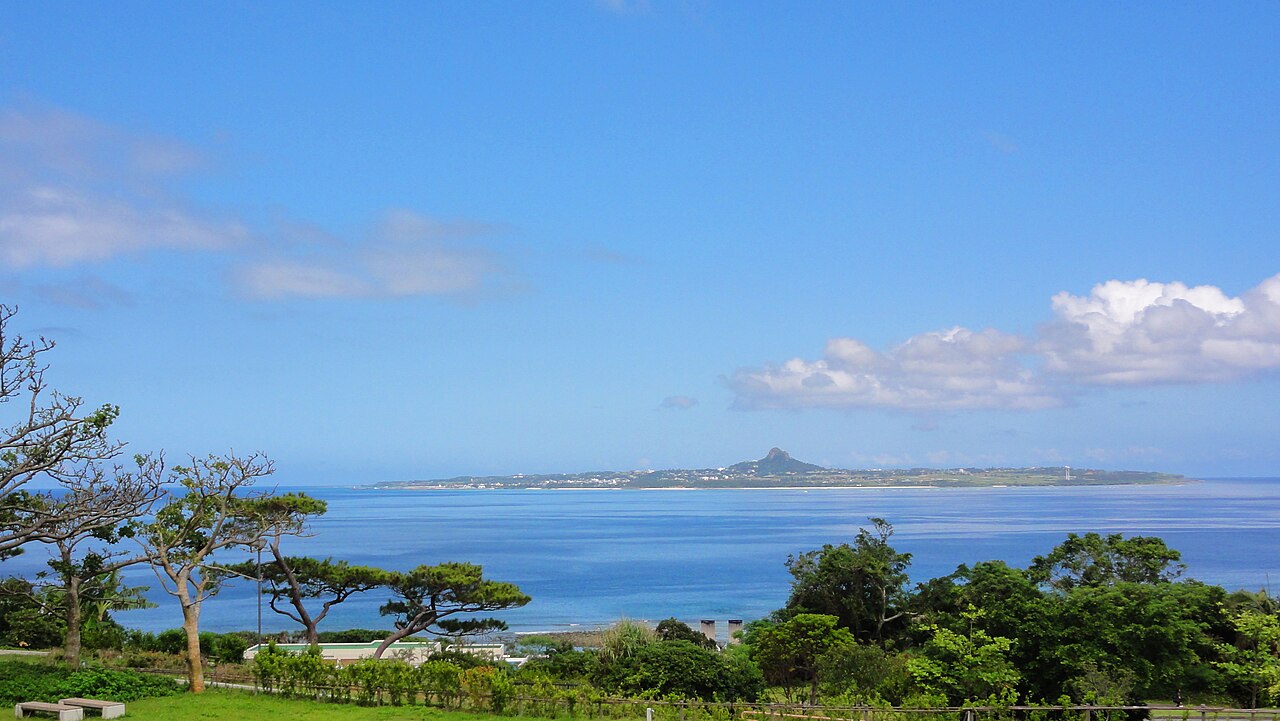
Walk the seaside path and look at the cobalt-blue sea and the islands floating far away on the horizon. Several staircases lead from the path down to the sandy beach. From the aquarium's gate, the view takes in Okinawa's emerald green sea and Ie Island.
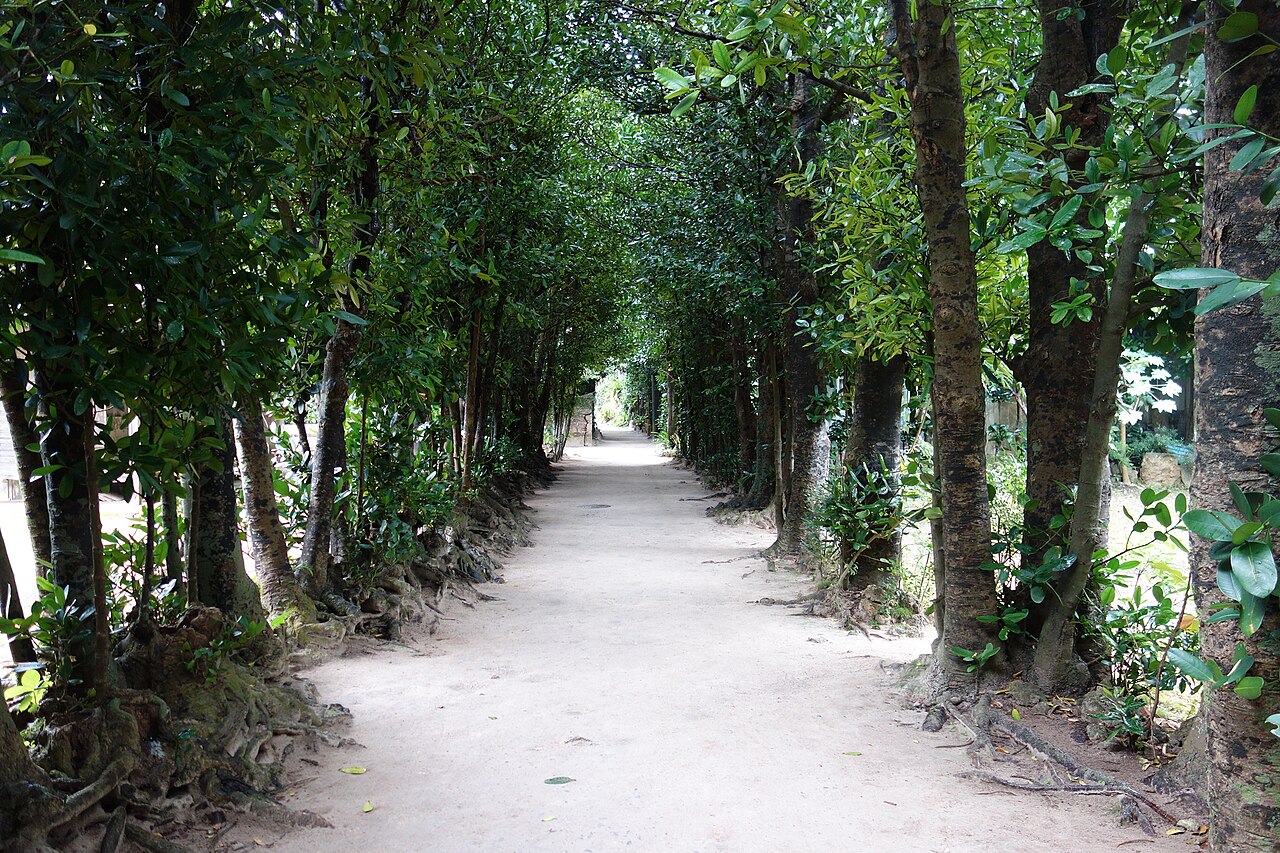
See how Fukugi trees shape a village in the Bise area near Ocean Expo Park. The village is laid out in a grid, and most of its roughly two hundred fifty houses are surrounded by dense Fukugi groves. Fukugi have long served in Okinawa as windbreaks and were planted in large numbers around houses in coastal villages.
Look over the garden from the lookout terrace of the Tropical Dream Center, a botanical garden with orchids on display at all times. Arowana and pirarucu can be observed in its Victoria greenhouse. A museum of Pacific cultures introduces the history and culture of oceanic peoples of the Pacific region, Okinawa included, and its planetarium hall projects one hundred forty million stars.
Getting to Churaumi Aquarium
New to rural buses and one-man trains? See how to ride them, step by step.
| Route | Item | Detail |
|---|---|---|
| Car | Naha Airport to the aquarium | about two hours by expressway |
| Bus | Kinenkoen-mae bus stop to the aquarium entrance | about ten minutes on foot |
| On foot | Aquarium exit to the Okichan Theater | about five minutes |
| On foot | Aquarium exit to Emerald Beach | seven minutes |
If you would rather stay overnight, places to stay in Motobu is a place to start.
Hours and Fees
| Place | Item | Time or fee |
|---|---|---|
| Churaumi Aquarium | Admission | adults two thousand one hundred eighty yen, high school students one thousand four hundred forty yen, elementary and junior high school students seven hundred ten yen, tax included; children under six free |
| Churaumi Aquarium | Hours | eight thirty in the morning to six thirty in the evening, last entry five thirty in the evening |
| Okichan Theater, Dolphin Lagoon, Sea Turtle House and Manatee House | Hours | eight thirty in the morning to five thirty in the evening |
| Tropical Dream Center | October to February: admission and hours | adults, high school age and above, seven hundred sixty yen; eight thirty in the morning to five thirty in the evening, last entry five in the evening |
| A museum of Pacific cultures with a planetarium | October to February: admission and hours | adults, high school age and above, one hundred ninety yen; eight thirty in the morning to five thirty in the evening, last entry five in the evening |
| Ocean Expo Park | Parking | all nine parking lots are free of charge |
Fees and hours were checked against official sources between 19 November 2026 and 20 November 2026.
Thinking of staying overnight?
Compare places to stay near Motobu, Okinawa, Japan →
Disclosure: This post may contain affiliate links. If you book through them, we may earn a commission at no extra cost to you.