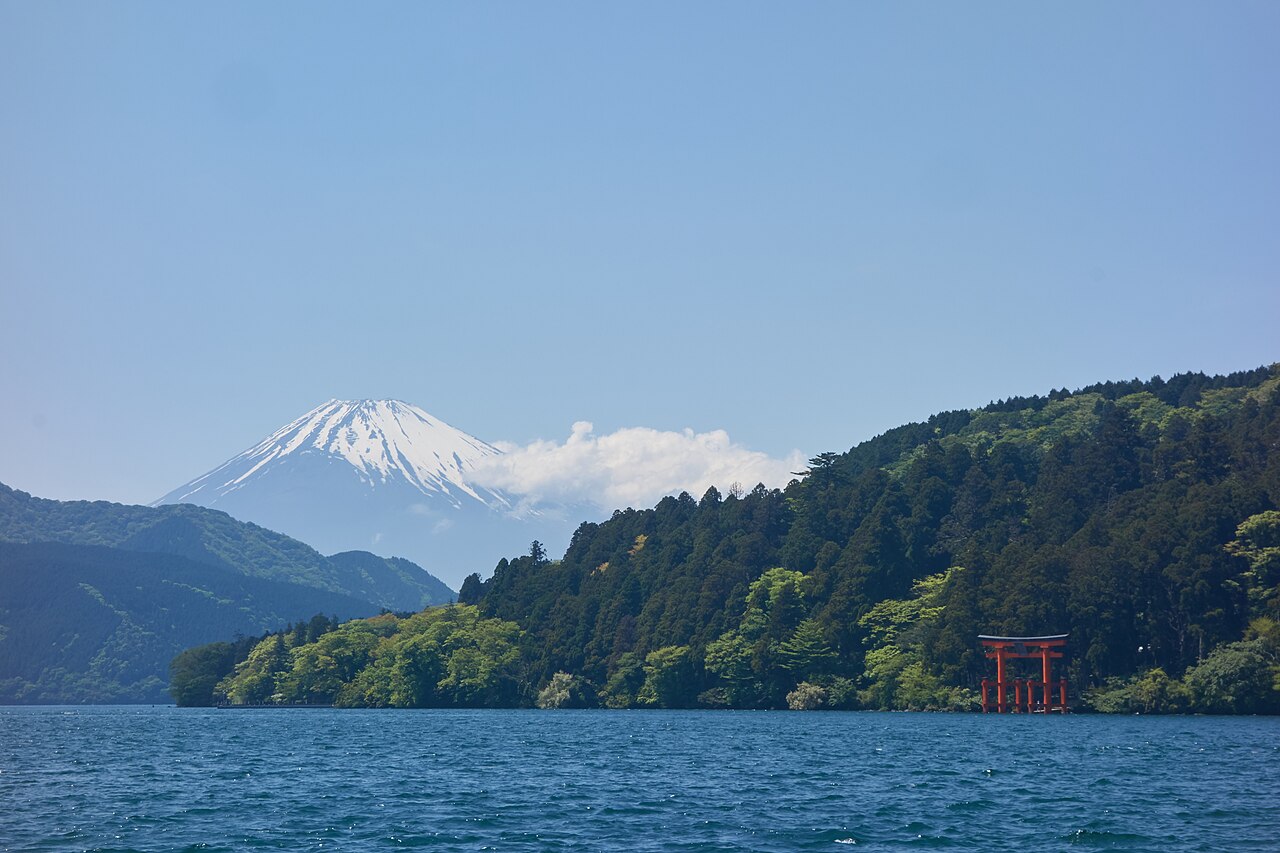
The Hakone Checkpoint site faces Lake Ashi at the front, with Byobuyama at its back. The cedar avenue that remains along the old road is protected as a nationally designated historic site. Onshi Hakone Park looks down on Lake Ashi with Mount Fuji in front, and keeps a garden.
Hakone Shrine, Its Steps and the Dragon Water
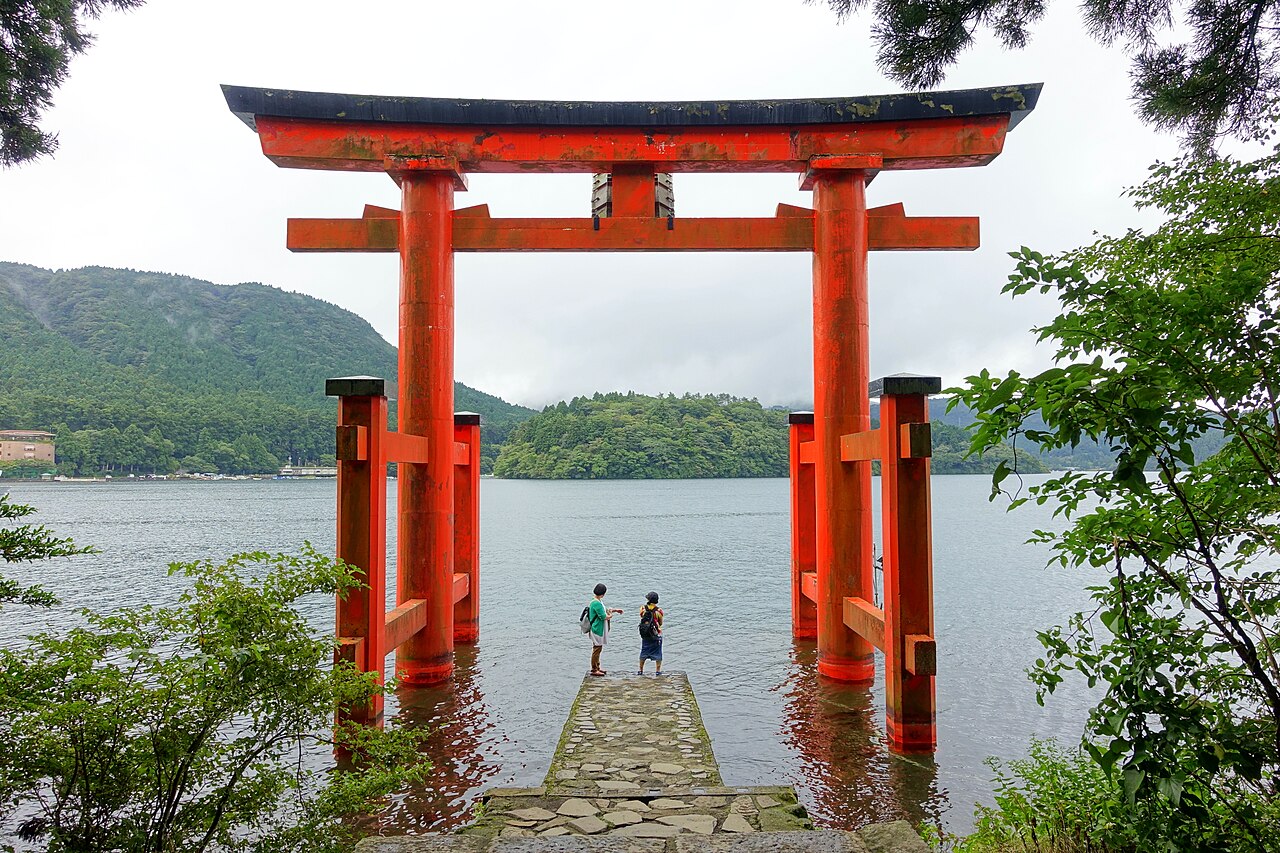
The main approach climbs about ninety stone steps of moderate height, and at the top the Gongen-style main hall appears in the forest, its vermilion standing out among the trees.
Of the three hand-washing pavilions, one stands in front of the main approach's stone steps, beside the fourth torii gate. Lettering on the water basin at the hand-washing pavilion sets out the spirit of the rite: purifying the body washes the heart as well.
The basic rule divides the drawn water into three portions, and the ladle must not touch the mouth directly when rinsing it. Before the shrine, worshippers pay their respects with two bows, two claps and one more bow.
A branch shrine of Kuzuryu Shrine stands within the precincts, and in front of it the sacred water known as the dragon water wells up and can be drawn. The branch shrine was built on New Year's Day in a year of the dragon.
The Cedar Avenue and Onshi Hakone Park
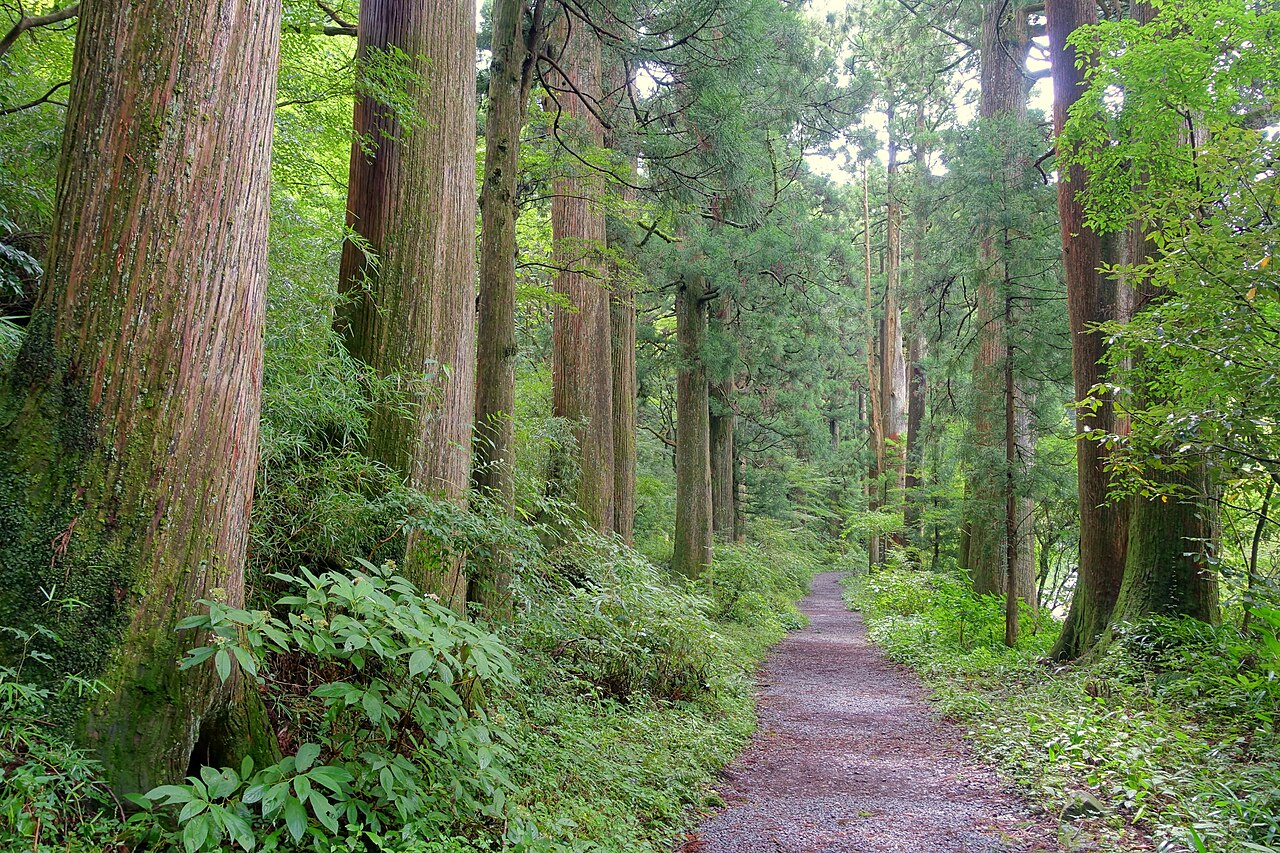
A row of Tokaido cedars stands alongside Hakone Sekisho and protected travellers from wind, rain and sunlight. The cedar avenue on the Hakone old road continues for about five hundred metres from Moto-Hakone to Onshi Hakone Park.
The avenue was reportedly planted by order of the shogunate by Matsudaira Masatsuna, lord of Kawagoe Castle. About four hundred and twelve large trees remain. Some of the cedar trunks measure four metres around.
The song Hakone Hachiri sings of the old avenue as dark even at noon. Cedars from it were once cut and sold to cover a shortfall in the money for a new road to the Lake Ashi shore.
Onshi Hakone Park spreads over the site of a former detached palace, on a peninsula that juts out into Lake Ashi.
The Reconstructed Checkpoint on the Lake
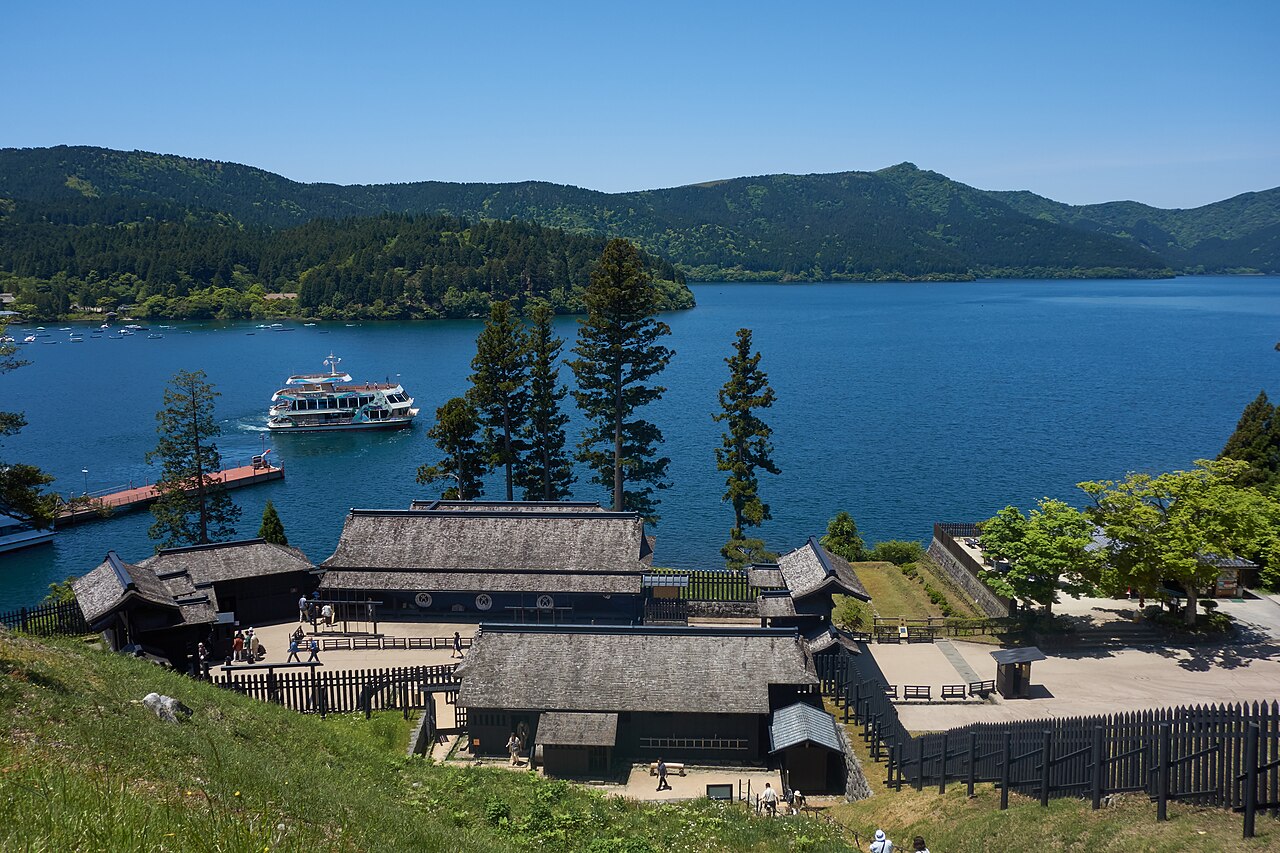
The checkpoint's buildings are painted black with shibu-nuri lacquer. In the main guardhouse, officials carried out strict inspections of travellers passing through, and the jail held checkpoint-breakers.
In the lookout building, two ashigaru foot soldiers took turns day and night, keeping watch over Lake Ashi and the highway from the large windows on all four sides.
The Hakone Checkpoint Museum explains the checkpoint in thirteen themes, and its displays include a miniature daimyo procession, the travelling retinue of a feudal lord.
Passing the Gate in the Edo Period
The checkpoint's two gates opened at dawn and shut at dusk. In the Edo period, travellers were forbidden from crossing Lake Ashi by boat.
A traveller without a permit was asked whether one was held, called to the guardhouse and questioned about name, origin, purpose and destination, and could pass once the thorough examination found nothing suspicious.
A woman travelling toward Edo had the hat and fan that covered her face taken by the officials. A traveller of another kind, an elephant bound for Edo, crossed Hakone Pass and reached Hakone-juku, where exhaustion left it unable to move.
Officials sent word to Edo that the elephant was unwell and nursed it with manju buns and mikan oranges, which it liked. The elephant recovered, passed through the checkpoint gate and set off walking toward Edo.
Lake Ashi and the Stone Buddhas of Moto-Hakone
The name Lake Ashi is thought to come from the reeds growing in large numbers on the shore. The lake fills a caldera inside the Hakone volcano; its water stays at four degrees Celsius or more all year and does not freeze even in midwinter. Rainbow trout, black bass and wakasagi live in it.
Lake Ashi was formerly a sacred lake where the yamabushi ascetics of Hakone Gongen performed misogi. The stone Buddha group of Moto-Hakone stands on the shore of Shojin pond, and the medieval Yusaka road across Hakone passes around the pond. People feared the area as hell, with its desolate scenery and volcanic smoke rising in many places.
About seven hundred years ago, from late Kamakura into early Muromachi times, many stone Buddhas and pagodas enshrining Jizo Bodhisattva were made around the pond, and most of them carry Jizo carvings. One Buddha is carved straight into a rock face of Kamifutagoyama lava, and a stone pagoda is cut from lava.
The stone is hard andesite; weathering wears the surfaces and moss covers them. Carved inscriptions on individual Buddhas and pagodas record the people involved in building them and their origins.
Getting there
New to rural buses and one-man trains? See how to ride them, step by step.
| What | Detail |
|---|---|
| Odawara Station to the checkpoint site by bus | about fifty-five minutes |
| Hakone-Yumoto Station to the checkpoint site by bus | about forty minutes |
| Checkpoint site bus stop to Hakone Sekisho on foot | two minutes |
| Hakone-machi Port (Hakone Pirate Ship) to Hakone Sekisho on foot | five minutes |
| Hakone-Yumoto to Moto-Hakone by bus | sixty minutes |
| Odawara Station to Moto-Hakone by bus | seventy-five minutes |
| Hakone Pirate Ship, Togendai Port to Hakone-machi Port and Moto-Hakone Port | about twenty-five to forty minutes |
| Hakone-Yumoto Station to Hakone Tourist Information Center on foot | one minute |
Buses from Odawara Station and Hakone-Yumoto Station serve both places, and the Hakone Pirate Ship links the three ports.
If you would rather have the day arranged for you, look at guided tours around Hakone.
Hours and Fees
| What | Detail |
|---|---|
| Hakone Sekisho hours, first of March to thirtieth of November | nine in the morning to five in the afternoon |
| Hakone Sekisho hours, first of December to the end of February | nine in the morning to half past four in the afternoon |
| Hakone Sekisho last admission | thirty minutes before closing |
| Hakone Sekisho standard visit time | about forty-five minutes |
| Checkpoint general admission, adults | five hundred yen |
| Checkpoint general admission, elementary school children | two hundred and fifty yen |
| Checkpoint admission with the Hakone Free Pass and similar passes | four hundred yen for adults, one hundred and fifty yen for children |
| Hakone Shrine Treasure Hall admission reception, normal times | nine in the morning to four in the afternoon |
| Treasure Hall individual admission, adults (junior high school and older) | five hundred yen |
| Treasure Hall individual admission, elementary school children | three hundred yen |
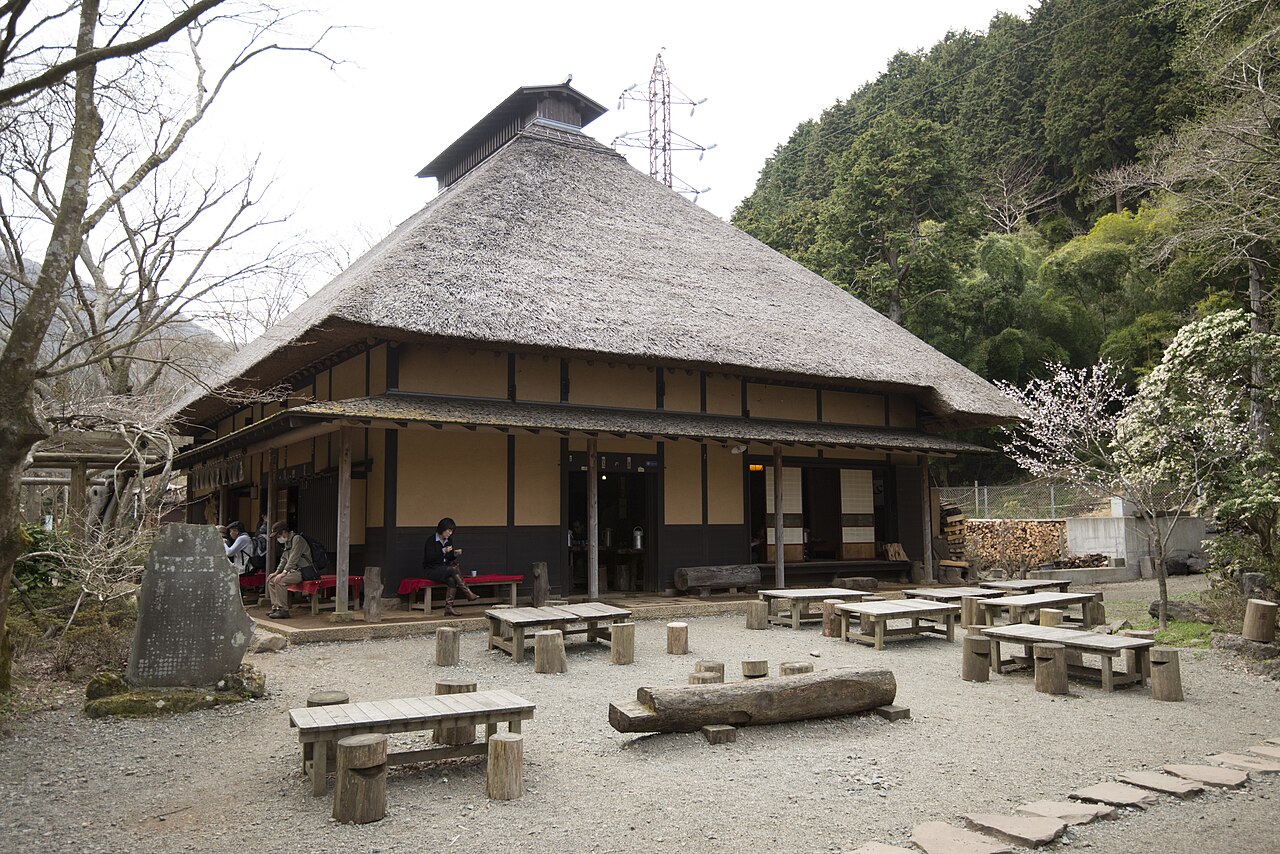
| Amasake-chaya business hours | seven in the morning to half past five in the afternoon, last order at five in the afternoon |
| Tourist Information Center business hours | nine in the morning to a quarter to six in the afternoon |
| Old Tokaido, Hatajuku Yamane district, closed to pedestrians for repair work | seventeenth of August to fifteenth of January (planned) |
| Ichirizuka milestone and stone pavement during the closure | cannot be visited or walked, detour via Prefectural Route seven hundred and thirty-two |
Fees and hours were checked against official sources between 15 October 2026 and 11 November 2026.
The checkpoint closes earlier in winter, and the old road near Hatajuku has a planned closure for repair work.
Compare options
See partner pricing and availability →
Disclosure: This post may contain affiliate links. If you book through them, we may earn a commission at no extra cost to you.