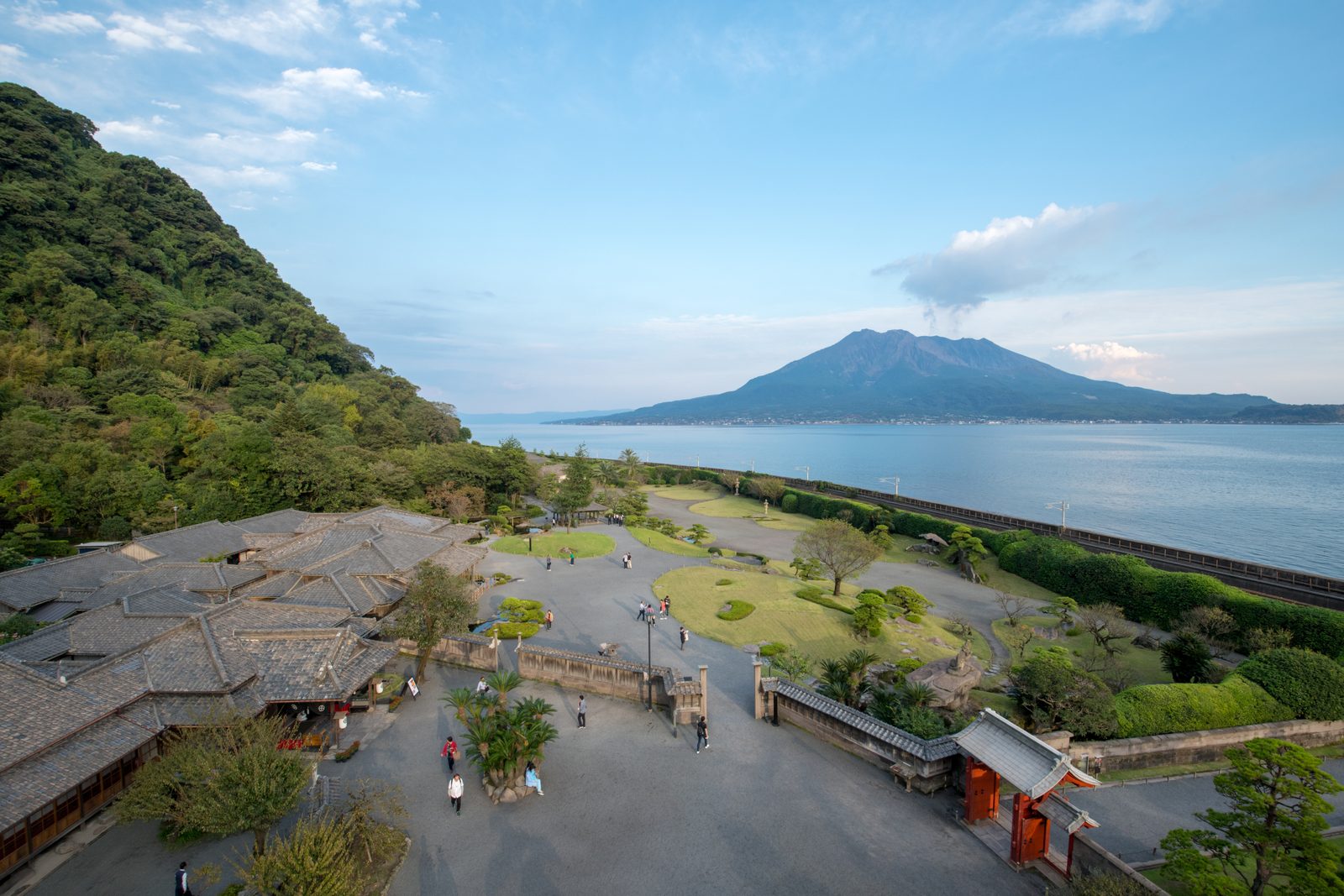
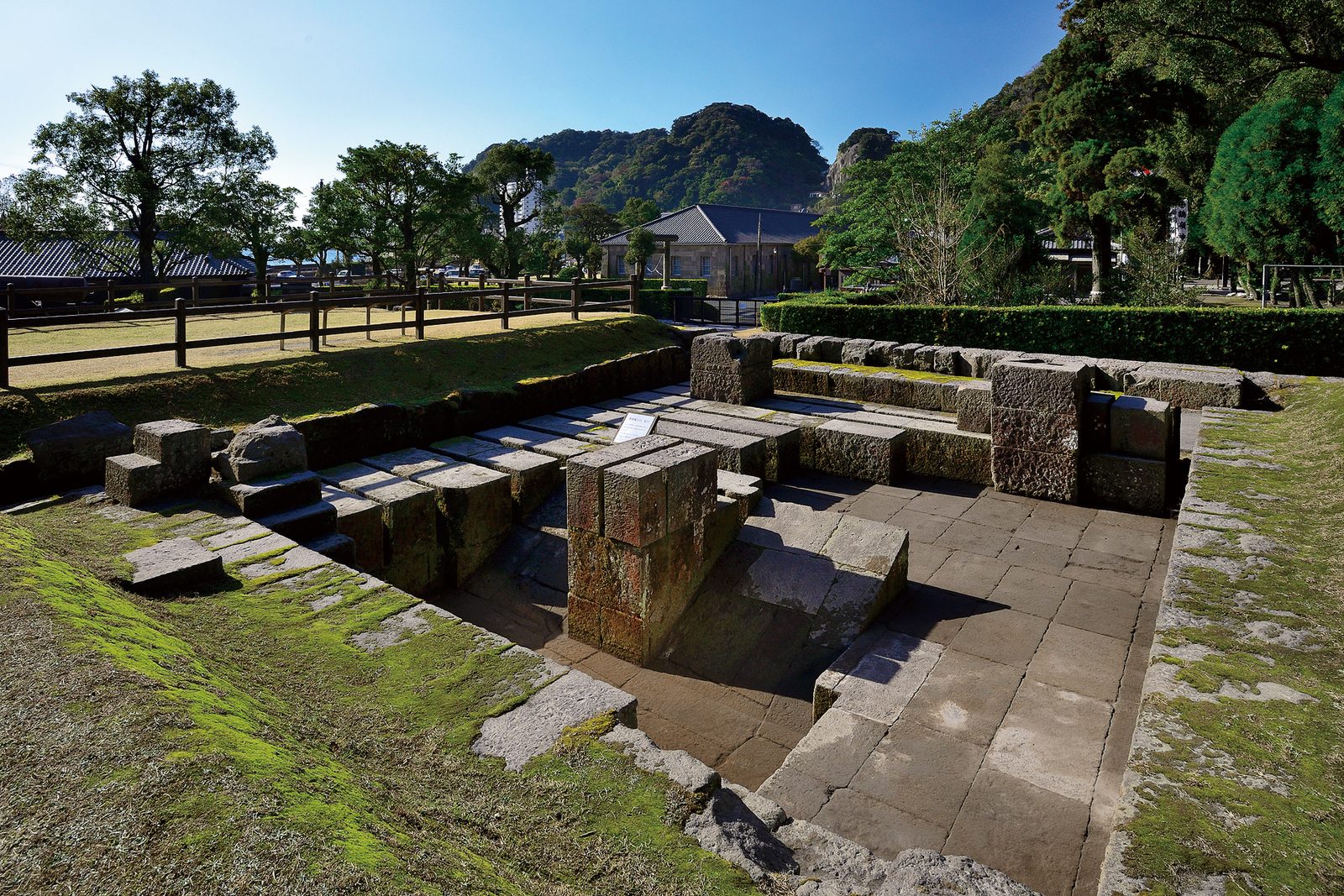
On clear days at Sengan-en, Sakurajima floating in Kagoshima Bay greets visitors in front of the Goten. Jambo-mochi, served at the garden's Jambo-mochi shop, has been loved by Satsuma samurai since the Edo period. At the reverberatory furnace site, a chimney-shaped furnace once stood on top of the stonework.
Jambo-mochi, Ohkatei and Saryo at Sengan-en
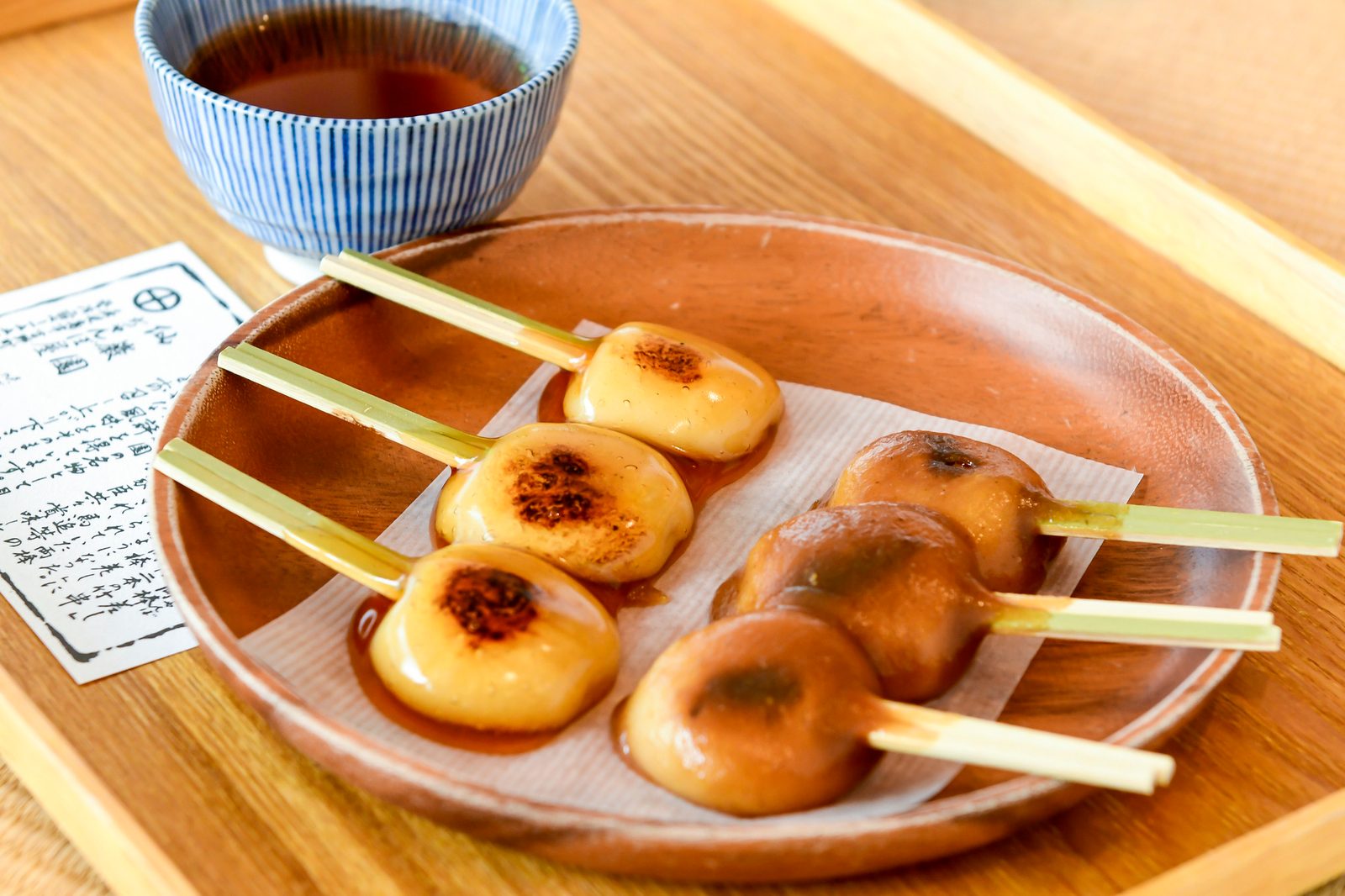
Jambo-mochi at Sengan-en is a bite-size rice cake with two skewers stuck in it. The skewers are bamboo, and the shape comes from the sight of a samurai wearing two swords, large and small, at the waist. Satsuma samurai have loved Jambo-mochi since the Edo period, and the Jambo-mochi shop serves it.
The sweet-potato stand offers sweets that use the natural sweetness of sweet potato, starting with roasted sweet potato. The stand uses Beni-haruka and Silk Sweet sweet potatoes harvested by the garden's own company. Its soft serve is made with plenty of brown sugar from Amami Oshima, a place associated with Saigo Takamori.
The sweet-potato stand also makes a mini parfait, and the parfait is loaded with sweet potato. A rich Beni-haruka shake is suggested as a companion for a walk around the garden on a hot day. At the drink stand, the original coffee is roasted on a Sakurajima lava plate.
Ohkatei serves Japanese set meals that change with the four seasons, including a set of Kagoshima local dishes made with local ingredients. Its black pork shabu-shabu set meal has thick-cut, sweet black pork dipped in broth and eaten with a special sesame ponzu sauce. Another black pork set meal at Ohkatei has a soft texture and overflowing meat juices.
In the matcha-whisking experience, visitors learn each step of the tea ceremony manners and whisk matcha themselves. The Saryo tea house menu lets visitors choose the sweet that comes with the matcha set. A traditional Satsuma sweet at the tea house is made mainly from yam and is soft and springy, with a gentle sweetness and richness.
Walking the Sengan-en Garden and the Goten
At the Goten, visitors can view the Audience Room used to receive guests from Japan and abroad, and rooms kept for the lord. The main gate of the garden, built by Tadayoshi, stands over seven metres high. The Suzu-mon was formerly the gate used by the head of the Shimadzu family and his heir.
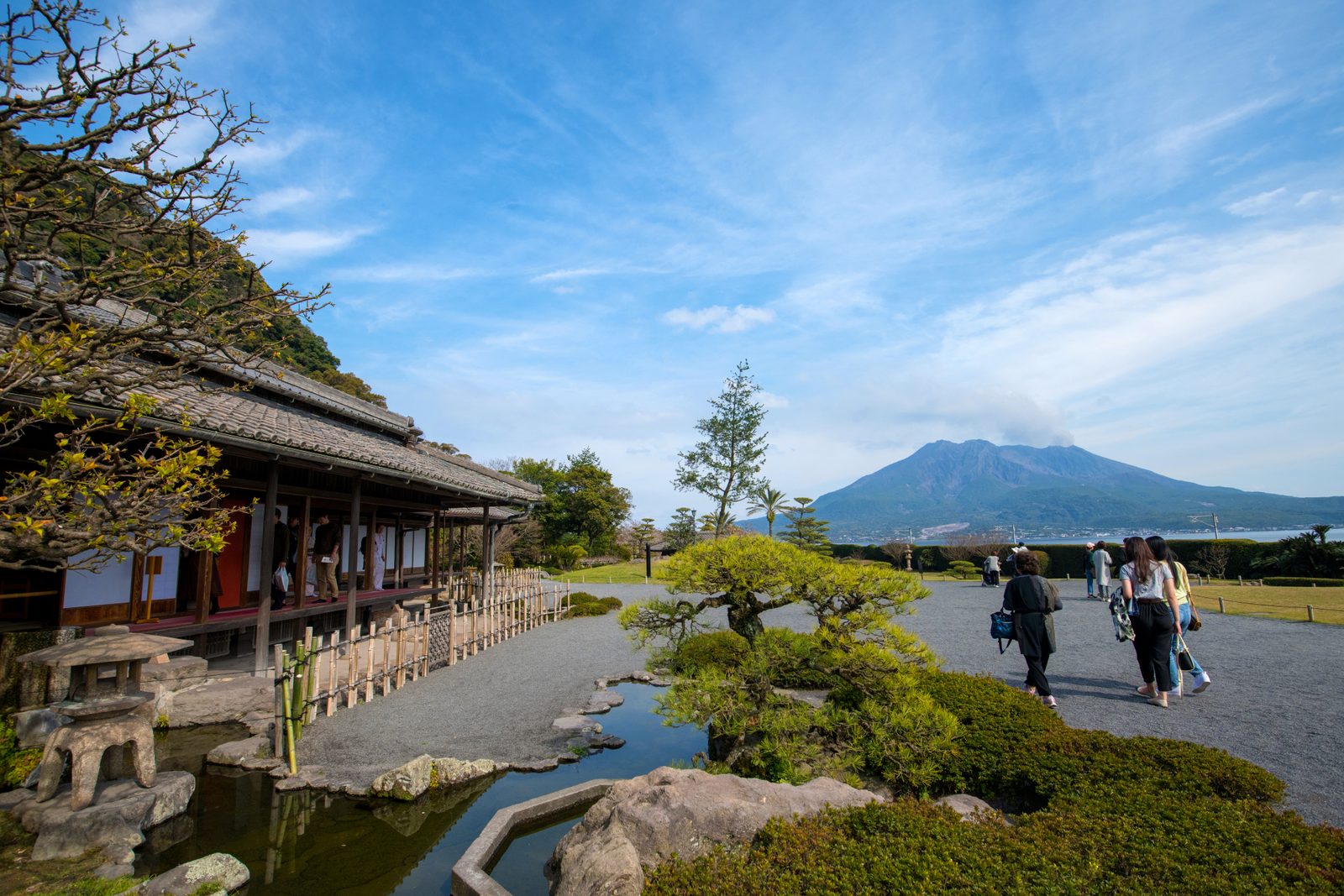
The main gate is made with camphor wood from the hill behind, and a crest is carved on its upper part. The Suzu-mon is the Edo-period main gate of Sengan-en, named for its tin roof tiles. In the courtyard of the Goten, the pond has an octagonal hollow that shows the influence of Chinese culture (feng shui).
Inside the Goten, the Audience Room was the room that the residence used to receive guests. In the Living Room of the Goten, Tadayoshi handled documents for approval and ate lunch. Under the floor of the Bedroom is a layer of rice husks that worked as insulation.
At the bath of the Goten, the water was heated in a separate place and carried in. The nail-cover ornaments in the Goten come in eleven kinds, including one in Satsuma ware and one shaped like a bat, a messenger of happiness.
Shoko Shuseikan and the Reverberatory Furnace Site
At the adjacent World Cultural Heritage Orientation Center, visitors can learn about the modernization projects of Satsuma at the end of the Edo period. A chimney-shaped furnace about sixteen metres tall once stood on the stonework of the reverberatory furnace site. In southern Kyushu the easily worked volcanic rock formed by ancient volcanic activity was abundant, so stone-building techniques developed traditionally.
The machine factory at Shoko Shuseikan Museum is a stone building put up in a Western style. The outer walls of the machine factory are made of stone rather than brick. The base of the outer wall has a stone footing of a kind often seen in shrine architecture. The roof framing has thin braces and unnecessarily thick beams, keeping a strong Japanese-style influence.
The building of the Shoko Shuseikan Museum was made as a machine factory, and the museum occupies that same stone building. Ship parts were once made at this machine factory, and machine tools were made there as well.
Chrysanthemum Season at Sengan-en
Colourful chrysanthemums bloom throughout Sengan-en in autumn, set alongside the historic garden during the Kikumatsuri. During the festival period, events with Japanese drums and gagaku are held besides the chrysanthemum displays. The Senganen lion dance is performed during the festival period, alongside the drums and the gagaku.
Visitors walk around Sengan-en with the staff who manage the garden, who introduce the characteristics of the chrysanthemums and the highlights of the displays. Staff who tend the garden and chrysanthemums year-round talk about the behind-the-scenes work and particular care that go into the Kikumatsuri. Matcha with chrysanthemum sweets is offered at Sengan-en for a limited period in the chrysanthemum season.
The Kikka-gozen, a limited-period menu, is a seasonal set meal that uses seafood and mountain produce from Kagoshima Prefecture. The kanpachi (amberjack), landed in Kinko Bay, has moderately fatty, firm flesh and rich umami. The mikan has a thin peel and juicy, sweet flesh, and is offered as an after-meal dessert.
Getting to Sengan-en and Shoko Shuseikan
New to rural buses and one-man trains? See how to ride them, step by step.
| Route | Item | Detail |
|---|---|---|
| Sengan-en and Shuseikan | Ticket | One common ticket |
| Kagoshima City View bus | Fare per ride | Two hundred thirty yen |
| Kagoshima City View bus | One-day pass, adult | Seven hundred yen |
| Nippo Main Line | Window view | Sakurajima |
To stay overnight in Kagoshima, browse places to stay in Kagoshima.
Hours and Fees
| Place | Item | Time or fee |
|---|---|---|
| Sengan-en and Shuseikan | Hours | Nine hundred to seventeen hundred |
| Sengan-en and Shuseikan | Closed | First Sunday of March |
| Common ticket, adult | Counter | Sixteen hundred yen |
| Common ticket, adult | Web | Fifteen hundred yen |
| Common ticket, student | Counter | Eight hundred yen |
| Common ticket, student | Web | Seven hundred fifty yen |
| Jambo-mochi shop | Hours | Nine hundred to seventeen hundred |
| Jambo-mochi shop | Order stop | Sixteen fifty |
| Jambo-mochi shop | One serving | Five hundred yen |
| Jambo-mochi shop | Take-away pack | Seven hundred yen |
| Ohkatei | Hours | Eleven hundred to sixteen hundred |
| Ohkatei | Order stop | Fifteen thirty |
| Ohkatei | Local dishes set | Thirty-two hundred yen |
| Ohkatei | Limited-period set meal | Three thousand yen |
| Saryo tea house | Hours | Nine hundred to seventeen hundred |
| Saryo tea house | Order stop | Sixteen thirty |
| Saryo tea house | Matcha and sweet set | One thousand yen |
| Car parking | Normal rate | Five hundred yen |
Fees and hours were checked against official sources on 14 November 2026.
Thinking of staying overnight?
Compare places to stay near Kagoshima, Japan →
Disclosure: This post may contain affiliate links. If you book through them, we may earn a commission at no extra cost to you.