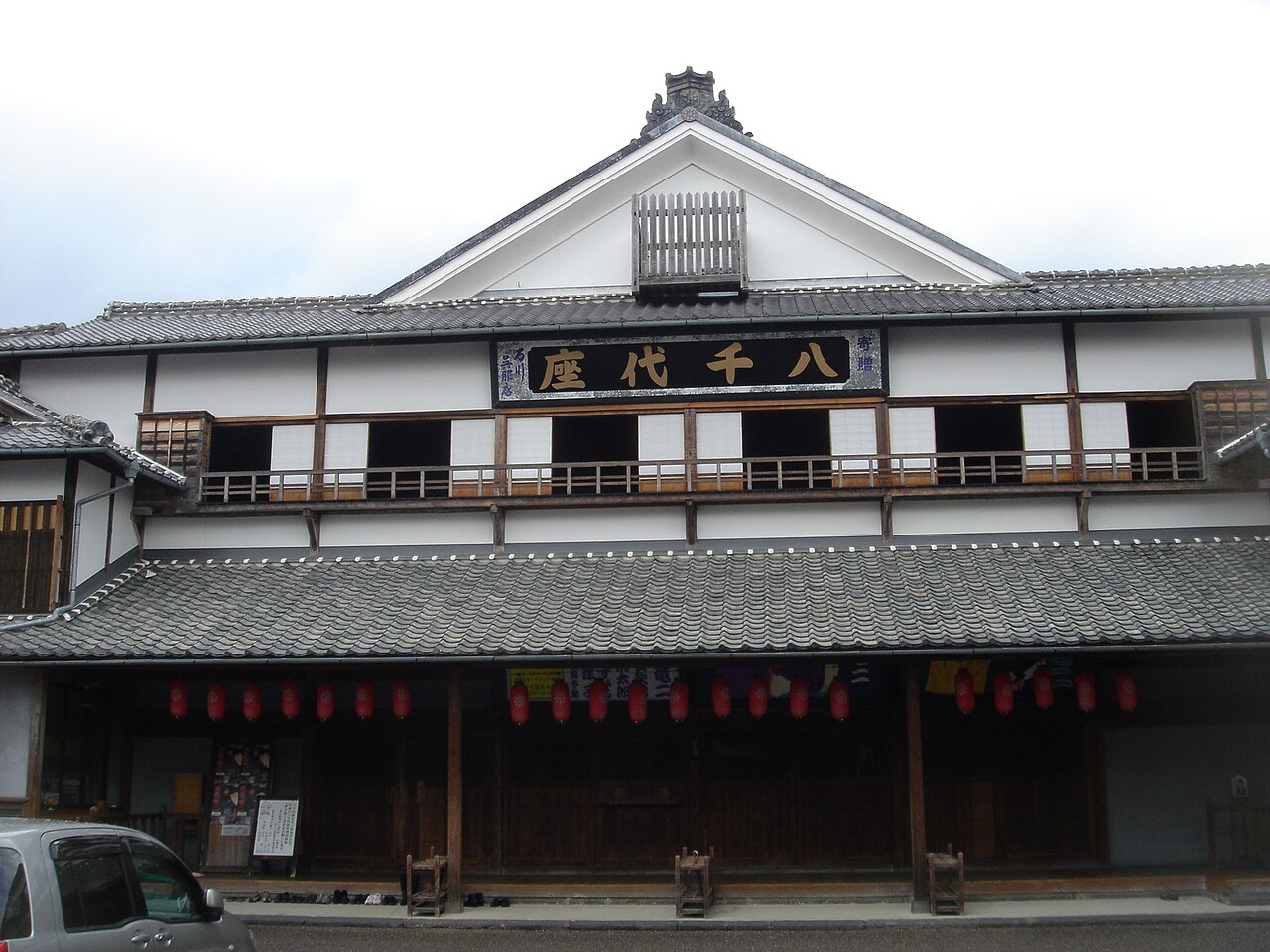
In the far north of Kumamoto Prefecture, where the Kikuchi River comes down out of the hills, there is a small town that has been receiving bathers for about as long as anyone has kept records in this part of Kyushu. Yamaga is the kind of place the island does well and advertises badly: a bathhouse at the centre of everything, a gilded playhouse a street away, and a craft of paper lanterns that once a year turns into a festival and for the rest of the year sleeps quietly in a museum.
The prewar guidebooks placed the town near the middle of its old county, ringed by low mountains, with the river running along its southwestern edge. That geography still explains the mood. Yamaga is not on the way to anywhere; you come up the valley for the town itself, and the reward is a day that moves at the speed of bathwater.
The bathhouse and the deer
The town's claim to its water is old enough to have a legend attached. The district records are said to tell of a hunting party, led by the warrior Uno Chikaharu, that saw a single deer bathing in a pool of this valley — and that is how the spring was found. A place-name dictionary compiled in the Heian period is said to list the district as a hot-spring village already, so the deer, if it existed, was late to the discovery.
The old guide counted two spring mouths in the town, called Sakura-no-yu and Matsu-no-yu, and described the water of both as alkaline and lightly carbonated. At the source, it recorded the water at forty-two degrees. It also noted a custom the town kept from its early days: a date in the first month set aside as the bath festival, when the baths were drained and scrubbed clean for the year ahead.
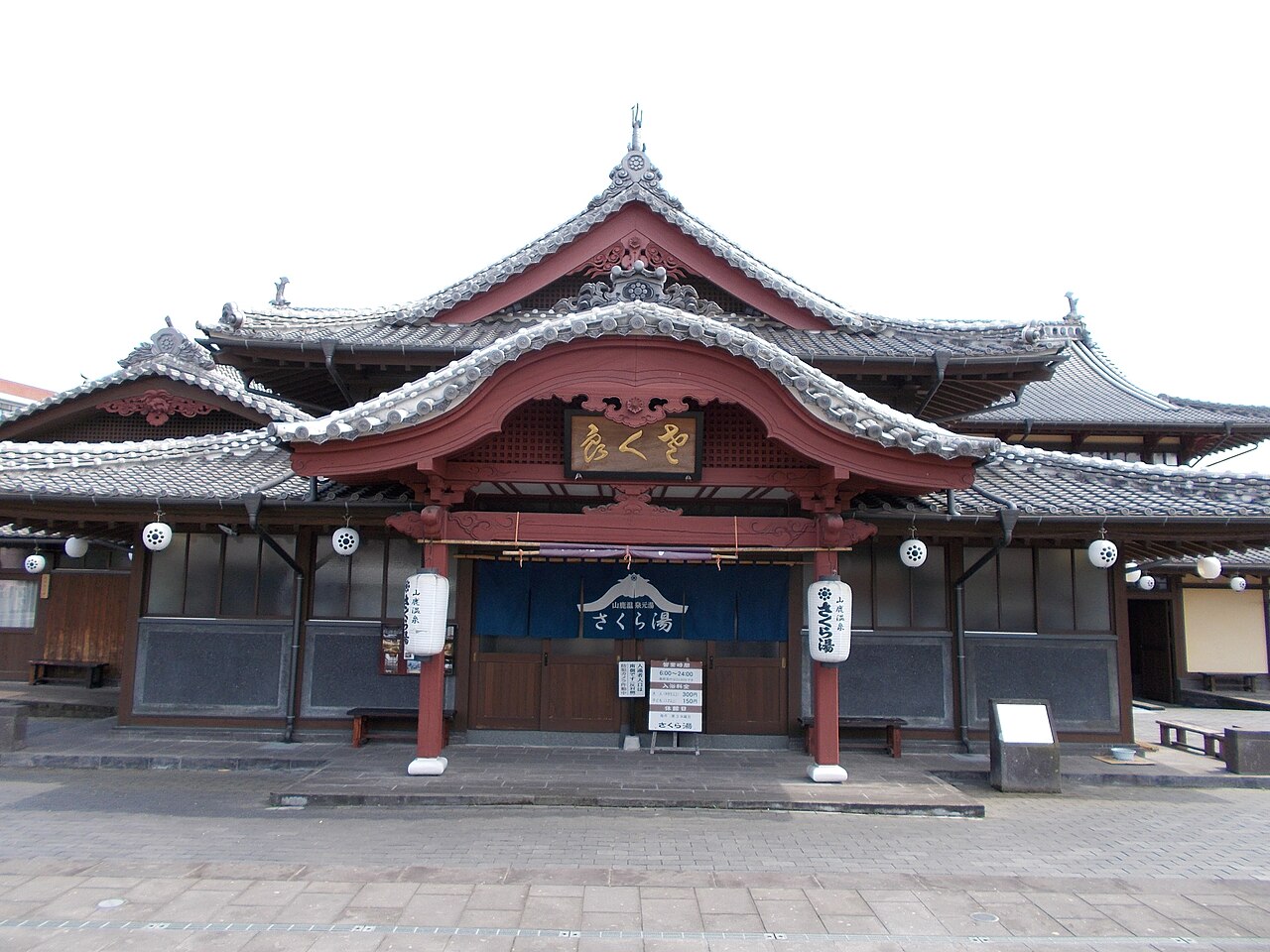
The first of those two names is still on the map. Sakura-yu, the public bathhouse in the middle of town, stands behind a dark indigo curtain under a sweeping red-lacquered gable, and it remains the natural first stop of a Yamaga morning: bathe first, then let the rest of the day arrange itself around you.
The lantern town, and the Yachiyoza
A short walk east of the springs stands Omiya Shrine, which the old guide says enshrines Emperor Keiko together with the twelve deities of Aso. The lanterns that made Yamaga famous belong to this shrine: in the middle of August each year, by the same account, lanterns were carried there and offered at a night ceremony, and the town's lantern craft is said to descend from that rite.
The place to see the craft up close today is the Yamaga Toro Mingeikan, the town's lantern museum. Admission to the museum alone is three hundred yen for an adult. Elementary and junior-high-school visitors pay one hundred and fifty yen instead. A combined ticket that adds the Yachiyoza kabuki theatre and its archive hall costs seven hundred and thirty yen for an adult, and the combination is the right way round: paper first, then the stage the paper lights.
The Yachiyoza itself earns the walk even from the outside — a two-storey wooden front hung with red paper lanterns under a gilded signboard, on a street that has kept its scale. Inside the paired archive hall, the theatre's history does the talking.
Getting there
The way in is a two-step: a fast leg across the plain, then a local leg up the river. From JR Hakata Station, the Kyushu Shinkansen reaches JR Shin-Tamana Station in about forty minutes. From Shin-Tamana, a Kyushu Sanko bus continues to the Yamaga Bus Center in about fifty minutes.
Coming from Fukuoka Airport instead, the Hinokuni-go highway bus runs to the Ueki interchange in about eighty minutes. A connecting bus covers the stretch from Ueki to the Yamaga Bus Center in about thirty minutes. Either way, you step off in the middle of town rather than at its edge.
New to rural buses and one-man trains? See how to ride them, step by step.
Where to stay
Disclosure: This post may contain affiliate links. If you book through them, we may earn a commission at no extra cost to you.
Make it a slow day
The prewar guide praised this valley for its climate — mild in winter, cool in summer, spared the sudden swings of the coast — and that is still a fair description of how a day here feels. Take the water first, while the town is at its morning pace. Give the middle of the day to the lantern museum and the playhouse. Keep the end of the afternoon for the riverbank, and leave without hurrying.
Details change; check the latest information on the town's tourism pages before you travel. If Kyushu's slower corners suit you, the steaming lanes of Beppu's Kannawa district and the great camphor tree and bathhouse town of Takeo sit well in the same week as Yamaga. And if you would rather not hurry back down the valley the same evening, compare places to stay in Yamaga first.