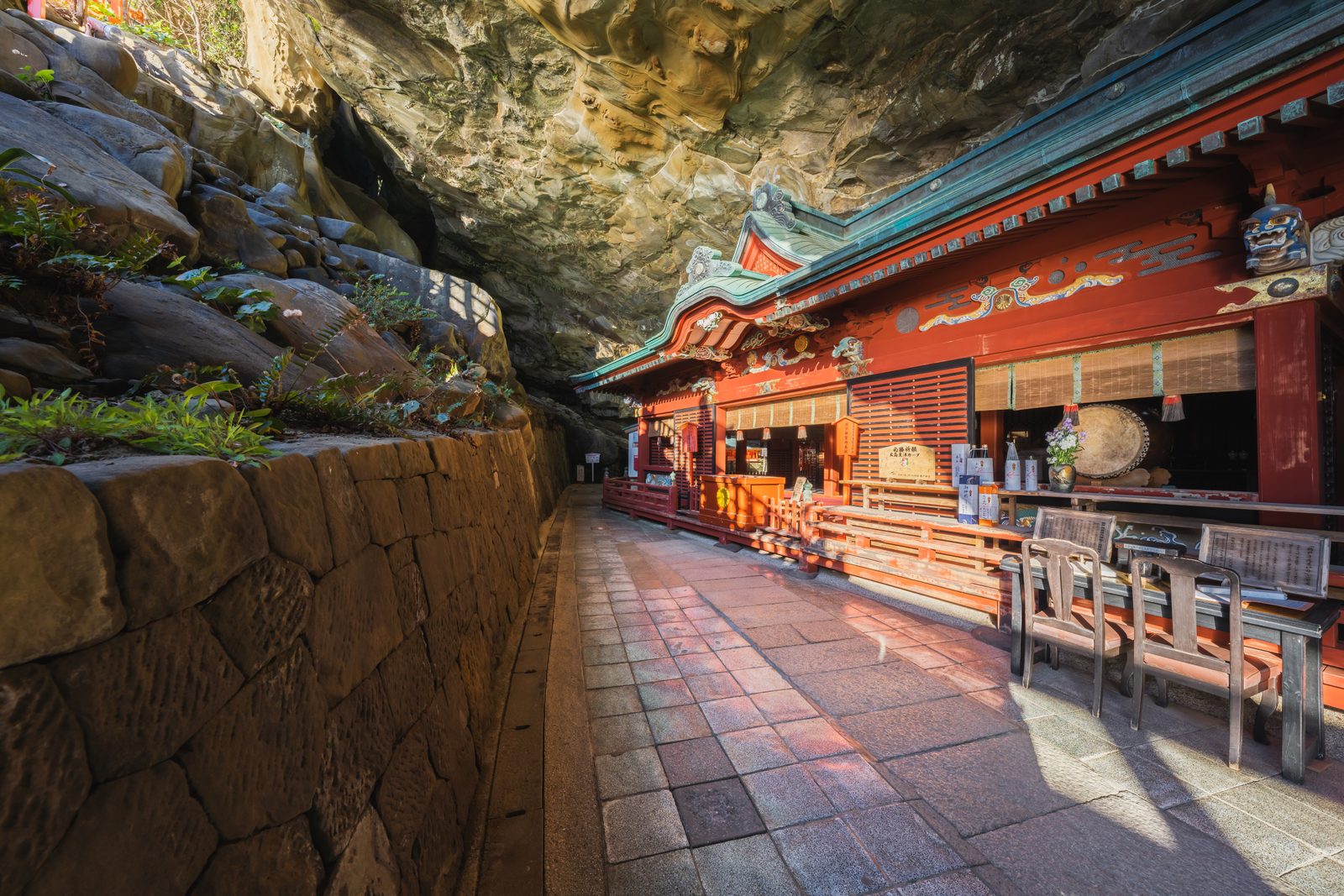
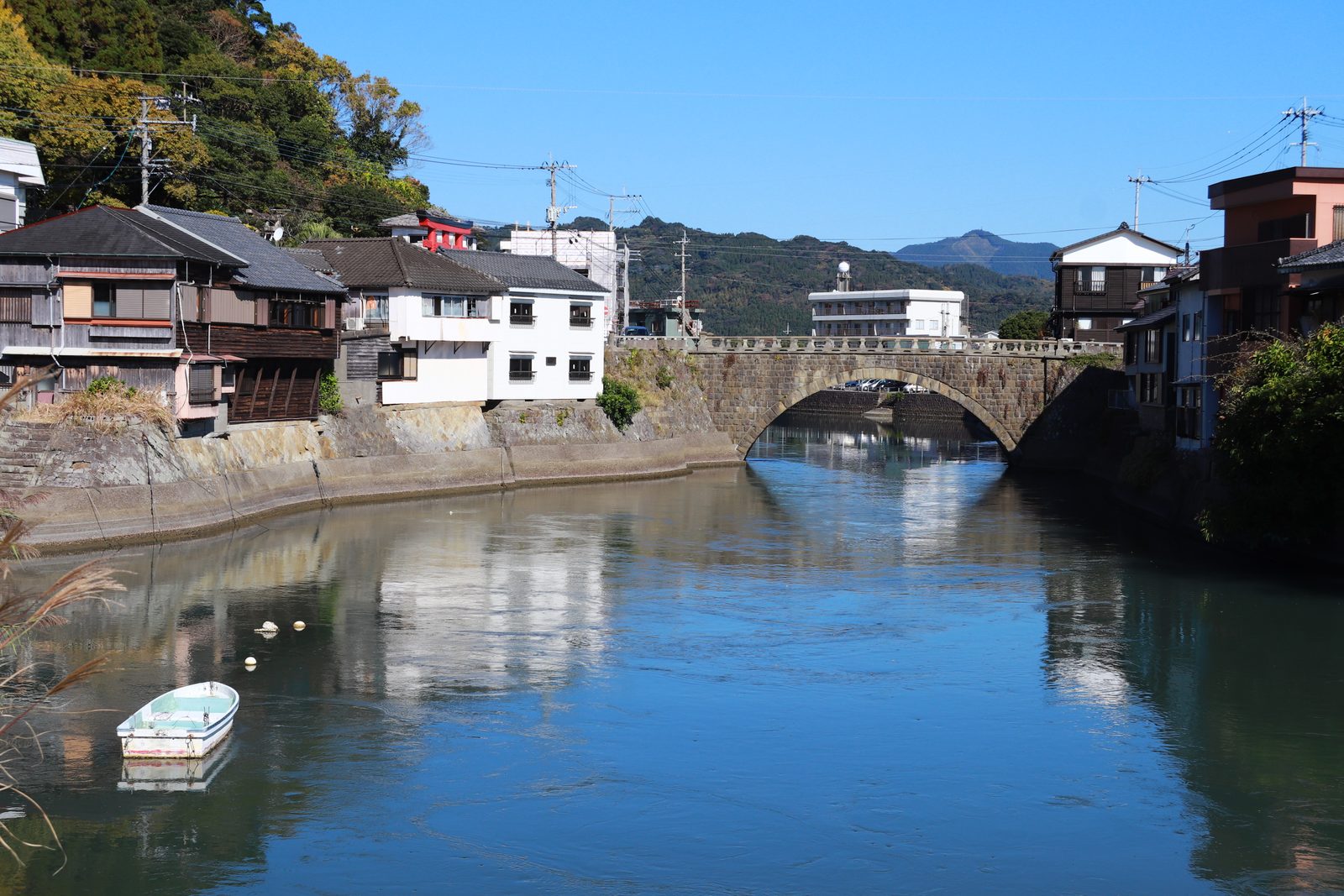
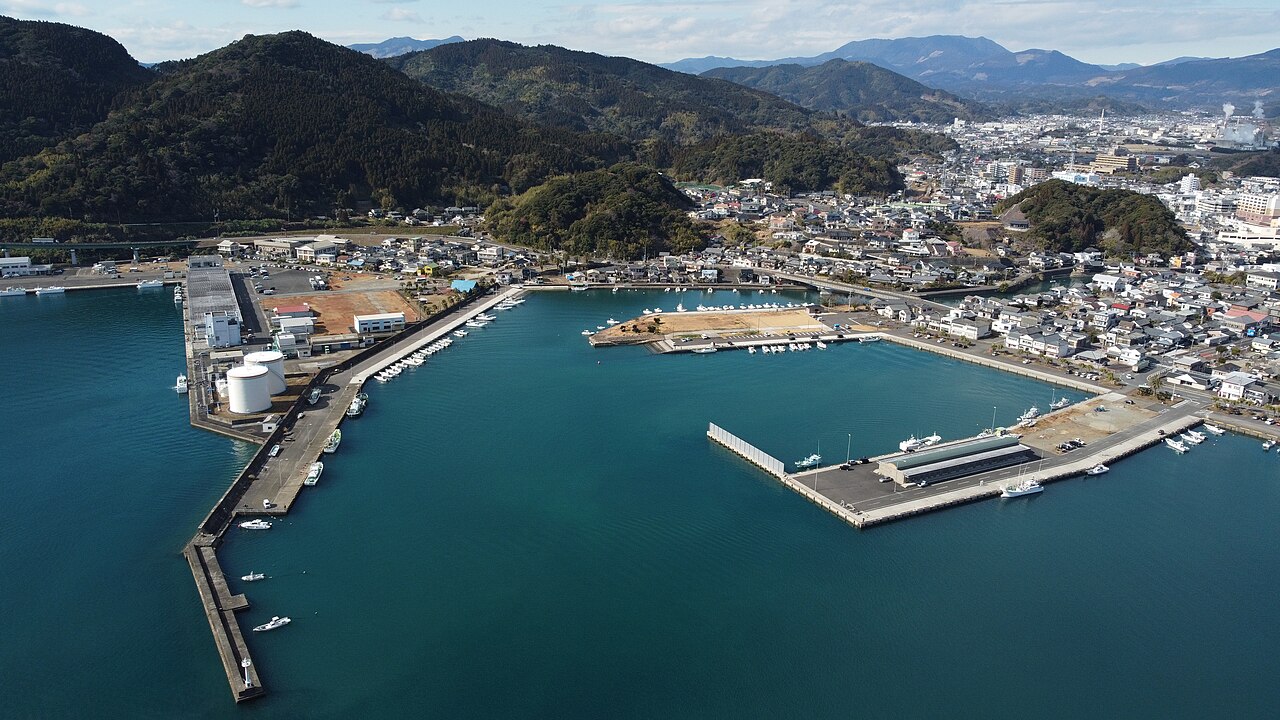
Udo Shrine keeps its vermilion-lacquered main hall inside a cave on a cape that juts into the sea, and the path to it comes with the sound of waves, the wind off the water and the smell of the sea. In Aburatsu, the harbour town of the same city, a stone arch bridge over the Horikawa canal still carries the people who live around it. Nichinan itself serves seared bonito bowls from spring to autumn and has a fish udon born in the post-war food shortage.
The Sea Cave Hall of Udo Shrine
Step into the sea cave at Udo Shrine and the vermilion main hall stands inside it, set into the cape that faces the Hyuga sea. The cave is said to be the site of the chief deity's birthing hall. Worship there follows the order of two bows, two claps and one bow.
Inside the cave are two spots the shrine treats as sources of power, the breast rock and the breast water. In the sea in front of the cave, rock formations stand in a variety of shapes, and the area around the shrine is a national place of scenic beauty under the name Udo. If time is short, give it to the hall and the rocks in front of it first.
The Hachocho Steps and the Coast Approach
Walk the roughly eight-hundred-metre Hachocho stone steps from Fukei-i port toward Udo Shrine. Allow time, because four hundred thirty-eight steps go up to a cemetery and three hundred seventy-seven go down from there. The steps are shore stones carried up from the nearby coast, every one hollowed in the middle. They are said to date from the Enryaku era, built by a nun who carried the stones on her head.
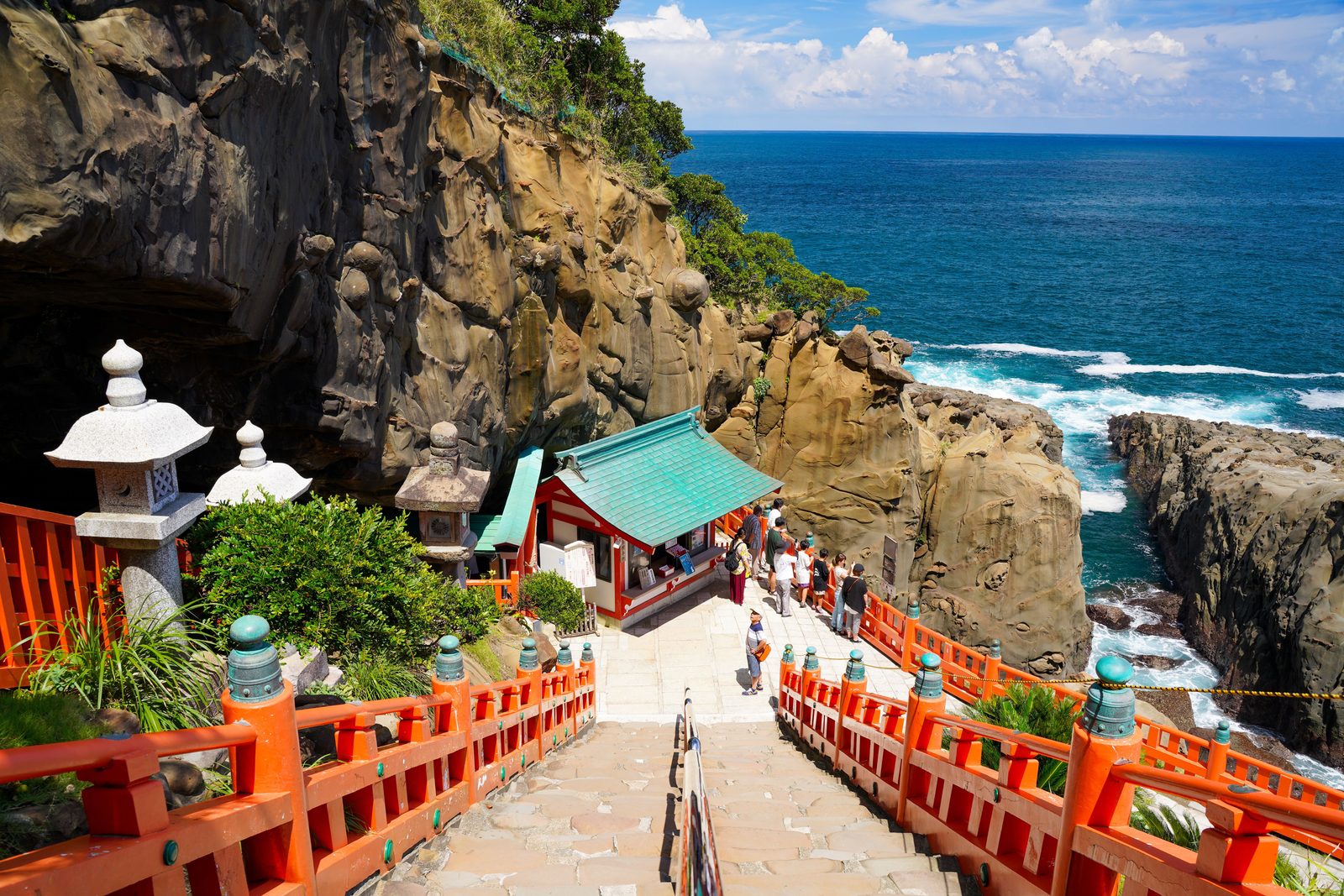
Two vermilion-lacquered bridges mark the approach, and at the Chidori bridge people stop for commemorative photos, while once the Tama bridge is crossed the main hall comes into view. From the path the Hyuga sea spreads wide with a row of oddly shaped rocks along it, the waves hit hard enough to be heard, and the wind brings the sea's scent.
Lucky Balls, the Turtle Rock and the Breast Rock
At Udo Shrine you throw a lucky ball at the turtle rock on the shore below the main hall, men with the left hand and women with the right. Each ball starts as a lump of clay rolled round, is pressed with the character for luck and is lightly fired. Today they are made mainly by the pupils of Udo elementary and junior high school and their parents, and the shrine supports the children's schooling and school trips.
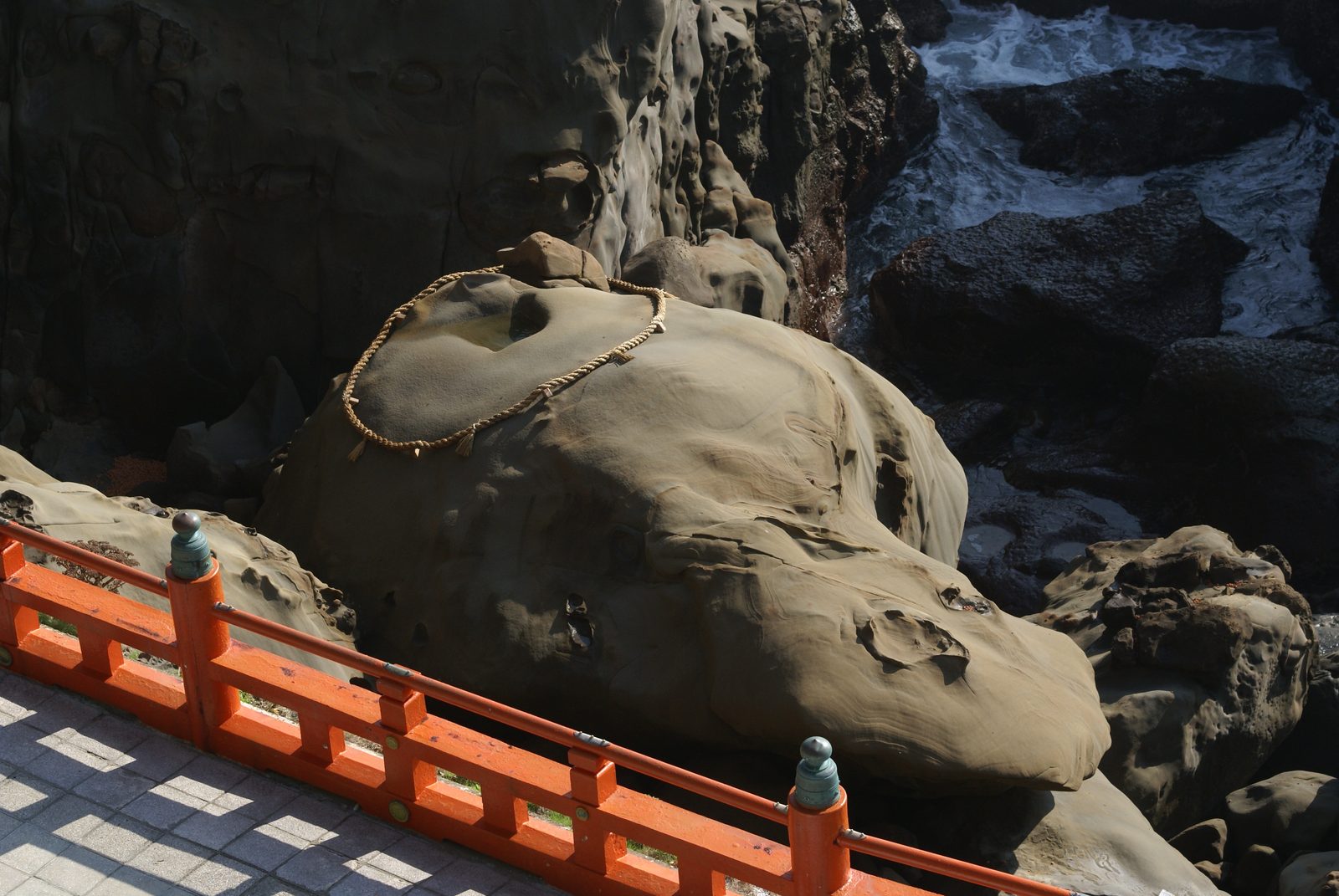
The Nihon Shoki tells of Toyotama-hime coming from the sea palace on a great turtle to give birth, and the shrine holds that this turtle became the turtle rock. Inside the cave, Ochichi-iwa, the breast rock, is said to be where she pressed her breasts to the rock and to drip water like jewels, and people pray there for an easy birth and for raising children. The main deity is said to have been raised on candy made from that water in place of breast milk. The Ochichi-ame of today is still made from the rock's dripping water.
From the mid-Edo period until the end of the Meiji era a bride rode to Udo Shrine on the Shan-shan horse, the groom leading it by the reins over a route named for its seven coves and seven passes, and a yearly re-enactment and a folk song contest are now held for visitors.
The Horikawa Canal, the Stone Bridge and the Red Brick Hall
Cross the Horikawa stone arch bridge over the Horikawa canal in Aburatsu and you are on a twenty-one-metre-long, five-metre-wide span from the Meiji era. An Obi stonemason took about four years to build it. It is still in everyday use by the people of the town, a place to cross as well as to look at. At its foot stands a shrine to the consort of Emperor Jimmu, reached across the bridge.
East of the canal, on the Chumachi-dori side, stands the Aburatsu red brick hall, a two-storey brick warehouse with an arched-ceiling passage through the centre, a room on each side and arches above the entrance and each doorway in a Western-style design.
The hall goes back to the Taisho era, when the fourth son of an Aburatsu merchant added a two-storey structure to the main house. It now serves as a base for local cultural activities, with tourist and history guidance on the first floor and a second floor used for events, meetings and mini concerts. Both stand by the canal, so one walk takes in the two.
Tuna, Bonito, Fish Udon and Shochu in Nichinan
Order tuna in Nichinan and one restaurant menu runs it from teppanyaki steak to sashimi to tempura, with a tuna course that takes in all three along with stewed gongori, the tuna stomach, and simmered tuna offal. The same menu lists a tuna arani set meal.
A fish restaurant and izakaya very close to Aburatsu port cooks freshly caught seafood, and its recommended dish is seared line-caught Nichinan bonito. Bonito sashimi from Miyazaki waters sits on the tuna menu too. From spring to autumn, ten restaurants across the city serve seared bonito bowls, each with its own marinade sauce, the fish seared over shichirin charcoal before the bowl is finished as chazuke with dashi.
The Nichinan spiny lobster has flesh with a translucent look, a spiny lobster festival follows once the season opens in September, and shops taking part serve a shochu with grilled lobster shells added. Fish udon came out of Nichinan in the post-war food shortage.
Kyoya Shuzo brews shochu in Aburatsu in traditional jars with hand-made koji for a mellow, deep flavour, and one of its signature brands uses a potato the company grows itself.
Autumn Rites and Sea Weather at Udo Shrine
Come to Udo Shrine in November and three rites are on the calendar, the Meiji festival with its autumn fair on the third, the Seven-Five-Three festival on the fifteenth and the harvest thanksgiving festival on the twenty-third. Timing a visit to one of those days gives it a focus beyond the cave.
Visitors who get up early can watch the sun come up from the horizon, and on a windy day the Pacific gnaws at the rocks and sends up a hard spray. An early sunrise is easier to catch after a night in Nichinan, so look at places to stay in Nichinan if the sunrise is the plan.
Getting to Udo Jingu and Aburatsu
| Leg | How | Time and estimate |
|---|---|---|
| Tokyo to Miyazaki Airport | Flight | 90 minutes |
| Miyazaki Station to Nichinan Station | JR Nichinan Line | About 1 hour 20 minutes |
| Miyazaki Airport bus stop to Udo Shrine | Route bus bound for Nichinan, Obi or Toimisaki, then on foot | About 60 minutes by bus, then about 10 minutes on foot |
| Bus centre in front of JR Aburatsu Station to Udo Shrine | Route bus | About 20 minutes |
| Miyazaki city to Udo Shrine | Car on national route 220 | About 60 minutes |
| JR Aburatsu Station to Aburatsu red brick hall | On foot | About 15 minutes |
| JR Aburatsu Station to Horikawa stone arch bridge | On foot | About 10 minutes |
A notice from the shrine dated the seventh of September reported a road collapse that closed the access road to the first and second car parks, so check the shrine's latest notice before you set out. From the tourist car park it is about twenty minutes to the main hall.
New to rural buses and one-man trains? See how to ride them, step by step.
Hours and Fees
| Place | What | Hours or fee |
|---|---|---|
| Udo Shrine | Grounds | 6:00-18:00 |
| Udo Shrine | Meiji festival and autumn fair festival | 3 November, 10:30 |
| Udo Shrine | Seven-Five-Three festival | 15 November, 10:00 |
| Udo Shrine | Harvest thanksgiving festival | 23 November, 10:30 |
| Aburatsu red brick hall | Hours | 9:00-18:00 |
| Aburatsu red brick hall | Second-floor exchange space, private hire | 280 yen per hour |
| Aburatsu red brick hall | Air conditioning and heating with the second-floor hire | 100 yen per hour extra |
| Kyoya Shuzo | Brewery tour | By appointment; 9:00-16:00 |
| Restaurant menu | Tuna course of eight items, tax included | 3,300 yen |
| Restaurant menu | Tuna steak teppanyaki set meal | 1,600 yen |
| Restaurant menu | Tuna tempura set meal | 1,500 yen |
| Restaurant menu | Stewed gongori (tuna stomach) | 900 yen |
| Restaurant menu | Bonito sashimi | 1,200 yen |
| Fish restaurant near Aburatsu port | Seared line-caught bonito, tax included | 1,500 yen |
Where to stay
Places to stay near Nichinan, Miyazaki, Japan →
Disclosure: This post may contain affiliate links. If you book through them, we may earn a commission at no extra cost to you.