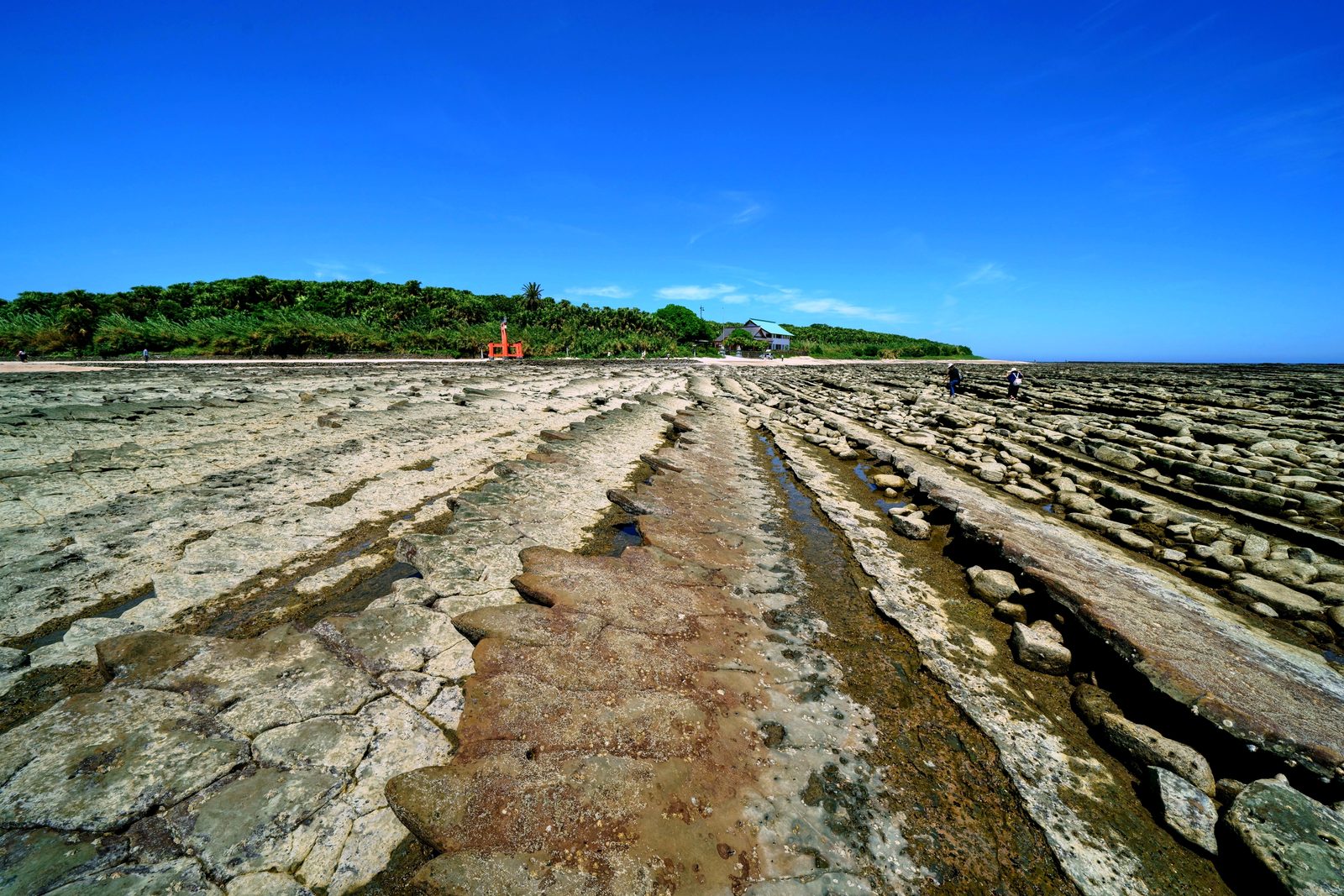
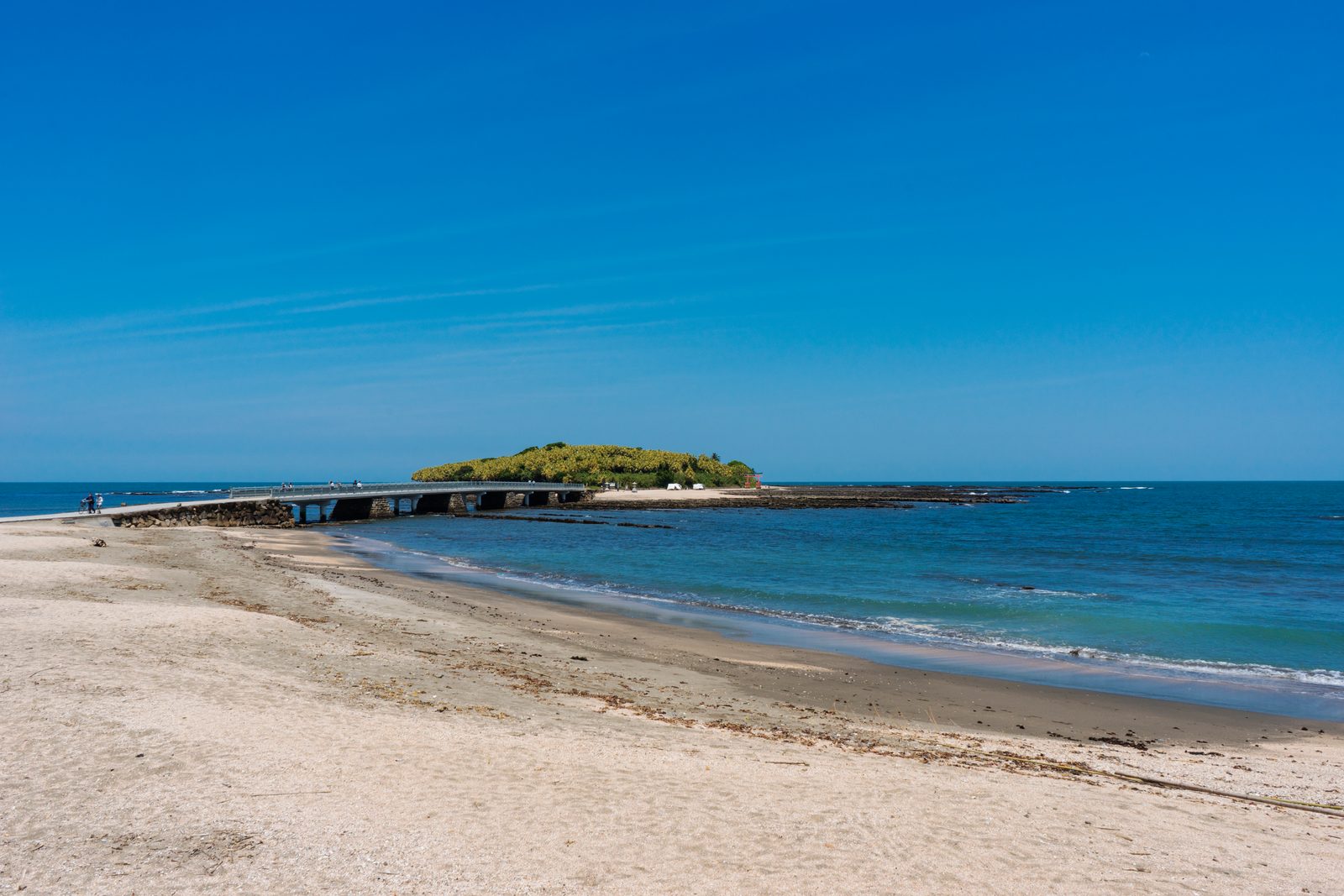
Aoshima pairs a shrine in the centre of an island with the Devil's Washboard, rock formations spreading toward the sea around it. Subtropical plants, biro palms among them, grow thickly on the island, and its inner primeval forest stays dark even in daytime under trees thick with vines. Visitors cross the bridge to worship, and when the tide goes out the shelf becomes a place for tidepool play.
Aoshima Shrine and the Subtropical Island
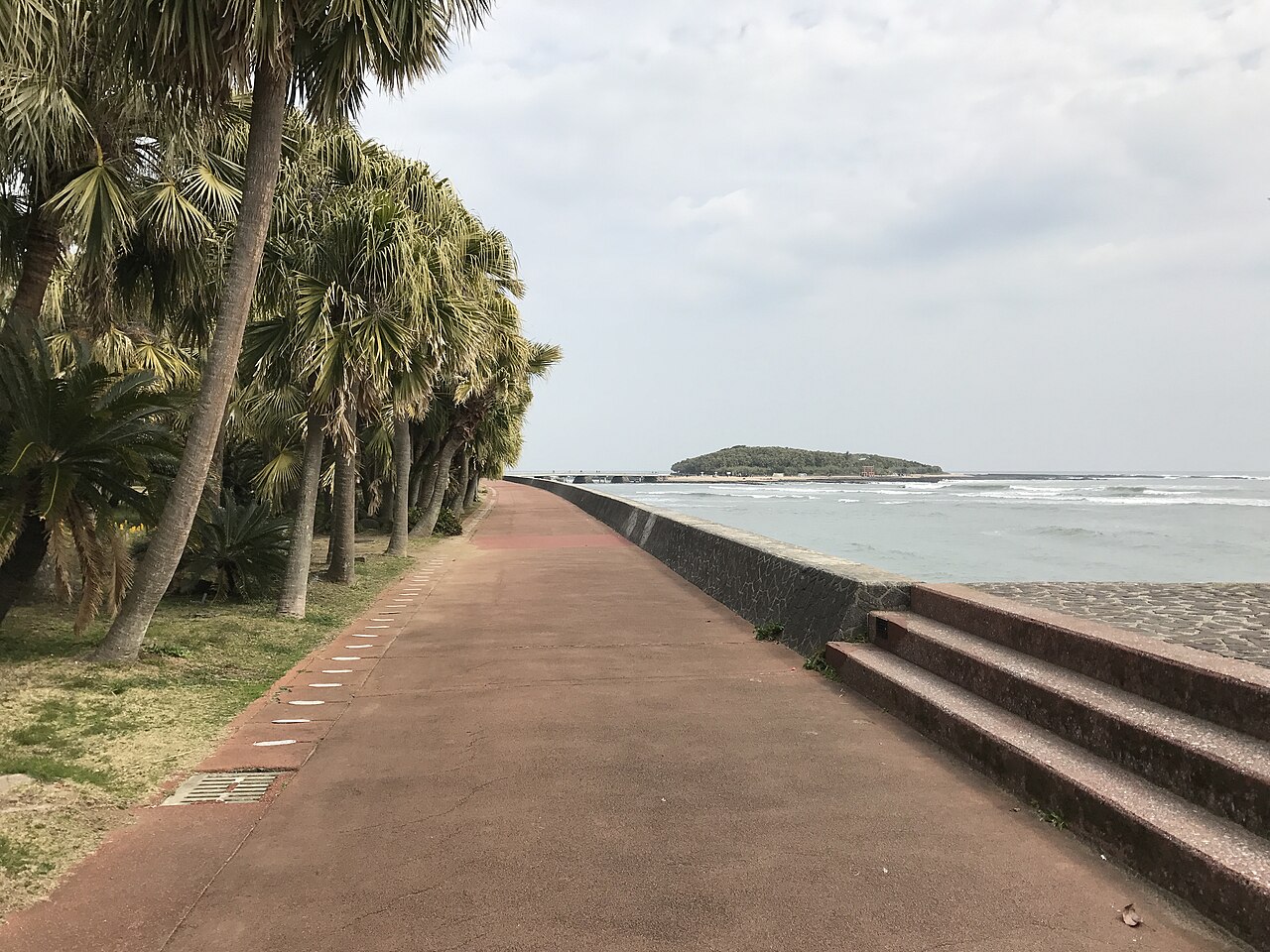
The shrine stands in the centre of Aoshima, and the visit begins by crossing the bridge that spans to the island. Subtropical plants grow thickly there, biro palms above all, and a southern-country atmosphere drifts over the island. The mature biro palms alone number about five thousand.
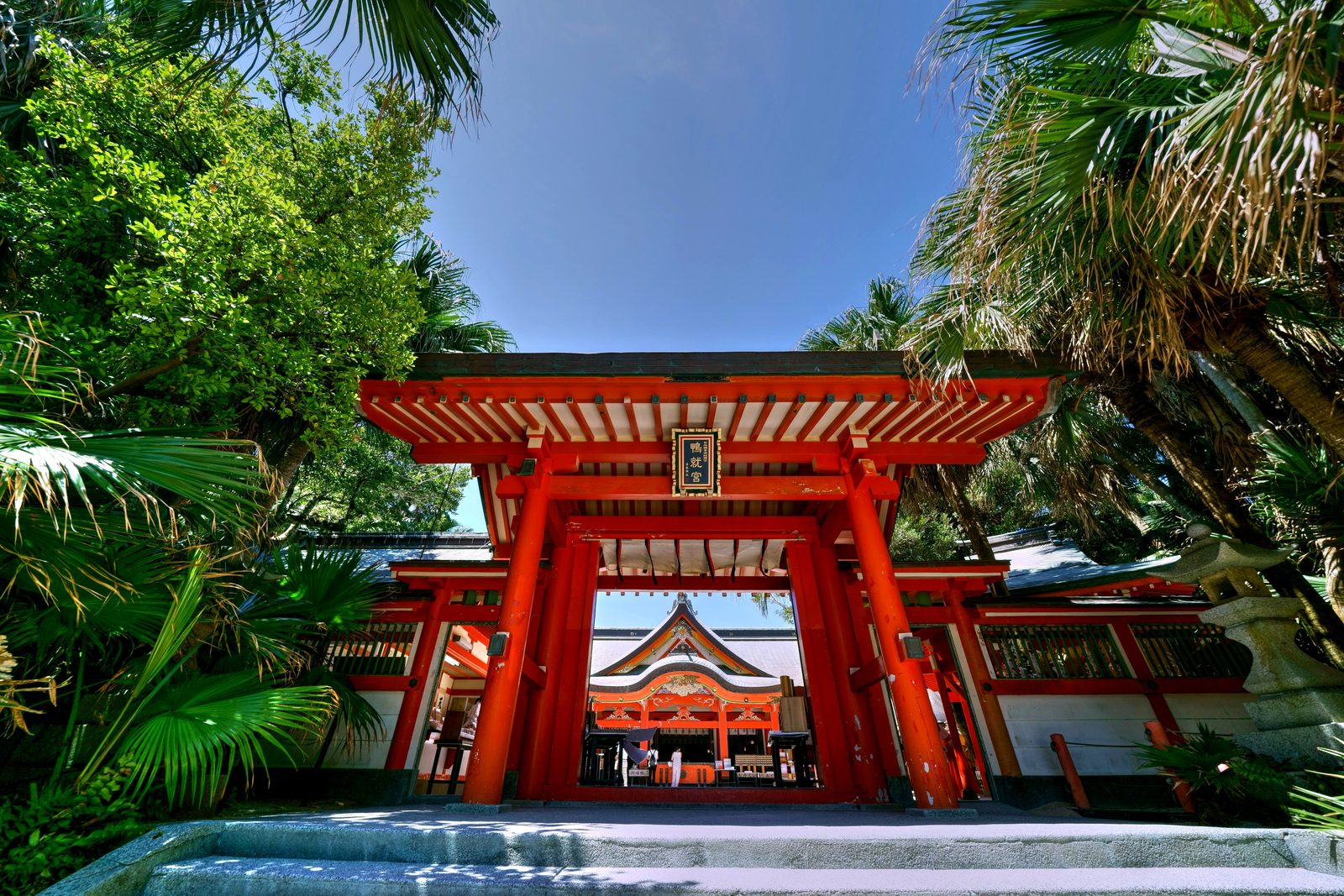
Deeper in, the inner primeval forest is a different setting: trees so densely overgrown with vines that it is dark even in daytime, like a tropical jungle. The path to the main sanctuary is surrounded by many biro palms and stays dim even in daytime.
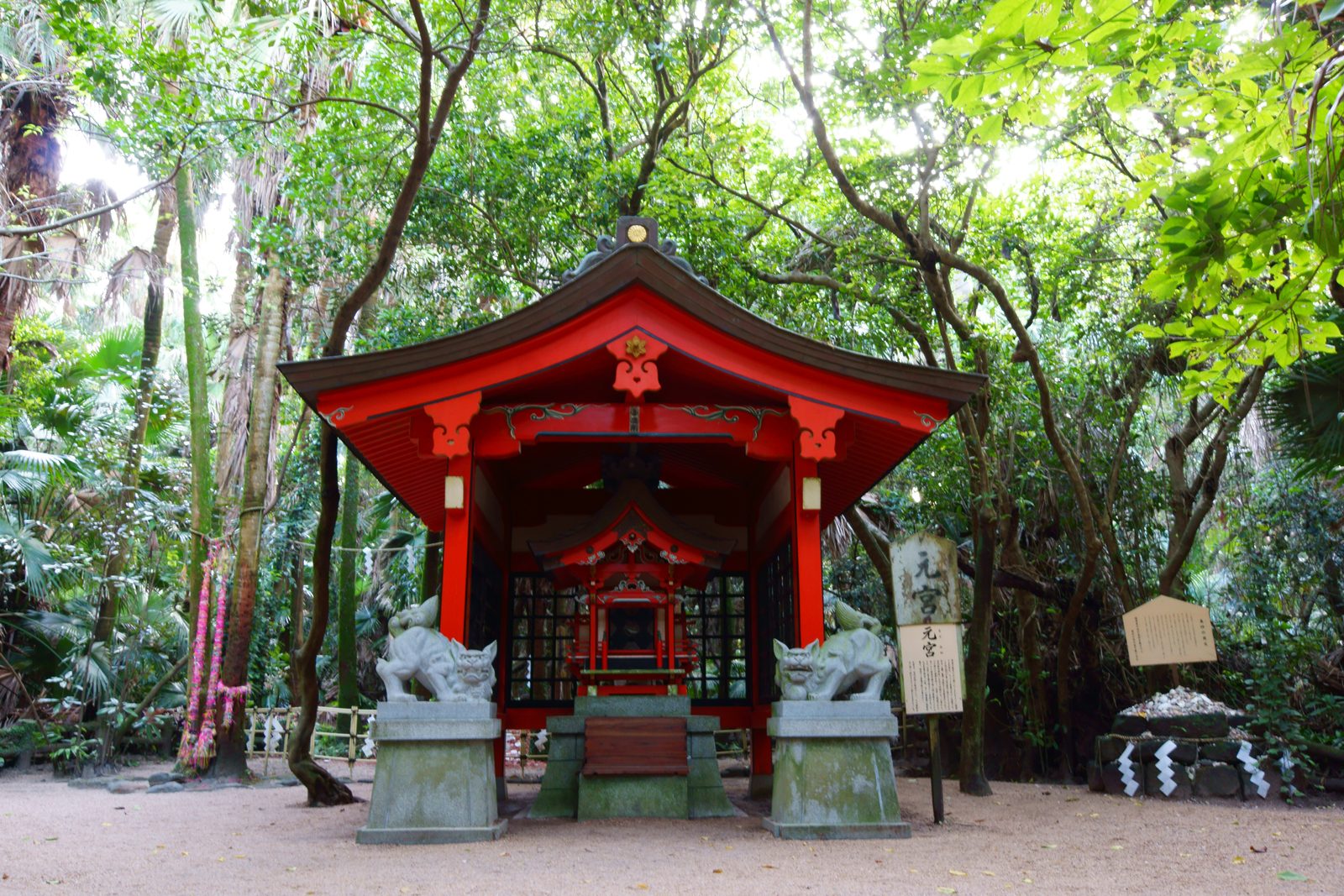
The shrine enshrines three deities, and visitors can take part in three rituals: in Wadatsumi-harai, a wish written on paper is dissolved in the island's well water; in Ama-no-hiraka, an unglazed dish is thrown while a wish is murmured; in Musubi-koyori, coloured paper strips are tied to the married biro tree at the main sanctuary.
The precinct also has heart-shaped ema, and visitors can look for hidden hearts around the grounds. The shrine holds its great purification rite twice a year, once at the end of June and once at the end of December, and at its festival dozens of fishing boats decorated with flags follow in a line behind the boat carrying the portable shrine.
The Devil's Washboard and the Tide
The Devil's Washboard is a group of rock formations spreading toward the sea around Aoshima, and its story is in the layers. They were uplifted in a slightly tilted state, then washed by waves for a long time, until the hard sandstone layers alone were left, appearing stacked like boards. That stack is the washboard of the name.
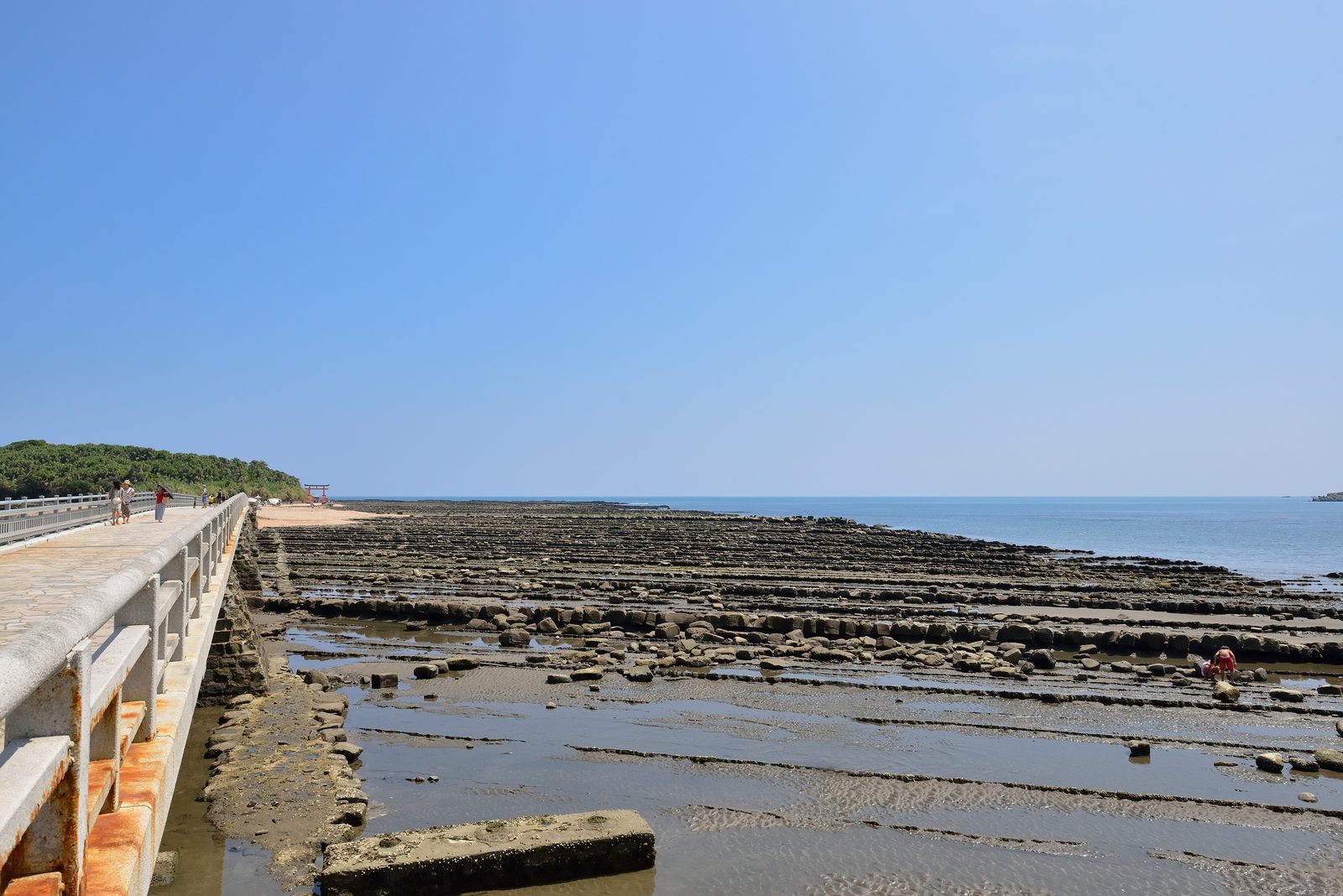
Around the island, the shelf is formed of regular alternating layers of sandstone and mudstone that were exposed above the sea and eroded by waves, so the difference in hardness between the two produced the unevenness in the surface. The formation runs well beyond the island: it is seen along about eight kilometres of coastline south to Kinchakujima.
The tide sets the rhythm of a visit. When it goes out, tidepool play becomes possible on the exposed shelf.
Horikiri Pass and the Roadside View
Horikiri Pass is where the mountain road from central Miyazaki City comes out along the coast. After the mountain stretch, a view of phoenix palms and the blue sea opens in front of the driver, and from the coast at the pass, looking down at the sea, the Devil's Washboard can be glimpsed between the waves.
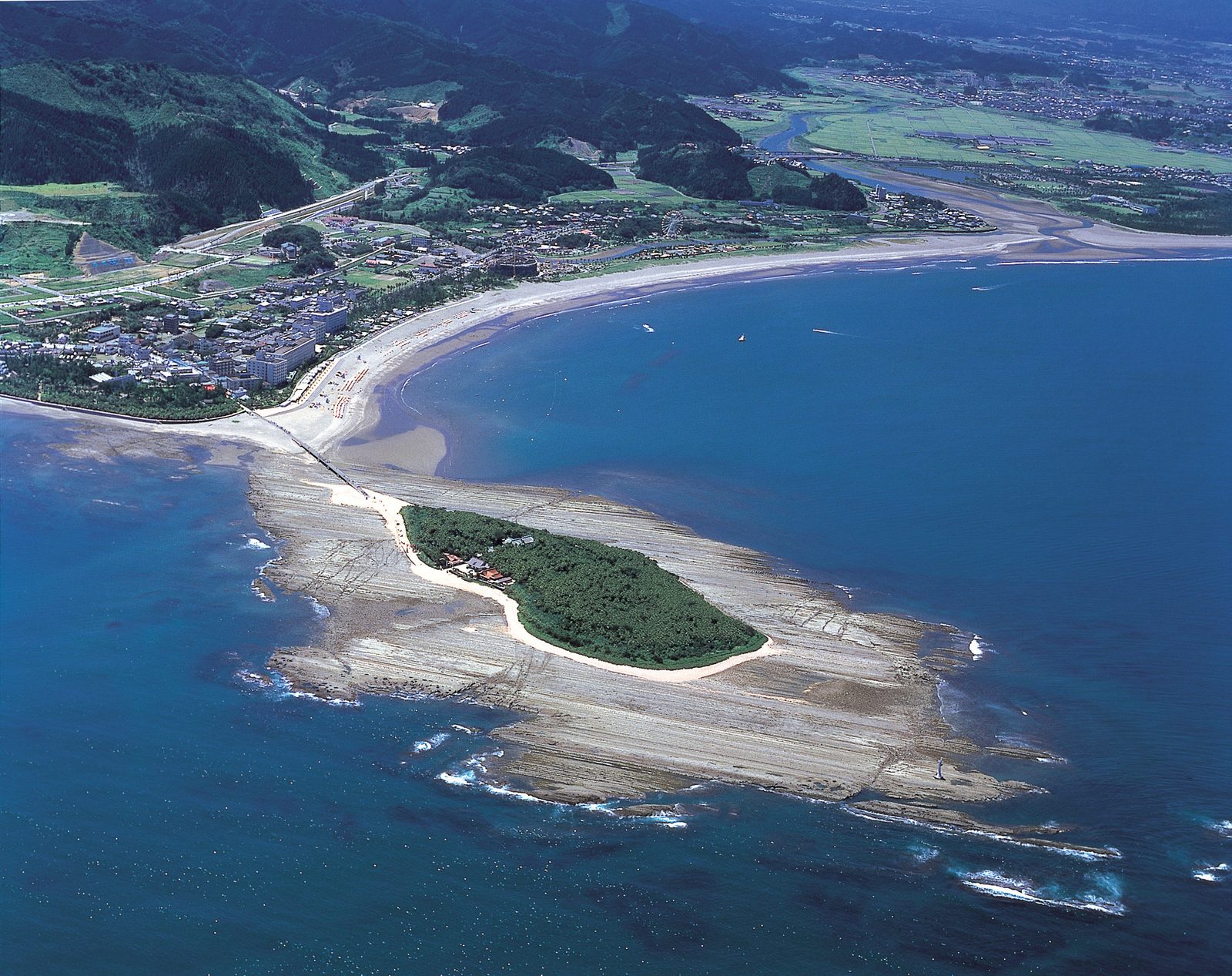
Michi-no-Eki Phoenix has an observation deck with a similar view: the blue sea below and the strange rocks of the Washboard in it. Flowers bloom through the four seasons around the site, and about twenty phoenix palms, jacaranda and bougainvillea surround it. The market sells soft-serve ice cream in Miyazaki mango and premium Hyuganatsu flavours.
Both the pass and the deck at Michi-no-Eki Phoenix look down on the Washboard from above, a different angle from the shore at Aoshima.
Garden, Beach and Nojima Shrine
The botanic garden is a second way to see the plant life of the coast. Its outer area has native biro palms of Aoshima alongside phoenix, queen palms and date palms, with bougainvillea and hibiscus between them, and the tropical fruit greenhouse holds fruit trees such as pineapple, papaya and star fruit.
At the garden cafe, smoothies, parfaits and fruit juice made with prefecture-grown ripe mango come with the sound of waves as background music, and the cafe suggests pineapple cake, its baked aroma drifting, to go with them.
Nojima Shrine's grounds are covered with Aoko fig trees, a national natural monument, with banana trees growing wild among them. The shrine purifies bicycles and surfboards, offers sea and bicycle amulets made of cedar, has cycle stands, and hands out a limited goshuin that changes every month; kagura is offered in the grounds every year in late November.
The Aoshima Activity Center offers twelve water activity menus for getting onto the water. Kodomo-no-kuni adds camping: at the forest camp area a cool wind can be felt even in summer, with the river through the park and the sea of Aoshima in view, while the beachside camp area faces the sea of Aoshima, with surfing tens of metres away.
Food and Souvenirs
There are two things to eat and three souvenirs to take home. At the homemade-syrup shop, the shaved ice is made without any white sugar and without additives, so its sweetness is natural and gentle. Grilled oysters come with firm, springy flesh, and a savoury scent of the sea fills the mouth.
For souvenirs, Aoshima uiro comes pre-cut into small pieces and arranged in a wavy pattern that imitates the shape of the Devil's Washboard; the flavour is traditional, plain and gentle, and the texture soft and chewy.
Aoshima senbei sandwiches a cream flavoured with Western liquor between thin-baked, crisp senbei that contain rice flour. Cheese manju wraps cheese in place of the sweet bean filling, and the dough varies, from a crisp cookie dough to a moist dough and one with raisins.
Getting to Aoshima
New to rural buses and one-man trains? See how to ride them, step by step.
| Leg | How | Time or charge |
|---|---|---|
| Miyazaki Station to Aoshima Station | JR Nichinan Line | about 30 minutes |
| Miyazaki Station to Aoshima | by car | about 25 minutes |
| Miyazaki Airport to Aoshima Shrine | by car | about 15 minutes |
| Aoshima Station to Aoshima Shrine (on the island) | on foot | about 10 minutes |
| Aoshima Station to the Devil's Washboard | on foot | about 10 minutes |
| Aoshima bus stop to the Devil's Washboard | on foot | about 5 minutes |
| Aoshima Station to Aoshima Beach Park | on foot | about 5 minutes |
| Aoshima Station to the Aoshima Beach Center area | on foot | about 10 minutes |
| Miyazaki Station to Kodomo-no-kuni Station | JR Nichinan Line | about 30 minutes |
| Kodomo-no-kuni Station to the Aoshima Activity Center | on foot | about 7 minutes |
| Parking in front of Aoshima Station | car | free, until 17:00 |
| Miyako City (bus hub) to Horikiri Pass | bus bound for Nichinan | 35 minutes |
Both the rail trip and the drive from Miyazaki Station come in at around half an hour, and from Aoshima Station the shrine, the Washboard and the beach park are each a short walk.
Hours and Fees
| What | Hours or fee | Note |
|---|---|---|
| Aoshima Shrine, visiting | 6:00 until sunset | evening closing varies by season |
| Aoshima Shrine, formal prayer | offering from 5,000 yen | individual offering |
| Hyuga Mythology Hall, adult admission | 600 yen | 500 yen with the discount ticket |
| Aoshima night special visit | 1,000 yen including tax, ages 6 and over | during the Aoshima Night Up event hours; free for ages 5 and under |
| Aoshima Beach Center (Nagisa-no-Koban) | 9:00 to 17:00 | closed Wednesdays, except during the swimming beach period |
| Aoshima Beach Center activity program | 5,000 yen adults, 2,500 yen children | cash only |
| Aoshima Activity Center | 9:00 to 17:00 | no closing days |
| Botanic garden grounds | 8:30 to 17:00 | |
| Nojima Shrine | 9:00 to 17:00 | may change with the season or weather |
| Nojima Shrine goshuin and amulets | 500 yen | placed in the offertory box |
| Kodomo-no-kuni (AOSHIMA PICNIC CLUB) | 7:00 to 18:00 | no regular closing day; may differ by tenant |
| Miyazaki City Tourist Information Center | 9:00 to 18:00 | closed January 1 and 2 |
Fees and hours were checked against official sources between 14 October 2026 and 3 November 2026.
The shrine gate opens early and closes at sunset, while the garden, the beach center, the activity center and Nojima Shrine keep daytime schedules that end in the late afternoon.
Guides to Obi and Takachiho are also on this site. To give the tide and the island forest a second day, browse places to stay in Miyazaki.
Thinking of staying overnight?
Compare places to stay near Miyazaki, Miyazaki, Japan →
Disclosure: This post may contain affiliate links. If you book through them, we may earn a commission at no extra cost to you.