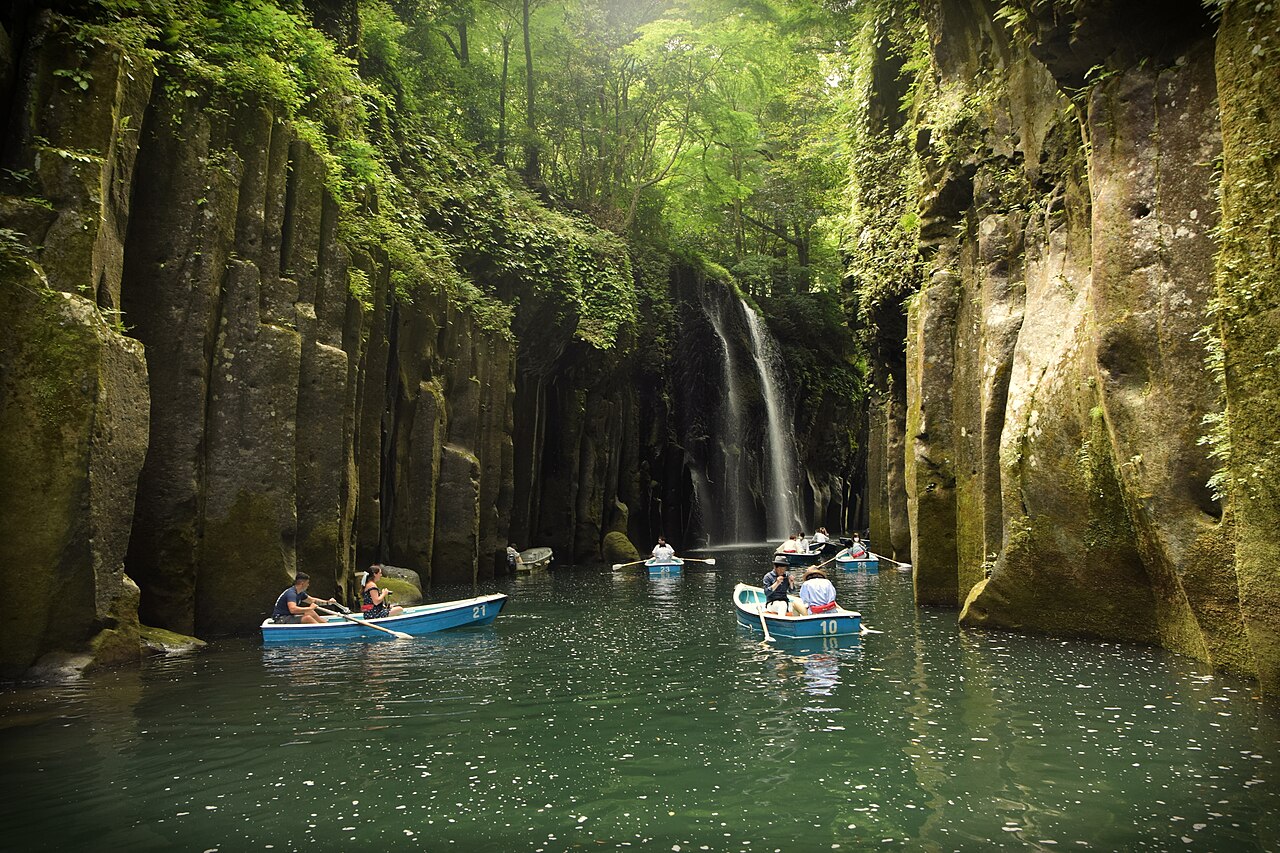
Deep in the mountains of northern Miyazaki, where a mountain river has cut a dark corridor through ancient rock, the town of Takachiho holds Japan's founding stories closer than almost anywhere else. Tradition places the descent of the gods on these ridges, and the shrines that grew beneath them are still working places of prayer rather than showpieces. A Japanese guide to the great shrines of Kyushu supplies the deeper history; the valley itself supplies the quiet. Timed with a little care, the whole day can be done without a car.
The Gorge, and the Boats on Still Water
The gorge below the town is the picture most visitors carry away: dark walls of old volcanic stone, water the colour of bottled glass, and a thin waterfall pouring down the rock face into the ravine. Rowing boats can be hired to drift beneath it, and this is worth planning around. In the regular season the rental boats operate from half past eight in the morning until five in the afternoon, and the final reception is at half past four. Come early or late in the day and the water is at its stillest; midday belongs to the crowds. The district as a whole is held in tradition to be the land where the gods first came down from heaven, and the gorge reads like scenery invented for that story.
A Shrine Older than the Chronicle that Names It
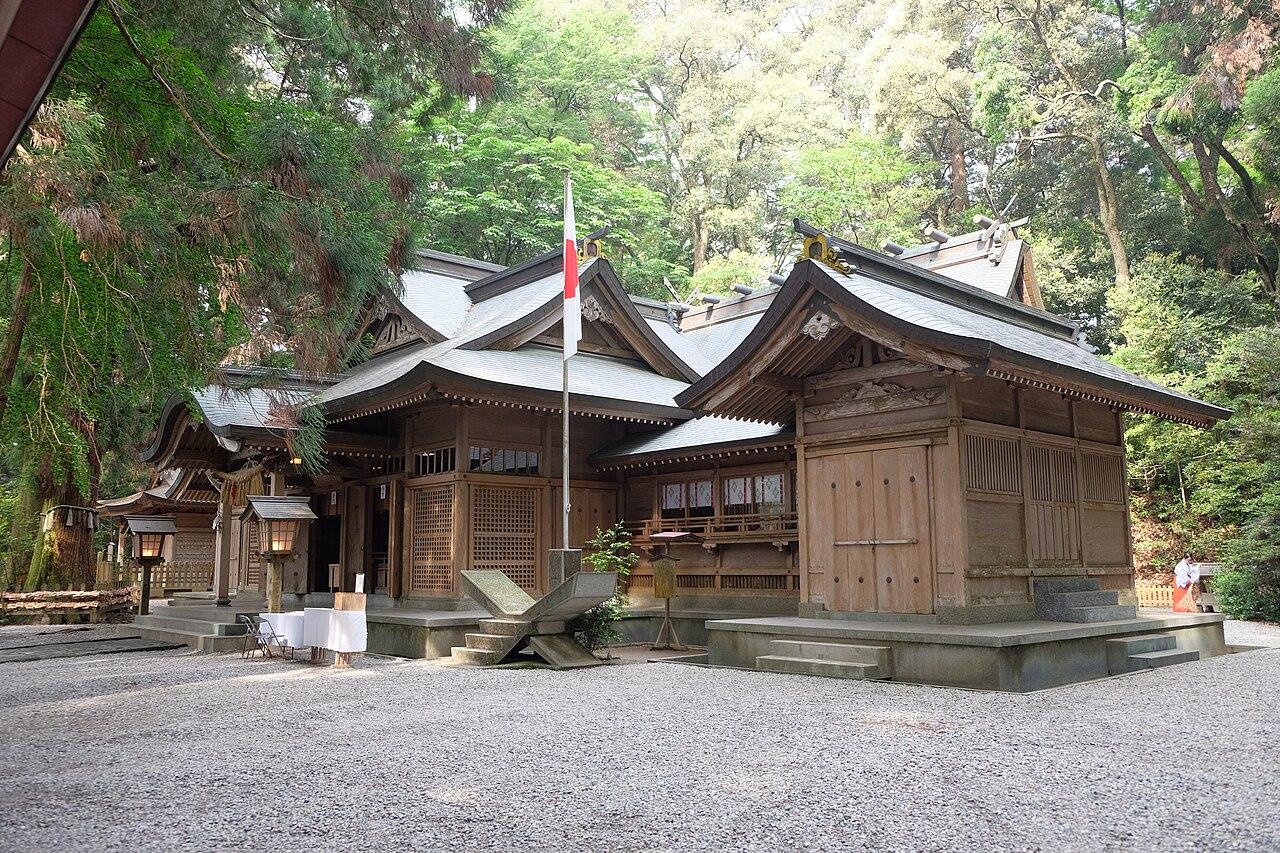
A short walk above the gorge stands Takachiho Shrine, head shrine of the group revered as the Eighty-eight Shrines of the old Takachiho district. Its founding is placed more than nineteen centuries back, and the shrine is recorded in the Shoku Nihon Koki, a court chronicle of the Heian age — a sanctuary older than the paperwork that first records it. The present main hall, rebuilt in the year seventeen seventy-eight, is listed as an Important Cultural Property of the nation, its dark timbers standing in a grove of tall cedars. The altars honour Takachiho Sumegami together with the ten deities revered as the Jissha Daimyojin.
Two Cedars with One Root
In the shrine's grove stand the Meoto-sugi, the wedded cedars: two great trunks whose roots are joined beneath the ground into a single living base. The shrine's tradition has it that a couple who circle the pair hand in hand will stay close for the rest of their lives, and on a weekday morning you may have the circuit to yourselves. It is a small ritual, quickly done, and it sets the tone for the mountain shrine that follows.
Up the Mountain to Futagami
An excursion into the hills at Oshikata, behind the town, leads to Futagami Shrine on the folds of Mount Futagami. The mountain's two peaks — a male and a female summit — are themselves the object of worship: tradition names Futagami as a mountain of the divine descent, and the whole massif serves as the shrine's sacred body. The shrine's founding is dated to the year eight hundred and ninety-eight, and its two enshrined deities are Izanagi and Izanami, the wedded pair who begot the islands in the old land-making myths. Their presence gives the place its reputation: it is said to draw a steady stream of visitors praying for harmony at home and for children. The worship hall sits on the lower slopes of the women's peak, at the third of the ten stages by which climbers measure the mountain, built so quietly into the woods that it seems to grow out of them. Near it stands the Futagami ginkgo, a sacred tree in whose trunk tradition finds the forms of man and woman, and which is said to grant a blessing to those who touch it.
Getting There Without a Car
The simplest approach is from Nobeoka, on the coast: a local bus from the front of Nobeoka Station climbs to Takachiho in about one hour and thirty minutes. The round-trip discount ticket between Nobeoka and Takachiho Bus Center costs three thousand one hundred and forty yen for an adult and one thousand five hundred and seventy yen for a child, and a coupon book of four tickets, useful for a pair travelling together, is five thousand nine hundred and fifty yen. From the west, the Takachiho-go highway bus links Kumamoto with the town: the run from Kumamoto Station takes about three hours, with a single booked-ahead departure a day, and the one-way fare from Takachiho to Kumamoto is two thousand seven hundred yen. The same highway service runs the full length of the mountains — from Nobeoka through to Kumamoto's Sakuramachi terminal in four hours and five minutes, four thousand yen one way — so the town can be threaded into a larger crossing of Kyushu.
Where to stay
Places to stay near Takachiho →
Disclosure: This post may contain affiliate links. If you book through them, we may earn a commission at no extra cost to you.
Make It a Quiet Day
The day assembles itself naturally: the gorge and its boats early, before the water traffic thickens; Takachiho Shrine and the wedded cedars before noon; the mountain quiet of Futagami in the afternoon. If you would rather have the connections handled for you, a guided day around Takachiho can string the gorge and the shrines together. Details of times and prices do change, so confirm the latest before you travel. And if sacred trees are what draw you, the great camphor in the onsen town of Takeo, across the mountains in Saga, keeps the same unhurried company on the far side of Kyushu.