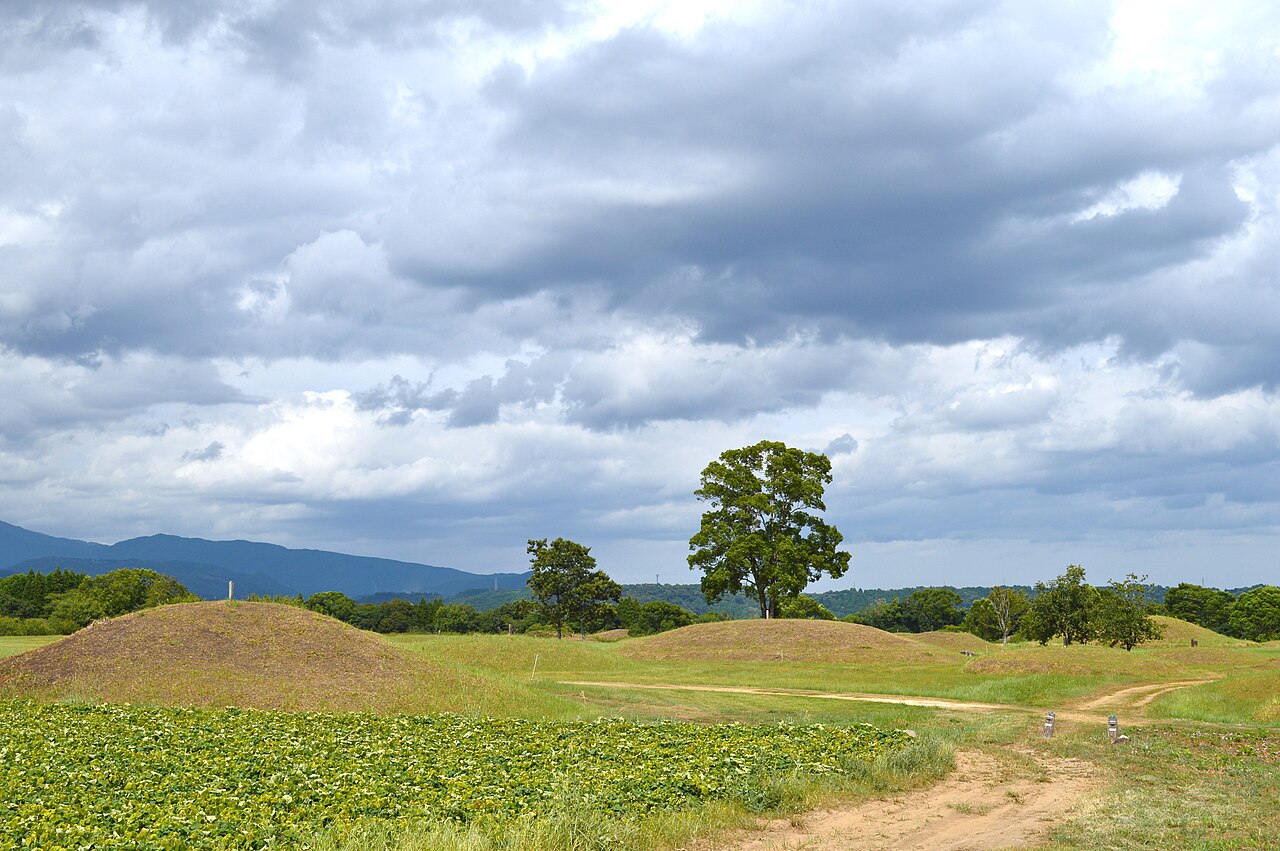
Saitobaru is a plain in Saito, Miyazaki, with three hundred and nineteen burial mounds spread across it, the Osahozuka and Mesahozuka reference mounds among them. In November, about three million cosmos planted for the Saito Kofun Festival bloom across the mound group. You can walk into the stone chamber of Oni-no-Iwaya. At the festival, the love story of Ninigi-no-Mikoto and Konohanasakuya-hime is performed to ocarina, zither and drums amid flickering flames.
The Saitobaru Plain: Mounds, Cosmos and Spring Blossoms
The Saitobaru burial mounds number three hundred and nineteen, thirty-one of them keyhole-shaped and two hundred and eighty-six round. You cross a plain that stretches four point two kilometres north to south and two point six kilometres east to west, so the mounds read as a landscape rather than a single site. Tradition holds that Osahozuka is the tomb of Ninigi-no-Mikoto and Mesahozuka the tomb of Konohanasakuya-hime. The two can be entered only on special visit days.
About three million cosmos, planted to coincide with the Saito Kofun Festival in November, bloom across the Saitobaru burial mound group, so in that month you walk between the mounds through the flowers. The plain is wide, and a rental bicycle from Konohana-kan suits anyone who wants to reach more than one mound group in a day.
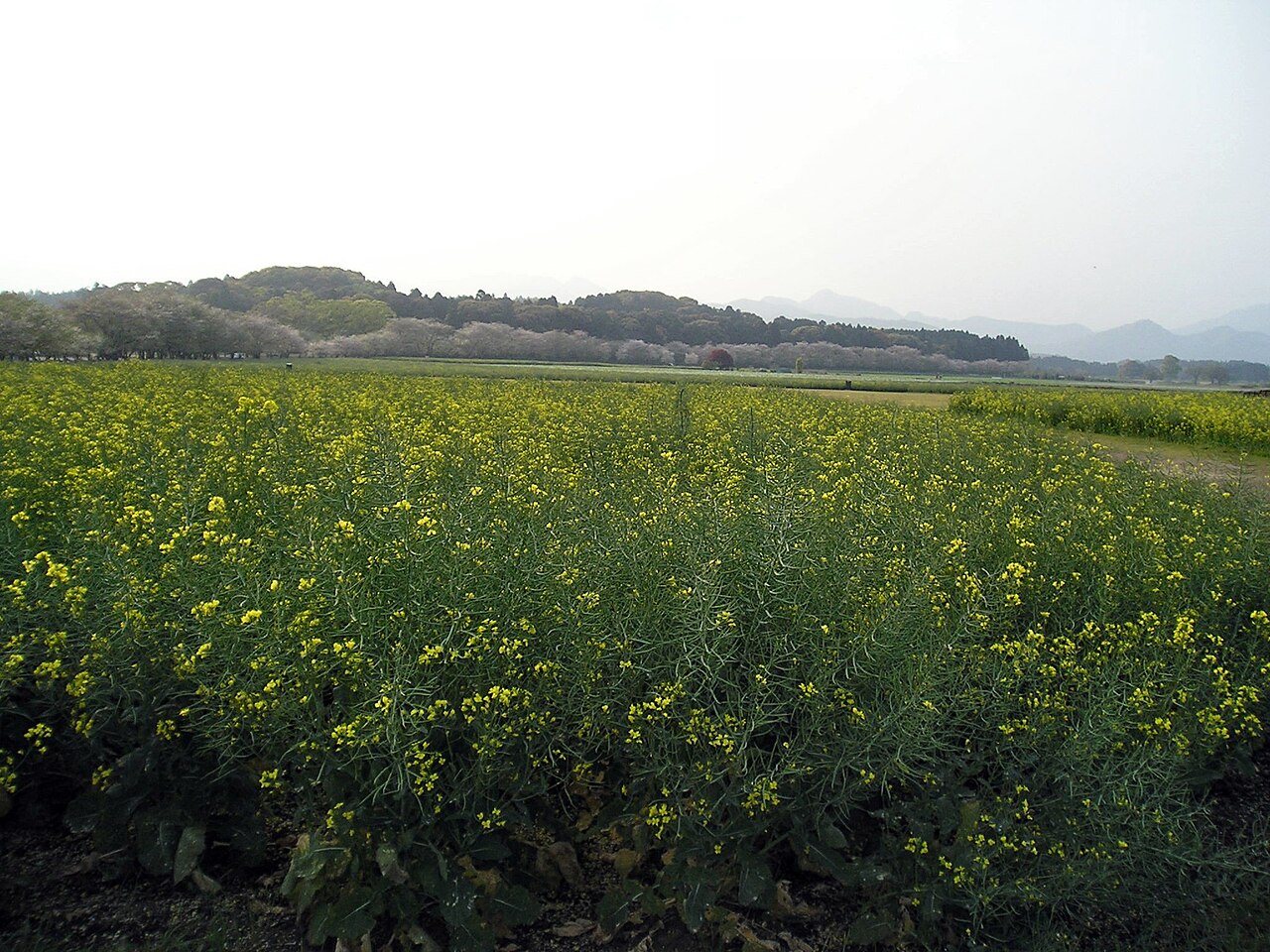
In spring you see cherry blossoms and rape blossoms on the plain instead, with the season listed as late March to early April. If flowers rather than festivals are the point of the trip, those weeks and the cosmos month are the two times to aim for.
Start at Konohana-kan, the guidance centre, where you see a building shaped like a keyhole-shaped mound cut lengthwise, modelled on the thirty-one keyhole-shaped mounds of the group. All guided tours of the plain start from the parking lot in front of it. The restaurant at Konohana-kan serves Saito beef soba with fried tempura batter, chicken nanban made with Miyazaki chicken, and a Saito beef rice box, so you can eat without leaving Saitobaru.
Inside the Oni-no-Iwaya Stone Chamber
Oni-no-Iwaya is a thirty-seven-metre round mound with a horizontal-entrance stone chamber. Visitors can go inside it, and inside Mound Thirteen as well, which makes this the place to choose if you want to be within a burial mound rather than beside one. Inside, you stand in a chamber built up entirely of worked cut stones.
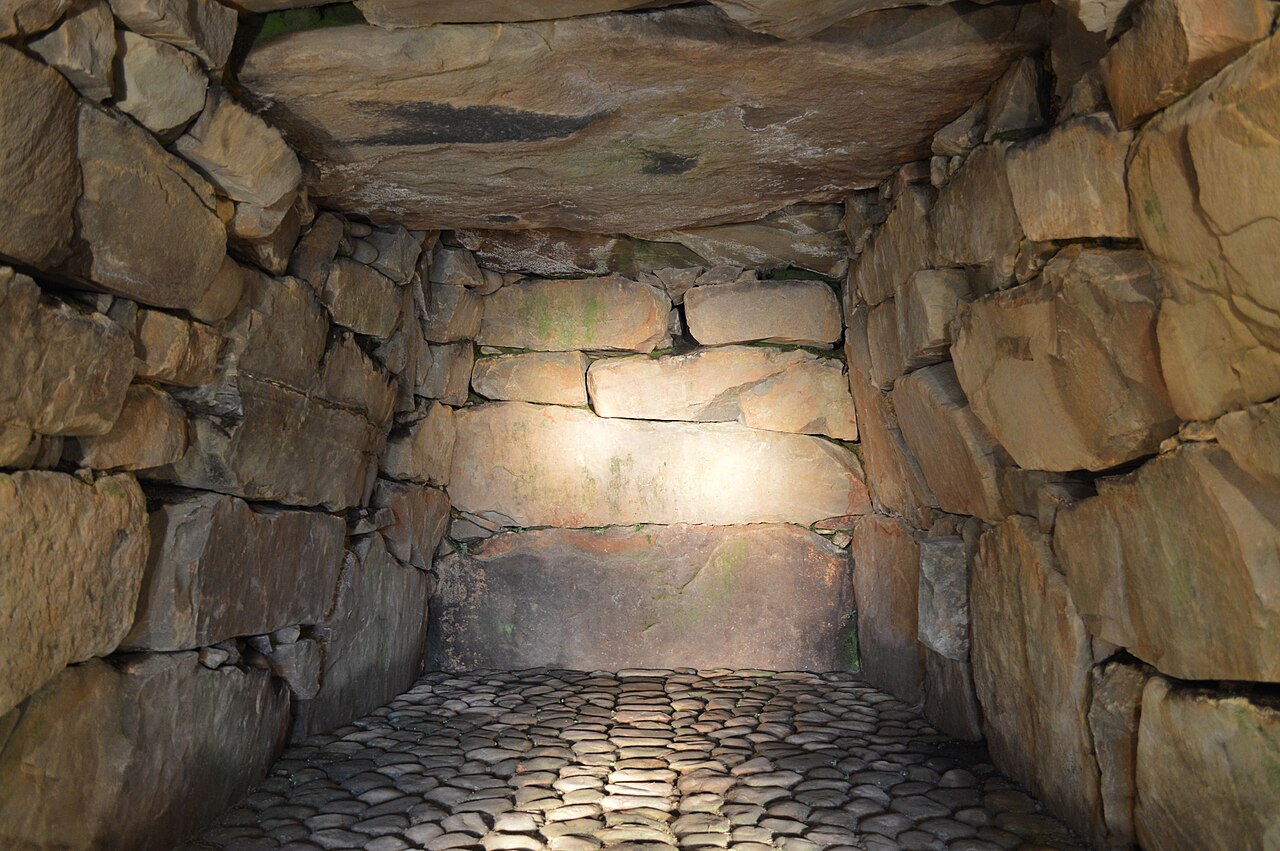
Overhead, you look up at ceiling stones that are large slabs, each about the size of three tatami mats. You walk through a one-point-eight-metre-high entrance passage into a rear chamber of the same length, where the ceiling rises a little higher. Outside, you see a roughly two-metre-high earthwork bank with a nine-metre-wide base ringing the mound.
Oni-no-Iwaya is said to be a cave that an oni, asking for Konohanasakuya-hime's hand, completed in a single night at the demand of Oyamatsumi no Kami. The story ties the chamber to the same Konohanasakuya-hime whose tomb tradition places at Mesahozuka.
Hands-On Making at the Archaeological Museum
At the Saitobaru Archaeological Museum, the hands-on programmes at the ancient-life experience hall let anyone who wants to handle the material rather than read about it choose between clay, stone and beads.
You work a kilogram of clay into pottery or a haniwa. You shape a stone tool, or you make a magatama pendant in a large or small size. The clay session takes one hundred and twenty minutes, so if you have a full afternoon, start there and add a stone tool or a pendant afterwards.
At the museum you can view a survey reconstruction image of Osahozuka and Mesahozuka. The museum shop sells original goods, books and crafts made from natural materials, and there is a tea lounge for a pause between the exhibition rooms.
Fire, Drums and Torches at the Festivals
The Saito Kofun Festival is held on the first Saturday of November and the following Sunday. Several hundred participants carry the flame of Ninigi-no-Mikoto, taken at Takachiho, and the flame of Konohanasakuya-hime, taken at Tsuma Shrine, on torches along Kiki-no-Michi to Goryobo-mae Hiroba. You see participants in ancient costume carry torches along a course of about four kilometres from the Saito city area to the venue. The Kiki-no-Michi section of the route climbs a stone stairway of one hundred and sixty-nine steps.
At the fire ceremony, you hear ancient music played on the ocarina, five-string zither and drums while flames flicker and the love story of Ninigi-no-Mikoto and Konohanasakuya-hime is performed. You watch dances based on myth, and the first night ends with a performance of kofun drums. If your trip coincides with the festival, plan the evening around the fire ceremony; the main venue also has local products on sale and food stalls lined up. A special visit to Osahozuka and Mesahozuka is held once a year on the Sunday of the festival.
The summer festival in Saito's town centre has a different sound. Inside the drum float, four children tied to its pole with bleached cloth beat drums, and keep beating even when the float is turned upside down. The young men call out Chosai, Chosai, Iyasassa as they parade. The words are said to mean the flourishing of the town and ever-growing prosperity.
Tsuma Shrine and the Legend of Konohanasakuya-hime
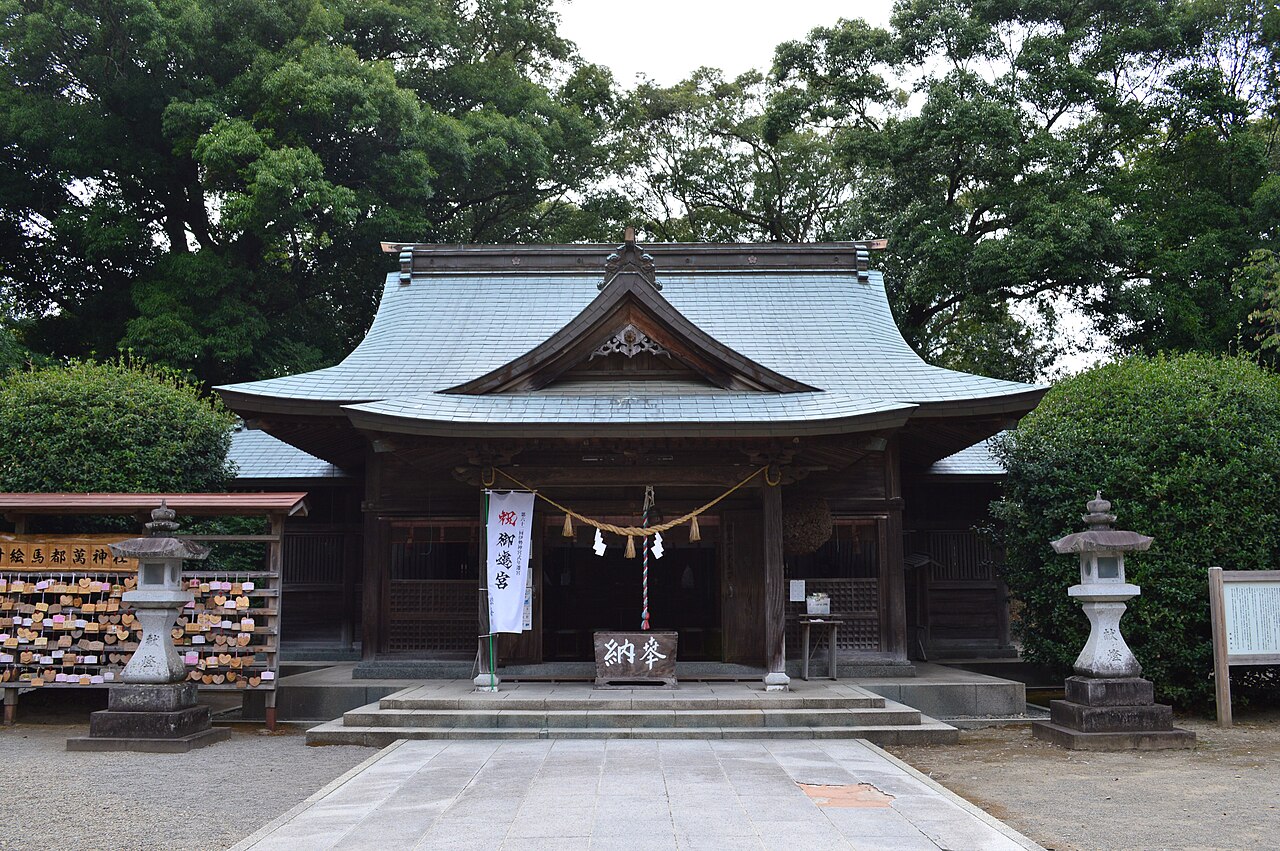
Tsuma Shrine enshrines Konohanasakuya-hime, the consort of Ninigi. Because she is said to have raised the three princes on sweet sake in place of milk, the shrine is said to be the birthplace of Japanese sake.
Mifunezuka is said to have been a deep inlet reached by sea, where the party of Ninigi no Mikoto descended from Takamagahara toward the peak of Takachiho. Utsumuro is the doorless birthing hut where Konohanasakuya-hime is said to have given birth to three princes amid flames, to prove her innocence after Ninigi doubted her. The eldest, Hoderi no Mikoto, is said to have been born amid blazing flames, Hosuseri no Mikoto when the flames had weakened, and Hoori no Mikoto when they were shrinking and receding.
The Aizome River is traditionally said to be where Ninigi no Mikoto, out walking, saw Konohanasakuya-hime drawing water and proposed marriage. The river itself is a small stream that flows out of Koyu Pond. Yahirodono nearby is said to be the remains of the palace built for their married life with the three princes. The places sit along one short walk, so you can follow the story in order from the shrine to Mifunezuka, the Aizome River and Yahirodono.
Getting to Saitobaru
| Leg | How | Time and estimate |
|---|---|---|
| Miyazaki Airport to the cosmos viewing area | By car on general roads | About 1 hour |
| JR Miyazaki Station to the cosmos viewing area | By car on general roads | About 50 minutes |
| Saito IC (Higashi-Kyushu Expressway) to the cosmos viewing area | By car on the expressway | About 15 minutes |
| Miyazaki city to the museum | By car via Route 219 | About 40 minutes |
| Saito IC to the museum | By car | About 10 minutes |
| JR Miyazaki Station to Saito Bus Center | Bus | About 70 minutes |
| Saito Bus Center to the cosmos viewing area | Taxi | About 5 minutes |
| Tsuma Shrine to Mifunezuka | On foot | 3 minutes |
| Mifunezuka to Aizome River | On foot | 12 minutes |
| Aizome River to Yahirodono | On foot | 1 minute |
The cosmos viewing area is about fifteen minutes by car from Saito IC on the Higashi-Kyushu Expressway. Parking is available, with space for seven hundred cars.
New to rural buses and one-man trains? See how to ride them, step by step.
Hours and Fees
| Place | What | Hours or fee |
|---|---|---|
| Oni-no-Iwaya and Mound 13 | Inside viewing | 10:00-17:00 |
| Volunteer guides | Hours | 10:00-15:00 |
| Saitobaru Archaeological Museum | Hours | 9:30-17:30; entry to the exhibition rooms until 17:00 |
| Saitobaru Archaeological Museum | Closed | Mondays (the next day if Monday is a national holiday); the day after a national holiday (except Saturdays, Sundays and holidays); December 28 to January 4 |
| Museum hands-on programmes | Hours | 9:30-12:00 and 13:00-17:00, for up to 8 people |
| Museum hands-on programmes | Pottery and haniwa making | 500 yen for 1 kg of clay, 120 minutes |
| Museum hands-on programmes | Stone tool making | 150 yen, 30 to 60 minutes |
| Museum hands-on programmes | Pendant making | 100 yen and 250 yen, 30 to 90 minutes |
| The museum's tea lounge | Hours | 10:00-16:00, last order 15:30; closed Thursdays |
| Konohana-kan | Hours | 9:00-18:00 |
| Konohana-kan | Closed | December 31 and January 1 |
| Konohana-kan restaurant | Hours | 10:30-14:30, last order 14:30 |
| Konohana-kan restaurant | Saito beef soba | 1,650 yen |
| Konohana-kan restaurant | Chicken nanban | 1,350 yen |
| Konohana-kan restaurant | Saito beef rice box | 1,950 yen |
| Konohana-kan rental bicycles | Hours | 10:00-15:00 |
| Konohana-kan rental bicycles | Closed | Mondays (the next day if Monday is a national holiday); December 28 to January 4 |
| Konohana-kan rental bicycles | Prices | 500 yen for a children's bicycle, 500 yen for a standard bicycle, 1,000 yen for an electric bicycle |
For a night in the city, look at places to stay in Saito.
Where to stay
Places to stay near Saito, Miyazaki, Japan →
Disclosure: This post may contain affiliate links. If you book through them, we may earn a commission at no extra cost to you.