This guide covers Tsuyama Castle, now Kakuzan Park, in Tsuyama City, Okayama Prefecture: how to reach it, its opening times and entry, what survives on the hill, the Shurakuen garden to the north, and a few older sites in the surrounding countryside.
Kakuzan Park is the name the place goes by today. It is a public park laid out over the former grounds of Tsuyama Castle, on a low hill in the center of Tsuyama City, in the northern part of Okayama Prefecture. What remains is a hill of layered stone ramparts, with the town spread out below.
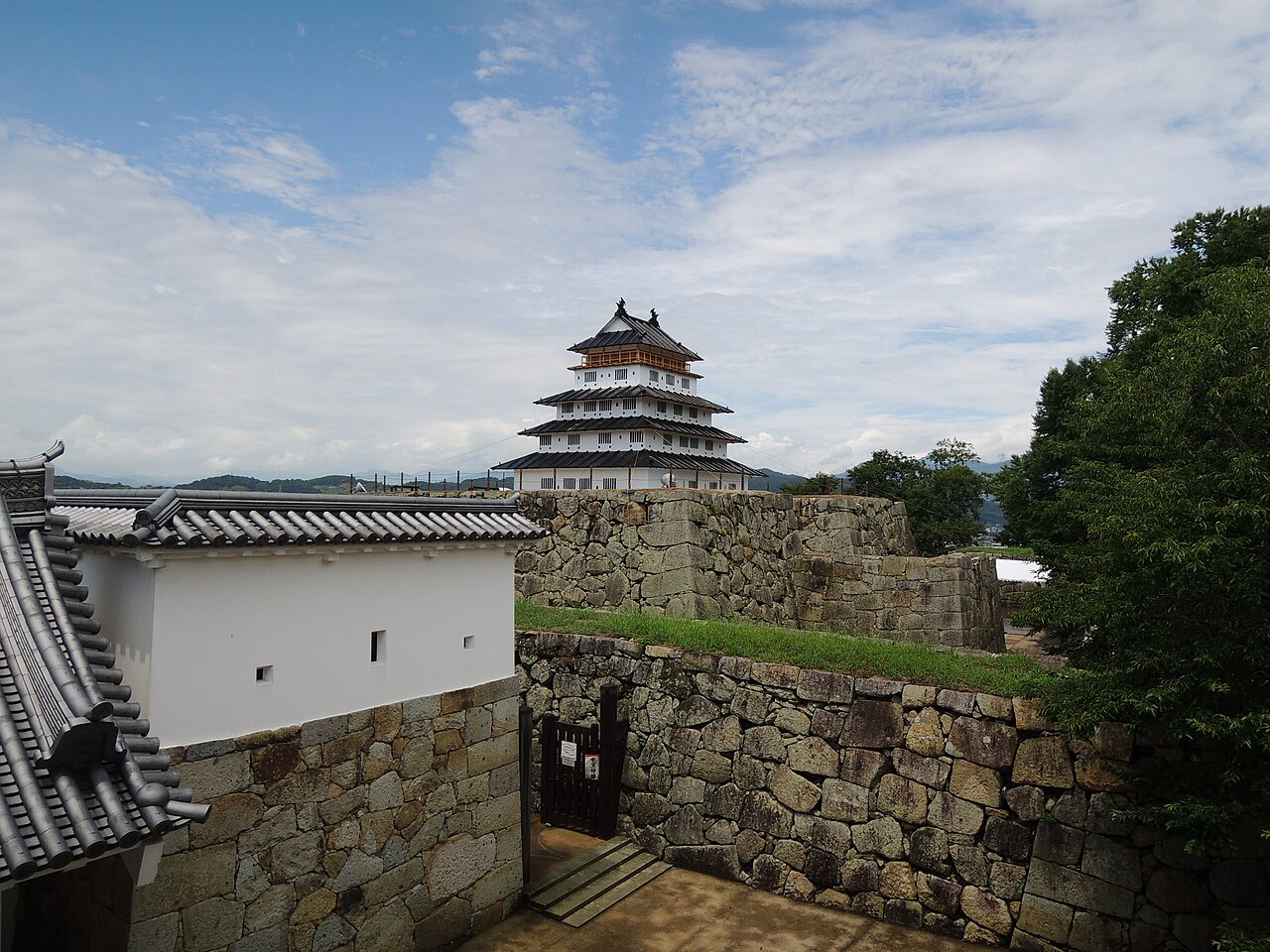
The tower and whitewashed gate wall seen from below the ramparts.
A castle town in a mountain basin
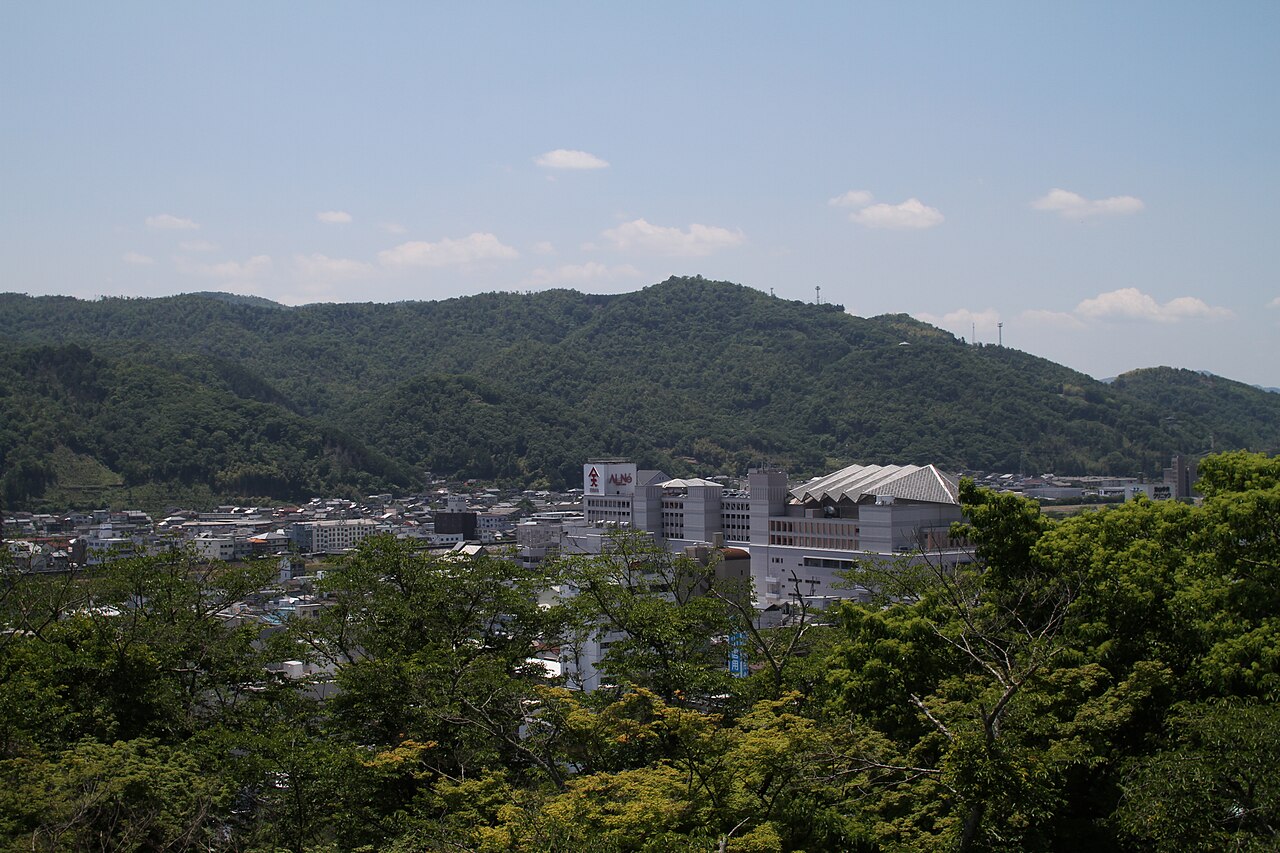
Tsuyama sits in the middle of the Tsuyama Basin, a bowl of flat land ringed by mountains on every side. The Tsuyama River runs along the southern edge of the town, and from the castle hill you look straight down over the water and the rooftops, with the ridgelines closing the picture in the distance.
In the days of the old provinces this region was Mimasaka, and Tsuyama grew into its largest town. That standing is worth keeping in mind as you climb, because the size of the ramparts makes more sense once you know this was the chief town of a whole province, not a minor outpost.
Getting there
The castle is easy to reach on foot from the center of town, and the walk in from the railway is short. Drivers coming along the Chugoku Expressway have two interchanges to choose from, both a similar drive away from the hill, so pick whichever suits the direction you are arriving from.
- By train: about a ten-minute walk from JR Tsuyama Station to Tsuyama Castle.
- By car: about 15 minutes from Tsuyama IC or Insho IC on the Chugoku Expressway to Tsuyama Castle.
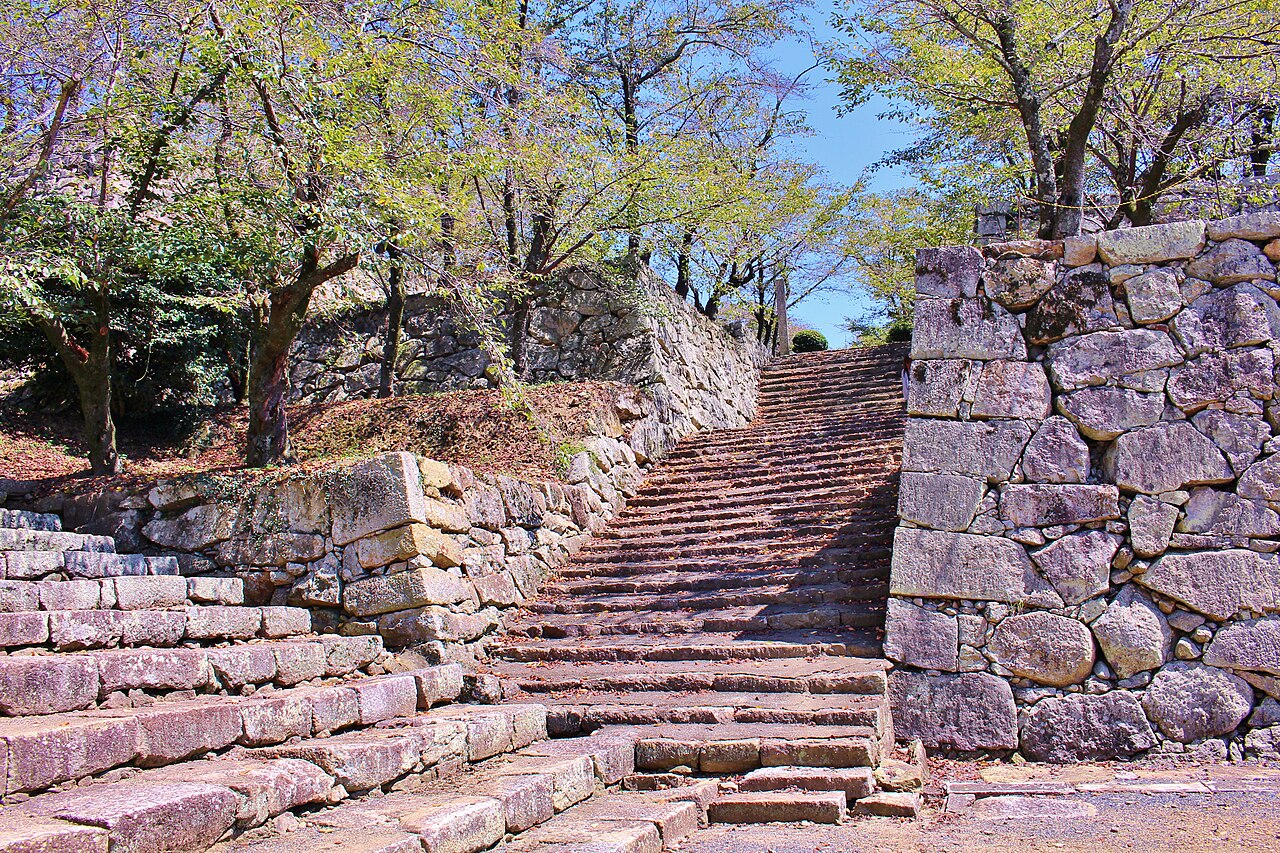
One of the long stone stairways that climb between the ramparts.
Tsuyama also works as an overnight base rather than a quick stop on the way to somewhere else. Staying in town lets you see the castle hill in the early morning before the day warms up, then wander to Shurakuen without watching the clock. If that appeals, look at places to stay in Tsuyama before you set your dates.
Opening hours and admission
The park keeps seasonal opening times: the longest in the warm half of the year, the shortest in winter, and a short closure at the end of December. During the Tsuyama Sakura Festival the park starts earlier in the morning and stays accessible late into the evening, so cherry season is the one time you can be here after nightfall.
| Period | Opening times |
|---|---|
| April to August | 8:40–19:00 |
| March and September | 8:40–18:00 |
| January to February and October to December | 8:40–17:00 |
| Tsuyama Sakura Festival period | 7:30–22:00 |
| December twenty-ninth to thirty-first | Closed |
- Admission: 310 yen for adults (high school age and above); conditions may change, so check official information before visiting.
If you are planning around the table above, note that the festival period is the exception rather than the rule, and that the closing time moves with the season, so an autumn visit ends earlier than a summer one and a winter visit earlier still. Arriving in the morning gives you the fullest day whatever the month.
Where to stay
Disclosure: This post may contain affiliate links. If you book through them, we may earn a commission at no extra cost to you.
What remains: the walls and the view
The castle walls are the heart of the visit. They survive in long runs of fitted stone, climbing the hill in stages, and they are the clearest sign of how substantial this fortress once was. Walk along the base of one rampart and look up, then climb and look back down over the one you have just passed.
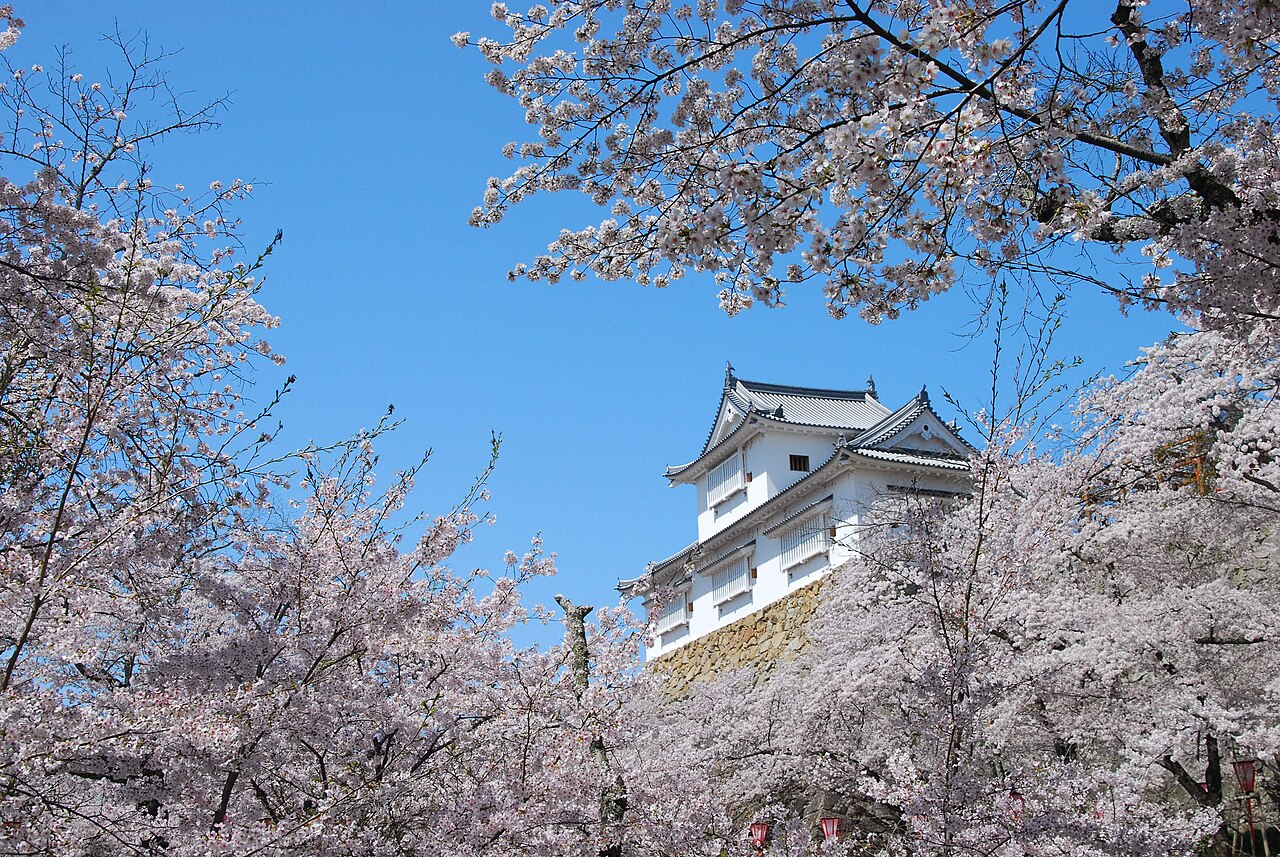
The Bitchu Yagura turret above the ramparts, with the cherry trees in bloom.
The top of the hill is level ground, and that flatness is part of the pleasure: you can wander from one side to the other without effort and take in the whole basin. Below lie the Tsuyama River and the rooftops of the town, with the mountains that ring the basin closing the view on every side.
Cherry trees grow among the ramparts, which is why the festival is held here and why the opening times stretch then. Outside the festival, the same trees are simply green shade over the stone, and the level top of the hill is an easy place to sit with the town at your feet and nowhere else to be.
Shurakuen: the garden beyond the walls
North of the castle site lies Shurakuen, a garden that began as the private grounds of the Matsudaira family, the lords who held Tsuyama until the Meiji Restoration. It is the natural second stop after the hill: where the castle is all stone and height, the garden is water, shade and gentle walking on the flat.
Old trees stand throughout the grounds, and between them are spring-fed water and small pavilions set where the views are best. The whole arrangement has a settled, deliberate elegance, the kind that comes from a garden being tended for generations rather than designed all at once, and it rewards a slow circuit rather than a quick look.
A brief history, then and now
The hill was first fortified in the fourteen-forties, by tradition under Yamana Norikiyo. The castle whose walls survive is later work: in the early sixteen-hundreds Mori Tadamasa rebuilt it on a grand scale, a project that took nine years and was finished in the middle of the sixteen-tens, giving the hill the shape it keeps today.
When the Mori line ended after three generations, Matsudaira Tsunanaga was appointed keeper of the castle, and the Matsudaira ruled Tsuyama as a domain of one hundred thousand koku until the Meiji Restoration. A Meiji-era gazetteer directed visitors north past the silk-reeling company to reach the walls; those are landmarks of their own day, not a route to follow now.
Beyond the castle, if you have time
The old gazetteers that describe Tsuyama also list a handful of sites in the countryside around it. Their distances are given in ri and cho, the old Japanese league and its subdivision, measured from the town of the day, so take them as a sense of direction rather than as walking directions for this afternoon.
About one ri north of the old town, at the foot of Mount Nagara in what was Ichinomiya village, the gazetteers place Nakayama Shrine. It was the first shrine of Mimasaka Province, the ichinomiya, and in the early modern period it held the rank of a national shrine of the middle grade, a mark of its standing in the region.
Due south of the town by about the same distance is Kojinyama. The path from the foot to the top was reckoned at fifteen cho, and on the summit the records note the site of an old castle of the Hanabusa clan, with a former temple site and a pine known as the fuda-matsu on the northern side.
Farther out, two and a half ri north in the former village of Kagami-minami, is Entsuji, a Shingon temple and a branch of Daikakuji, founded by tradition under Kobo Daishi in the early eight-hundreds, with the bodhisattva Kannon as its principal image. These belong to a second day, so if they tempt you, begin with places to stay in Tsuyama.