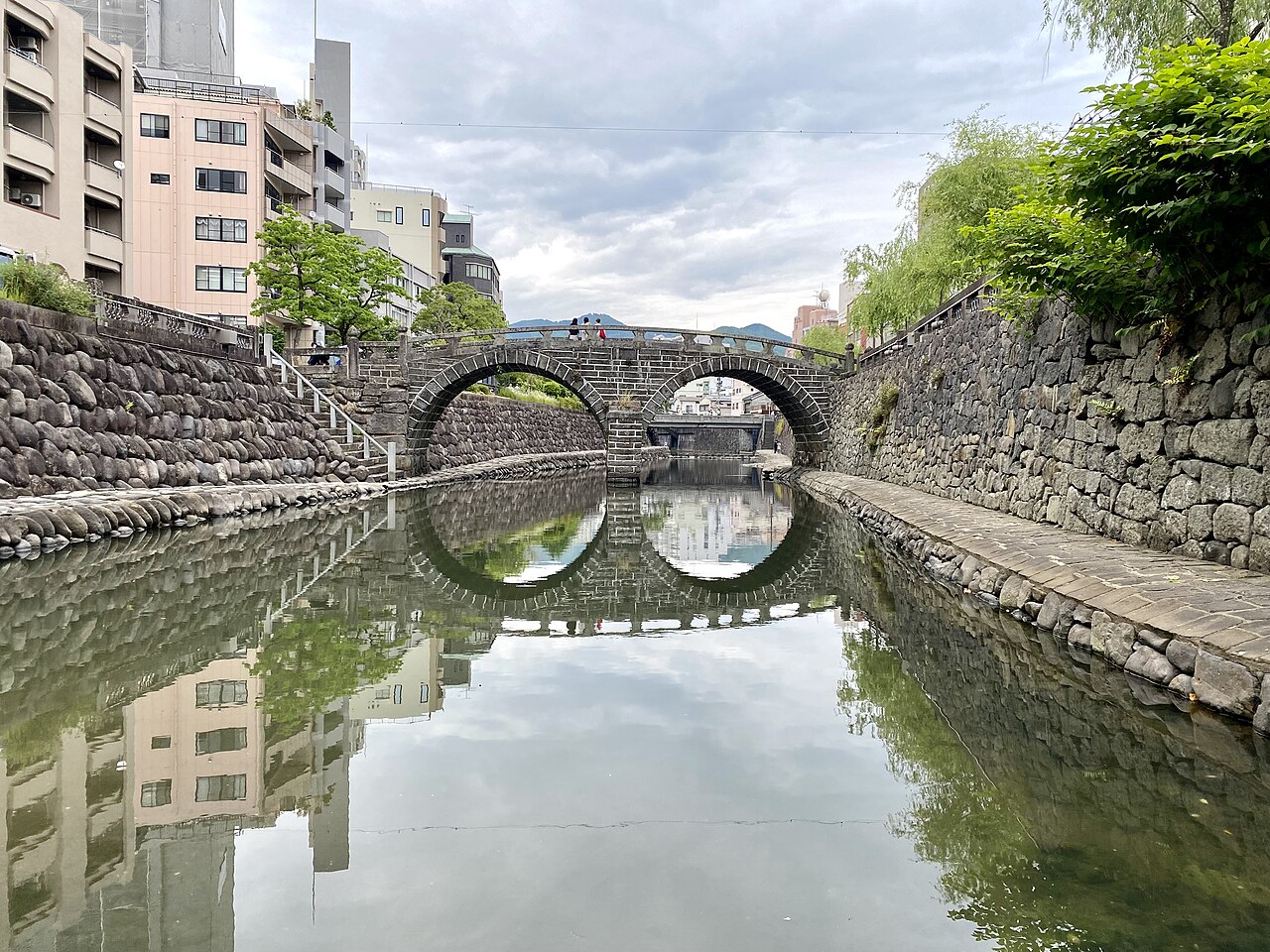
Walking along the water's edge below Spectacles Bridge (Meganebashi) is possible when the river runs low, because steps lead down to the riverside. Meganebashi is a nationally designated Important Cultural Property. At Kofukuji, a wooden fish board hangs at the entrance of the kuri, the building where matcha is prepared. Bats, peonies and peach blossoms, treated as auspicious motifs in China, are carved or painted throughout the grounds of Sofukuji.
Meganebashi and the Stone Bridges of the Nakashima River
Meganebashi spans the Nakashima River, where carp, herons, ducks and softshell turtles can be seen around the water.
Starting at Meganebashi puts a nationally designated Important Cultural Property at the head of the walk. A long-standing tradition holds that a Tang monk who served as chief priest of Kofukuji built the bridge. Following the river also explains the link with the temple, since an arched bridge crosses the Nakashima River on the approach to Kofukuji.
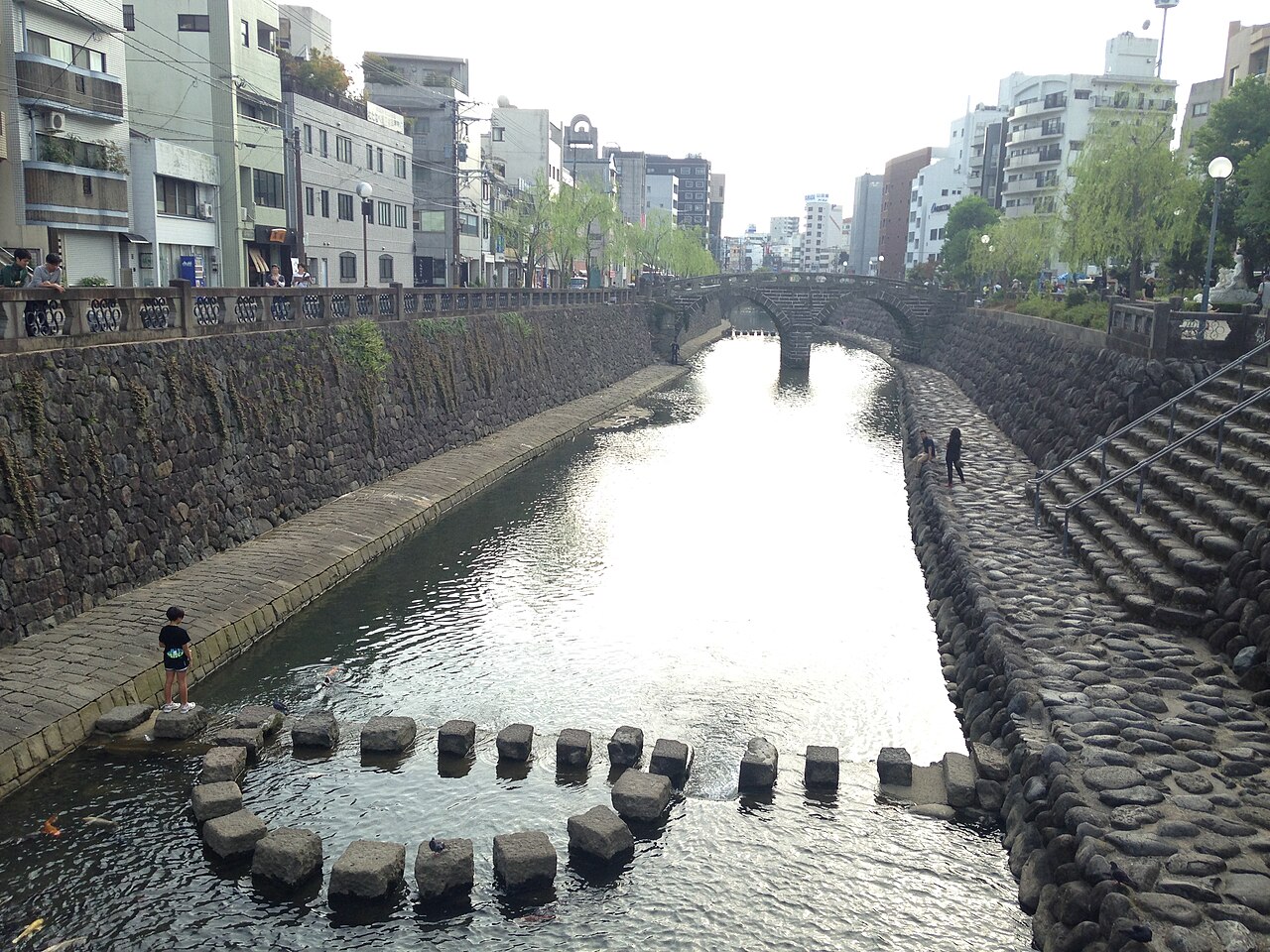
Stepping down to the riverside is possible when the water level is low, because steps lead down to the bank. Visitors can then walk along the water's edge instead of keeping to the street above. Watching the river adds living creatures to the walk, since pigeons, carp, herons, ducks and softshell turtles are seen around the Nakashima River.
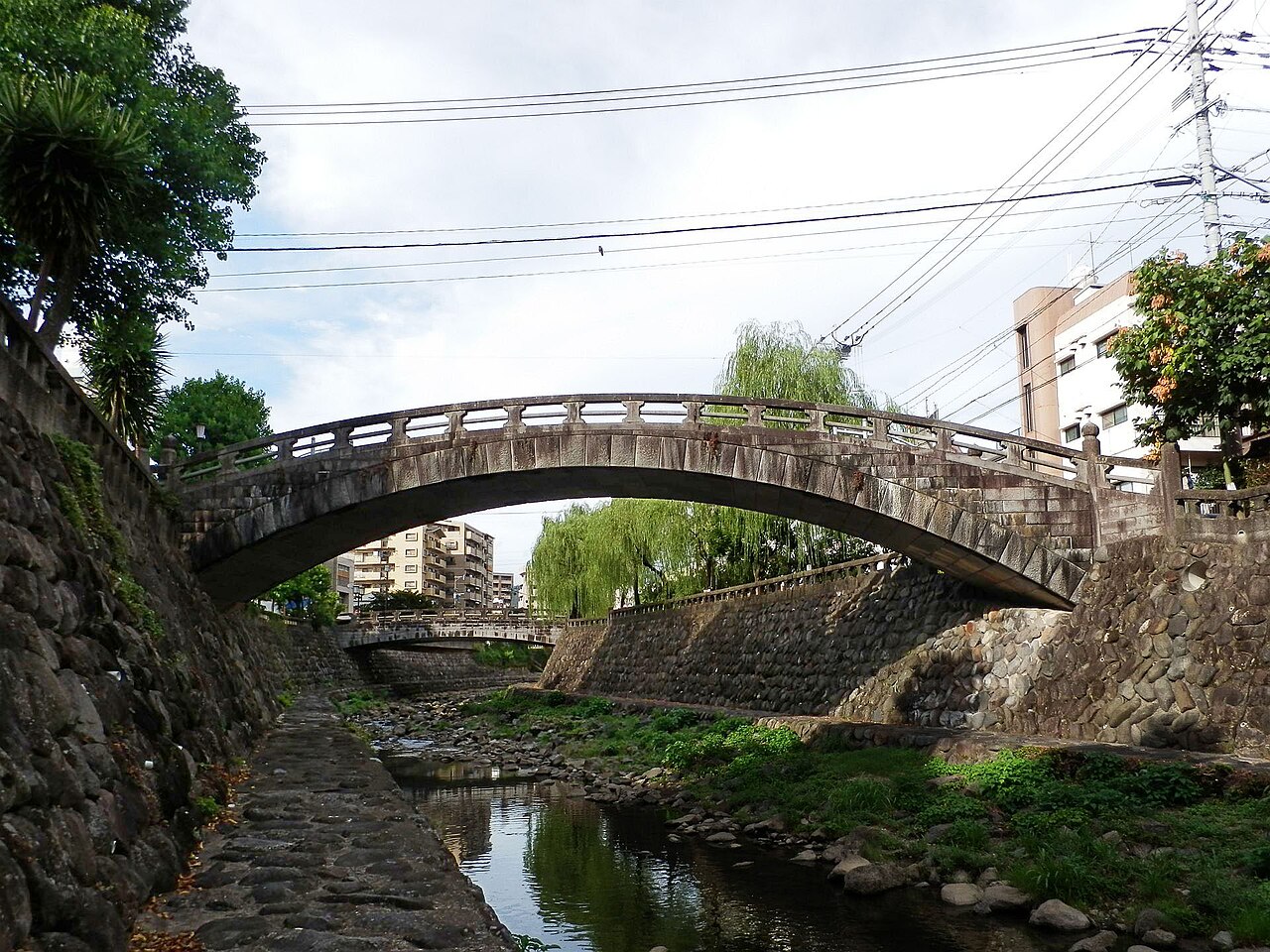
Heading upstream brings a different kind of bridge, Ichinosebashi, a semicircular bridge over a mountain stream upstream of the Nakashima River. Reading the sign at the foot of that bridge gives the distance on the old Nagasaki highway from Nagasaki to Isahaya. The sign ties the bridge to a road as well as to the river, which suits walkers who like a route with a reason behind it.
Kofukuji and Sofukuji: Chinese-Style Temples in Teramachi
Kofukuji holds the Daiyuhoden and a fish board once struck for mealtime, and Sofukuji shows bats and peonies on the doors of its gate.
Walking into Teramachi means following a street where temples stand side by side at the foot of Kazagashira, which overlooks the harbor. Kofukuji began when a monk from China built a small hermitage on the site for prayers for the sea voyage. Looking at the Daiyuhoden shows pillars and beams with carvings of flowers, people, birds and animals, round windows of ice-crack lattice, an arched Obaku ceiling and a gourd-shaped vase ornament on the roof.
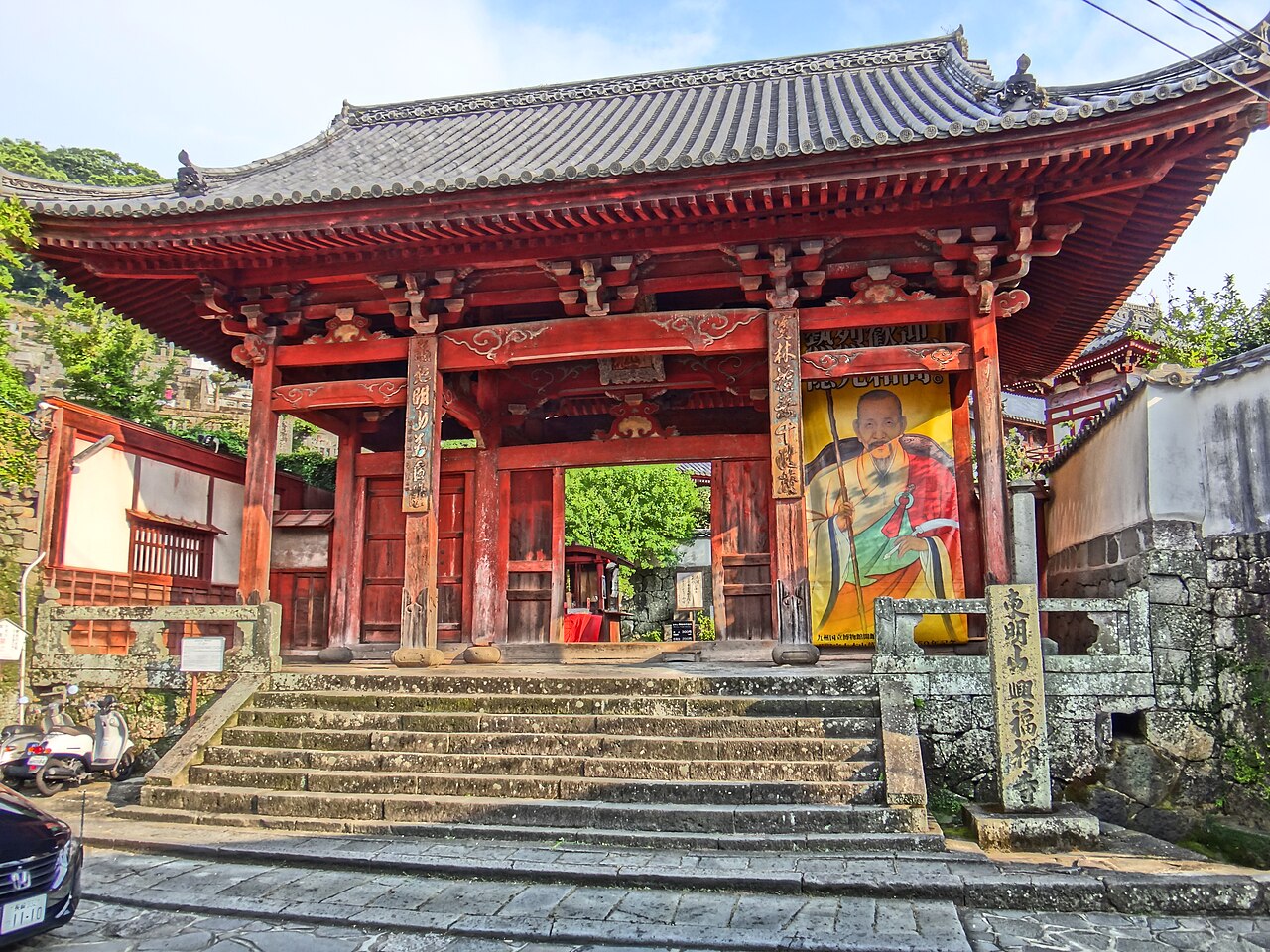
Approaching the Daiyuhoden, visitors find a plaque written by Ingen Zenji hung high on the front outside the hall. Inside, the principal image Shaka Nyorai stands on the platform at the front, with Juntei Kannon Bosatsu and Jizo-o Bosatsu as attendants. The Ruri lantern hangs high in the center of the hall, and glass surrounds it in place of the conventional paper or silk.
Moving on to the Mazu hall brings a building in a mainly Japanese style into view, finished entirely in vermilion inside and out. Obaku-style elements appear as well, such as the Obaku ceiling in the front corridor. The attendant figures of the Mazu hall are normally called the red and blue demons, Senrigan and Junpuji.
Passing the bell and drum tower reveals a building with a bell hung and a drum placed on the upper floor and a Zen hall below. Flower-shaped windows and a railing mark that floor, and the ridge-end roof tiles show a demon face facing outward and a Daikokuten image facing inward. The old Tojin-yashiki gate has a double door, and its inner gate was reserved for distinguished visitors.
Stopping at the entrance of the kuri brings visitors to the wooden fish board, whose proper name is hanpo. The board was struck to tell the monks that it was mealtime. Its shape follows the kechigyo, a fish from China, and the ball held in its mouth means desire that is struck to be spat out. A smaller board hanging beside the large board is female, and a monument with a haiku by Mori Sumio also stands at Kofukuji.
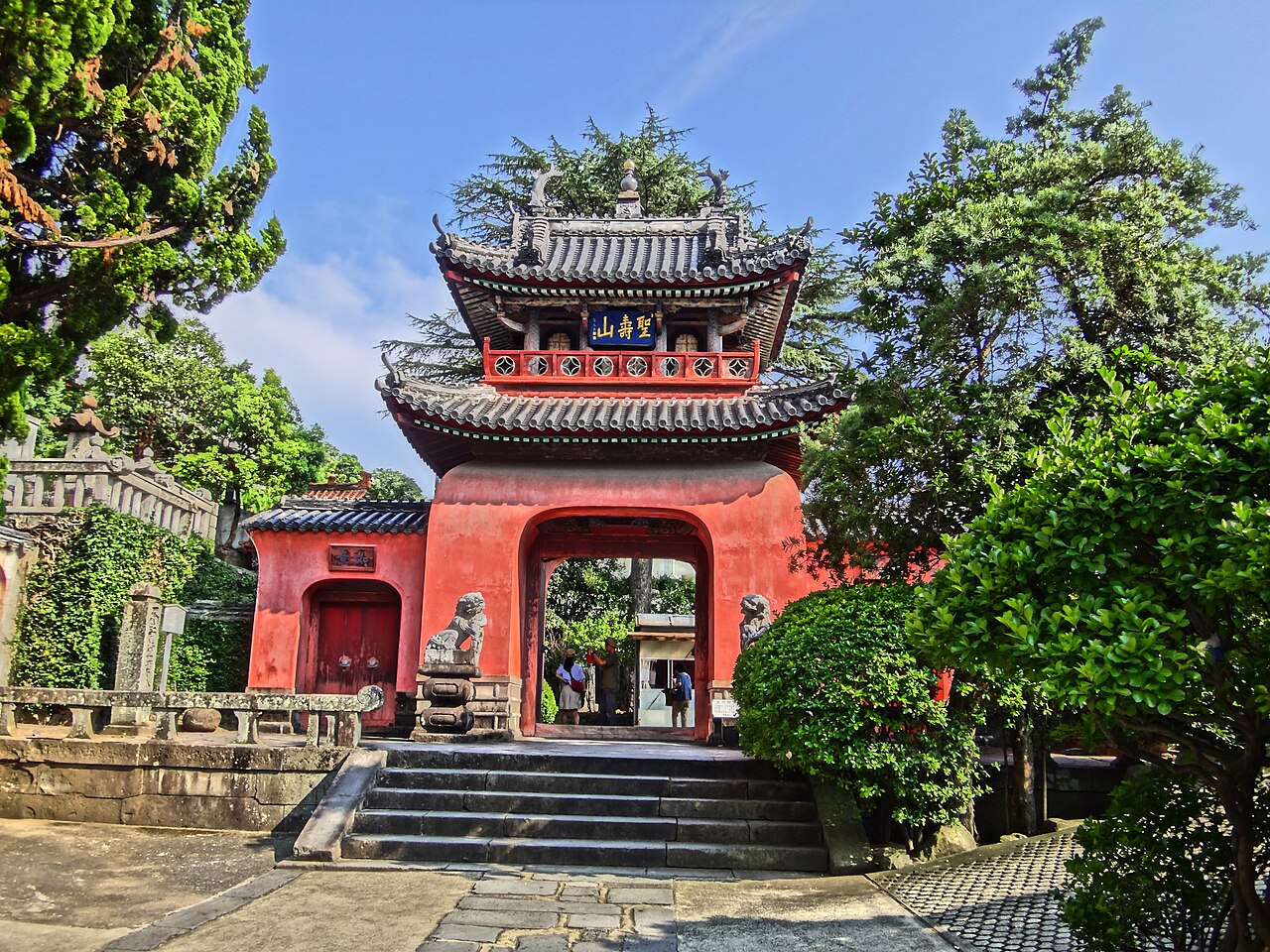
Visitors to Sofukuji see bats, peonies and peach blossoms, motifs treated as auspicious in China, throughout the grounds. A peach is carved on the sleeve stone beside the steps leading to the Daiippomon gate, and a carp climbing a waterfall appears on its back. Bats and peony flowers are painted on the red doors of the gate.
Climbing a stone-stepped slope between the temples leads up to the summit of Kazagashira. Another such slope, beside a temple, appears in the opening and final scenes of a film. The graves of the wife of Siebold and their daughter lie in a temple graveyard reached by climbing such a slope, and a ginkgo listed as a city natural monument grows behind the main hall of another temple.
Matcha and Fucha Cuisine at Kofukuji
Kofukuji prepares matcha in its kuri, and its Fucha ryori menu lists vegetarian dishes.
Sipping matcha at Kofukuji comes with something to look at, as the temple has a small garden with a pond that can be viewed while drinking it. The matcha is prepared in the kuri of the temple. Pairing the drink with the garden gives a pause in a walk that otherwise moves from bridge to hall to gate.
Reading the Fucha ryori menu outlines the Chinese-style vegetarian cuisine of Kofukuji. The menu lists braised tofu cubes, bean sprouts wrapped in yuba, sesame tofu and vegetables in a kudzu starch sauce. It continues with a dressed dish, a deep-fried peach manju and fruit. For an overnight visit after the temples, see places to stay in Nagasaki.
Getting to Meganebashi, Kofukuji and Sofukuji: Walking Times, Hours and Parking
New to rural buses and one-man trains? See how to ride them, step by step.
Details below follow the official guides. With limited time, start at Meganebashi and continue on foot to Kofukuji, as the top row of the table shows.
| Item | Details |
|---|---|
| Meganebashi to Kofukuji | about ten minutes on foot |
| Kofukuji hours | eight in the morning to five in the afternoon, every day in principle |
| Kofukuji parking | free lot on the grounds with space for three cars |
| Sofukuji hours | eight in the morning to five in the afternoon, no closing days |
| Sofukuji tram access | about three minutes on foot from the terminal tram stop named Sofukuji |
| Sofukuji parking | free visitor lot in front of the Sanmon gate with space for ten vehicles |
| Nagasaki Lantern Festival | February five to twenty-one, twenty twenty-seven; the lanterns around Meganebashi are yellow |
For Dejima, the trams and champon, see the Dejima and champon day trip. For Western-style houses on the hill, see Glover Garden.
Thinking of staying overnight?
Compare places to stay near Nagasaki →
Disclosure: This post may contain affiliate links. If you book through them, we may earn a commission at no extra cost to you.