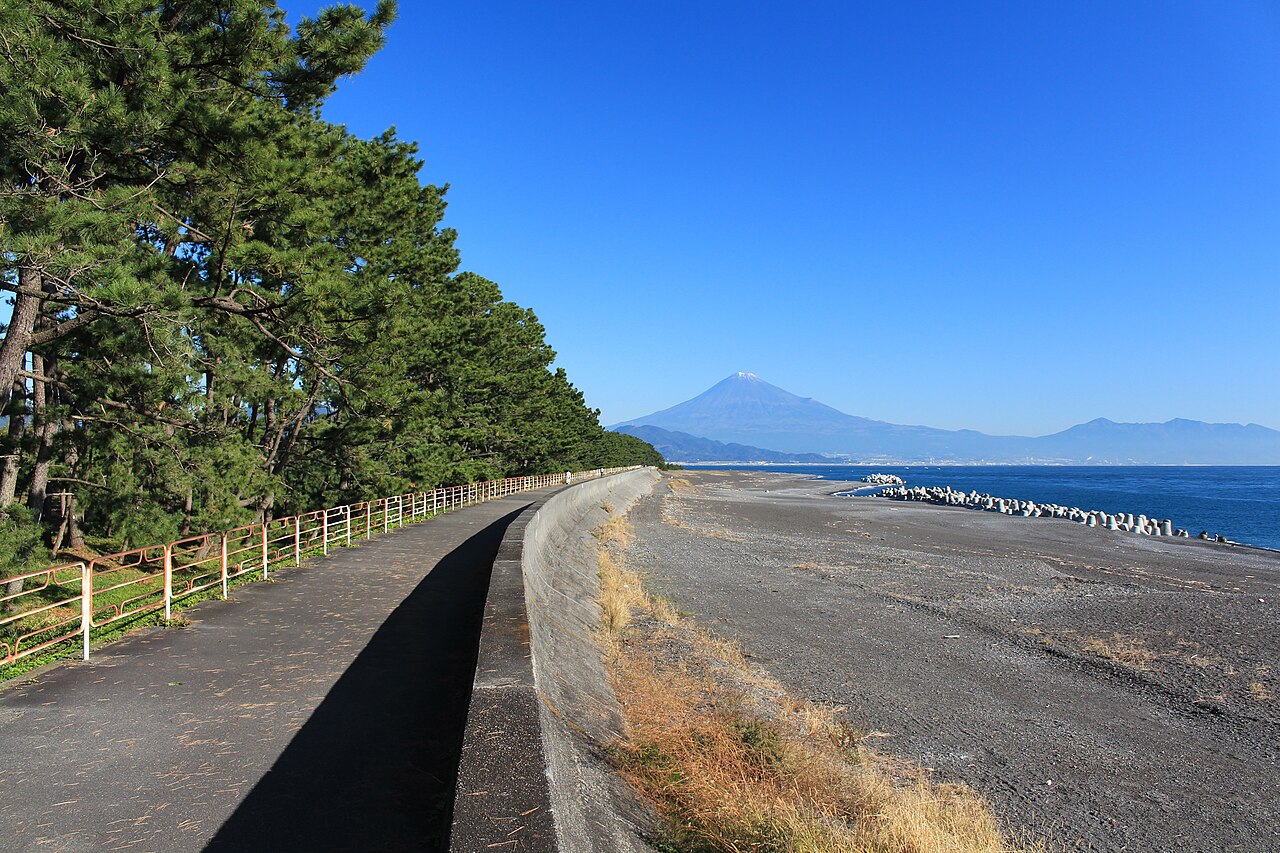
At Miho no Matsubara, a boardwalk called the Kami no Michi runs from in front of Miho Shrine toward the grove, built so that visitors do not step on the pine roots. The grove has always been depicted together with Mt Fuji and has been regarded as an entrance toward the mountain. Come for the walk itself, in which shrine, path, pines and shore follow one another on foot.
Walking the Pine Grove and the Shoreline
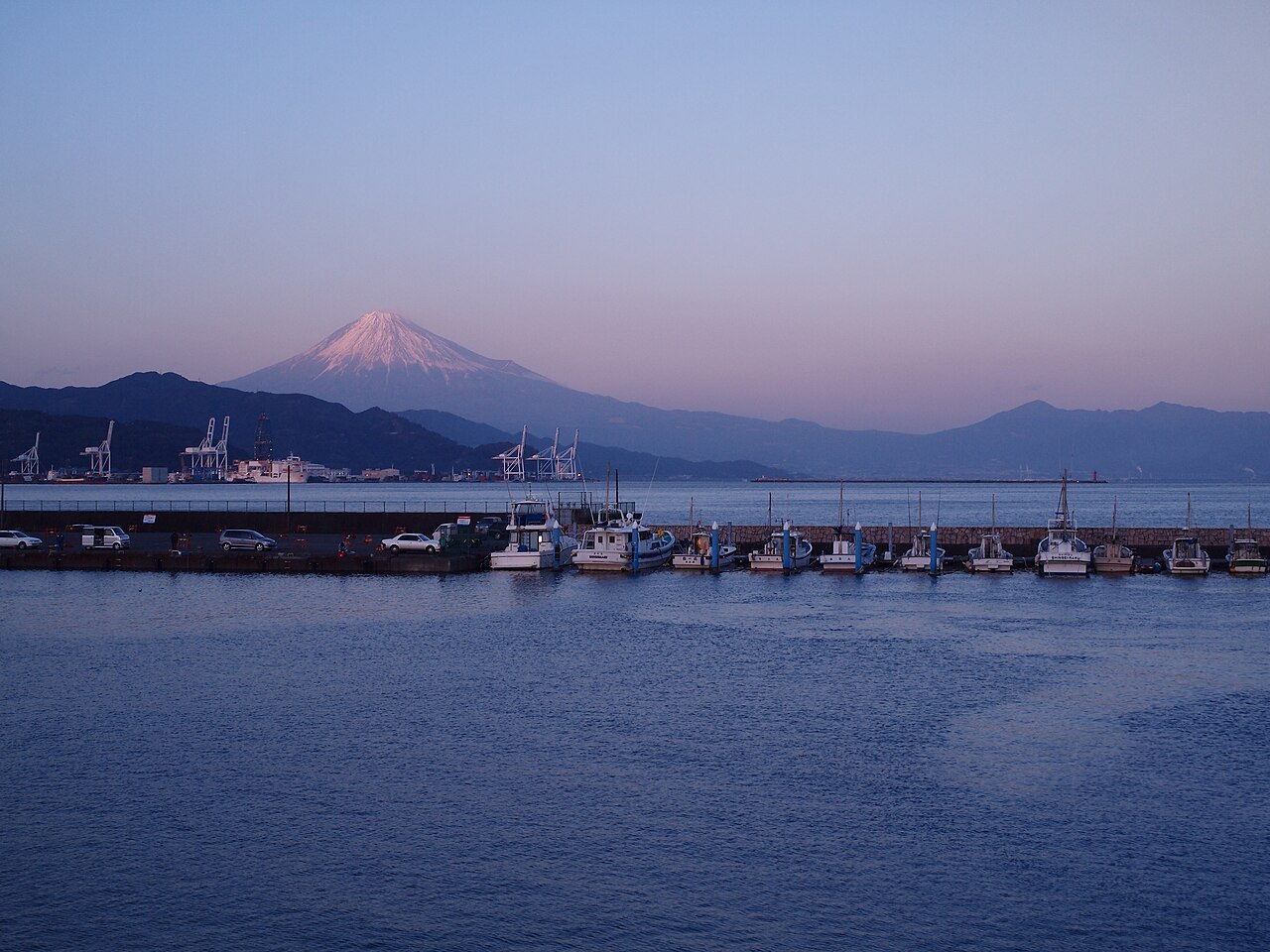
If the aim is Mt Fuji seen over the pines, take the walking path through the grove and come out by the wave-dissipating blocks along the shoreline, where one area guide places the view.
Walking in from Miho Shirube takes visitors among the pines almost at once. A walking path is laid out inside the grove, according to that guide. First follow the path between the trees, then continue toward the shore. Miho no Matsubara is registered as a component part of the World Cultural Heritage listing for Mt Fuji.
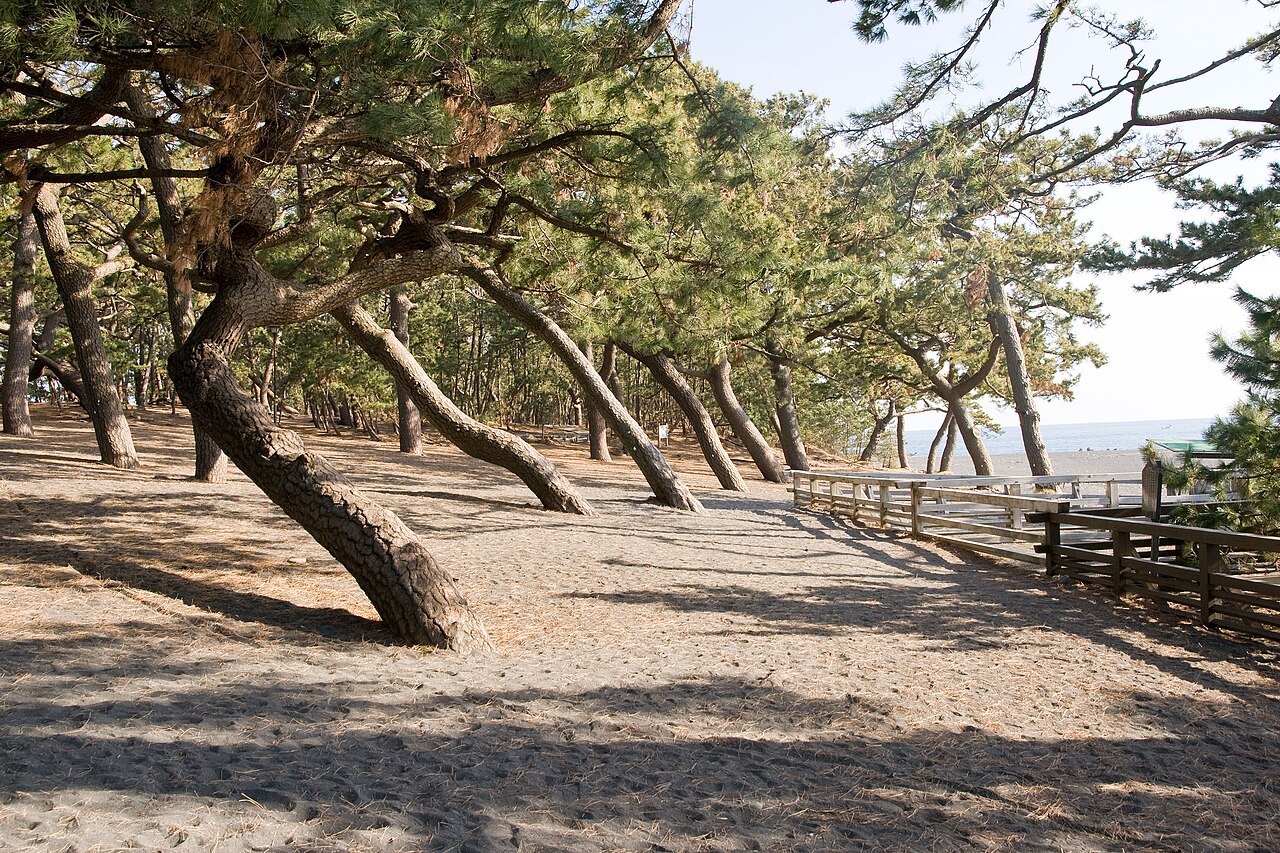
Looking closely at the trees shows more than one kind of pine. Red pines, hybrids of red and black pine and some foreign pines grow here and there among the others. Black pine tends to have harder leaves and thicker bark than red pine. Weeding and pine-needle raking are carried out so that the soil does not become rich.
Following the shoreline a short way to the right leads to the wave-dissipating blocks. The guide names the area around those blocks as the spot from which Mt Fuji can be seen over the pines, on clear days. Next, look back at the setting: pines, sand spit and beach together form the core of the designated scenic area.
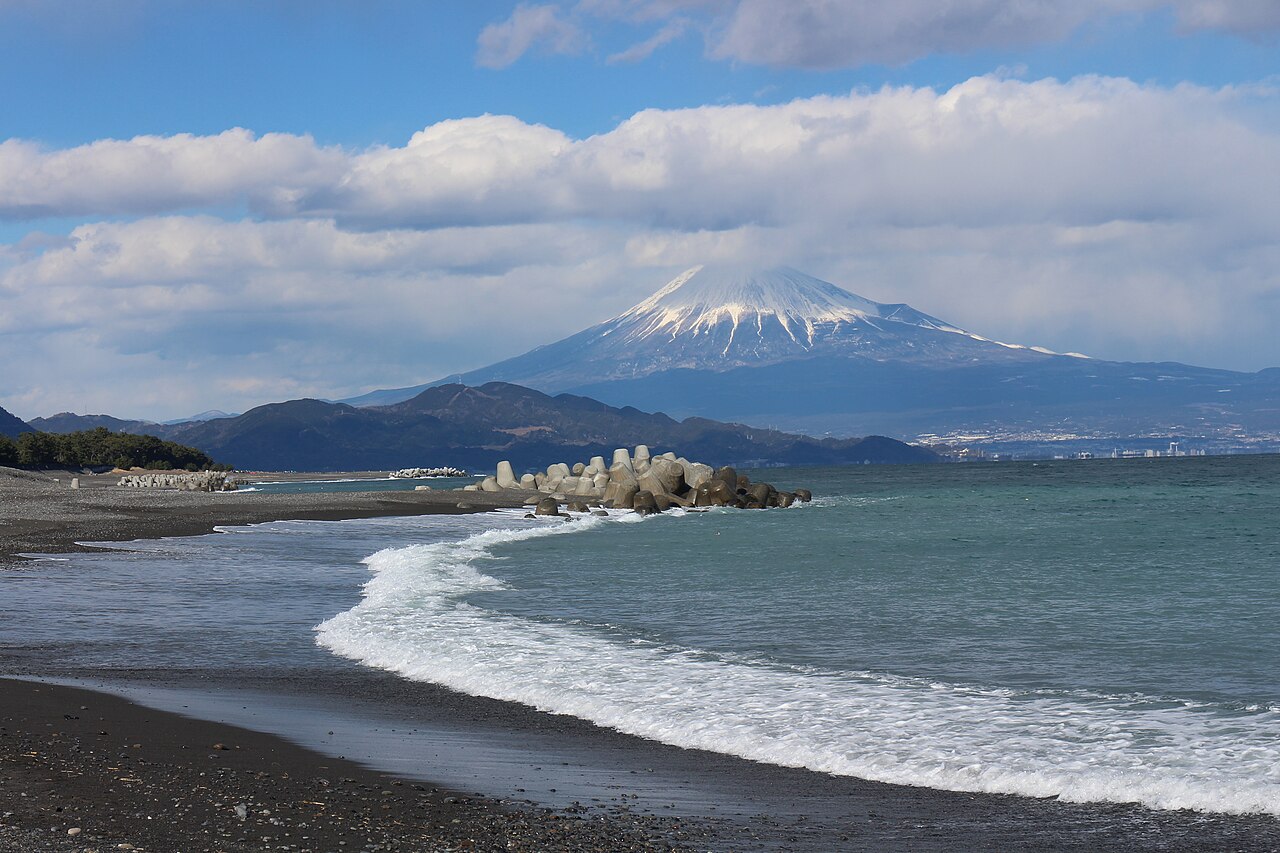
Stepping onto the beach puts visitors on a sand spit, a landform made by the movement of gravel. On the inner sea side, Miho Uchihama beach has relatively calm waves and a swimming area marked by buoys. The music played inside Miho Shirube is an original piece made from sounds collected at Miho no Matsubara.
The Kami no Michi and Miho Shrine
Hagoromo no Matsu, the Kami no Michi and Miho Shrine stand on a single straight line, so start at the shrine and follow the path until it reaches the pines.
Walking from the Miho Matsubara Iriguchi stop brings visitors to Miho Shrine first. The Kami no Michi continues from in front of the shrine toward the grove, lying opposite the shrine. It is the pine-lined path by which the deity who descended to Hagoromo no Matsu is received at Miho Shrine.
Following the Kami no Michi means walking on a boardwalk, built so that visitors do not step on the pine roots. Information boards along it carry songs and stories related to Miho no Matsubara. The pines on both sides are said to be centuries old, and the path is lit up at night.
Stopping at the grant counter, visitors receive ofuda, charms and goshuin. The Miho Matsubara special goshuin commemorates the World Cultural Heritage registration, and the sunrise goshuin is a seasonal one given in winter. Omikuji are available at the worship hall and the Mai-den. Ofuda and charms can also be mailed to people who cannot visit in person.
Hagoromo no Matsu and the Early Hours
For Hagoromo no Matsu with few other tourists nearby, a local travel guide notes that the early morning is the time to choose.
Visiting the pine points to the shrine, which holds what is said to be a fragment of a hagoromo, a feathered robe. The tree stands in line with the Kami no Michi and the shrine. In summer, one travel guide adds, arriving at the very start of the morning may allow a view of Mt Fuji before clouds cover it.
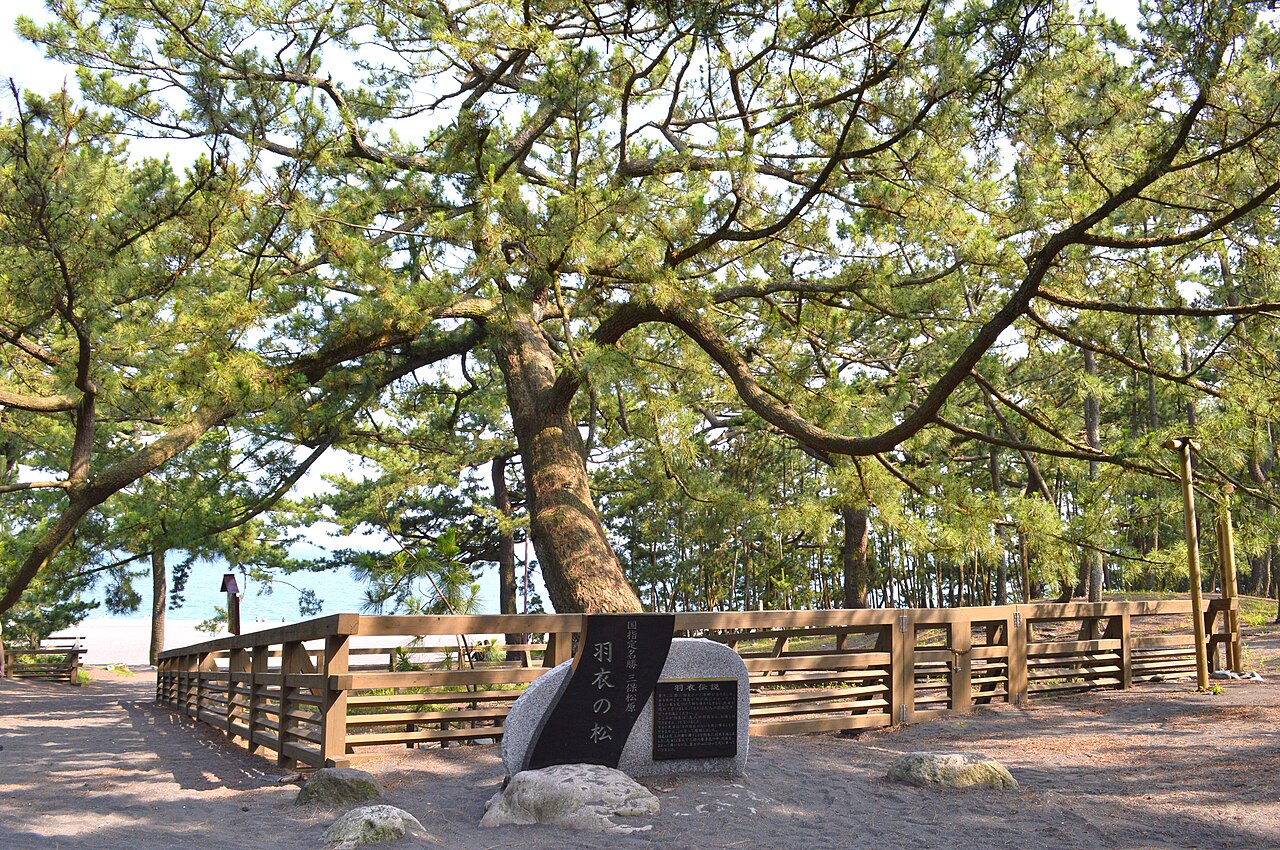
Walking around Hagoromo no Matsu adds to a known pressure on the tree: because many people walk near it, the ground becomes compacted. A conservation project digs up the ground to secure gaps in the soil. Pines grow on land poor in nutrients and in plenty of light, and left entirely to nature they would disappear.
Miho Shirube: Exhibits, Paintings and the Winter Foot Bath
Miho Shirube keeps its exhibits and its library corner through the year, and in winter a foot bath is added on weekends and public holidays.
Touring the exhibits covers the relationship between Mt Fuji and Miho no Matsubara, the Hagoromo legend and works of art. Among the artworks tied to the grove is a pair of hanging scrolls in three panels, with Mt Fuji in the center panel. Another painting shows Mt Fuji, a pine grove and a flying crane.
Asking at the information desk gets guidance on the building, the area around Miho no Matsubara and tourist spots in Shizuoka City. Next, the library corner lets visitors browse books about the grove. The museum shop sells products tied to it, including some sold there and nowhere else. A connecting corridor joins the building to the pines outside.
Soaking in the foot bath is a winter addition, offered on weekends and public holidays. The foot bath uses pine-scented bath salts. It has a roof and can be used in rainy weather.
Volunteering in the grove starts indoors. Visitors who want to take part tell the reception desk and receive garbage bags and work gloves. Miho Shirube also presents the importance of pine grove conservation.
The Peninsula's Edge: the Lighthouse, Kamagasaki and the Coast Cycle Path
The two places at this edge differ in character: the lighthouse is suggested for its silhouette just after sunset, while the Kamagasaki promenade is walked to the sound of waves, as one local page describes them.
Cycling from the pier leads first to the seaside park. Then the Pacific coast cycle path runs along the coast with pines on the right and Suruga Bay on the left. Many people on the Miho peninsula do marine leisure activities such as fishing, sea bathing and canoeing.
Taking the promenade at Kamagasaki comes with the sound of waves, in the words of a hotel's guide page. That page lists Kamagasaki as a place of scenic beauty. It suggests the morning as the time of day for the walk.
Looking for the lighthouse leads to the eastern end of the peninsula, where the hotel's page describes it as small and white. Its weather vane is shaped as a celestial maiden, and it was built as Japan's first reinforced-concrete lighthouse. The page suggests photographing the silhouette immediately after sunset, before the sky gets too dark.
Getting to Miho no Matsubara, Hours and Fees
New to rural buses and one-man trains? See how to ride them, step by step.
The grove lies on the Miho peninsula in Shimizu Ward, and places to stay in Shizuoka are listed for the area.
| Item | Details (as listed) |
|---|---|
| JR Shizuoka Station to JR Shimizu Station | about thirteen minutes by train |
| JR Shimizu Station to Miho Matsubara Iriguchi bus stop | about twenty-five minutes by bus bound for Miho |
| From the bus stop | about fifteen minutes on foot to Miho Shirube; about ten minutes on foot to Miho Shrine |
| By car | about twenty-five minutes from Shimizu IC; the Miho Shirube parking lot holds one hundred seventy-three cars |
| Water bus | one-way adult fare is listed as four hundred yen; about thirty minutes on foot from the pier to Miho Shirube |
| Miho Shirube and shrine office | Miho Shirube is open nine to four thirty with no closing days; the shrine office is open nine to four |
| The pine grove | listed as open twenty-four hours for strolling |
Thinking of staying overnight?
Compare places to stay near Shizuoka, Shizuoka, Japan →
Disclosure: This post may contain affiliate links. If you book through them, we may earn a commission at no extra cost to you.