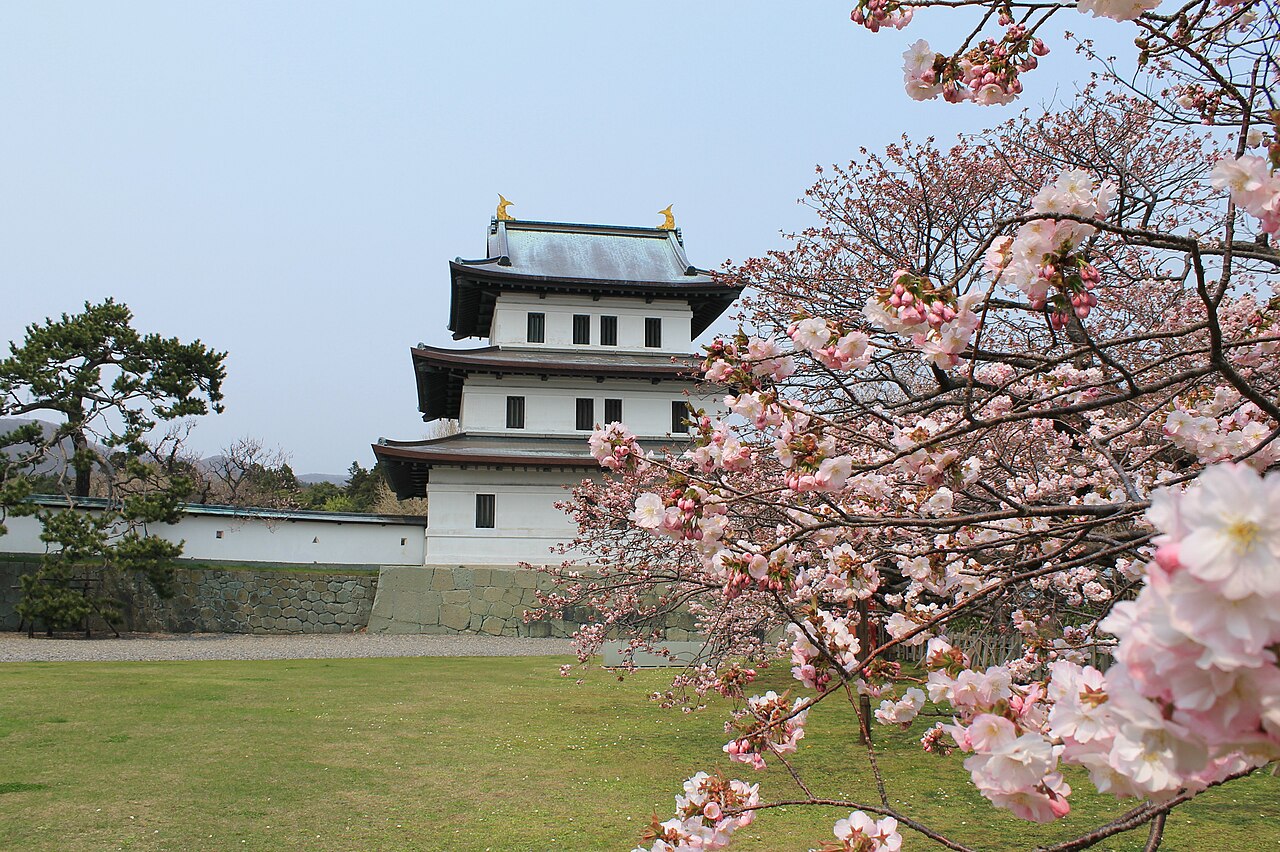
Matsumae is a castle town for doing as much as for looking. You walk a cherry sample garden of about one hundred and ten varieties and look for bullet marks still left in the stone wall of the castle's main gate. You chop dried squid to make your own Matsumae-zuke. Cape Shirakami, the southern tip of Hokkaido, is a short drive from the castle.
Cherry Blossoms in Matsumae Park
Matsumae Park is one of the hundred selected cherry-blossom spots, and its trees bloom in a variety of colours. Among them you find varieties bred in Matsumae town itself.
In the cherry sample garden you walk among about one hundred and ten varieties and three hundred trees, a living encyclopedia of cherry trees. You also walk the cherry blossom avenue, a straight road that runs for about four hundred and fifty metres.
North of Matsumae Castle stand five temples; at Ryuunin-in and Kozenji you view cherry trees counted among the three great cherry trees of Matsumae. The Ketchimyaku-zakura grows in the grounds of Kozenji temple, and the Ezo-kasumi-zakura at Ryuunin-in flowers in a very pale crimson-pink.
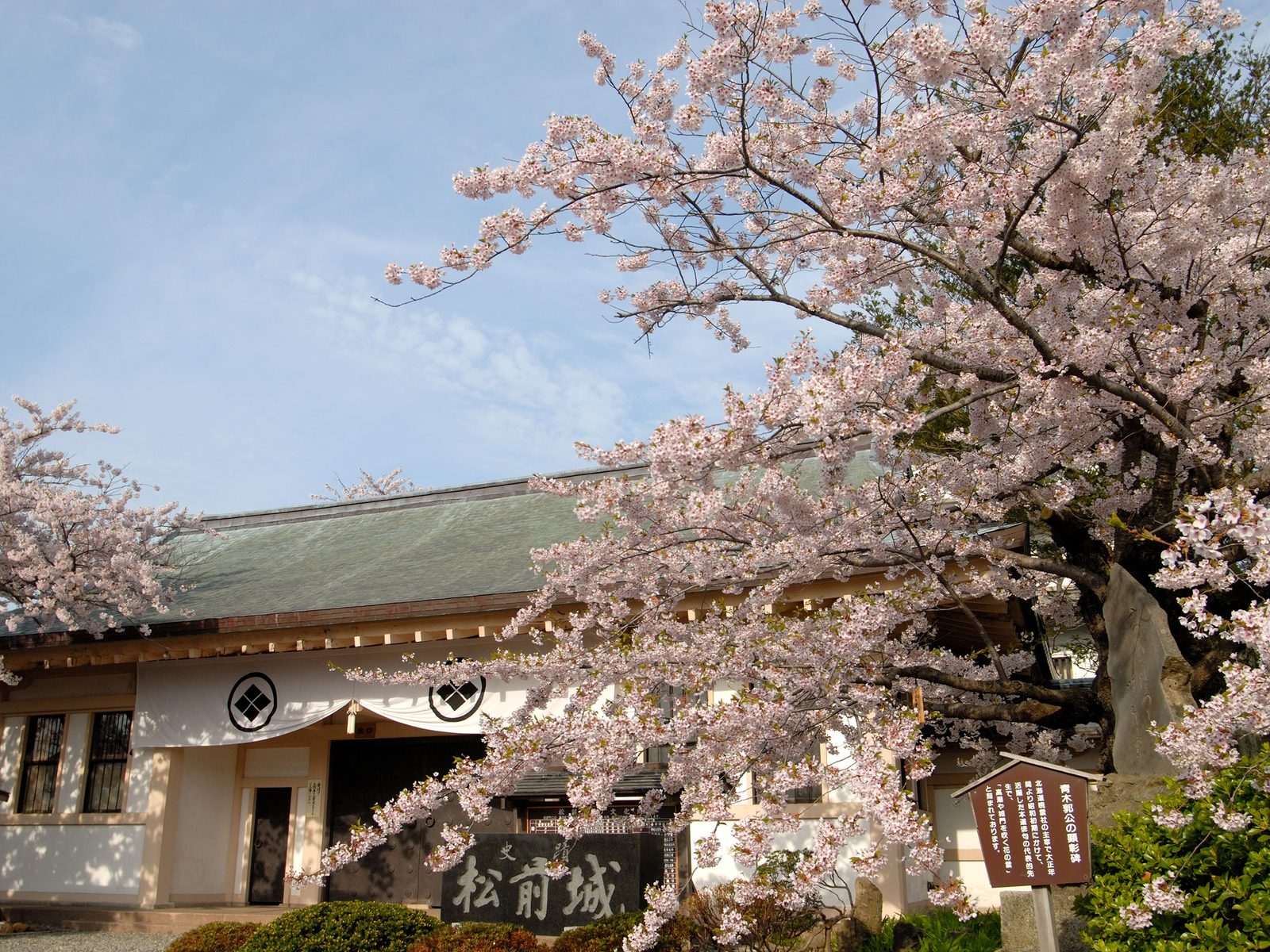
Matsumae Castle and Its Museum
Matsumae Castle, also called Fukuyama Castle, was commissioned by the shogunate and completed as the last Japanese-style castle. Walk up to the main gate and look closely at its stone wall, where bullet marks still remain.
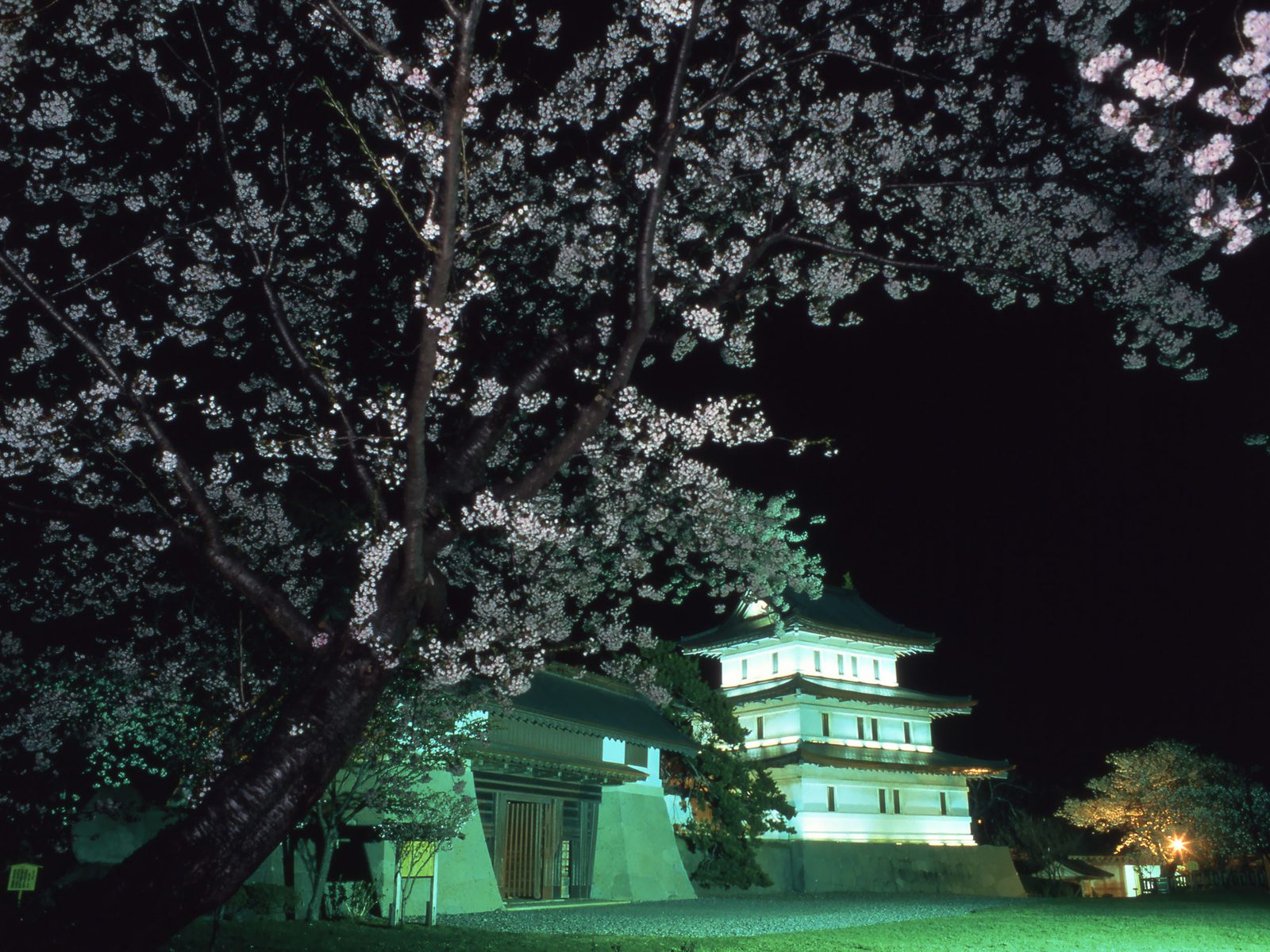
The original keep and the east wall burned down in an early-morning fire that spread from sparks at the town office. A reinforced-concrete replica keep was later built and opened as the Matsumae Castle Museum. Inside, four floors run from one basement level to the third floor above ground, and you move between them by stairs alone.
The Temple Quarter, the Lords' Graves and the Shrine
The town's temples include a Shingon-sect temple that served as the prayer temple of the Matsumae domain. At the Soto-sect family temple of the Matsumae lords you find a mortuary hall to the left of the main hall, where the tablets of the successive lords are enshrined, and visitors are asked to be quiet when visiting.
The graveyard of the Matsumae lords adjoins that temple's grounds and holds fifty-five graves of successive lords and their families, a nationally designated historic site. Many of the stone mausoleums use stone brought from the Hokuriku region by the Kitamaebune, trading ships that sailed from Osaka toward Matsumae. The graveyard is described as a space enveloped in stillness.
Matsumae Shrine stands on the site of the castle's former north bailey and enshrines Takeda Nobuhiro, founder of the Matsumae domain. In its grounds you see a plum tree said to have been granted to the domain by the third Tokugawa shogun Iemitsu, and an Itaya maple whose two trees look as if holding hands. You can also get omamori charms and goshuin stamps.
Costumes, Matsumae-zuke and a Lord's Banquet at the Domain Residence
The Matsumae Domain Residence recreates the castle town with thirteen buildings in all, a theme park that recreates "Matsumae in May". Colourful hydrangeas decorate its water channel. Once you have been dressed in costume, you stroll around inside the residence.
At a shop inside the Domain Residence you make Matsumae-zuke yourself, from chopping the surume, dried squid, to bagging it, and you take home the Matsumae-zuke you made. The instructor is the shop owner, who has made Matsumae-zuke since childhood, and you can also hear about dishes that use it. The session takes about sixty minutes.
You can also sit down to a meal reproduced from documents, the one served at the wedding of the fourteenth Matsumae lord, made up of dishes such as whale soup.
Seafood, Sweets and the Southern Cape
Matsumae-zuke, a Hokkaido local dish, is a preserved food made by cutting dried squid and kelp into thin strips and pickling them in a soy-sauce-based sauce, and it is said to have originated in the Matsumae domain. The seasoning and ingredients differ from shop to shop; buy several kinds in town and compare them by tasting.
Local confectioners make sweets modelled on seafood caught in Matsumae. Look also for a monaka shaped like Matsumae Castle, which comes in two flavours, and a castella-style sweet in which the scent of cherry blossom drifts.
Bluefin tuna caught in the Tsugaru Strait is described as rich in the flavour of its fat and firm in flesh, having grown up in rough waves; you eat it at restaurants in town, and souvenir shops sell tuna blocks. Matsumae rock seaweed is picked by hand one piece at a time, and when you lift the lid of a lunch box its scent wafts softly.
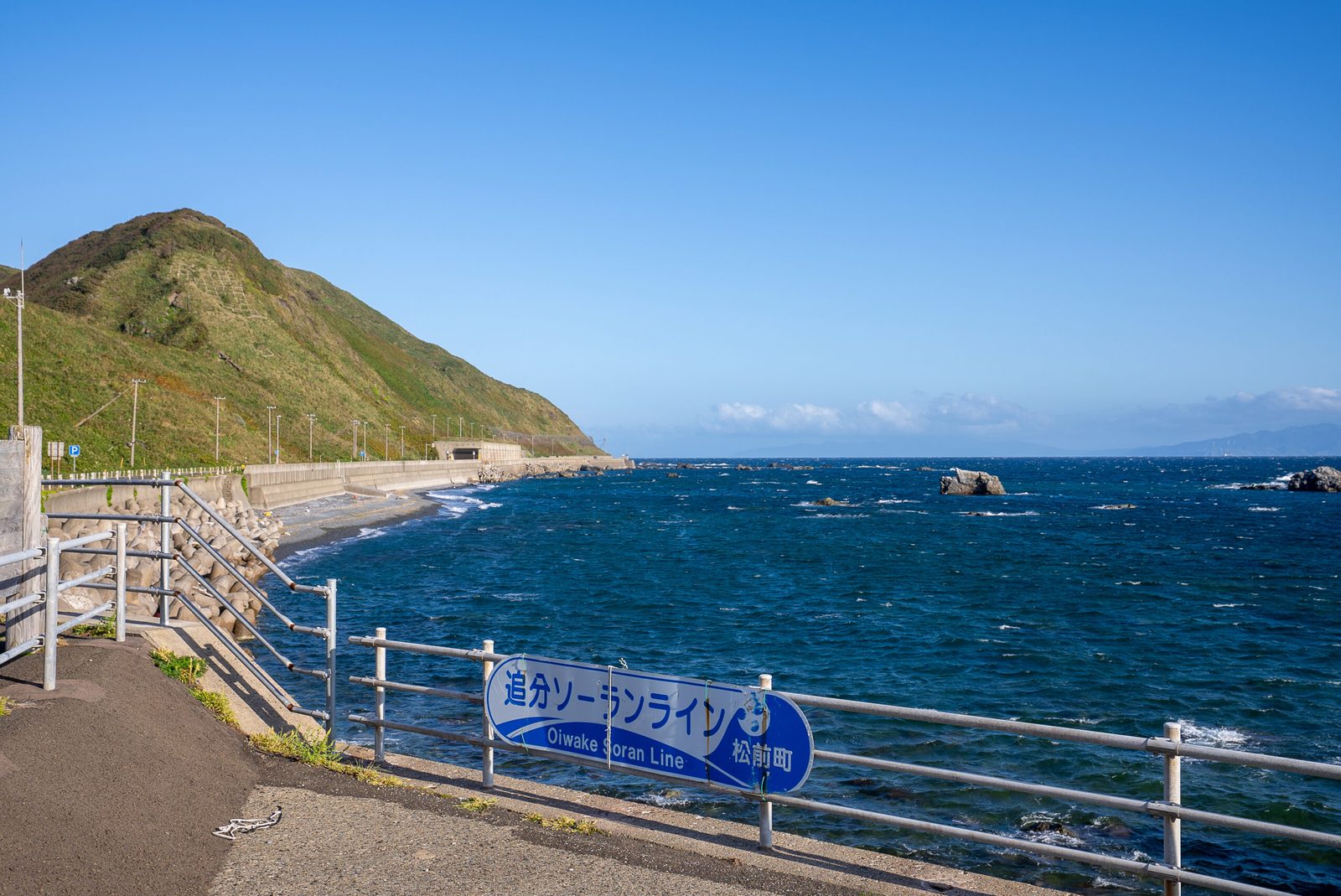
Cape Shirakami is the southern tip of Hokkaido. From here you look across the Tsugaru Strait toward Tappi Cape in Aomori Prefecture, about nineteen point two kilometres away, and on a clear day you see the wind turbines on the opposite shore. To stay the night in town, browse places to stay near Matsumae Castle.
Getting to Matsumae
New to rural buses and one-man trains? See how to ride them, step by step.
| Leg | How | Time or fare |
|---|---|---|
| Hakodate Station to Matsumae | Route bus and rail, one transfer at Kikonai; no direct service | About 3 hours |
| Kikonai Station to Matsumae | Route bus | About 1 hour 30 minutes |
| Hokkaido Shinkansen Kikonai Station to Matsumae | Rental car | About 1 hour |
| Shin-Hakodate-Hokuto Station to Matsumae | Car | About 1 hour 50 minutes, about 90 km |
| Hakodate Bus stop to Matsumae Castle Museum | On foot | About 10 minutes |
| Visitor parking lot to Matsumae Castle Museum | On foot | About 5 minutes |
| Matsumae Castle to Ryuunin-in | On foot | About 4 minutes |
| Matsumae Castle to Cape Shirakami | Car, toward Hakodate | About 14 minutes |
There is no direct service from Hakodate Station to Matsumae; the trip involves one transfer at Kikonai, and from Kikonai you continue by route bus or by car.
Hours and Fees
| What | Hours | Fee or note |
|---|---|---|
| Matsumae Castle Museum | 9:00 to 17:00 | — |
| Matsumae Castle Museum | Last admission 16:30 | — |
| Matsumae Castle Museum | Closed for the winter from December 11 to April 9 | — |
| Matsumae Castle Museum | — | Adults 360 yen |
| Matsumae Castle Museum | — | Children 240 yen |
| Matsumae Town Local History Museum | April 10 to December 10 | — |
| Matsumae Town Local History Museum | 9:00 to 17:00; last admission 16:30 | — |
| Matsumae Domain Residence | 9:00 to 17:00; last admission 16:30 | — |
| Matsumae Domain Residence | — | Adults 360 yen; junior high school students and younger 240 yen |
| Costume experience | — | 500 to 2,000 yen per person, tax included |
| Costume experience | — | 40 to 60 minutes |
| Matsumae-zuke making | Mainly 14:00 to 16:00 | — |
| Matsumae-zuke making | — | 2,500 yen per person, tax included |
| Matsumae lord's cuisine experience | — | 6,600 yen per person, tax included |
| Storyteller guide, Domain Residence course | — | About 30 to 45 minutes; 1,000 yen per person, tax included |
| Storyteller guide, history course | — | About 90 minutes; 2,000 yen per person, tax included; admission charged separately |
| Storyteller guide | — | Advance reservation; groups of two or more people |
Fees and hours were checked against official sources between 12 October 2026 and 6 November 2026.
The castle museum closes for the winter; check the Domain Residence's winter schedule before you go.
Thinking of staying overnight?
Compare places to stay near Matsumae, Hokkaido →
Disclosure: This post may contain affiliate links. If you book through them, we may earn a commission at no extra cost to you.