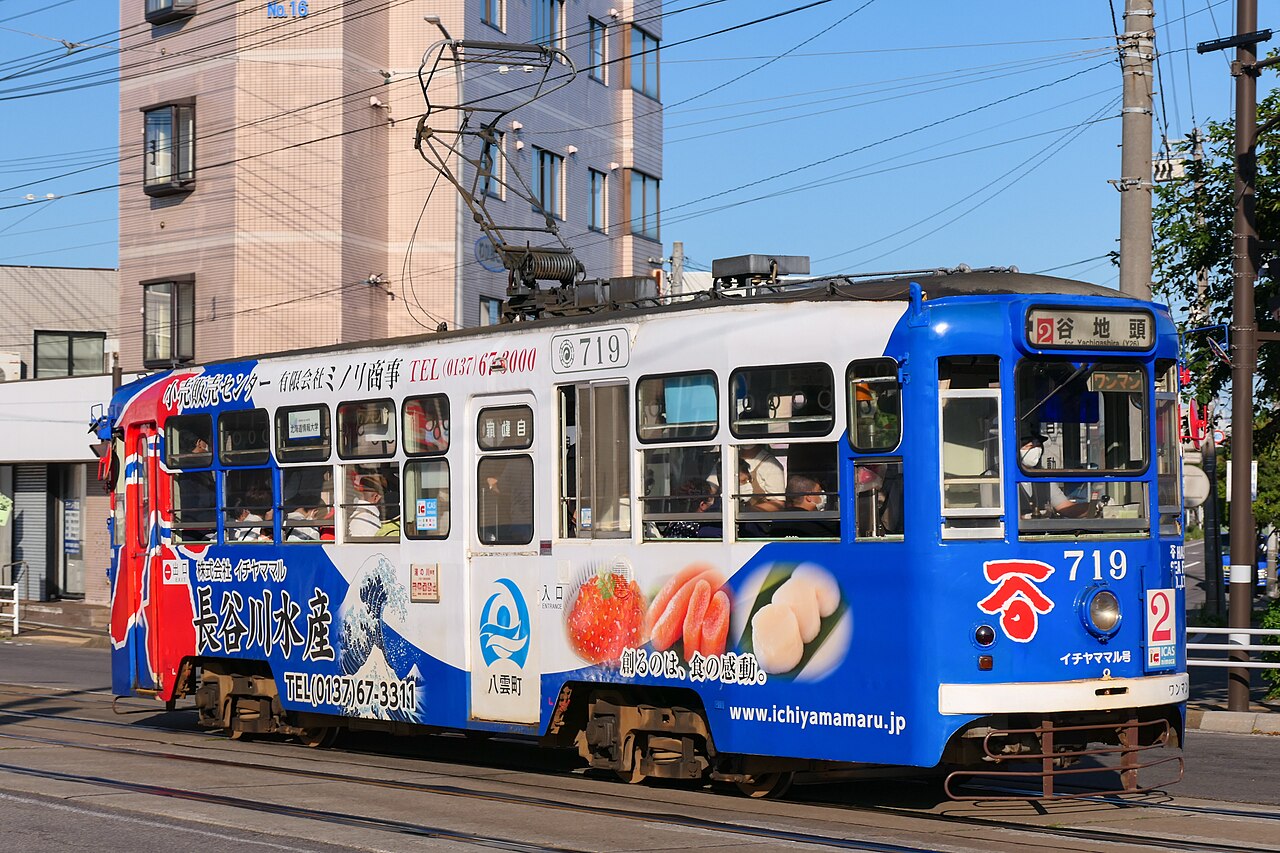
Hakodate rewards a slow day. Its sights fall into five areas: Motomachi with its churches and the Old Public Hall, Mount Hakodate, the Bay Area with its red-brick warehouses, the Morning Market, and Goryokaku Park. Four of them sit close enough together to walk between; only Goryokaku lies apart, out along the tram line, so the tram carries you between the clusters and your feet do the rest.
How the tram works
The stops stand in the middle of the road, so you cross at a crosswalk to reach the platform; each direction has its own platform, and the station numbering tells you which side to wait on. Board through the entrance and take a numbered ticket. When you get off, read the fare on the display at the front, then drop the ticket and coins into the fare box or tap a transit IC card on the reader. ICAS nimoca and the other major IC cards are accepted.
Fares are set by distance, and a child pays one hundred thirty yen for a ride of up to two kilometers.
| Distance ridden | Adult fare |
|---|---|
| Up to two kilometers | Two hundred fifty yen |
| Up to four kilometers | Two hundred seventy yen |
| Over seven kilometers | Three hundred yen |
Motomachi: the slopes and the Old Public Hall
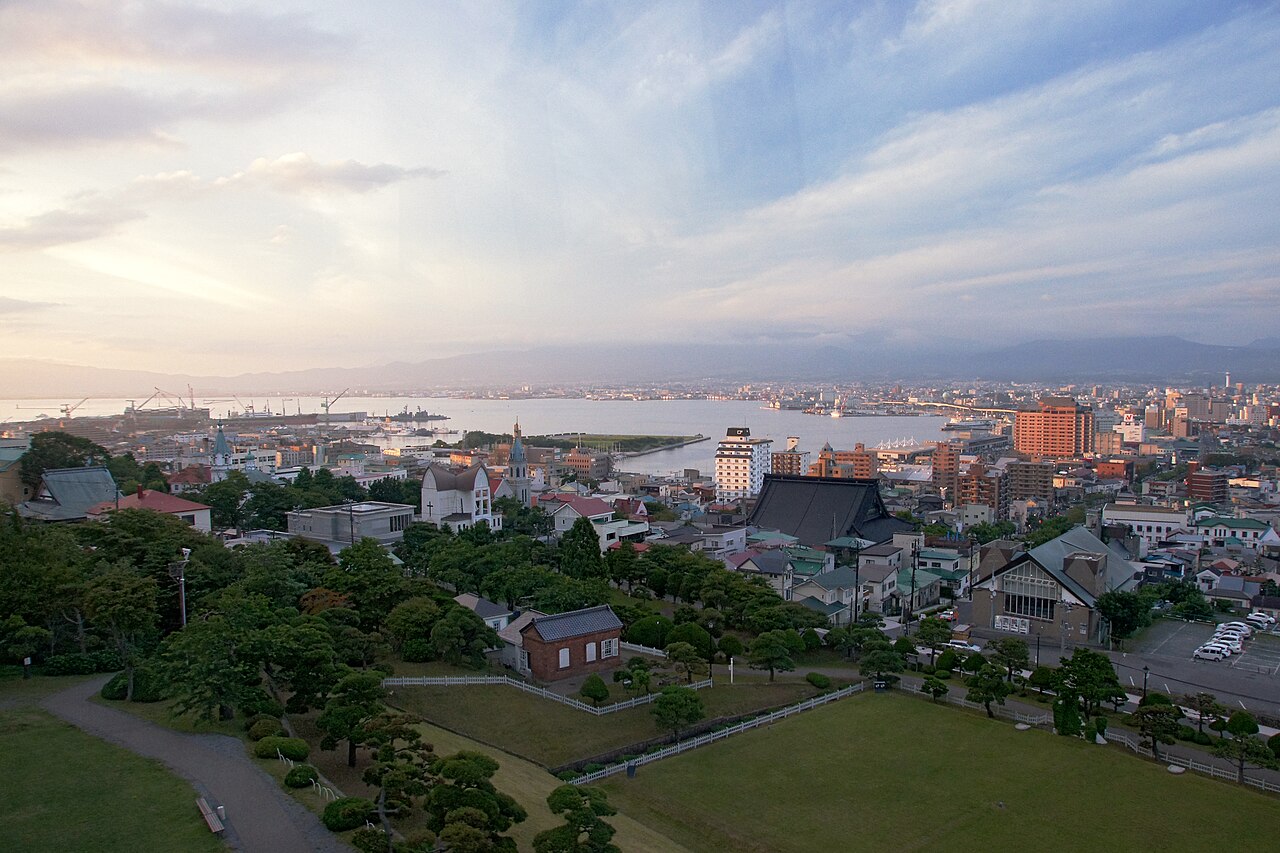
Get off at Suehirocho. Nineteen slopes climb from the tram street into the western district, each a proper climb up to Motomachi. From Hachiman-zaka you look back down to the bay and the moored ship Mashu-maru; from Motoi-zaka the view frames the Old Public Hall with Mount Hakodate behind it. The district is protected as a historic preservation area, and buildings that matter to the streetscape carry a registration plate on the wall.
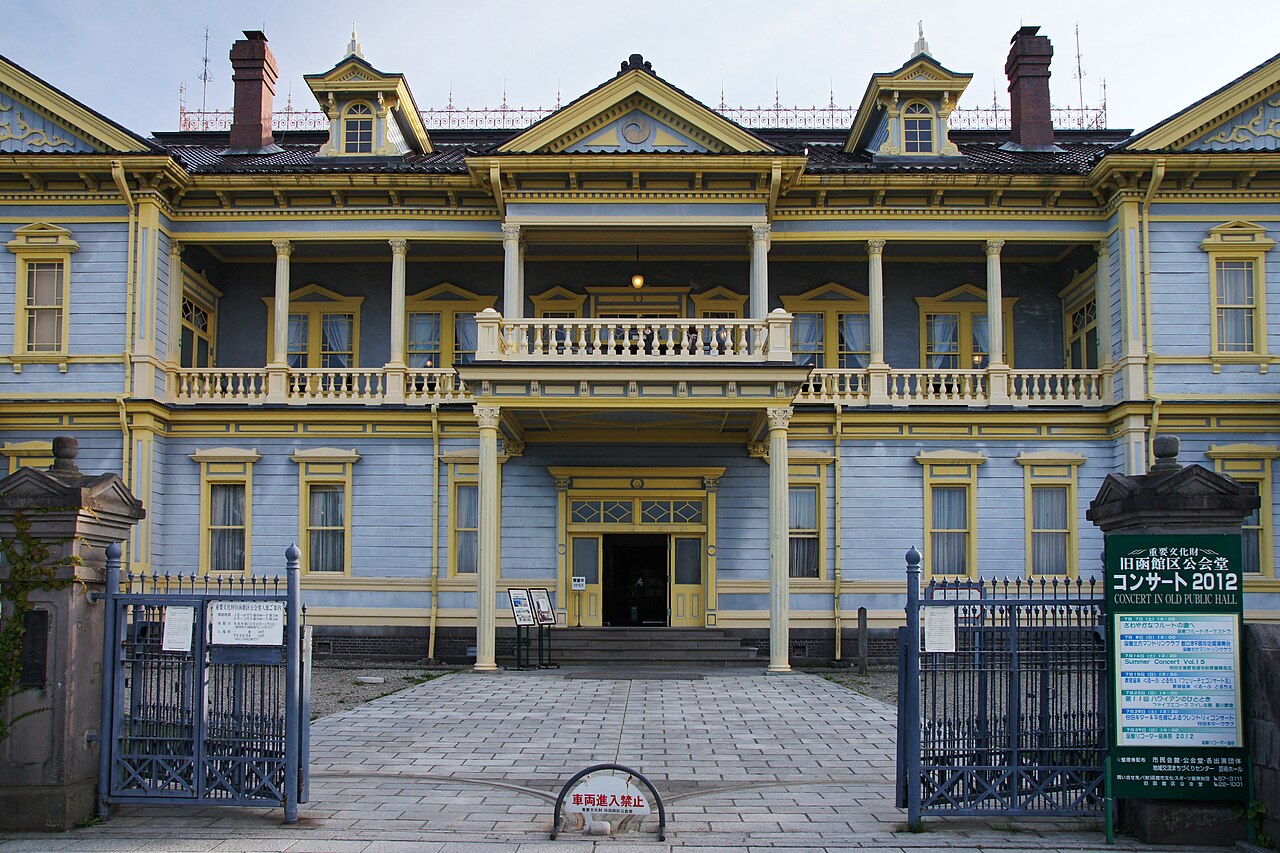
The Old Public Hall of Hakodate Ward is about a seven-minute walk from the Suehirocho stop, and admission is three hundred yen. Its symmetrical front pairs lemon yellow with blue-grey, and the balcony between the Corinthian columns looks straight out over Hakodate Bay. Inside, the ground floor keeps the old dining hall and offices, and the upper floor opens into a great hall hung with chandeliers. The wooden hall dates from the Meiji era and reopened after a full restoration in the spring of twenty twenty-one.
Two more buildings round out the morning: the Former Soma Residence, a merchant's private home in a blend of Japanese and Western styles and an Important Cultural Property, and the Former British Consulate, now a small museum on the opening of the port with a cafe and a shop of British imports.
Motomachi's churches
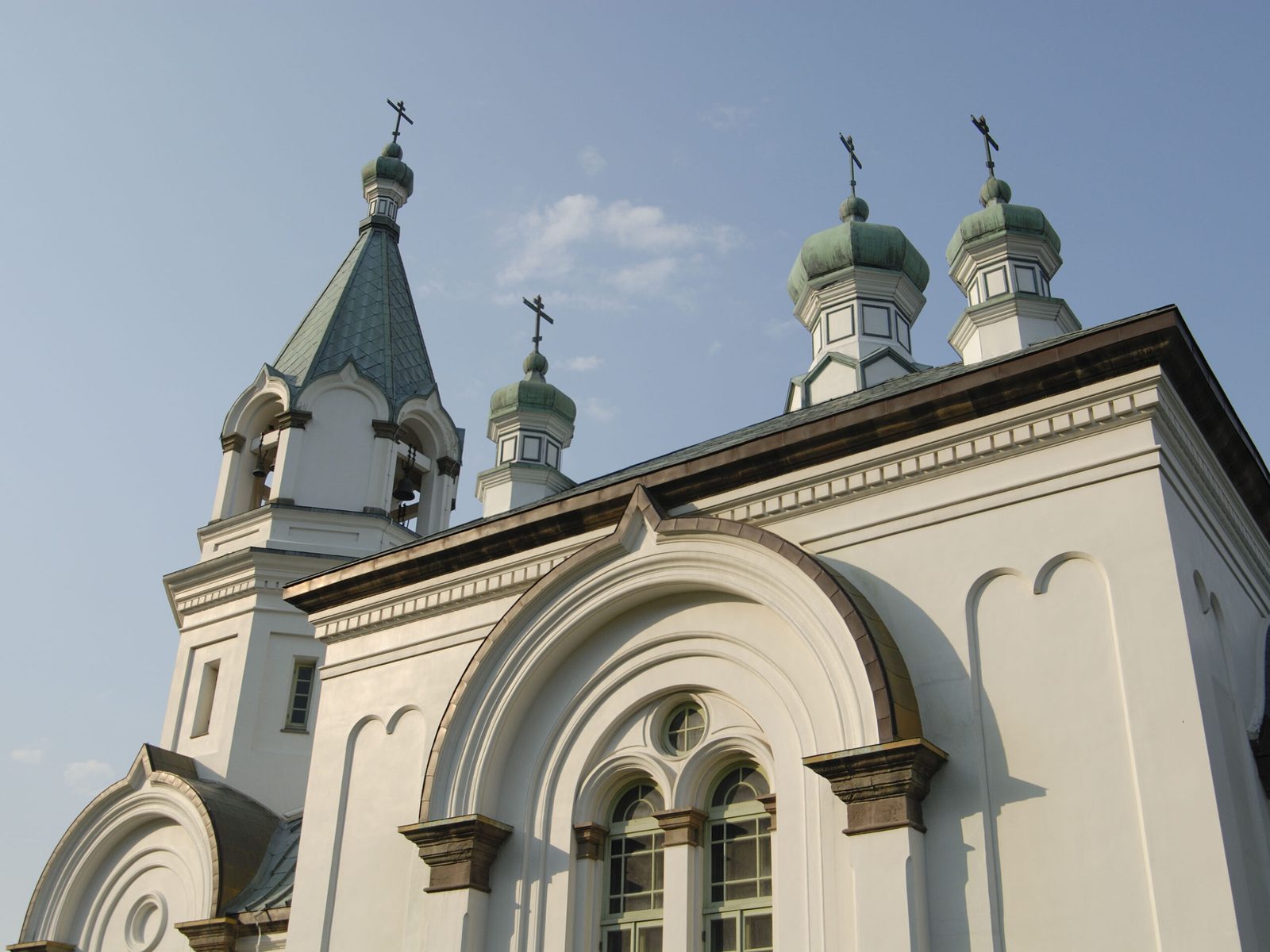
The Hakodate Orthodox Church is about a ten-minute walk from the Jujigai stop. Its white walls and green roof, crowned with six onion domes, follow the Russian Byzantine style, and the building is an Important Cultural Property. Locals call it Gangan-dera, the clanging temple, for its bells, whose sound is listed among Japan's hundred notable soundscapes. Beside it runs the slope called Chacha-nobori, said to be so hard a climb that everyone bends forward like an old man, which is what chacha means.
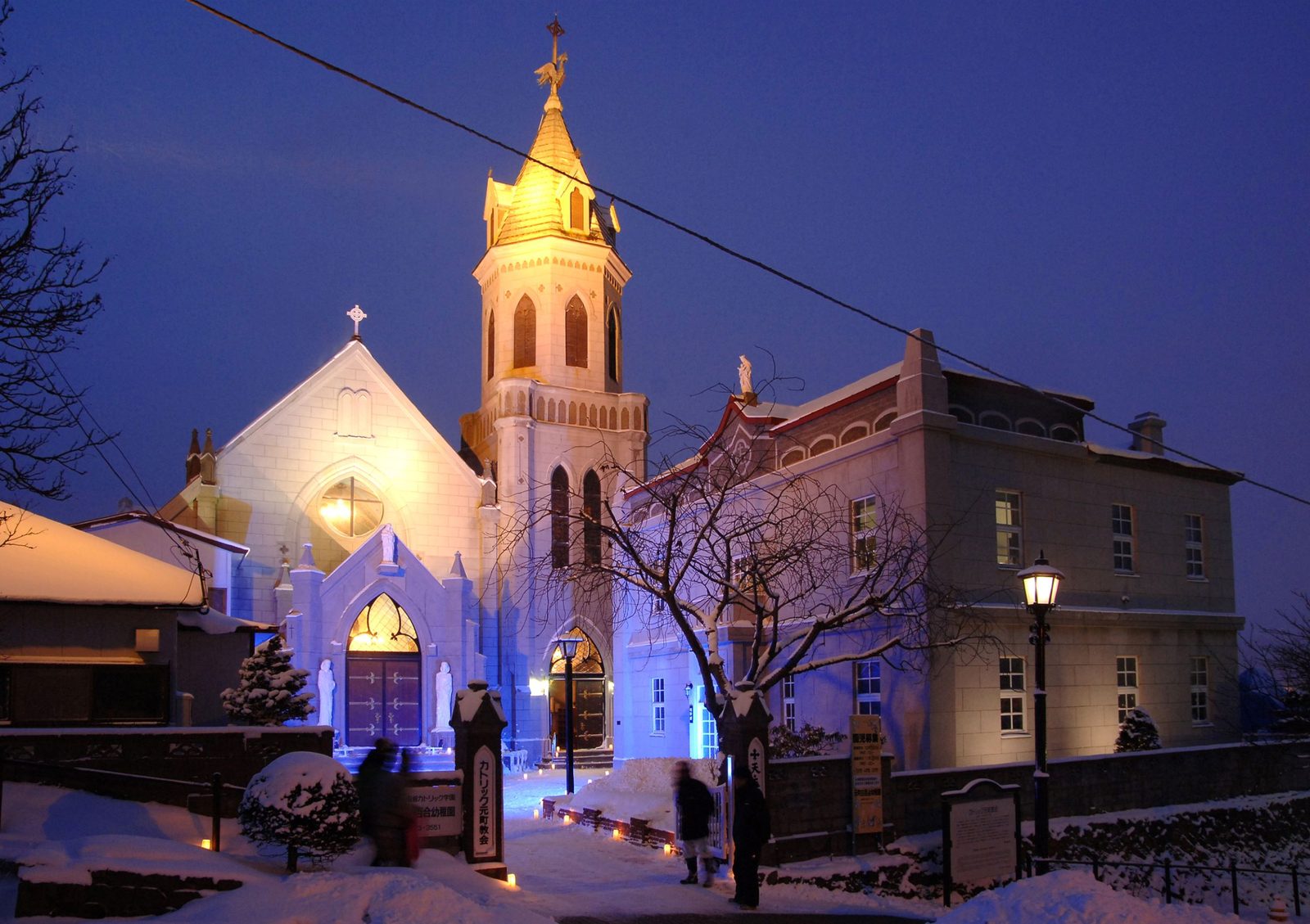
At the top of Hachiman-zaka is the Catholic Motomachi Church, a red roof with a tall blue bell tower. It is the oldest Catholic church in Japan; the altar was a gift from Pope Benedict the Fifteenth, and the ceiling is painted deep blue and scattered with stars.
Down to the Bay Area
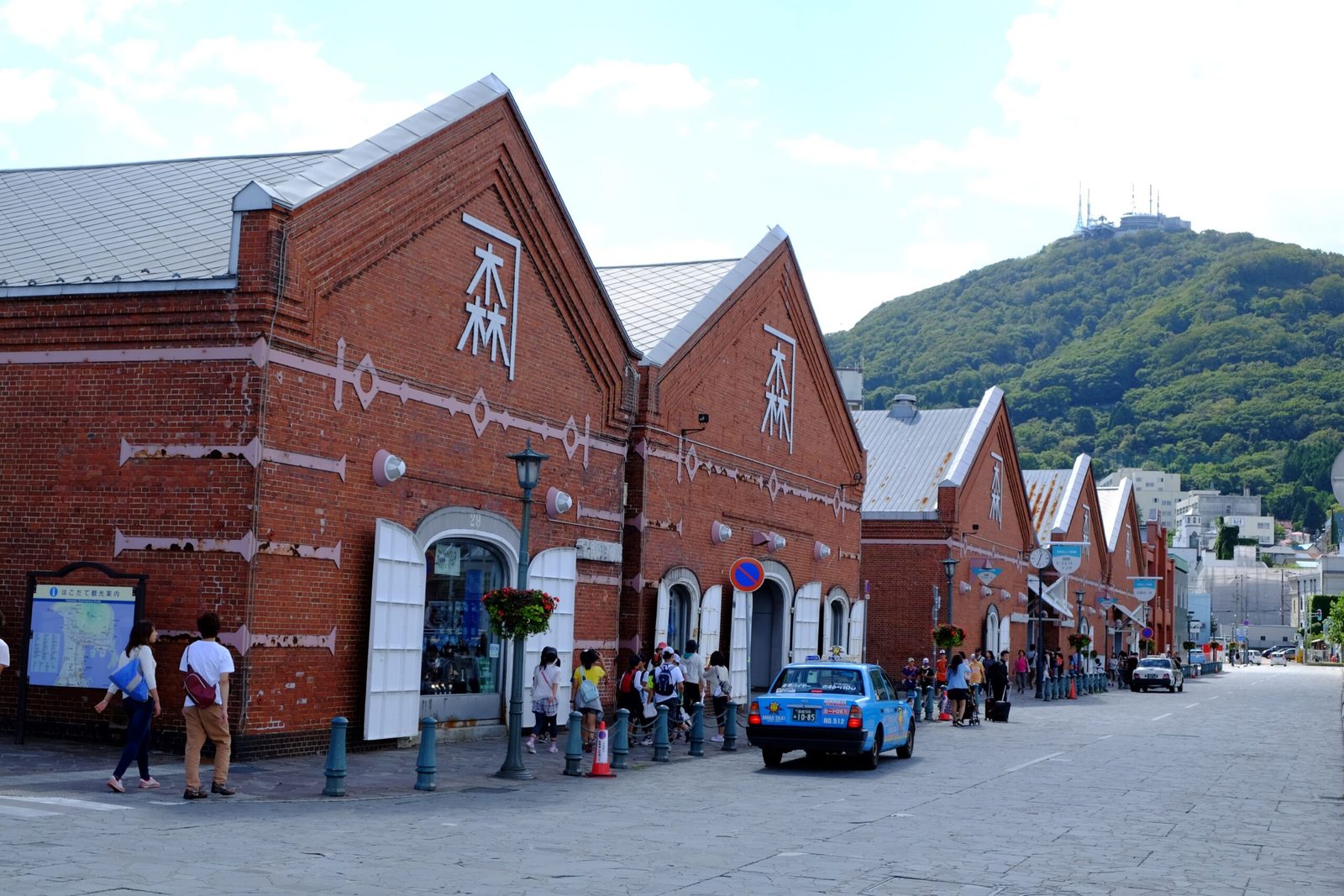
The slopes bring you down to the water and the Kanemori Red Brick Warehouses. The Kanemori Yobutsukan, rebuilt in brick in the Meiji era, is the centre of the Bay Area, lined inside with craft and souvenir shops and lit after sunset. BAY Hakodate, part of the same group, is two buildings facing each other across a canal dug in the early Meiji years, with restaurants, cafes, shops, a small chapel and a gallery, and a bridge over the canal where people stop for photographs. If you have half an hour to spare, the sightseeing boat Blue Moon is described as a two-deck catamaran for two hundred passengers that circles the harbour in about thirty minutes.
Where to stay
Places to stay near Hakodate →
Disclosure: This post may contain affiliate links. If you book through them, we may earn a commission at no extra cost to you.
Mount Hakodate at twilight
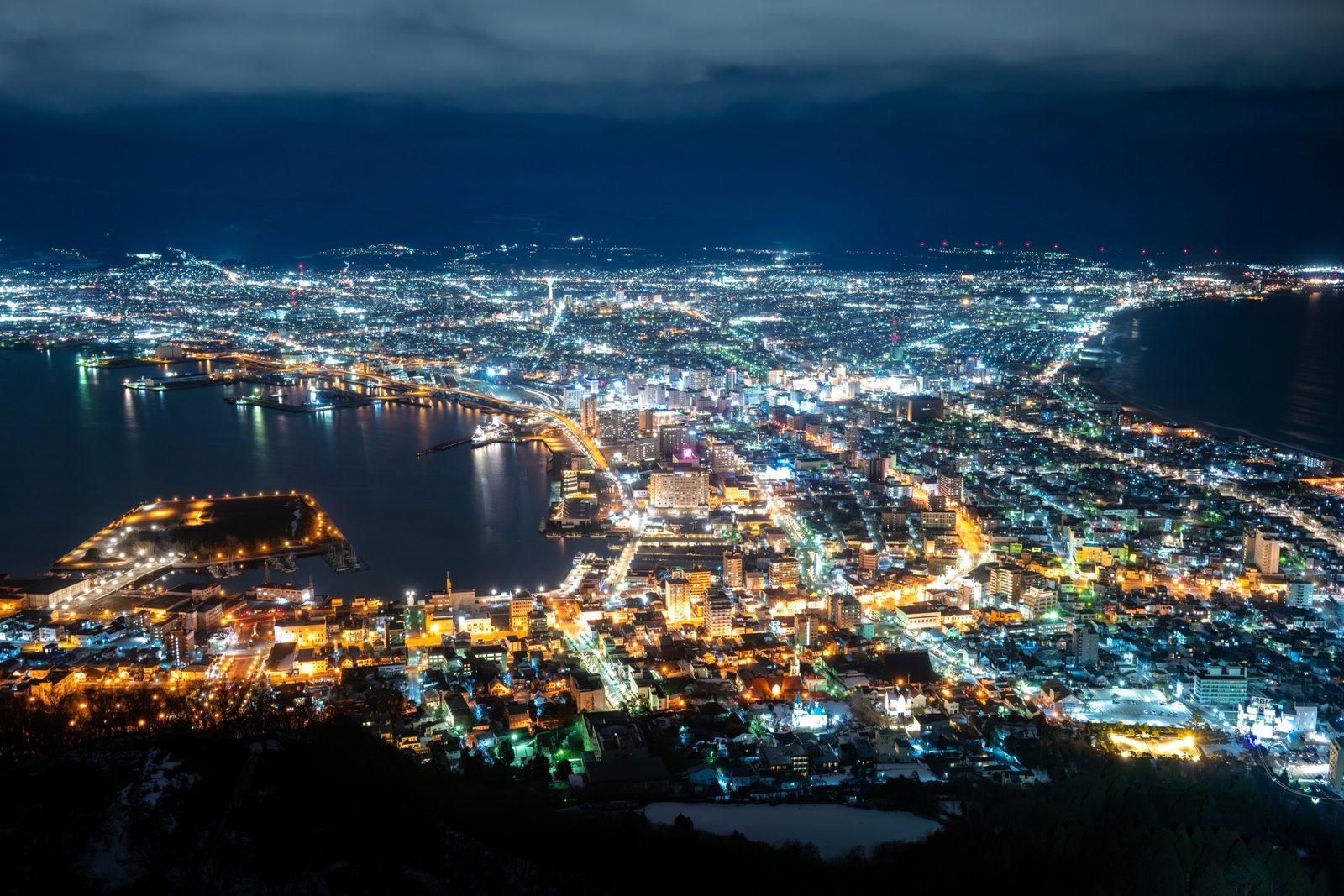
Mount Hakodate stands between the Tsugaru Strait and Hakodate Bay, and its profile, like a cow lying down, gives it the second name Gagyu-zan. The view from the top is Hakodate's signature experience, celebrated as the million-dollar night view. You can go up by ropeway, bus, taxi, car, sightseeing bus or on foot along one of ten hiking routes, but after sunset the paths lose their light, so come down by ropeway or bus.
- From Hakodate Station to the ropeway is about twenty-five minutes by tram.
- By taxi or car the same trip takes about ten minutes.
- The ropeway ride itself takes about three minutes.
- Round-trip fare for adults (junior high school age and above): one thousand eight hundred yen.
- A child pays nine hundred yen round trip or six hundred yen one way.
- From the twentieth of April to the end of September: first car at ten in the morning, last ascent at half past nine in the evening, last descent at ten.
- From the first of October to the nineteenth of April: first car at ten in the morning, last ascent at half past eight in the evening, last descent at nine.
The summit observatory has three floors, and the open-air deck on the roof has the best outlook. The finest moment is the quarter hour after sunset, when the sky turns from orange to blue; it is also the busiest, so go up earlier and hold your place at the rail.
A short history: fort, port and tram
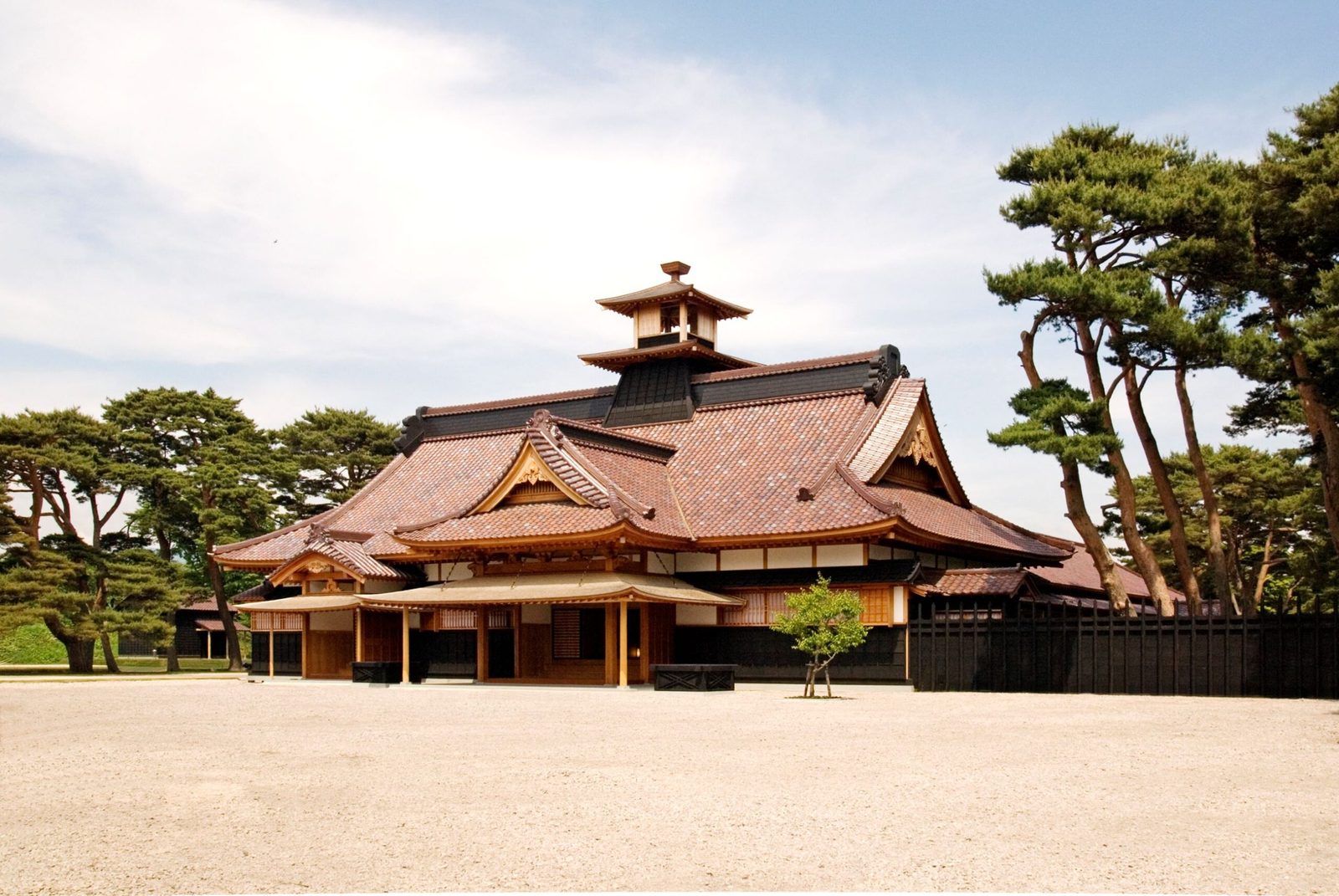
Goryokaku was completed in eighteen sixty-four as Japan's first Western-style star fort, and a few years later it became the stage for the Hakodate War. The magistrate's office at its heart was pulled down seven years after the fort was finished; in twenty ten it was rebuilt faithfully from old photographs and documents, using the same materials and shrine-carpentry techniques as the Edo-period original. The grounds have been a public park since the Taisho era.
Motomachi's skyline records the port's opening. The Orthodox church began as the chapel of the Russian consulate in the last years of the Edo period; the present building is from the Taisho era. The British Consulate was built by the British government in the same era.
The tram is of the same vintage. Horse-drawn carriages carried the townspeople until the electric tram began running in nineteen thirteen, and the city has operated it since the war years. At its peak there were six lines and twelve routes; since the early nineteen-nineties only routes Two and Five remain, which is why the route numbers have gaps.
Goryokaku: the star at the end of the line
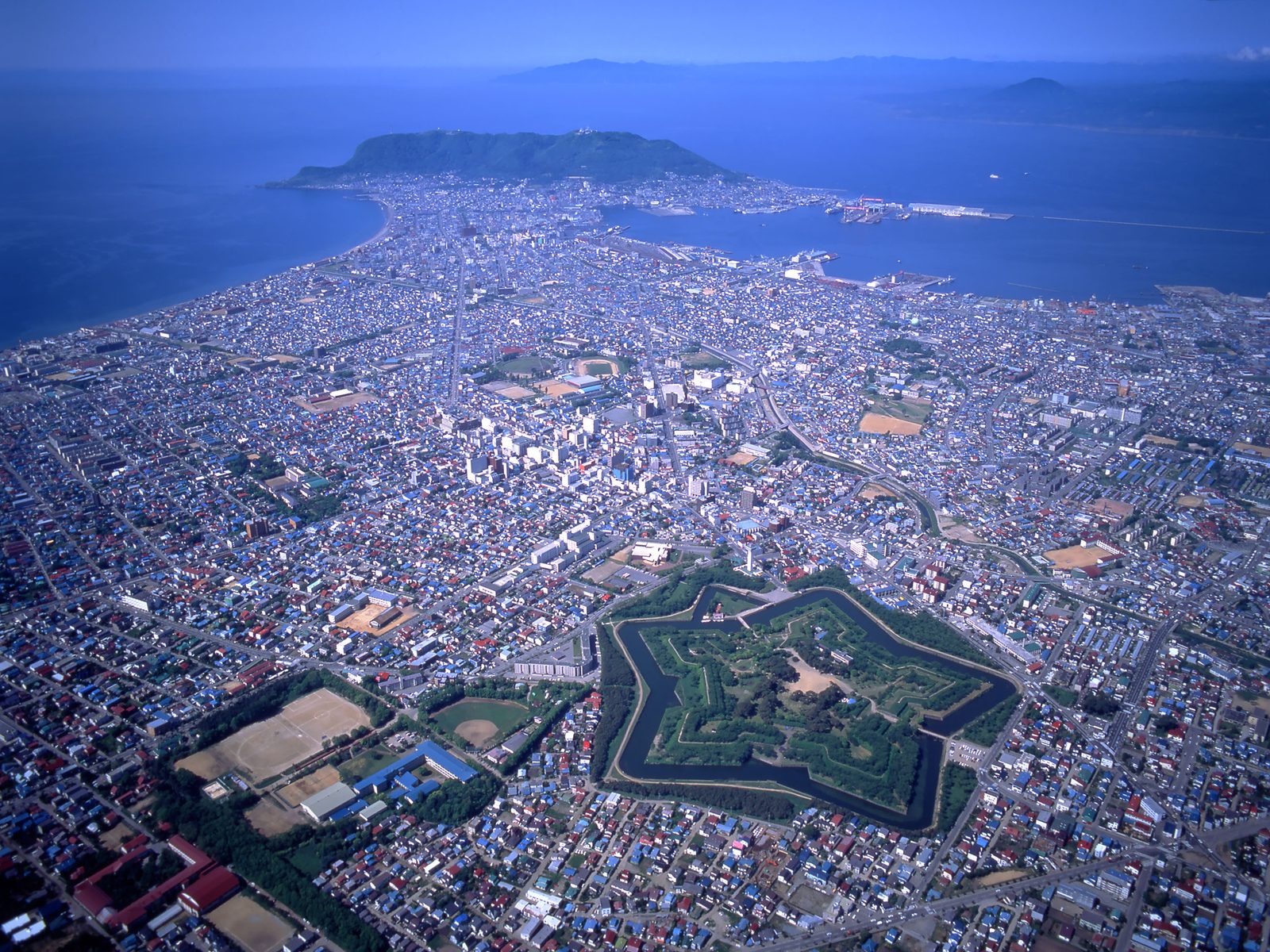
From Hakodate-ekimae the tram reaches Goryokaku-koen-mae in about sixteen minutes. From the stop it is about a ten-minute walk to Goryokaku Tower. The Hakodate Bus is an alternative: about seventeen minutes from Hakodate-ekimae for two hundred eighty yen. From JR Goryokaku Station the bus takes eleven to fifteen minutes, also for two hundred eighty yen.
The park changes with the seasons. Some fifteen hundred cherry trees bloom in late April, irises follow from late May into early June, the leaves turn from mid-October to early November, and snow covers the park from early January to early March. Goryokaku Tower stands beside the park, and the rebuilt magistrate's office sits within the park grounds.
| Goryokaku Tower | Details |
|---|---|
| Hours | Nine in the morning to six in the evening, every day of the year |
| Observation ticket sales | Stop shortly before closing time |
| Adult admission | One thousand two hundred yen |
| Students and children | Lower rates for junior and senior high school students and for elementary school children |
Putting the day together
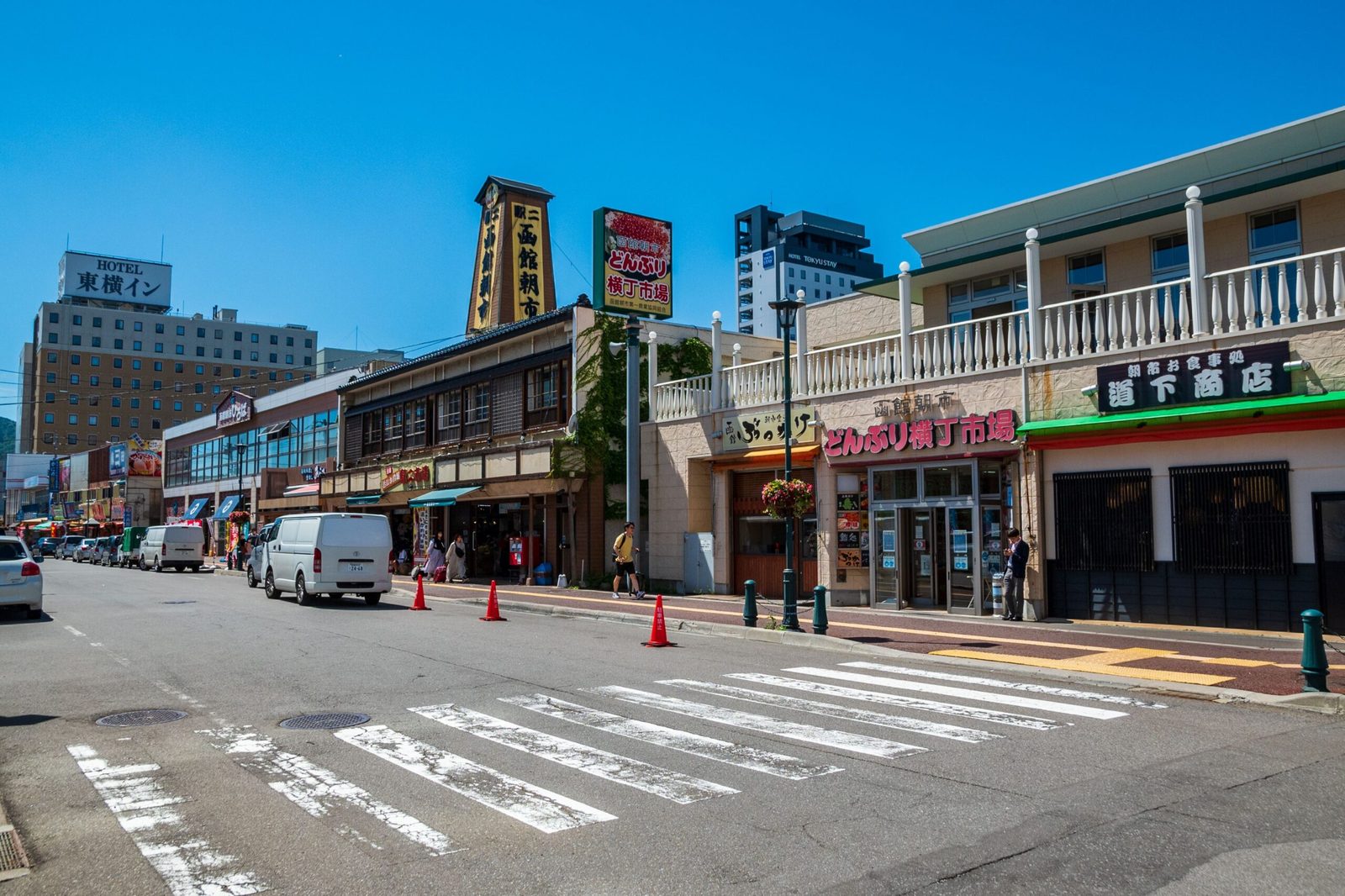
If you arrive by shinkansen at Shin-Hakodate-Hokuto, the Hakodate Liner reaches Hakodate Station in twenty-two minutes for four hundred forty yen. The limited express Hokuto does it in eighteen minutes with a reserved seat for one thousand two hundred ninety yen. The Morning Market is one of the four sight areas that cluster close together, so it can be folded into the walking part of the day.
A workable order for the day:
- Morning: tram to Suehirocho, then the slopes, the Old Public Hall and the churches on foot.
- Midday: walk down to the Bay Area warehouses.
- Afternoon: tram from Hakodate-ekimae out to Goryokaku-koen-mae for the park and the tower, and back.
- Evening: from Hakodate Station, about twenty-five minutes by tram to the ropeway, and up for the twilight view.
For a guided version of the same ground, browse guided tours and tickets in Hakodate. And if one day feels short for all of this, find a place to stay in Hakodate near the tram line and give Motomachi a second, slower morning.
Fares, hours and journey times above are the published figures and they do change, so check official information before visiting.