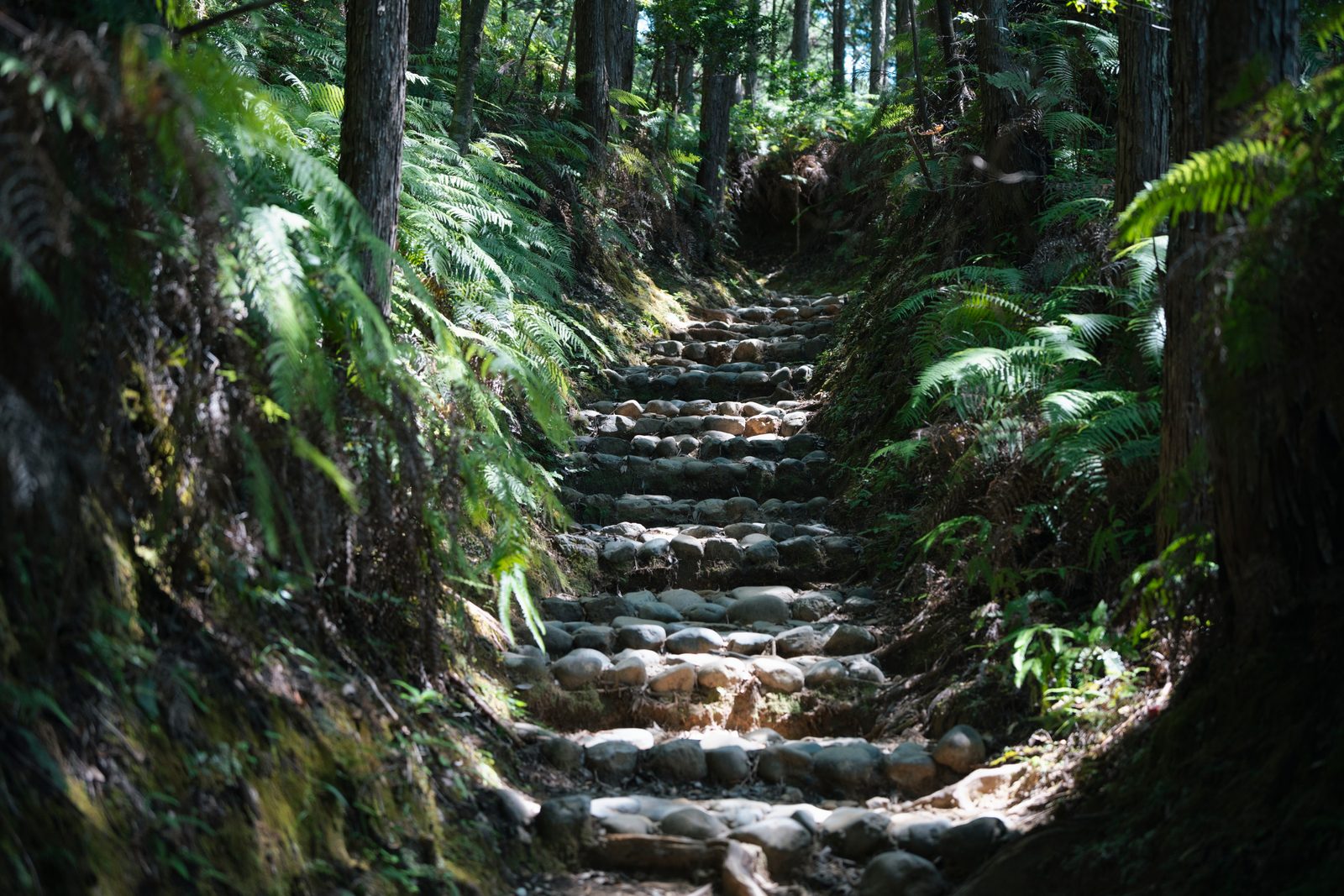
Unpaved mountain trails, ancient cobblestones, stairs and paved village roads follow one another along the Nakahechi route of the Kumano Kodo. The Nakahechi is the main route linking the three Grand Shrines of Kumano, and the core trail of a pilgrimage network with a history of over one thousand years. For travelers who want a pilgrimage route that alternates between mountain trail and village road, the Nakahechi offers both.
Takijiri-oji: Where the Trail Enters the Mountains
For the point where the route passes into the sacred mountains, Takijiri-oji is the place to begin.
Takijiri-oji marks the spot where passage into the sacred mountains begins, and it counts among the major Oji shrines. Step behind the shrine to find the trailhead of the Kumano Kodo. From there the path climbs through native and planted forest to Takahara Village.
Takahara: the Village in the Mist
If mountain views and a village above the mist are the draw, Takahara is the stop to plan around.
Takahara looks out over the Hatenashi mountain range in panoramic views. The village is known as "Kiri-no-Sato", the Village in the Mist, because the mountain vistas are often blanketed with mist. The valley below sometimes fills with fog and forms a sea of clouds.
Takahara Kumano-jinja shows a pavilion in the Kasuga style, with colorful paintings from the Muromachi period. Look up at a roof covered with the bark of hinoki, the Japanese cypress. Giant camphor trees stand in the shrine grove and are believed to be very old.
Gyuba-doji and Chikatsuyu: a Statue, a Staircase and a Coffee Shop
Gyuba-doji is a statue to look at on the pass, whereas Chikatsuyu is a village of inn placards and coffee.
Gyuba-doji stands as a statue at the Hashiori-toge Pass. The figure shows Kazan, one of the first abdicated emperors to make the pilgrimage to Kumano, sitting on a horse and a cow. The path then descends a cobblestone staircase to a viewpoint over Chikatsuyu Village below.
Chikatsuyu spreads across a large basin between the mountains, divided from north to south by the Hiki-gawa River. Look in the yards of residences along the streets for small wooden placards, which mark the historic locations of Edo Period inns. CABELO Coffee, a small shop in the center of the village, makes its own coffee and serves it hot or iced.
Tsugizakura-oji and Nonaka: Cedars, a Teahouse and a Spring
Tsugizakura-oji is where the giant cedars stand, and Nonaka is where the teahouse and the spring are.
Tsugizakura-oji holds many gigantic Japanese cedar trees. The Nonaka-no-Ipposugi cedars stand in the shrine grove. The shrine takes its name from a cherry tree grafted on a Japanese cypress, as "tsugizakura" means "grafted cherry tree".
Toganoki-jaya Teahouse sits next to the shrine sanctuary. It is a replica of a period teahouse, with a thatched roof and an "irori" hearth. The Hidehira-zakura cherry tree stands to the east of the teahouse.
Nonaka-no-Shimizu rises as a spring directly below the giant cedars of Tsugizakura-oji. Its waters are pure enough to drink. The forested area of Nonaka lies east of Chikatsuyu.
Tsugizakura-oji to Hosshinmon-oji: Passes, Jagata Jizo and Mossy Paths
Between Tsugizakura-oji and Hosshinmon-oji the choices are a run of passes, a mossy path along the river, or a lunch stop at the creek.
Kobiro-toge Pass comes first, reached by following the old highway from Tsugizakura-oji. Beyond it the path enters the forest and climbs and descends a series of passes, beginning with Waraji-toge Pass. The surface changes at Kobiro-toge from pavement to unpaved mountain trail, which continues to Hosshinmon-oji.
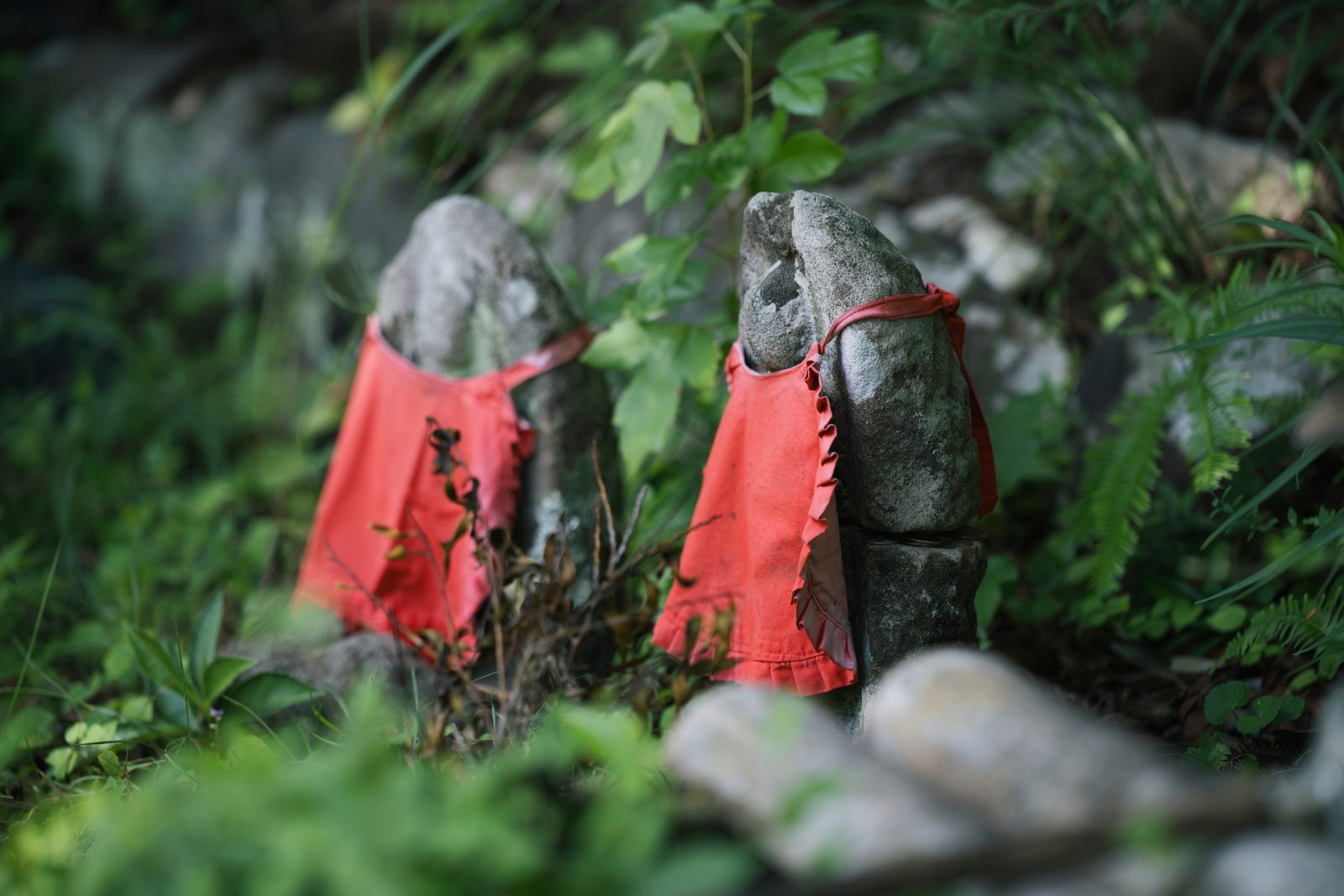
Jagata Jizo lies east along the river, reached by a mossy path. The creek beside it and Mikoshi-toge are common lunch stops. Cross a small bridge to the remains of the Yukawa settlement before the climb to Mikoshi-toge Pass. A long descent then leads to the junction for the Akagi-goe Route, which heads to Yunomine Onsen.
Hosshinmon-oji to Kumano Hongu Taisha: Villages, Carvings and a Rest Stop
The last section is for roadside carvings and tea fields, with a covered rest area where locals serve snacks.
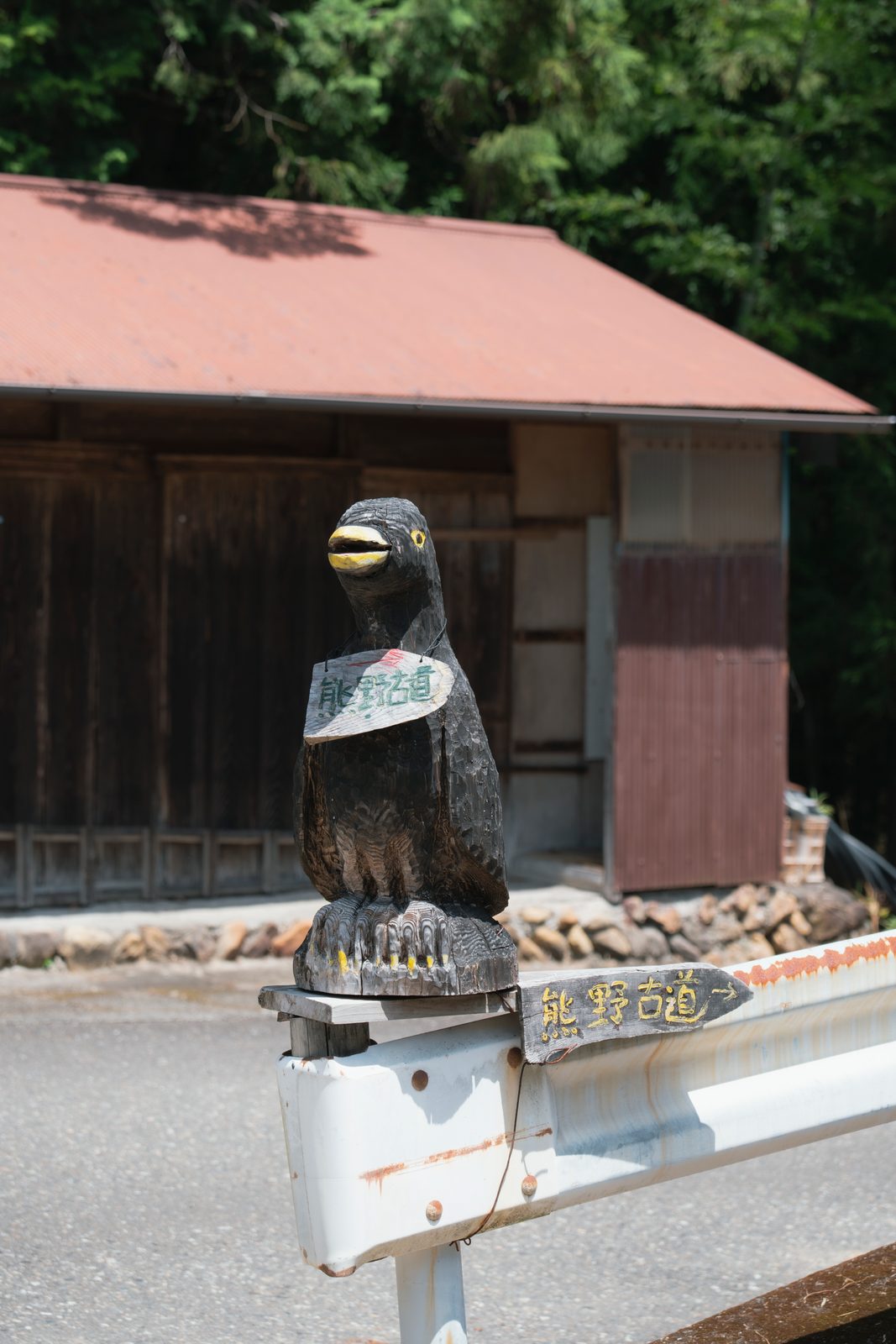
Hosshinmon Village is crossed on a road that runs from Hosshinmon-oji to Mizunomi-oji. Look along that road for folk-art word carvings. This section has many forest trails and isolated mountaintop villages.
Mizunomi-oji, the site of an old schoolhouse, sends the path into the forest. It exits at the west end of the Fushiogami settlement, which has numerous tea plantations and terraced fields. At Fushiogami-oji there is a covered rest area where locals serve handmade snacks and coffee made with hot spring water, though the days in operation may change. Panoramic viewpoints can be found along the way to Kumano Hongu Taisha.
Dual Pilgrim Stamps and Signposts Along the Nakahechi
Walkers who want a record of the route can collect stamps kept in wooden stands.
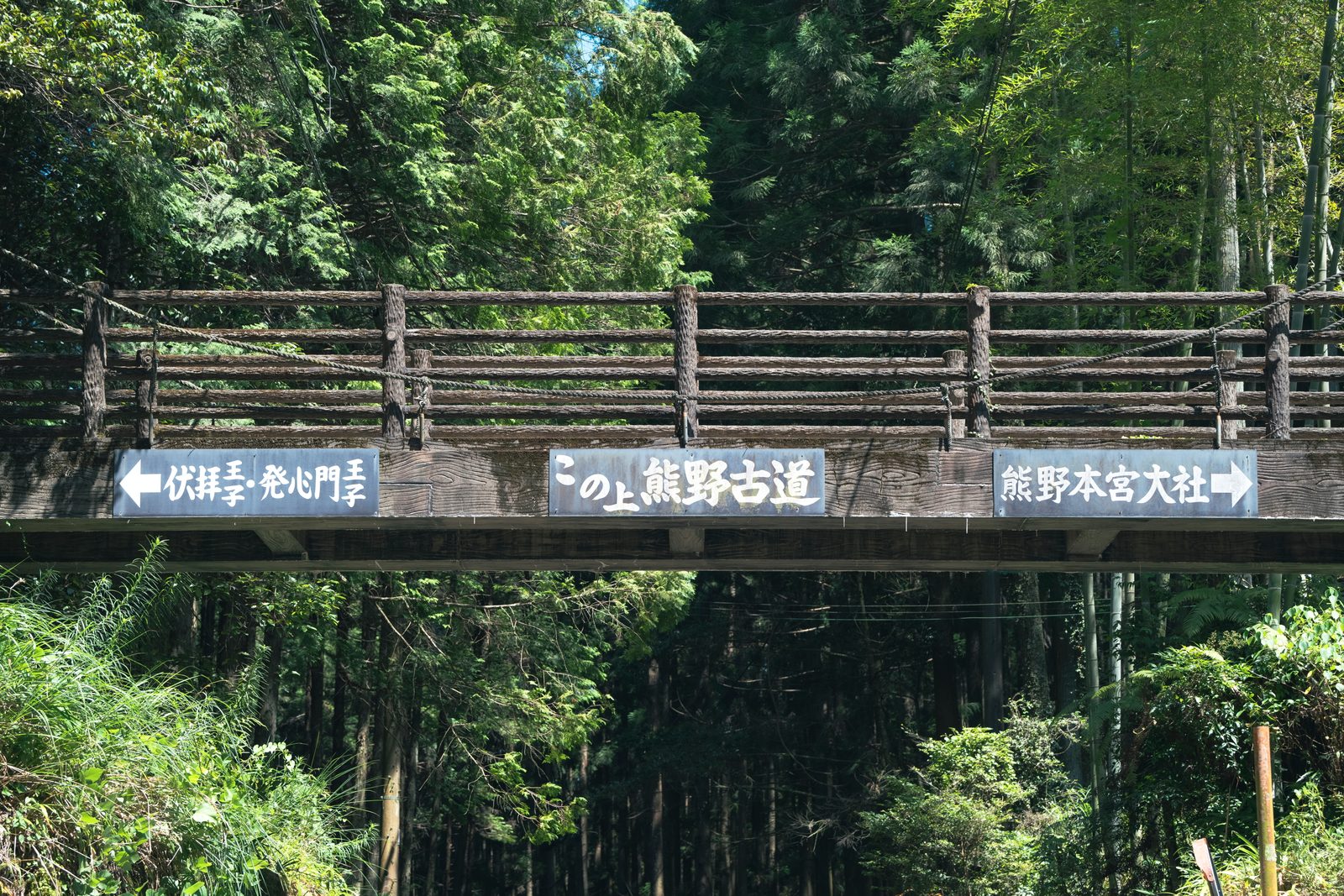
Dual Pilgrim Credential in hand, collect stamps along the trail as a record of the walk. Look for the stamps in wooden stands at most sites. The Dual Pilgrim completion certificate is made from local washi, Japanese handmade paper, and features the character for "Way" in the background. Numbered signposts are placed along many routes.
Putting the Sections Together: Stages from Takijiri-oji to Hongu
The sections above run in one direction and can be taken in order: Takijiri-oji to Takahara, then Gyuba-doji and Chikatsuyu, then Tsugizakura-oji, then Hosshinmon-oji and Kumano Hongu Taisha. Each of them begins and ends at a named shrine or village, so a plan can cover one section, several in a row, or all of them. With limited time, choose by what each section holds, and compare the section rows in the table below.
English signs, maps and luggage shuttle services are available along the Nakahechi. Local buses lead to the isolated villages where accommodations are located. The route is physically challenging. For a night near the end of the route, browse places to stay in Hongu.
Getting to the Nakahechi, Hours and Fares
New to rural buses and one-man trains? See how to ride them, step by step.
| Item | Details (as listed) |
|---|---|
| Kuroshio express to Kii-Tanabe | Shin-Osaka about two hours, about four thousand seven hundred fifty yen non-reserved; Kyoto about two hours thirty-five minutes |
| Bus Kii-Tanabe to the Hongu area | about two thousand yen each way; public buses serve the mountain villages daily from Kii-Tanabe, Shingu and Shirahama |
| Takijiri-oji to Takahara | about four kilometers |
| Gyuba-doji-guchi to Chikatsuyu-oji | about one point three kilometers; about thirty minutes |
| Chikatsuyu-oji to Tsugizakura-oji | about four kilometers, about one hour fifteen minutes |
| Kumano Kodo Kan pilgrimage center | open eight thirty to five fifteen; closed over the New Year holidays |
| Luggage | shuttle bookings at least twenty days ahead; Tanabe Tourist Information Center storage five hundred yen per bag, nine to six daily |
Times, fares and hours above are as listed.
Thinking of staying overnight?
Compare places to stay near Hongu, Wakayama, Japan →
Disclosure: This post may contain affiliate links. If you book through them, we may earn a commission at no extra cost to you.