In an old gazetteer Kitakata is described as sitting at the northern edge of the Aizu basin, a broad and fertile plain of ten ri, with hills closing in on the east, north and west and flat land running south toward Aizuwakamatsu. It is a compact town, and a single day is enough to walk its storehouse streets.
In the same account the town is described as lying four ri, roughly sixteen kilometres, north of Wakamatsu, with the district office for Yama county kept here in the Meiji years. That past matters less than the result: a dense fabric of kura, the thick-walled storehouses that still line the lanes, and a practical question of how to reach them.
Getting to Kitakata
From Tokyo the approach runs through Koriyama. The Tohoku Shinkansen from Tokyo Station to Koriyama Station takes about an hour and twenty-two minutes, and at Koriyama you change to the Ban'etsu West Line. The Ban'etsu West Line rapid service from Koriyama Station to Aizuwakamatsu Station takes about an hour and five minutes. They are the day's backbone.
From Aizuwakamatsu the same line continues north to Kitakata on local services. The timings above do not include that final leg or the waits at each change, so treat the whole journey as a morning rather than a quick hop, and check the Koriyama connection before you leave Tokyo so the two legs line up.
The Joetsu Shinkansen from Tokyo Station to Niigata Station takes about two hours, and it is worth a look if you would rather enter Aizu from the west; check official information before visiting, since timetables change. It is the longer way round, but it lets you enter Aizu by one route and leave by another.
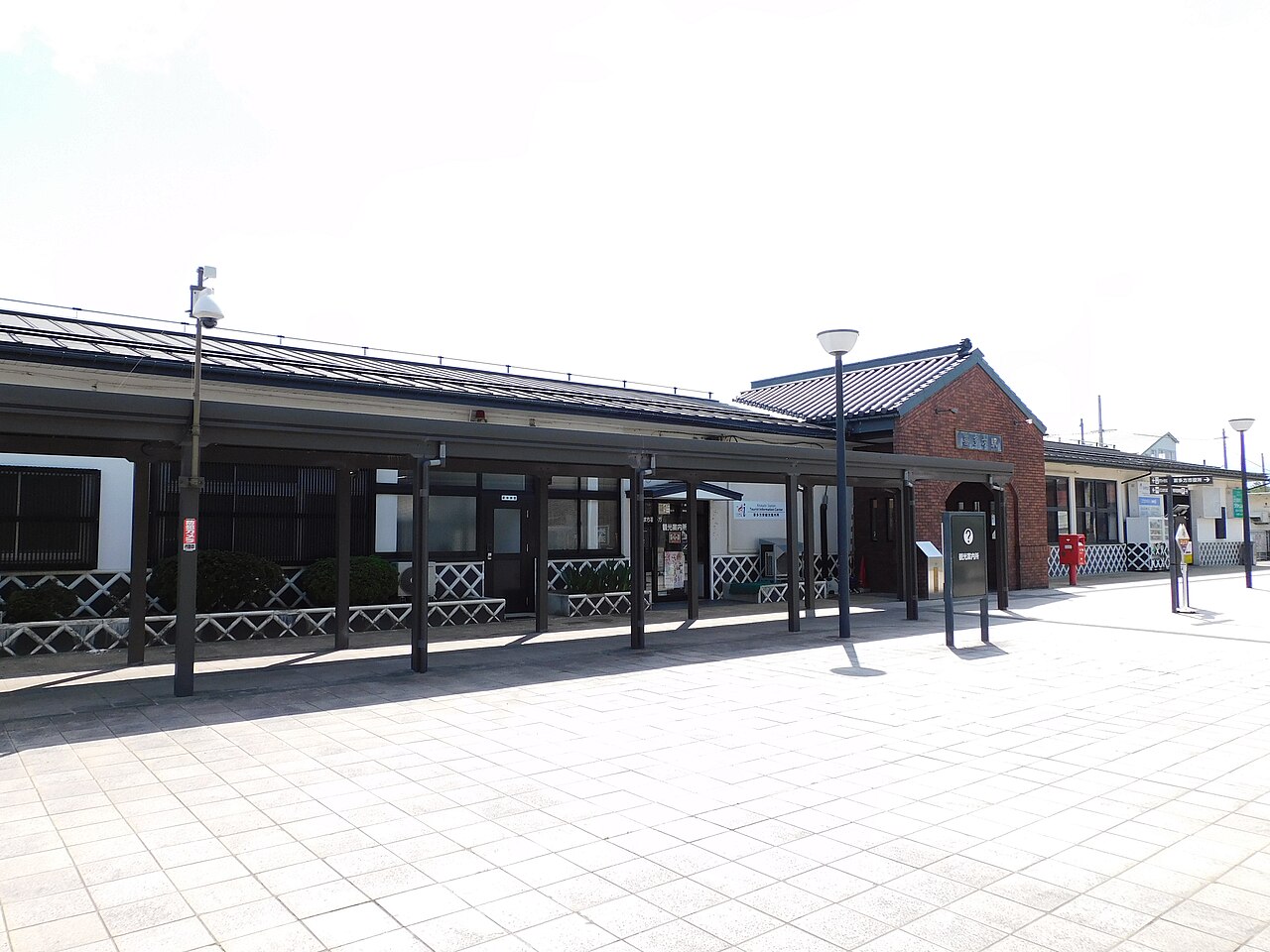
The frontage of JR Kitakata: a covered walkway, a red-brick gabled entrance and a wide paved forecourt, the first sight for arrivals before the storehouse lanes.
Getting around town
The city runs a loop bus called the Machinaka Junkan Line, and the adult fare on the Machinaka Junkan Line loop bus is two hundred and fifty yen. The child fare on the same loop bus is one hundred and thirty yen. Those are flat figures, so a second circuit late in the afternoon is no dearer than the first.
Passengers with disabilities who are of junior high school age or older pay one hundred and thirty yen on the Machinaka Junkan Line loop bus, the same as the child fare. Three figures, then, and none is large enough to make walking the obvious saving; ride when the distance is dull, walk when the lane is worth it.
Kitakata also has an on-demand bus called Noruto, and rides on the Noruto Kitakata on-demand bus can be booked through the LINE app twenty-four hours a day. The dedicated Noruto app takes bookings twenty-four hours a day as well, so a request can go in from your room in the evening while the next day is still being planned.
Install whichever app you prefer before you travel rather than on the platform. Setting up an account eats the kind of half-hour a short day cannot spare, and a booking made the night before means the morning starts with the storehouses rather than with a screen.
Where to stay
Places to stay near Kitakata →
Disclosure: This post may contain affiliate links. If you book through them, we may earn a commission at no extra cost to you.
The kura storehouse district and Kura no Sato
The storehouses are the point of the trip, and the natural first stop is Kitakata Kura no Sato, whose name translates roughly as the storehouse village. Individual admission at Kitakata Kura no Sato is four hundred yen for general visitors and university students. For elementary, junior high and high school students the individual admission is two hundred yen.
Groups of twenty or more people pay three hundred and fifty yen per general visitor or university student at Kitakata Kura no Sato. For elementary, junior high and high school students in a group of twenty or more the admission is one hundred and fifty yen. A typical family will not reach that threshold; budget on the individual figures.
Why so many storehouses in one small town? In a Meiji-era account Kitakata is described as a town where mechanised silk reeling and lacquerware were the leading trades, and it is easy to read the kura as the residue of that prosperity. That is the one line of history worth carrying; the rest can wait.
Give the district the middle of the day. Walking from one kura to the next is slow, because doors, plaster and roof tiles reward looking, and the town is small enough that you will pass the same lane twice. If the storehouses persuade you to linger, compare places to stay in Kitakata before you commit to a same-day return.
Shrines and temples in quiet corners
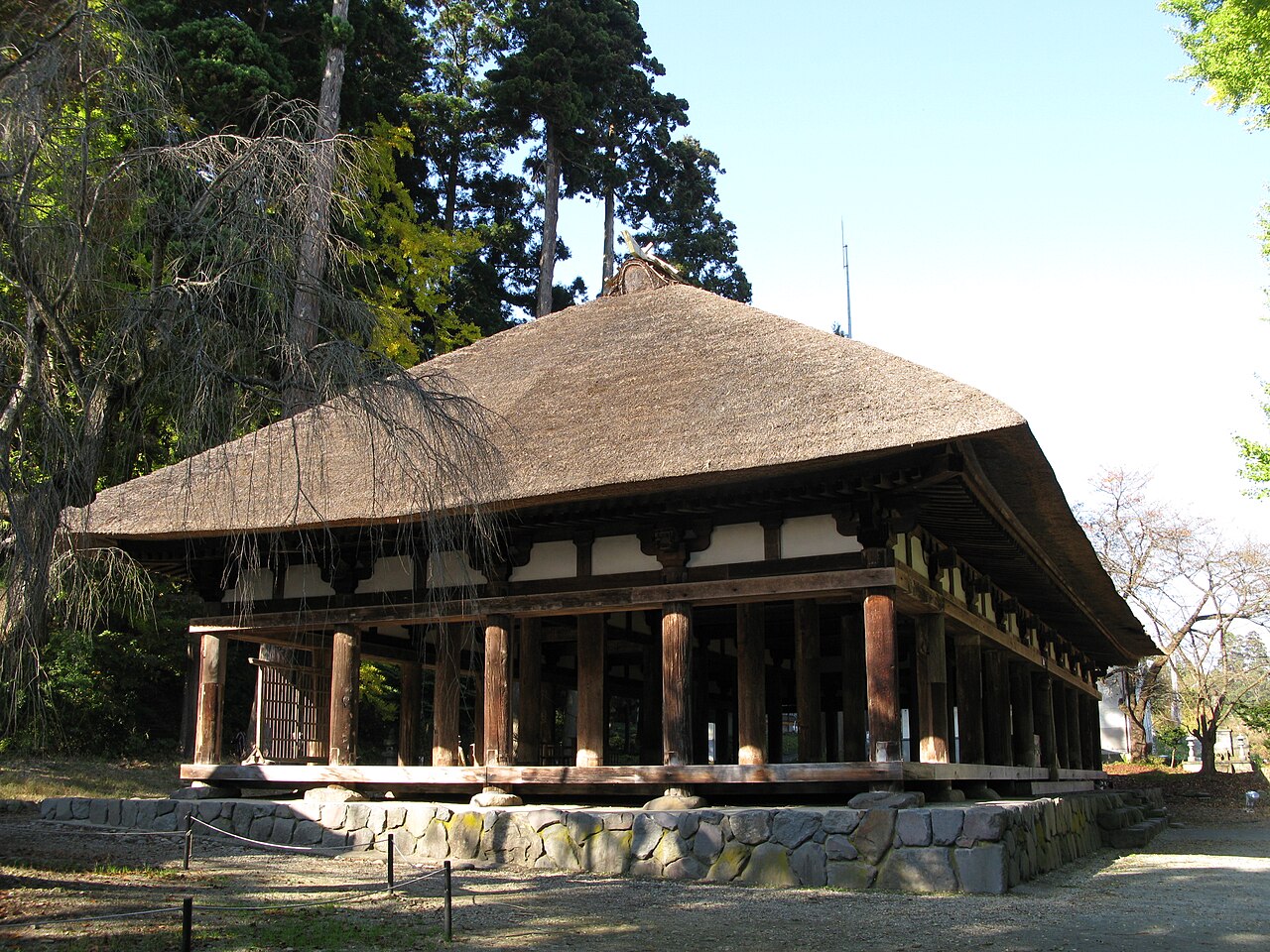
The Nagatoko hall at Shingu Kumano Shrine: rows of round pillars on a stone base, under a sharply pitched thatched roof.
The Nagatoko hall at Shingu Kumano Shrine is the kind of building that stops a walk. It is long and low, a forest of round pillars carrying a sharply pitched thatched roof, with no walls to interrupt the view through it. Go for the proportions and the shade; the building's story is better heard on the spot.
Ganjoji, a Pure Land temple in Kamisanmiya to the north of the town, is said to have been founded in the third year of the Karoku era, and is described as a training hall where those taking the tonsure and precepts from the two provinces of Ou gathered. Read it as a place of long teaching, not a sightseeing stop.
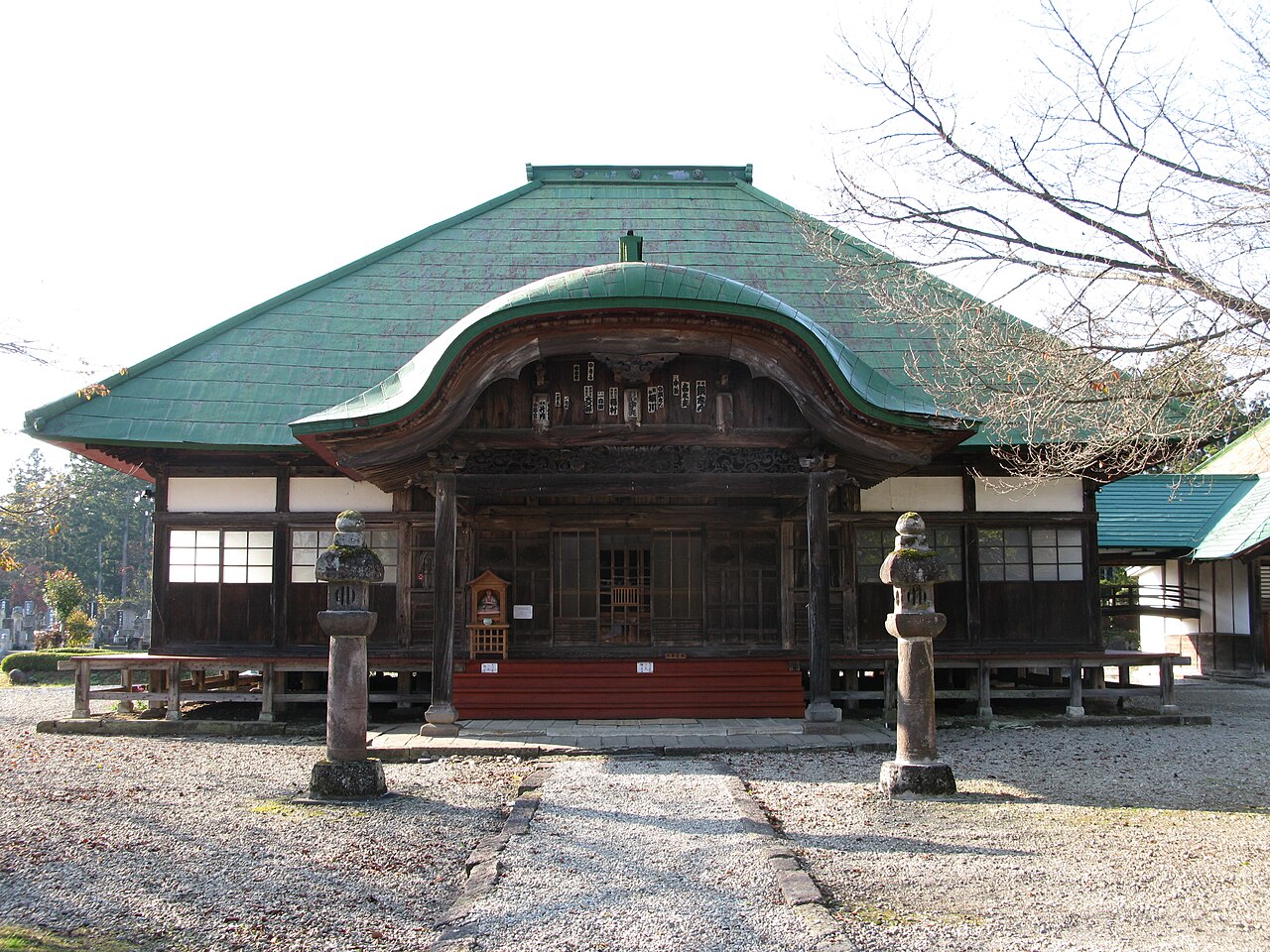
Ganjoji: a curved gable over the entrance, white plaster and dark wood, and two stone lanterns on the gravel approach.
Mountain and lake beyond town
The high mountain beyond the basin is Iide, which in the old gazetteer is said to straddle Yama county and the former provinces of Echigo and Uzen, and is described as Mikuni, the three-provinces peak. It is a separate trip; from the storehouse streets it is a backdrop, not a destination.
Local people are said to have called it the mountain of four seasons, because its climbing season is short and near the summit five-needled pines spread among strange rocks while cherry blossom, the cuckoo's call and autumn colour could be met on a single climb. The lakes around Bandai are a separate outing, not a detour from a storehouse day.
A taste to take home: ego
Ego is the dish to look for. It is made from a seaweed called ego-gusa, boiled until it dissolves and then set into square blocks, and the texture sits between agar and jelly. The main areas that keep the tradition are Nishiaizu town and Kitakata city, and it is now eaten widely along the Agano and Tadami rivers.
Ask for it by name rather than hunting for it on a shelf. For those who would rather cook than shop, a single ramen-making session in Kitakata can be booked ahead. Otherwise let the last of the day go back to the storehouses, which is where this trip began and where it ends best.