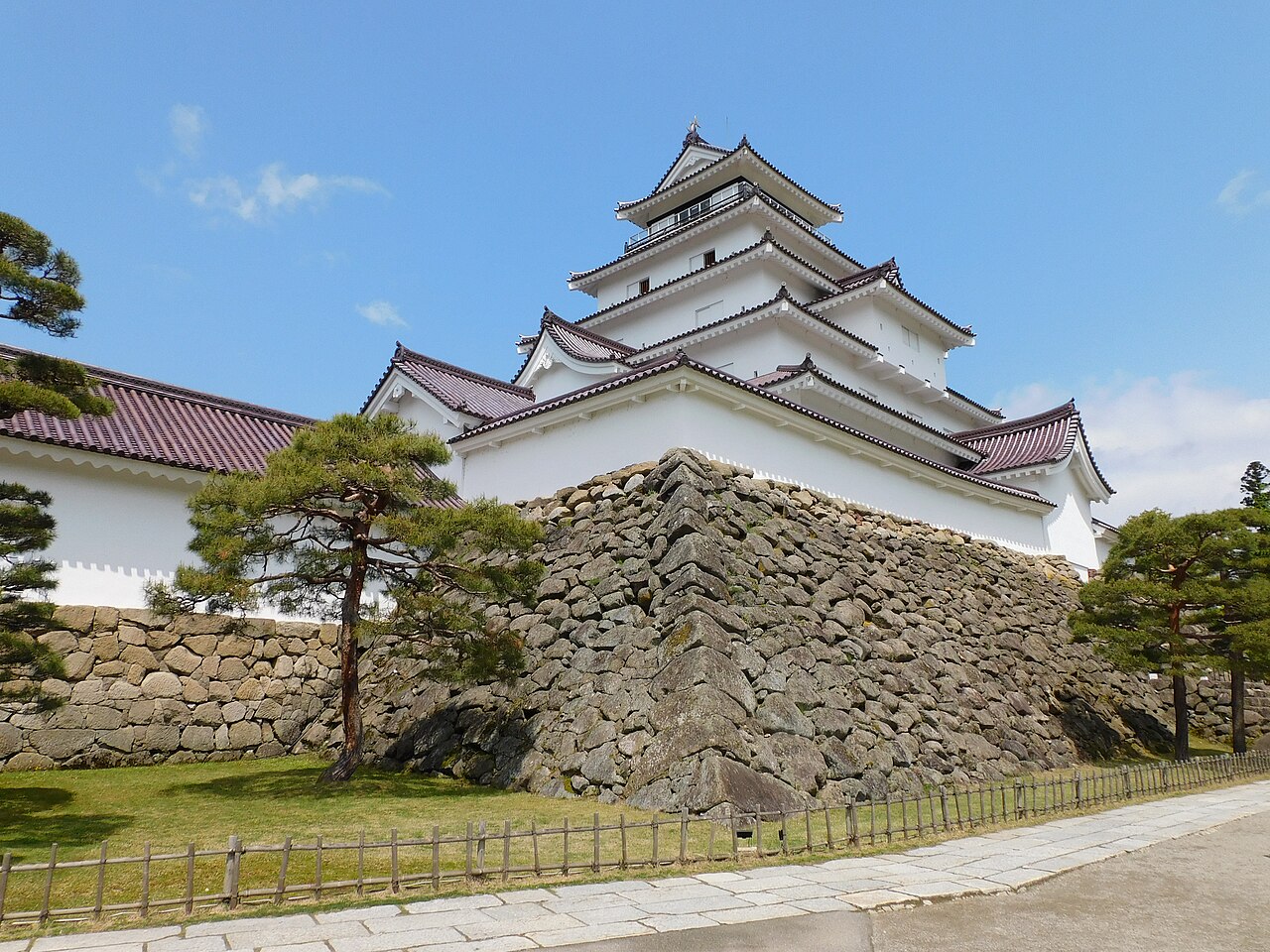
This guide covers one unhurried day in Aizuwakamatsu, Fukushima — Tsuruga Castle and the Rinkaku tea room, the town loop buses, Iimoriyama and the spiral hall of Sazaedo, the old street of Nanokamachi, and an evening extension to Higashiyama Onsen — pairing current fares and times from the operators' pages with scenes from the Meiji-era railway guidebook 岩越鉄道名勝案内誌.
Aizuwakamatsu sits in a wide basin in western Fukushima, a castle town that rebuilt itself more than once and kept its habits: lacquer workshops, temple-lined lanes, and a keep that looks best from below its stone walls. It is an easy town to walk slowly, and the quiet corners begin a short ride from the railhead.
A castle town that asks for a slow pace
The name Aizu is bound to the closing act of the Boshin War. The fighting scattered the town's craftsmen, burned shrine halls, and left graves and steles that are still tended; the Meiji-era railway guide reads in places like a memorial register, noting where the dead of both sides lie.
It is also a town of long memories. The same guide walks past a shrine honoured as the province's chief guardian since the twelve-nineties, a riverside sanctuary where a renga master is said to have prayed for skill, and temples whose founding stories run older than the castle itself.
Getting around on the loop buses
Two loop routes, Haikara-san and Akabee, thread the sights together, and a one-day pass keeps the arithmetic simple: ride as often as the plan changes. The fares and times below are the operators' current ones, so read them as this season's numbers rather than eternal truths.
- A single ride on the loop bus costs two hundred and fifty yen for adults and junior-high students, one hundred and thirty yen for children.
- A one-day pass costs seven hundred yen for adults and junior-high students, and three hundred and fifty yen for children.
- Haikara-san leaves Aizu-Wakamatsu Station from half past eight in the morning; the last departure goes at five past six in the evening.
- Akabee starts at half past seven in the morning and makes its last departure at a quarter past four in the afternoon.
- A few marked departures rest on weekends, national holidays and the days around the new year, so glance at the timetable before you fix the return leg.
The stop names double as a map of the day: Tsurugajo-iriguchi for the keep, Iimoriyama-shita for the hill and the spiral hall, Nanokamachi-ekimae for the old merchant street. The three of them carry this whole guide, and nothing in it needs a taxi.
Tsuruga Castle: red roofs above dry-laid stone
Ashina Naomori first fortified this ground at the close of the fourteenth century, and Gamō Ujisato later remade the castle and raised the keep that fixed its silhouette, finished in the Bunroku years. The Meiji guide adds the detail the town is proudest of: a siege of thirty days by a vastly larger army, and the castle never taken.
The same guide gathers poems left by statesmen and scholars who climbed here after the war, all circling the one theme of loyalty remembered. Walk the moat path with that in mind and the grounds feel less like a park and more like a long, green afterword.
- Admission to the keep costs four hundred and ten yen for adults and one hundred and fifty yen for elementary and junior-high students.
- A combined ticket for the keep and the Rinkaku tea room costs five hundred and twenty yen; adding the Oyakuen garden brings the three-site ticket to seven hundred and thirty yen.
- Doors run from half past eight in the morning to five in the afternoon, last entry at half past four, with no closing days.
- Parking costs two hundred yen for the first hour, then one hundred yen for each hour after.
- By loop bus, get off at Tsurugajo-iriguchi; the keep is a five-minute walk from the stop.
Rinkaku and the walk under the walls
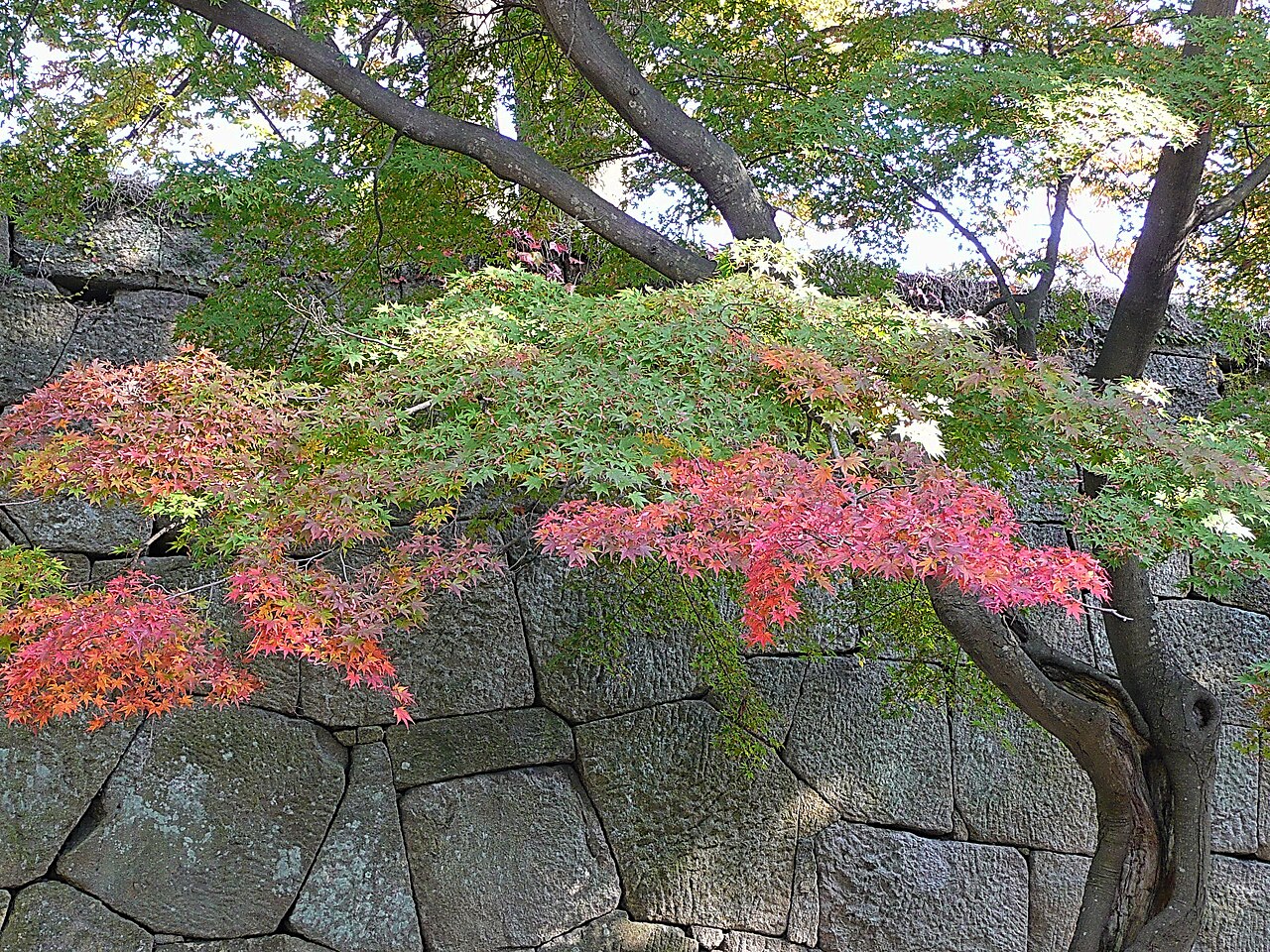
Rinkaku, the tea room inside the grounds, is the reason to take the wall path slowly rather than turn straight back toward the gate. In autumn the maples spill over the mossed stone in reds and golds, and the circuit under the walls repays every minute you give it.
The three-site ticket folds in Oyakuen as well, the garden villa of the Matsudaira lords. The Meiji guide describes old pines and cypresses knitted together over lawns, ponds and a tea pavilion, and notes that the family still kept the place as a villa in its own day.
- Rinkaku on its own costs two hundred and ten yen for adults and is free for elementary and junior-high students.
- A bowl of matcha with a sweet at the tea room costs six hundred yen.
Compare options
See partner pricing and availability →
Disclosure: This post may contain affiliate links. If you book through them, we may earn a commission at no extra cost to you.
Shaping the day
If you would rather have the history unpacked than read off placards, this is a good town for a guided day: the castle in the morning, Iimoriyama after lunch, the lacquer street before evening. Browse Aizuwakamatsu day tours and tickets if you want the sequencing handled for you.
Whichever order you choose, the loop buses make the switchbacks painless. The castle, the hill and the old street each sit a short ride apart, and with the day pass in your pocket a change of plan costs nothing beyond the minutes it takes.
Iimoriyama: the hill that misread the smoke
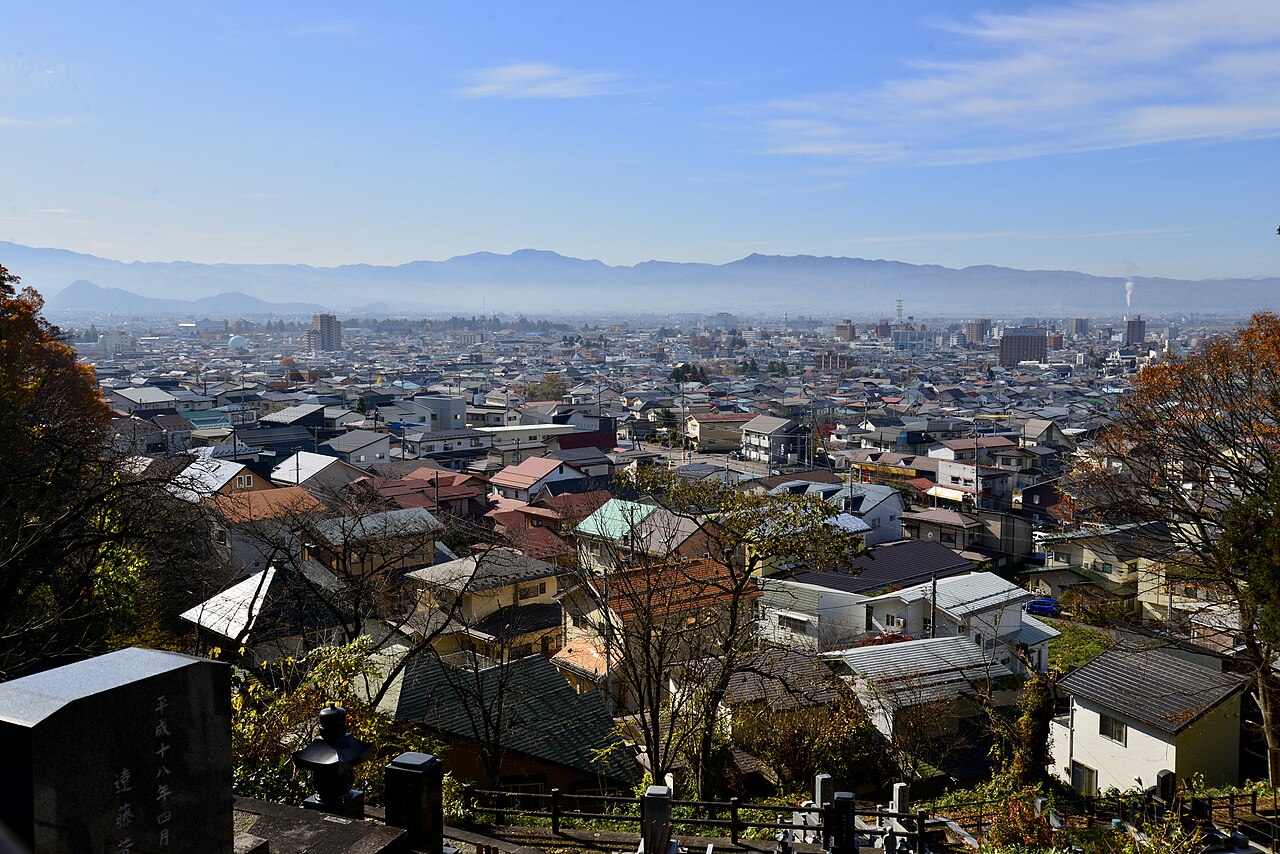
Iimoriyama is where nineteen young men of the Byakkotai, most of them sixteen and seventeen years old, looked down on smoke drifting over the town and believed the castle had already been taken. The memorial stele beside the Uganjindō hall records that misreading, and their deaths by their own hands, in formal carved prose.
The hall enshrines statues of the nineteen together with Kayano Gonbee, and stone markers nearby carry each name and age. The Meiji guide already describes the hill as parkland — cherries in spring, the whole slope red with maples in autumn — and the climb still ends in a long view over rooftops toward the ranges on the horizon.
Sazaedo: the ramp that never meets itself
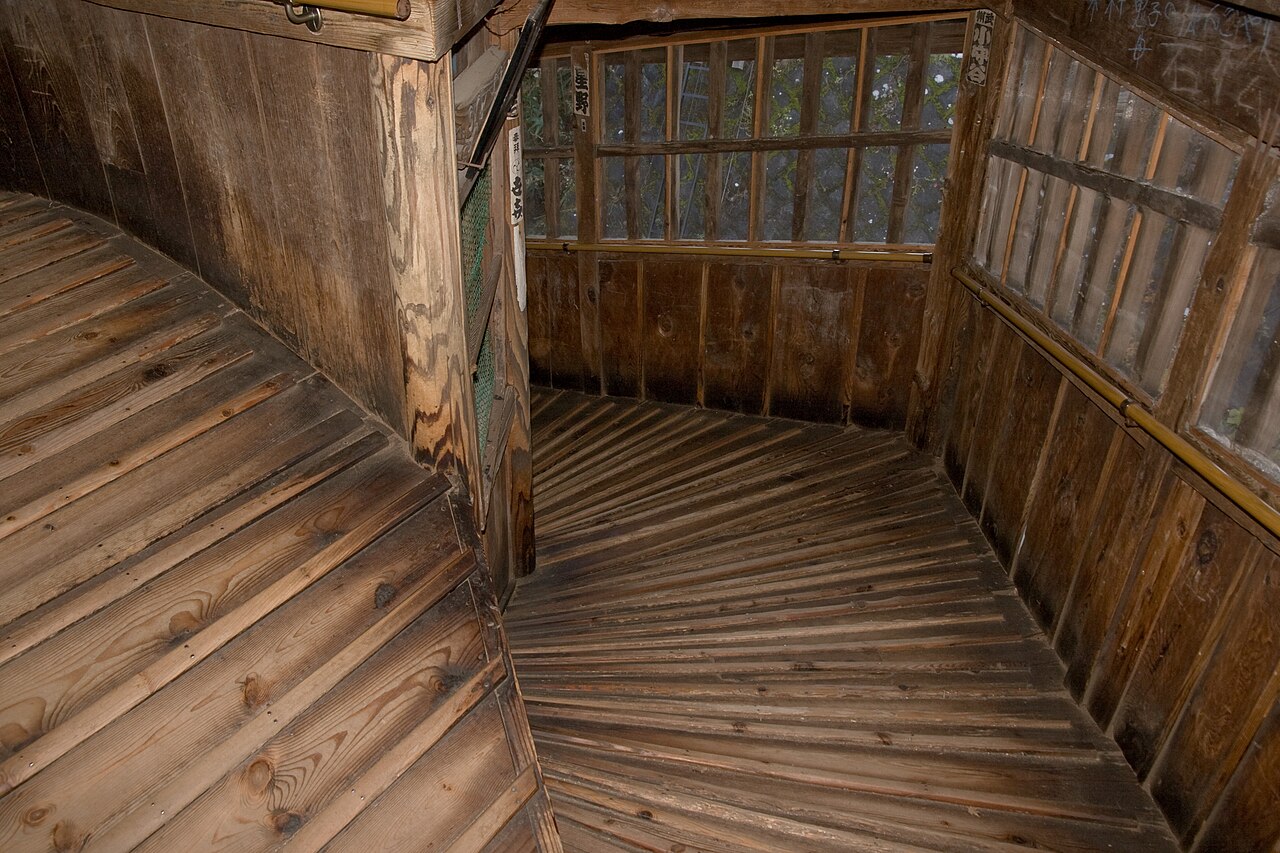
On the same hillside stands Sazaedo, a wooden hall whose inner path is wound as a double spiral: one ramp climbs, the other descends, and the two never cross. Bare boards carry you the whole way round without a single stair tread, which is most of the reason voices drop to a whisper inside.
Uganjindō shares the same grounds — the Meiji guide places the two side by side — so the spiral hall, the stele and the grave markers make one short circuit at the top of the town before you head back down to the stop at Iimoriyama-shita.
- Admission costs four hundred yen for adults, three hundred yen for high-school students and two hundred yen for elementary and junior-high students.
- Doors run from a quarter past eight until sunset from April to November, and from nine in the morning to four in the afternoon from December to March, with no rest days.
- By loop bus, get off at Iimoriyama-shita; the hall is a five-minute walk from the stop.
Nanokamachi: lacquer, photographs and old signboards
Nanokamachi was the town's front parlour in the Meiji years. The railway guide lists a photography studio, a theatre and a vaudeville hall along the street, and shops selling a then-new invention — lacquerware with photographs sealed into the coating, devised by a local craftsman and sold at Shirokiya here on this street.
The craft behind those shopfronts is the old one: lacquer promoted by the Ashina lords, carried to the Edo market under the Katō family, organised and replanted under Hoshina Masayuki, and taught its Kyoto polish by an invited master. The war scattered the workshops; a handful of merchants gathered the craftsmen back and set the trade on its feet again.
An evening extension: Higashiyama Onsen
Southeast of the town, where ridges close in on three sides and a stream runs straight through the middle, sits Higashiyama Onsen. The Meiji guide gives it a proper legend: the priest Gyōki, led up the valley by a three-legged bird, finding hot water rising from a hollow in the rock.
The same pages read like a hotel register from another century — inns keeping baths with names of their own, the Sedge Bath, the Ripple Bath, the Cave Bath — and they note that visitors came in every season: blossom in spring, cool air in high summer, the moon in autumn, and the cold itself in winter.
If the walk leaves you wanting a slower second day, the springs are the obvious answer. Otherwise, browse Aizuwakamatsu tours and tickets before you go, and let someone else mind the timetable while you keep your eyes on the stone walls and the hills.