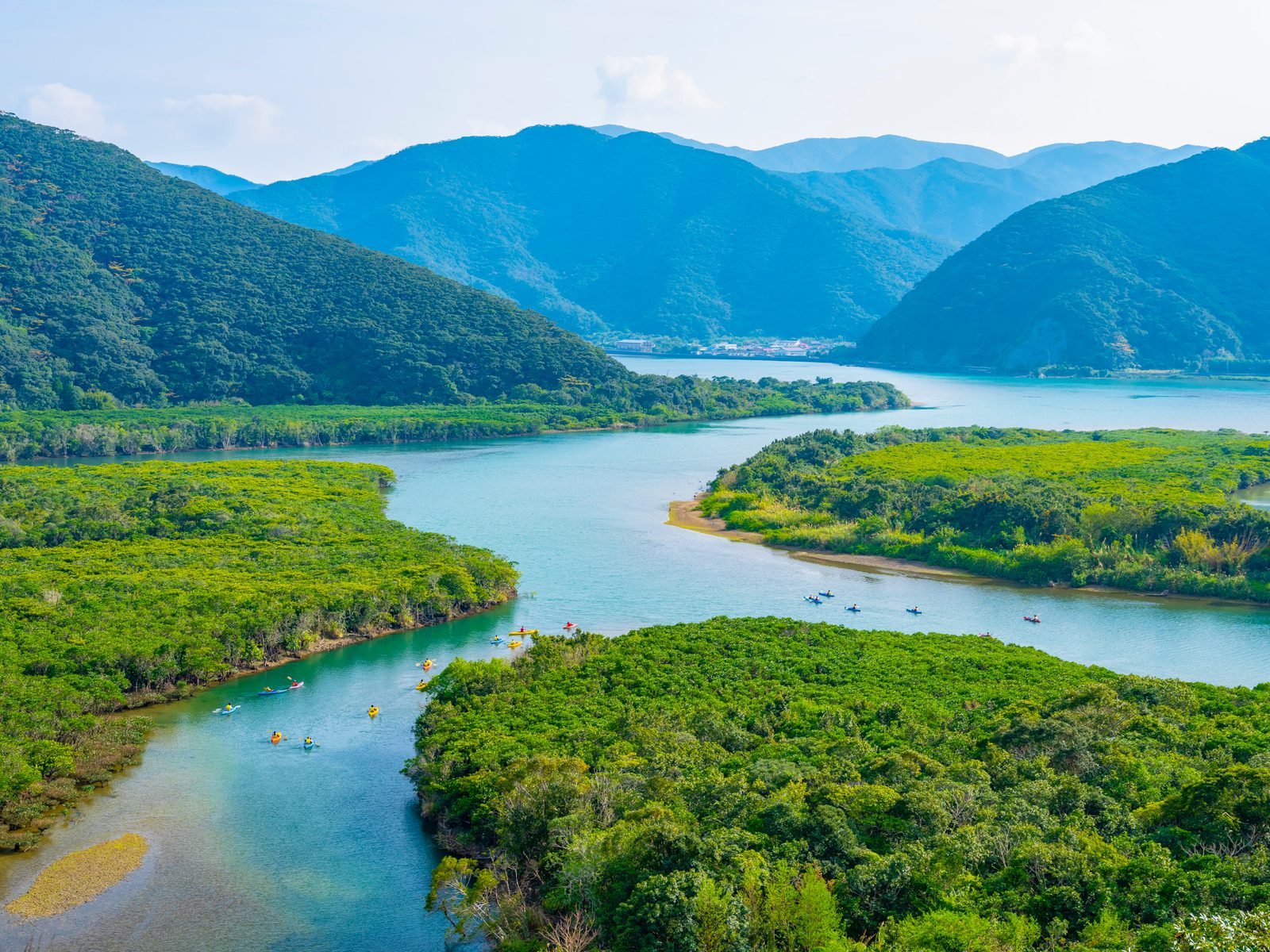
Amami Oshima pairs a mangrove forest that visitors can paddle through by canoe with Oshima tsumugi, a silk cloth whose deep black comes from repeated dyeing in a field of mud. On the tidal flats among the mangroves, crabs and other creatures can be observed, and at Oshima Tsumugi Village all the steps from white silk thread to finished cloth can be seen and tried. One way to work through the north-central part of the island is to start on the water among the mangroves, then watch silk being dyed in mud, swim at a calm inland sea in Tatsugo, and finish with shima-uta in Naze. Those songs carry folk tales and moral tales, which makes them a fitting close.
Paddling a Canoe Through the Sumiyo Mangroves
Kuroshio no Mori Mangrove Park, beside the primeval mangrove forest, runs a canoe trip through the mangroves, and visitors can ride close to the trees. A mangrove is a plant community living where seawater covers it when the sea is in and exposes it when the sea is out, so the view from the canoe changes greatly as the tide comes in and goes out.
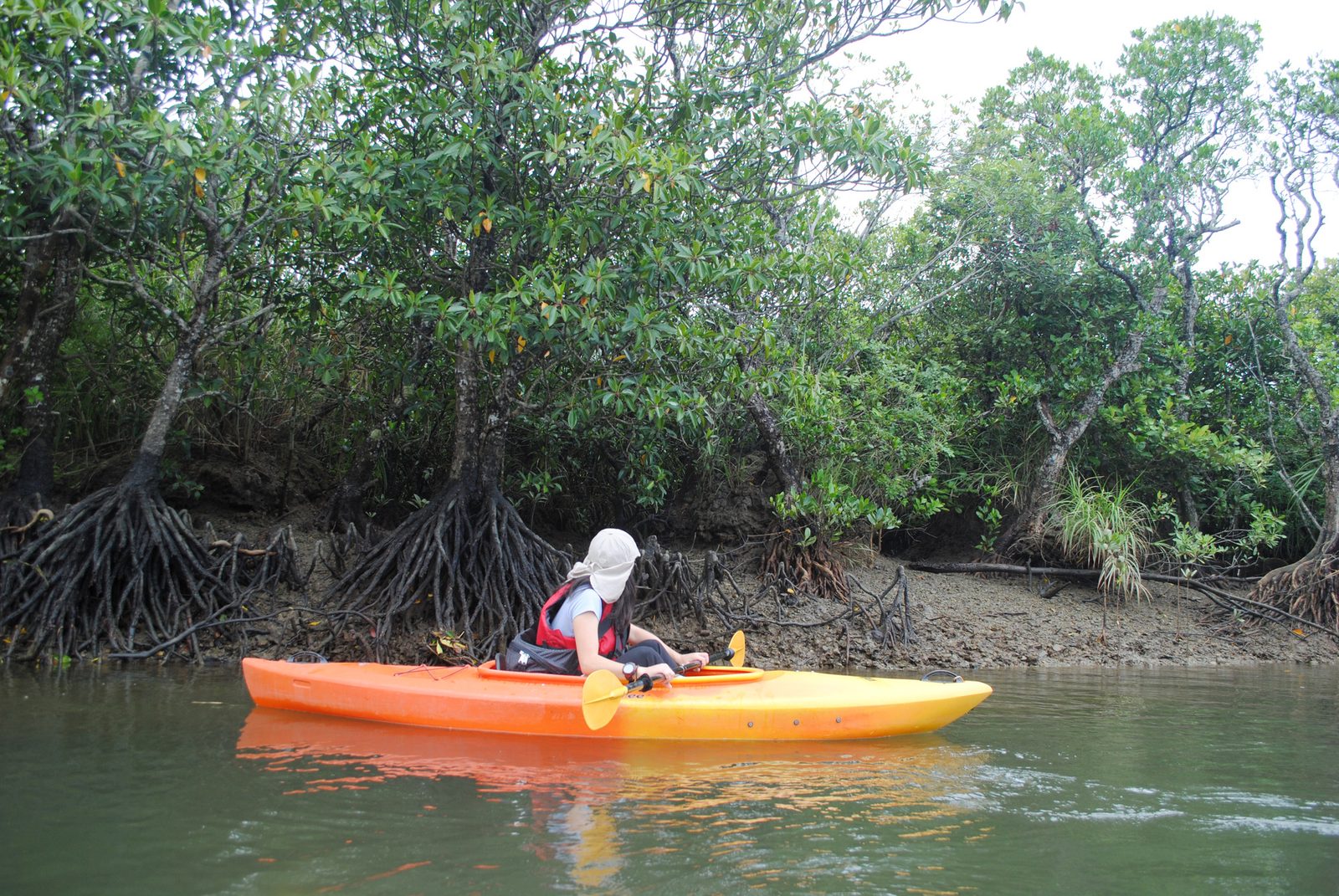
On the tidal flats, visitors can observe mangrove creatures, among them several kinds of crab. The holes dotting the ground are all crab burrows, so the ground deserves as much attention as the trees.
Just two plants of the Hirugi family grow in the mangroves of Amami Oshima, and both make up the forest at Sumiyo. One, with small, round leaves, grows on the coastal side, its absorbing roots holding a cork-like tissue that filters seawater and supplies fresh water. The forest spreads across the estuary where two rivers meet. If the mangroves are what you came for, give this part of the trip to the canoe and the tidal flats, treating the park's theater and rest area as a pause, not the point.
Mud Dyeing and Weaving of Oshima Tsumugi
Oshima Tsumugi Village lets visitors view and try all the steps from white silk thread to finished cloth in a garden surrounded by subtropical plants. General visitors can step into the mud field and take part in the mud dyeing.
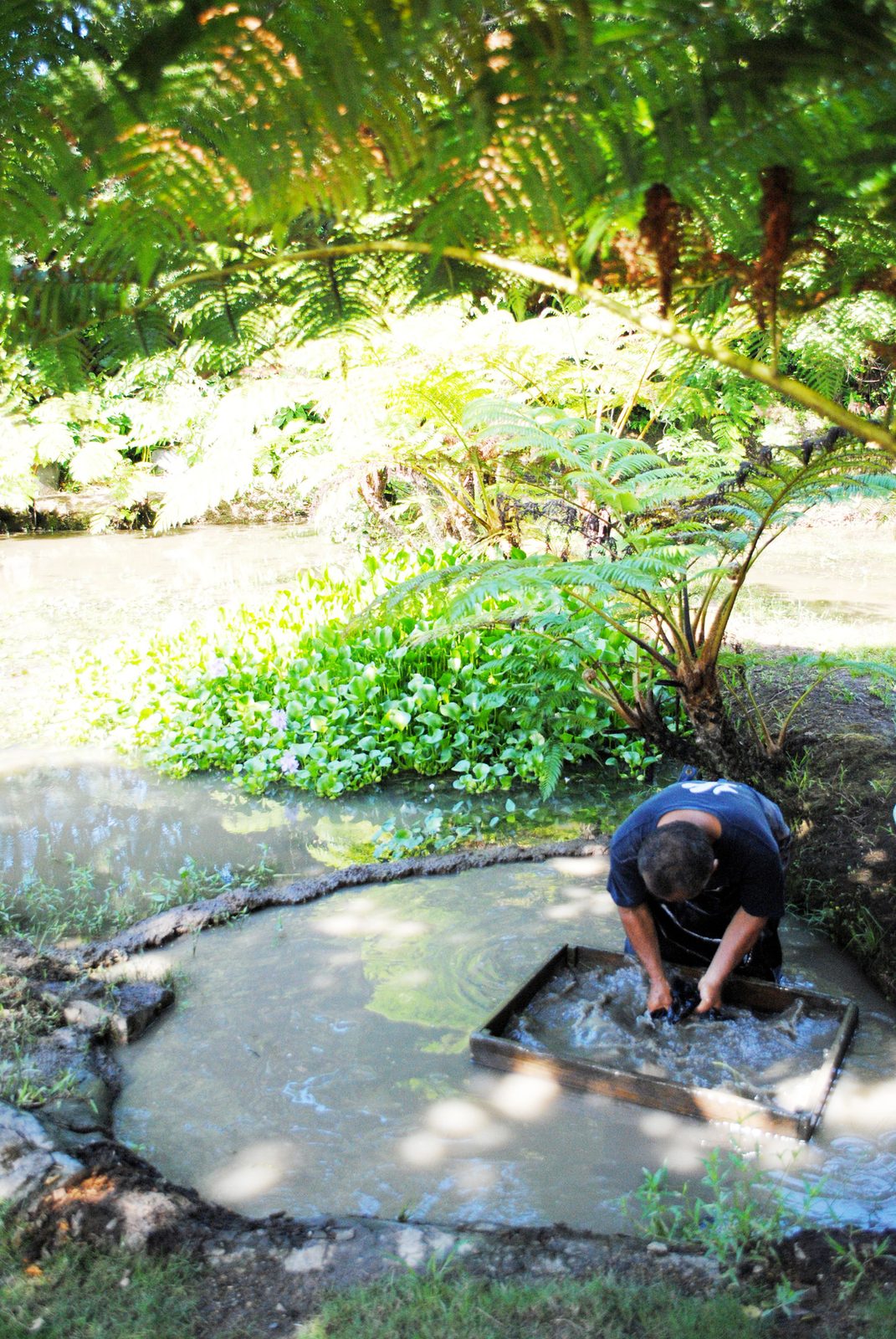
At a workshop in Tatsugo, visitors can see teechi wood, which grows wild on the island, chipped and boiled. Boiled in a large kettle, the chips give off a red-brown liquid, and the silk thread shown was dyed twenty-eight times in it.
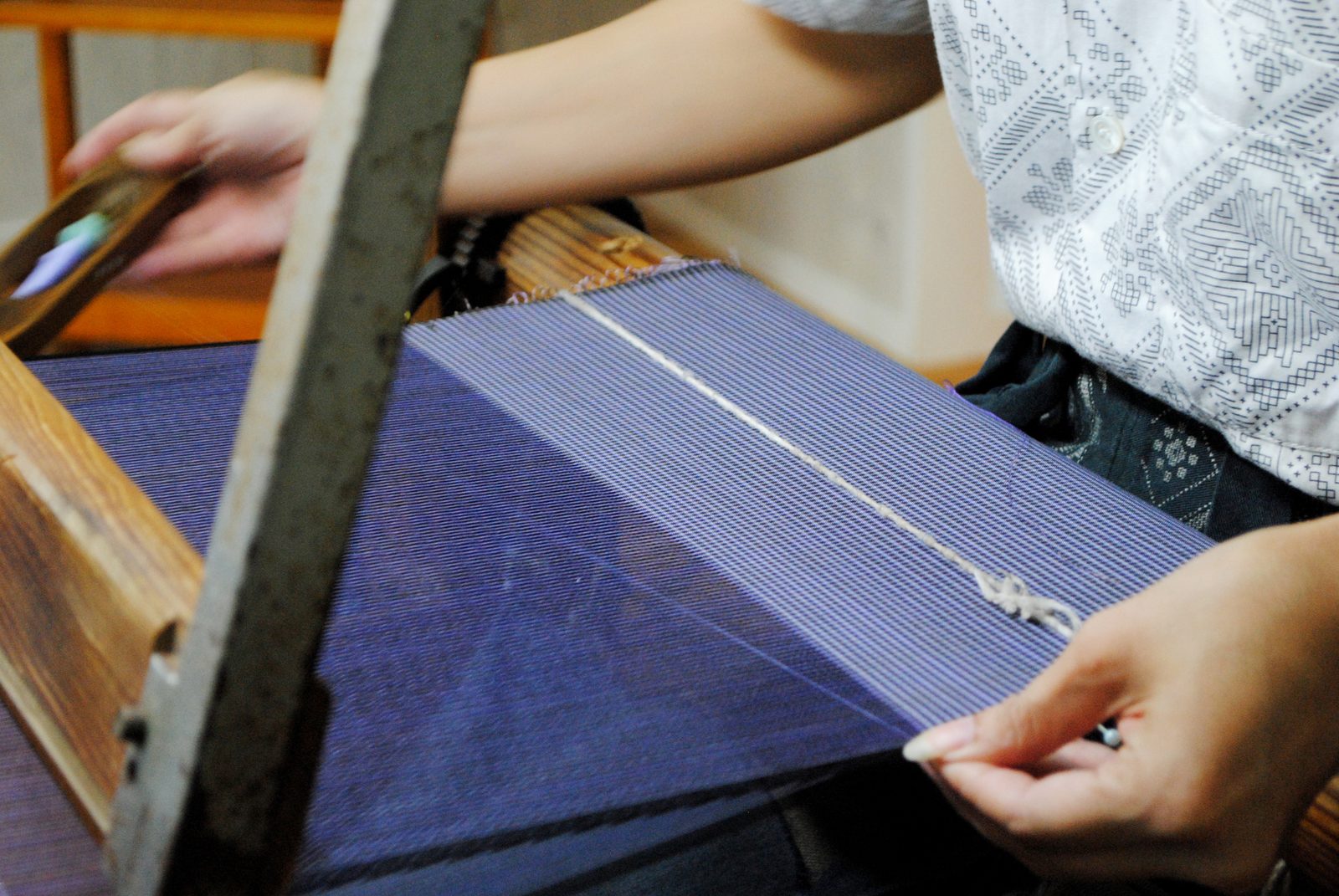
Tannic acid in the teechi wood reacts with iron in the mud, turning the thread grey, and repeated mud dyeing builds the deep, moist black of Oshima tsumugi, the step a visitor in the mud field joins. Oshima tsumugi takes thirty to forty production steps and, where ordinary fabrics have one weaving step, has two. The first, shimebata, weaves cotton thread into silk thread on a loom to make kasuri-mushiro, and the threads are dyed to match a pre-drawn design. If you want to understand why the cloth is so dark, watch the teechi liquid and the mud field before the loom, since the color is made there.
Calm Beaches, a Bamboo-Grass Cape and a Primeval Forest
Kurasaki coast in Tatsugo is an inland sea, calm and easy to swim in, and Kuninao beach in Yamato village has calm, clear seawater. Kuninao beach is also a sea turtle egg-laying site at night.
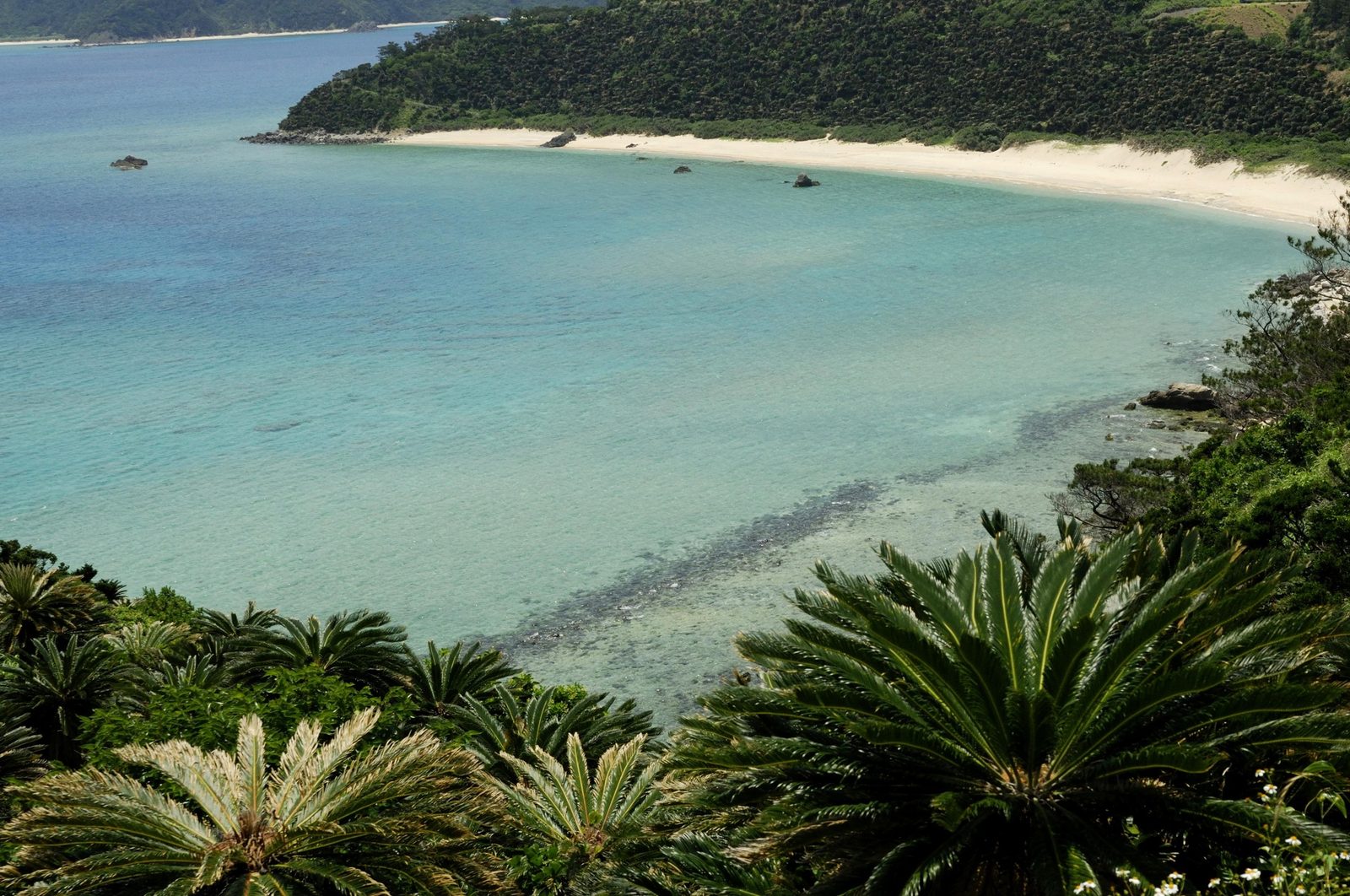
On a cape in Yamato village, a low bamboo grass covers the whole headland, and the grass takes its local name from a time when a bamboo-grass meadow spread over the cape, a name that was later shortened. Elsewhere on the island, a primeval forest where untouched nature remains is home to many endemic species and rare animals and plants. Ohama coast in Naze lies inside a seaside park and serves local islanders as a resting place. If you would rather spend time by the water than in the forest, Kurasaki coast and Kuninao beach are two calm choices, and Kuninao adds the turtle nesting shore after dark.
Shima-uta, Moon-Waiting Songs and a Circle Dance
At the shima-uta venue in Naze, folk tales and moral tales are told through shima-uta, the songs of the island. The organizer sometimes holds a workshop in which lyrics are written to fit a shima-uta, so the songs can be made as well as heard.
The venue's songs sit beside an old moon-waiting custom, in which several people gathered on nights from the thirteenth to the twenty-eighth of the old calendar, ate and drank while waiting for the moon to rise, worshipped it, and sang songs with a name of their own. Amami also has a traditional circle dance in which villagers dance to drums and songs, so the venue's singing is part of a wider habit of music made together. If songs and stories interest you, make the venue the reason for your time in Naze, and look in on the spring in the Okuma area while in town.
Getting to Amami Oshima
| Leg | How | Time |
|---|---|---|
| Tokyo to Amami Oshima | Flight | About 2 hours 20 minutes |
| Osaka to Amami Oshima | Flight | About 1 hour 50 minutes |
| Fukuoka to Amami Oshima | Flight | About 1 hour 20 minutes |
| Kagoshima to Amami Oshima | Flight | About 1 hour |
| Okinawa to Amami Oshima | Flight | About 1 hour 5 minutes |
| Amami Airport to Kuroshio no Mori Mangrove Park | Car | About 70 minutes |
From Naze, the park is about thirty minutes by car.
New to rural buses and one-man trains? See how to ride them, step by step.
Hours and Fees
| Place | What | Hours or fee |
|---|---|---|
| Oshima Tsumugi Village | Hours | 9:00 to 17:00; closes at 16:00 on shortened days |
| Oshima Tsumugi Village | Admission, adults (tax included) | 550 yen |
| Oshima Tsumugi Village | Admission, children in elementary and junior high school (tax included) | 220 yen |
| Kuroshio no Mori Mangrove Park | 60-minute canoe course | Departures at 10:00, 11:30, 13:00, 14:30 and 16:00 |
| Kuroshio no Mori Mangrove Park | 90-minute canoe course | Advance booking by the day before; departures at 9:30 and 15:30 |
| Shima-uta venue in Naze | Hours | Thursday to Sunday, 12:00 to 19:00 |
Paddling through the mangrove tunnel is possible while the tide is in, the canoe trip lasts about one hour, and small children can ride in a two-seat canoe with a parent. Oshima Tsumugi Village is closed on the Obon send-off day of the lunar calendar and over the year-end and New Year holidays.
Where to stay
Places to stay near Amami, Kagoshima, Japan →
Disclosure: This post may contain affiliate links. If you book through them, we may earn a commission at no extra cost to you.