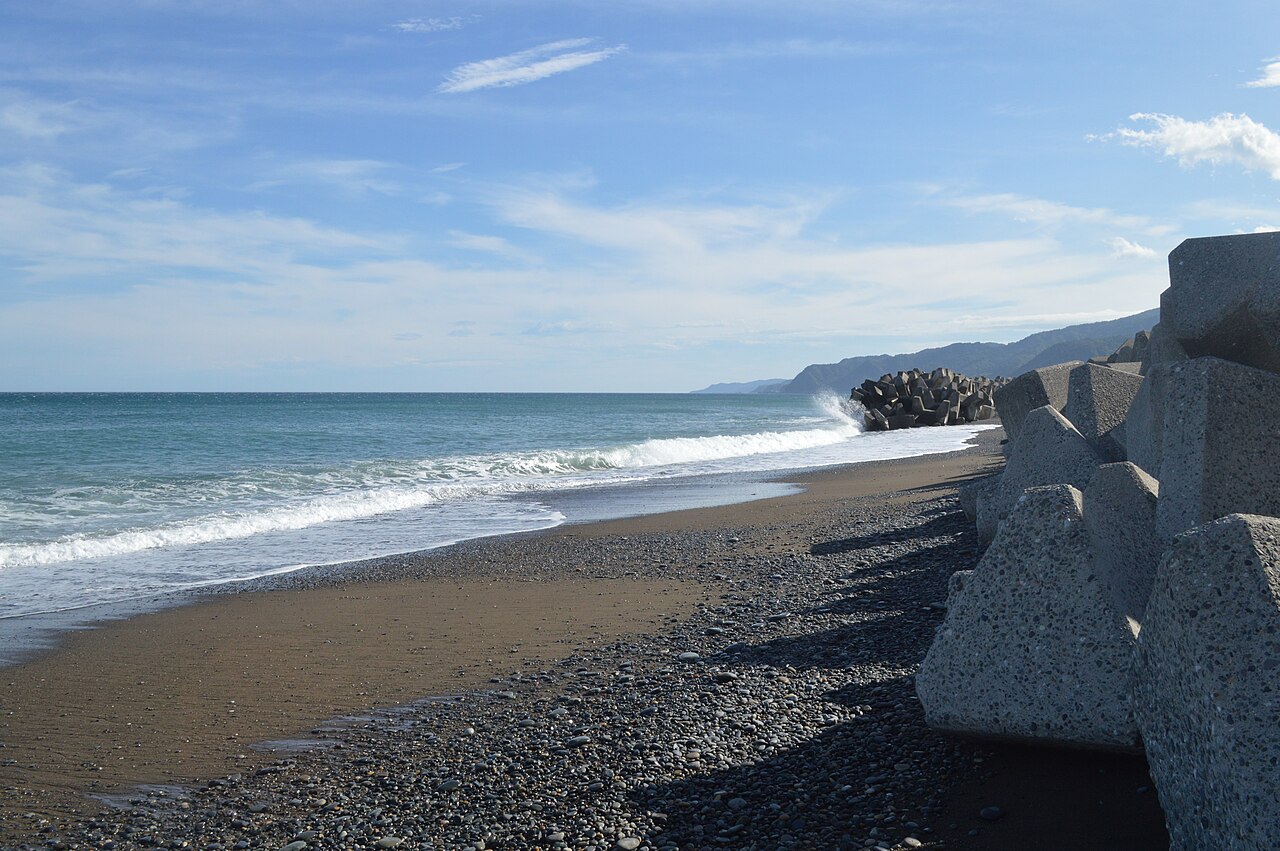
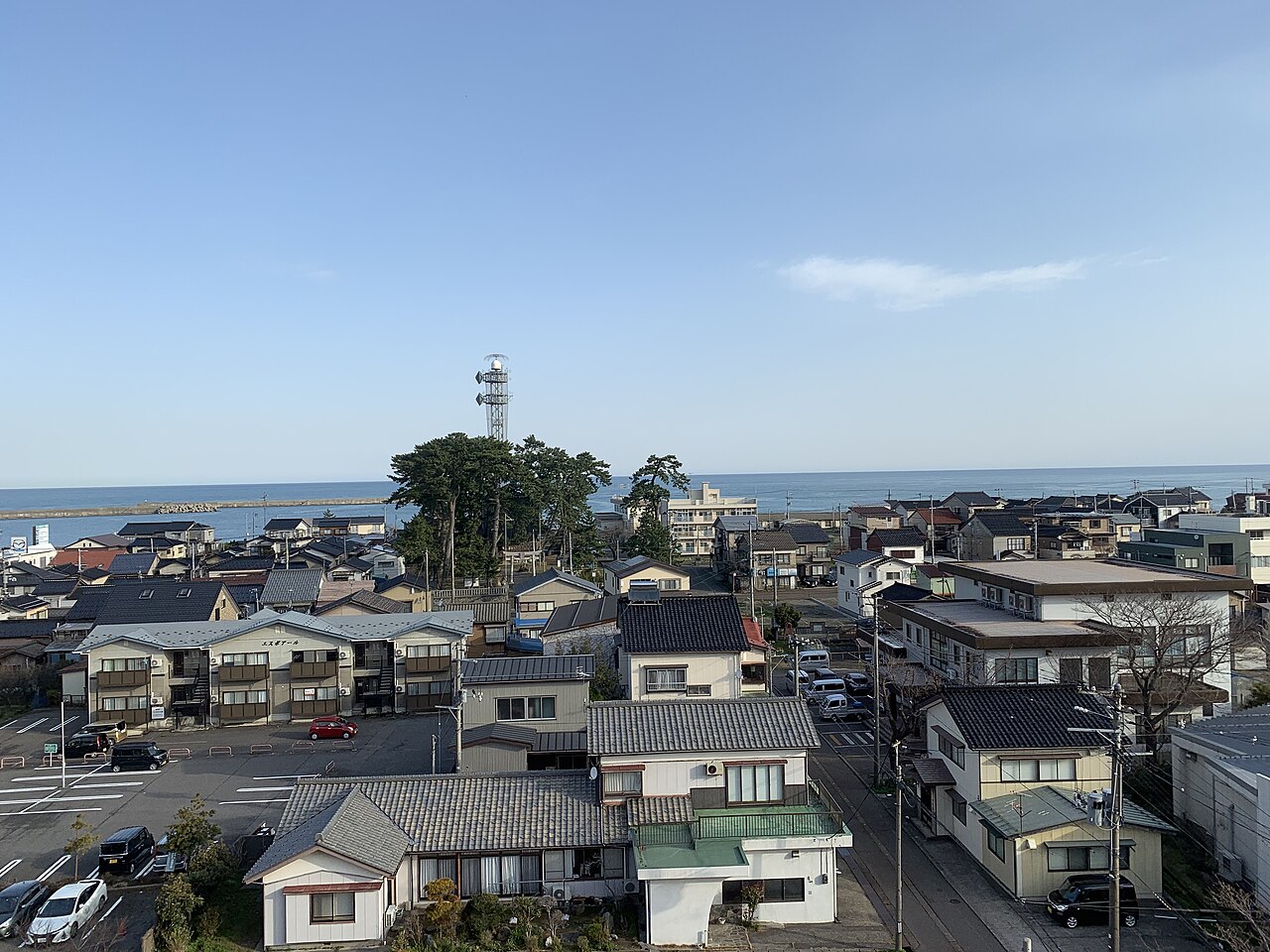
Itoigawa, on Niigata's Sea of Japan coast, has a long coastline and seven fishing ports. Jade from the Kotaki River area goes down the Himekawa River and washes up on the city's coasts, also called Hisui Coast, where enthusiasts are seen searching for it. Beyond the shore lie a jade gorge, a tectonic line you can touch, a three-tiered waterfall and, in spring, a festival of colliding portable shrines.
Oyashirazu and Benten-iwa on the Itoigawa Coast
Oyashirazu, one explanation of the name says, is where the wife of Yorimori, younger brother of Taira no Kiyomori, lost her two-year-old child to the waves and composed a poem that gave the place its name. On the same coast, the Oyashirazu Community Road is a viewpoint from which four generations of roads can be seen at once.
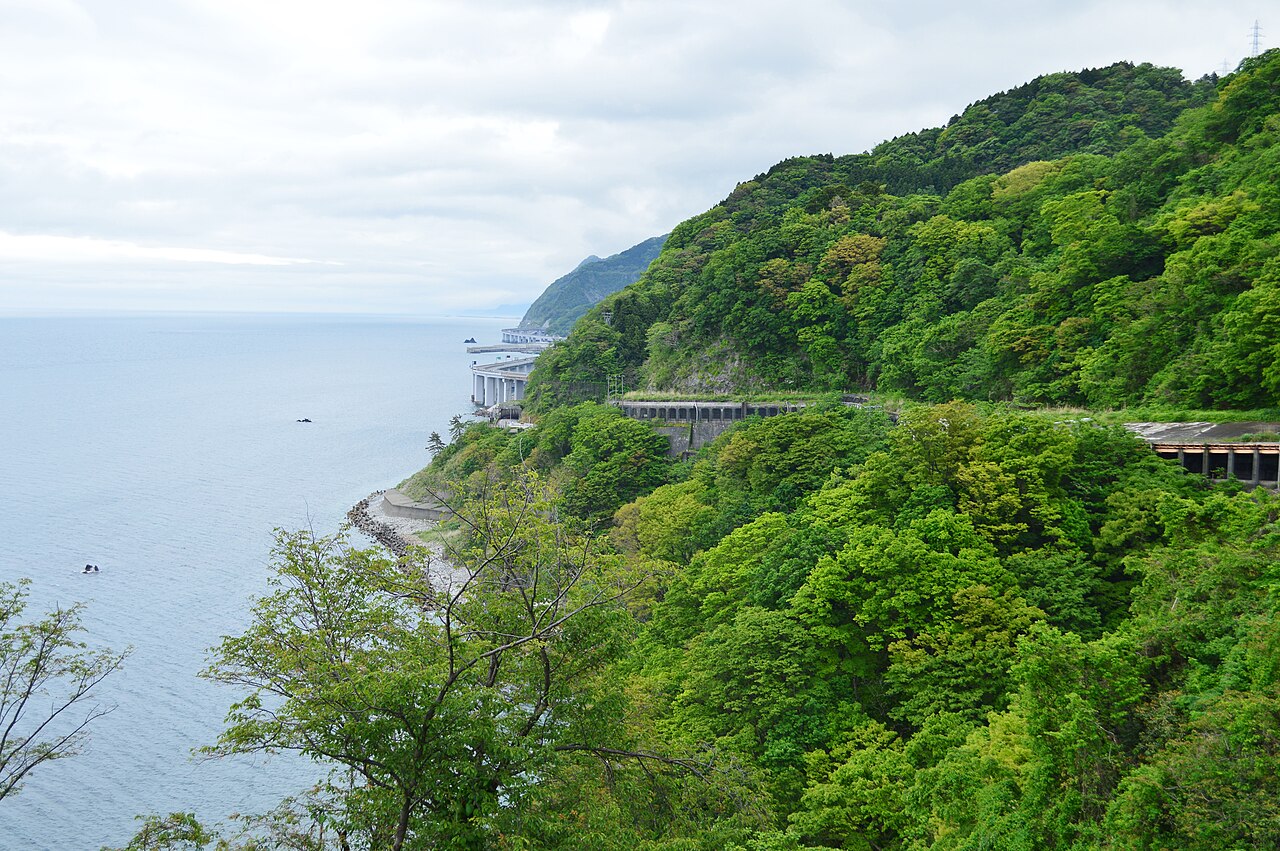
The observation deck at the Oyashirazu Community Road looks out over the Sea of Japan, with the Noto Peninsula visible on clear days. Models installed at the site reproduce the rock-face Namiyoke Kannon, Ofutokoro and Kofutokoro.
Benten-iwa is a large reef formed by a submarine volcanic eruption of the Fossa Magna. Visitors who cross to it can view volcanic ejecta made of lava fragments and volcanic ash. In the middle of the island stands Itsukushima Shrine, a shrine to a guardian deity of the sea. Crossing the red-railed Akebono Bridge gives a view over the Sea of Japan in all four seasons.
If you have to choose, Oyashirazu is the stop for a story and a view, and Benten-iwa the one for standing on volcanic rock.
Kotaki River Hisui Gorge and Myojosan
The Kotaki River Hisui Gorge is the riverbed where the great rock wall of Myojosan comes straight down to the Kotaki River, a tributary of the Himekawa. Below that wall, jade washed by the clear water of the Kotaki River can be observed, and hard raw jade stones lie scattered across the clear riverbed.
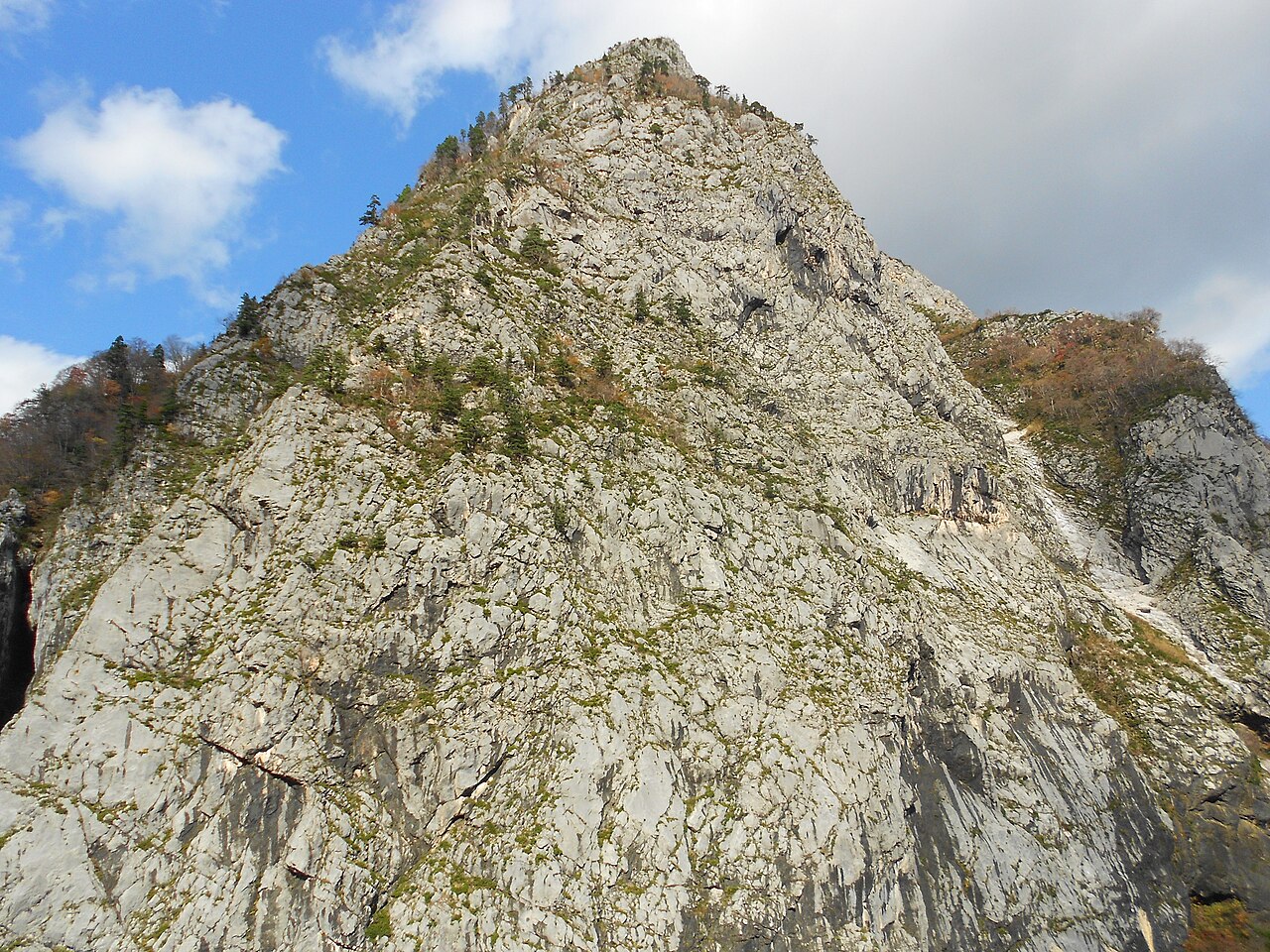
The jade here is polished naturally by the clear stream and is beautiful as a raw stone. Collecting jade or any other rock in the Kotaki River jade area is not possible, and jade may not be collected at the Hisui Gorges. This was also the first jade production site confirmed in Japan.
Myojosan itself is wholly limestone and is used as a rock-climbing ground. Its south wall, high above the river, is for advanced climbers, and on fine days climbers can be seen on the rock face.
If you want to see jade lying in a clear river, come to this riverbed, and know that every stone stays where it is.
Fossa Magna Museum and Fossa Magna Park
The Fossa Magna Park in Itoigawa lets visitors observe the Itoigawa-Shizuoka Tectonic Line and touch it. A line otherwise known from maps becomes something you can put a hand on.
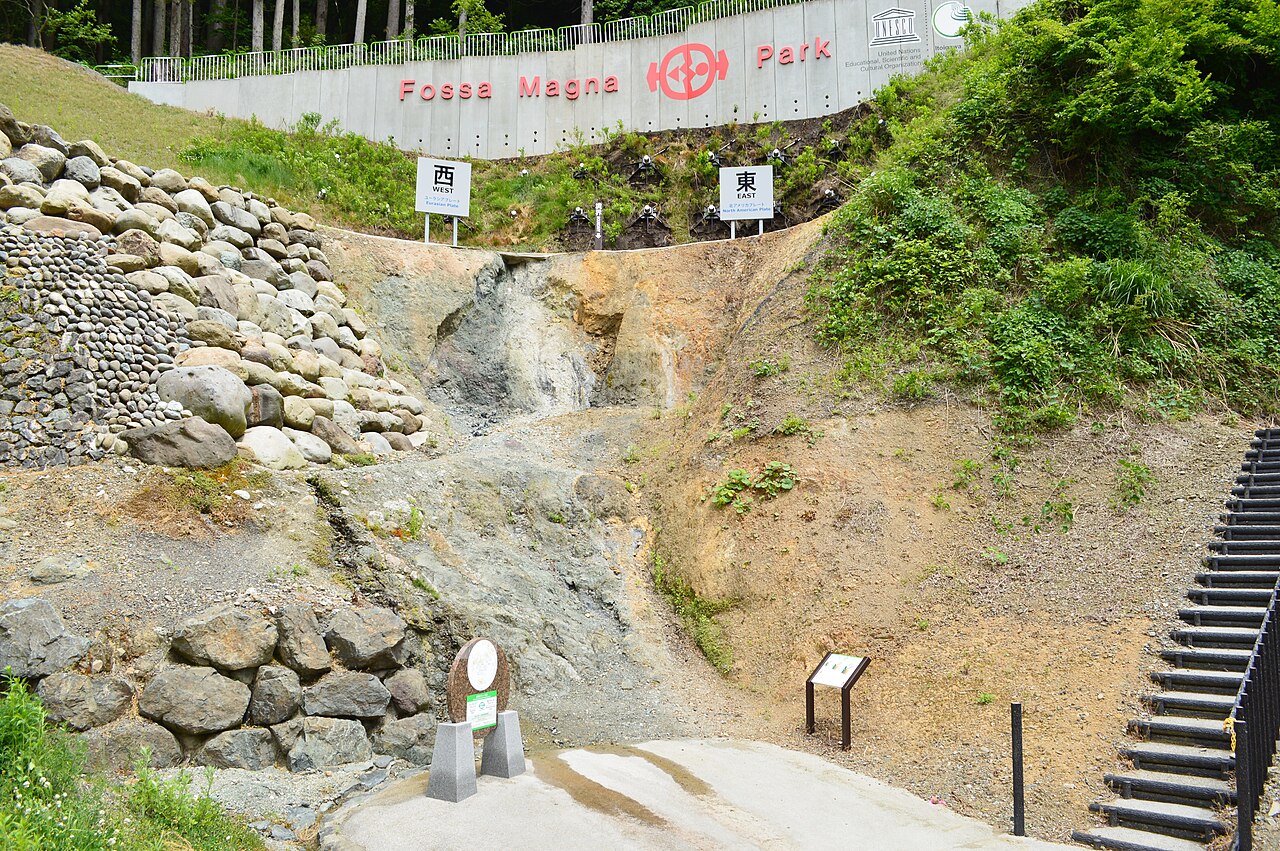
The Fossa Magna Museum builds on that with its Hisui Gorge exhibit, which shows a film of the gorge scenery while the sound of a stream can be heard. In the stone garden, a large map of Japan shows the position of the Fossa Magna as Dr Naumann conceived it, and a sundial there has a dial of jade. On slightly higher ground stands a suikinkutsu, where the sound of dripping water echoes in a jar.
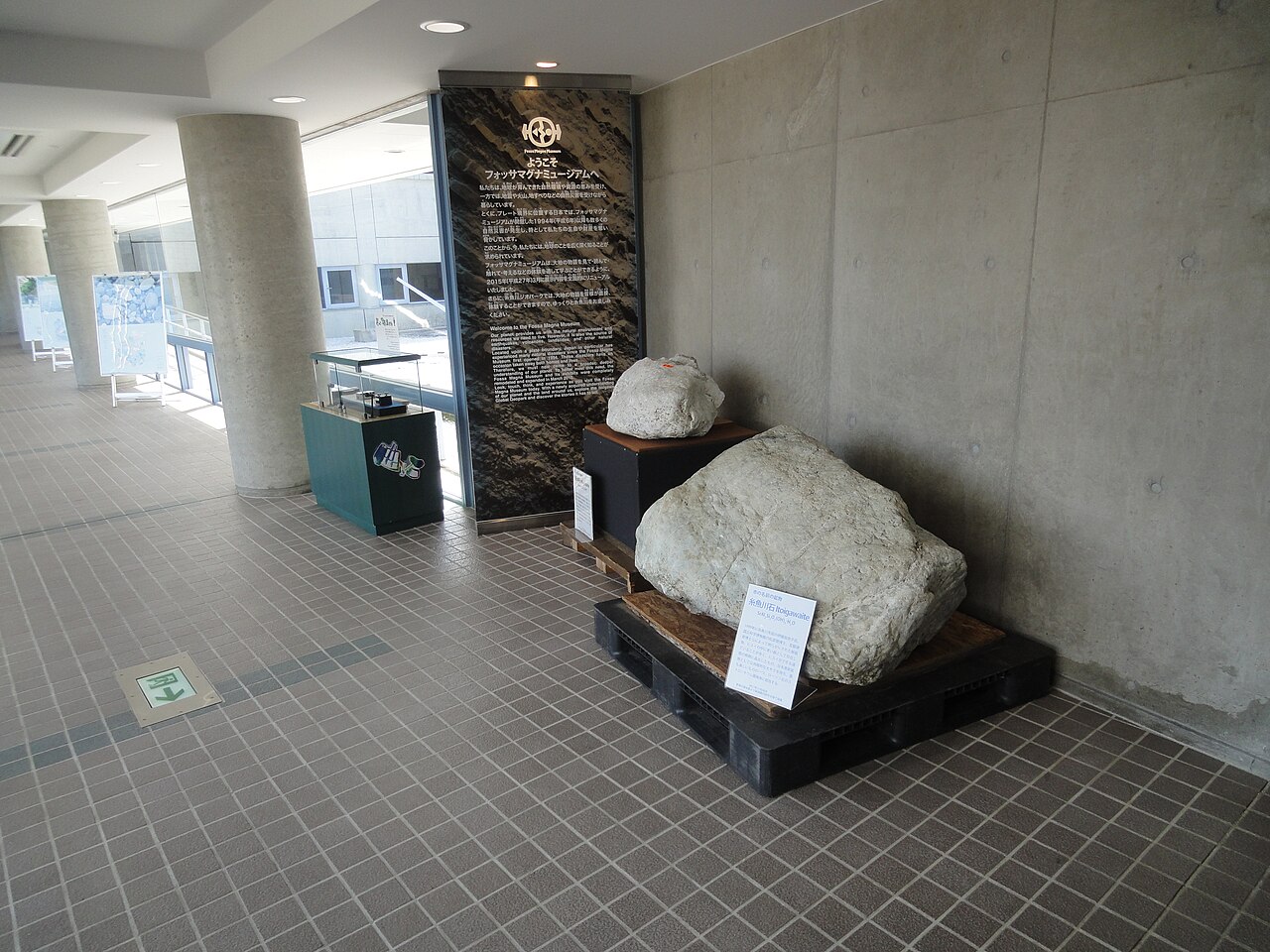
A fossil-collecting activity of seventy-five minutes is also offered for ages four and over. If you like to see a geological line you can touch and then learn what it means, pair the park with the museum's stone garden and its map.
Fudo Falls and Shindozan
Fudo Falls comes down in three tiers in a wooded area surrounded by mountains on three sides, chilly even in midsummer. In spring the volume of water increases with snowmelt.
A water shrine to Koryujin stands on a large rock in front of the plunge pool. A legend has been handed down that if the waterfall is made dirty, the dragon will bring heavy rain.
Shindozan was named as the mountain of the road the gods passed along, after a local legend of two gods. On the summit stands a bell for wishes to come true, the Sea of Japan is in view, and katakuri flowers bloom in profusion in early spring. In the same area, a rugged strange rock that legend says is a princess's birthplace is an object of worship. A large crack in the rock serves as a shrine and has a sacred rope stretched across it.
If old legends attached to a rock or a waterfall draw you, this part of Itoigawa has both.
The Amatsu Shrine Spring Festival and the Geopark Rice Bowl
The Amatsu Shrine Spring Festival, known as the Itoigawa Kenka Matsuri, is a festival in which two portable shrines collide. The first and second shrines jostle fiercely as they crash together, praying for a bountiful grain harvest. Scarlet happi coats lead the Oshiage ward shrine and moss-green ones the Teramachi ward shrine.
If the Oshiage ward wins, a good fish catch is said to follow; if the Teramachi ward wins, a good harvest. The shrines meet in the Amatsu Shrine grounds, and afterwards a bugaku dance is offered. In the surrounding villages, spring arrives quickly after the festival.
The Geopark rice bowl is based on the areas of the Itoigawa UNESCO Global Geopark. Another local dish uses jet-black noodles coated in squid ink. A set meal named after a dialect word for 'take care on your journey' pairs local dishes with sake from five breweries, made by master brewers.
If you plan a spring visit, build it around the festival; in any season, taste the Geopark in a bowl.
To stay overnight in the area, browse places to stay in Itoigawa.
Getting to Itoigawa
New to rural buses and one-man trains? See how to ride them, step by step.
| Leg | How | Time or cost |
|---|---|---|
| Tokyo to Itoigawa | Hokuriku Shinkansen | About 2 hours |
| Kanazawa to Itoigawa | Hokuriku Shinkansen | About 1 hour |
| Itoigawa to Niigata | Highway bus between the stops in front of the two stations | About 2 hours 45 minutes. 3,100 yen cash |
| Itoigawa Station to the Fossa Magna Museum | Taxi or bus | 10 minutes |
| Within Itoigawa | Community bus or shared taxi | 100 yen per boarding, some routes excepted |
Hours and Fees
| Place | What | Hours or fee |
|---|---|---|
| Fossa Magna Museum | Hours | 9:00 to 17:00, last admission 16:30 |
| Fossa Magna Museum | Admission, adult and school student | 700 yen and 300 yen |
| Fossil valley | Per person | 300 yen |
Fees and hours were checked against official sources on 8 November 2026.
Thinking of staying overnight?
Compare places to stay near Itoigawa, Niigata, Japan →
Disclosure: This post may contain affiliate links. If you book through them, we may earn a commission at no extra cost to you.