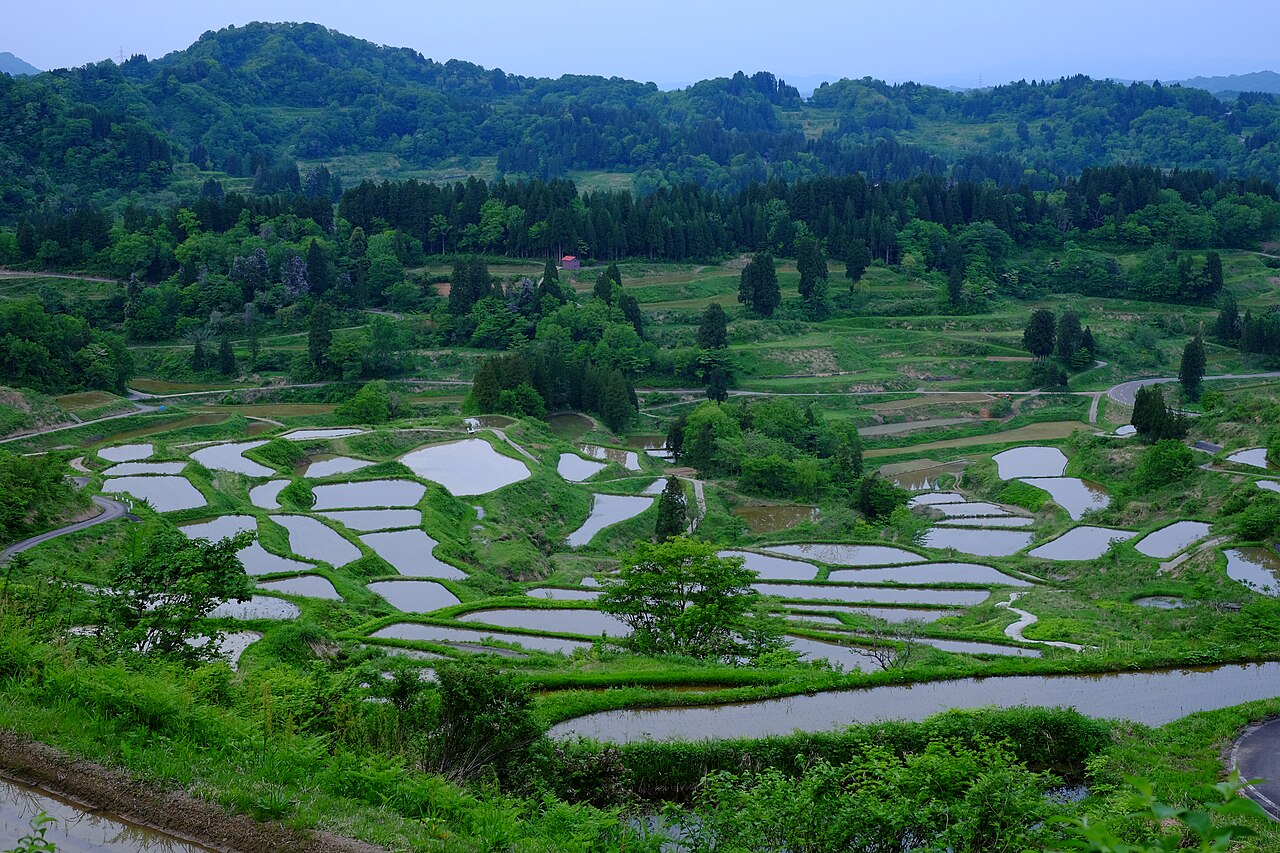
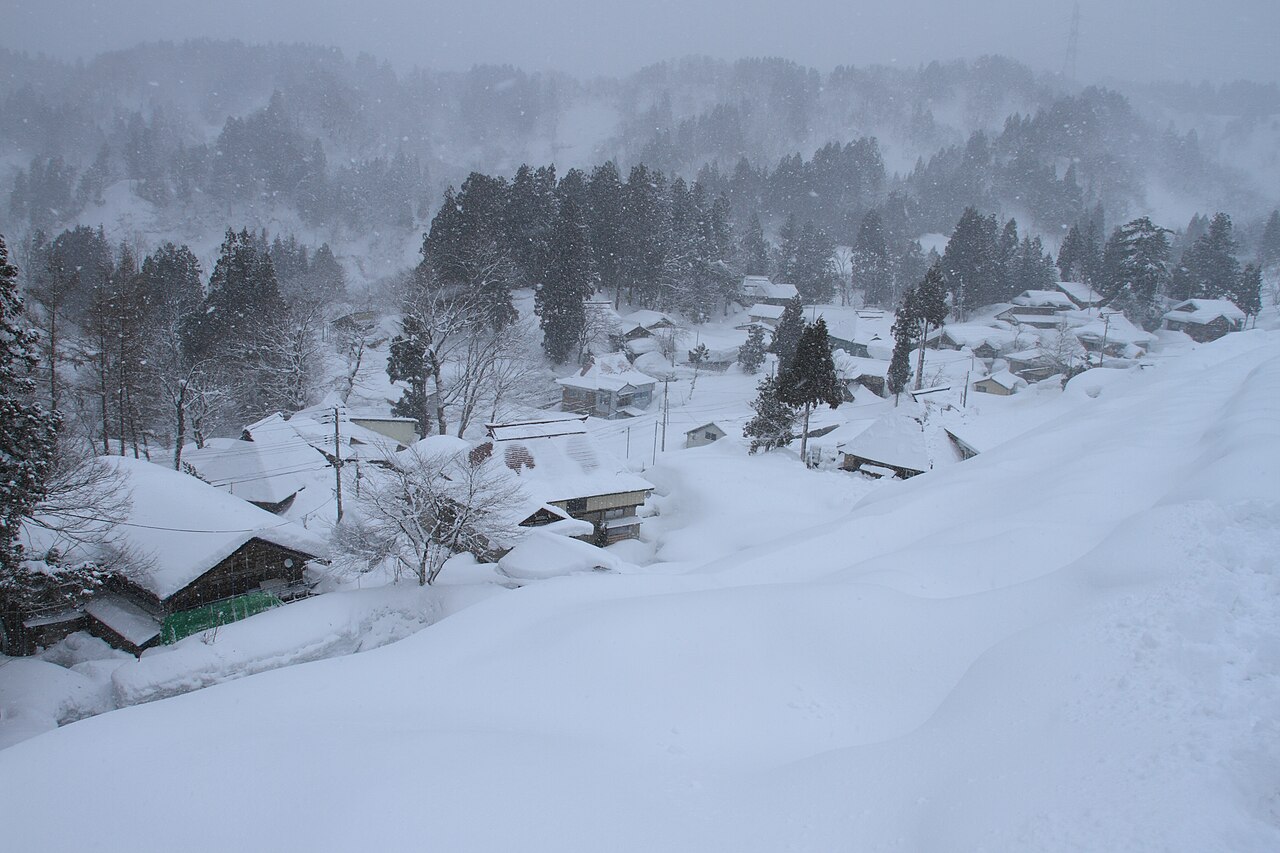
At Hoshitoge in Tokamachi, Niigata, about two hundred paddies spread over the slope like the scales of a fish. In spring and autumn, water pools in them and the terraces turn into a mirror. In Matsunoyama, the beech forest Bijinbayashi takes its name from the tall, elegant silhouettes of its trees. The water of Matsunoyama Onsen tastes salty when licked, and the same spring boils eggs, heats the pork and is kneaded into ramen noodles.
Water Mirrors and Fish-Scale Paddies at Hoshitoge
At Hoshitoge, about two hundred paddies, large and small, spread across the slope like fish scales. Terraced fields are paddies built in steps on sloping ground rather than on flat plains. In two thousand twenty-two the Ministry of Agriculture, Forestry and Fisheries designated Hoshitoge a Connecting Rice Terraces Heritage site.
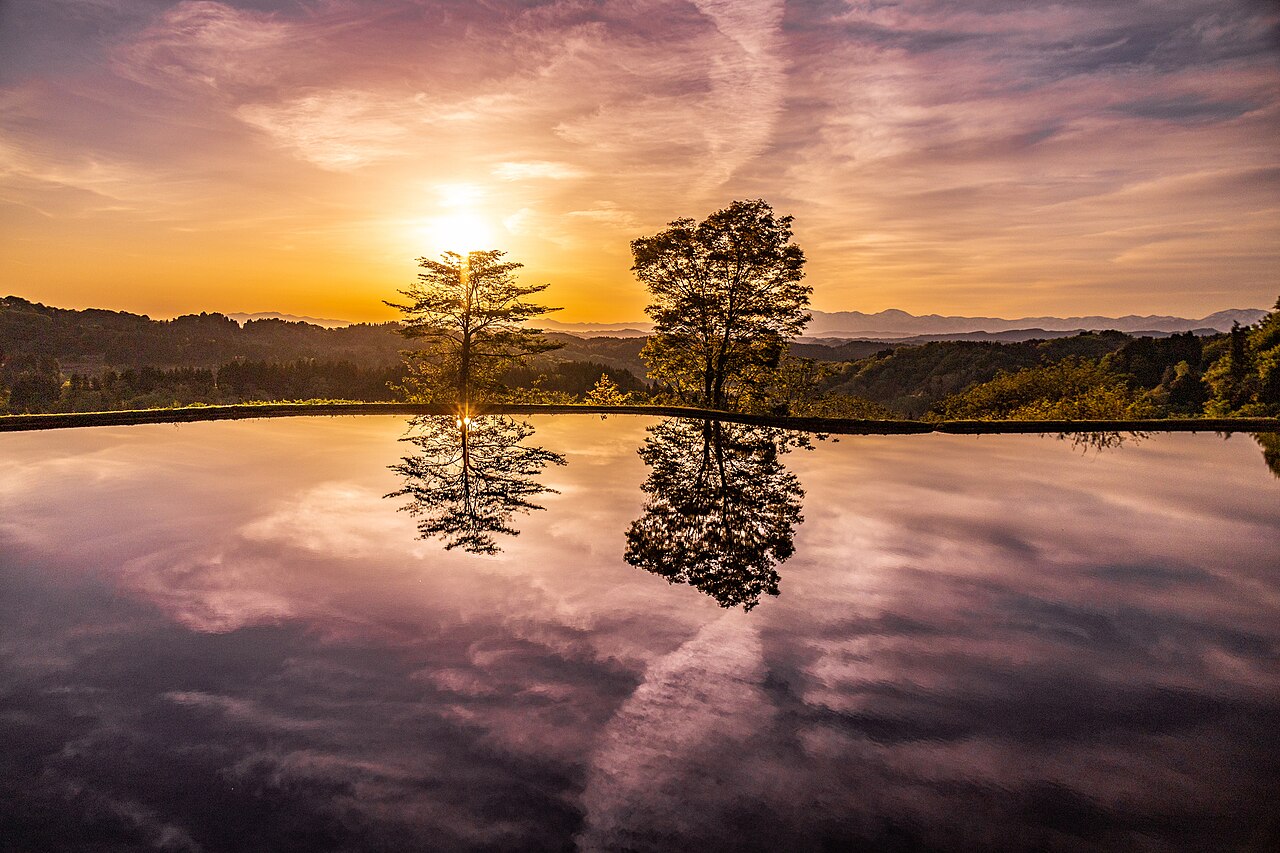
In spring, from snowmelt until rice planting, and again in autumn, from late October until the first snowfall, water pools in the paddies and creates a mirror-like surface. Snowmelt soaks into the surrounding forest, becomes mineral-rich water and irrigates the terraces. If the water mirror is what you came for, plan around spring and autumn.
Autumn is also working time. After the harvest in late autumn, the paddies are puddled, a step called shirokaki. Harvested rice is dried on racks that use the cedar trees around the paddies as posts, a method known as hasagake or hazagake.
Bijinbayashi, the Forest of Beauties
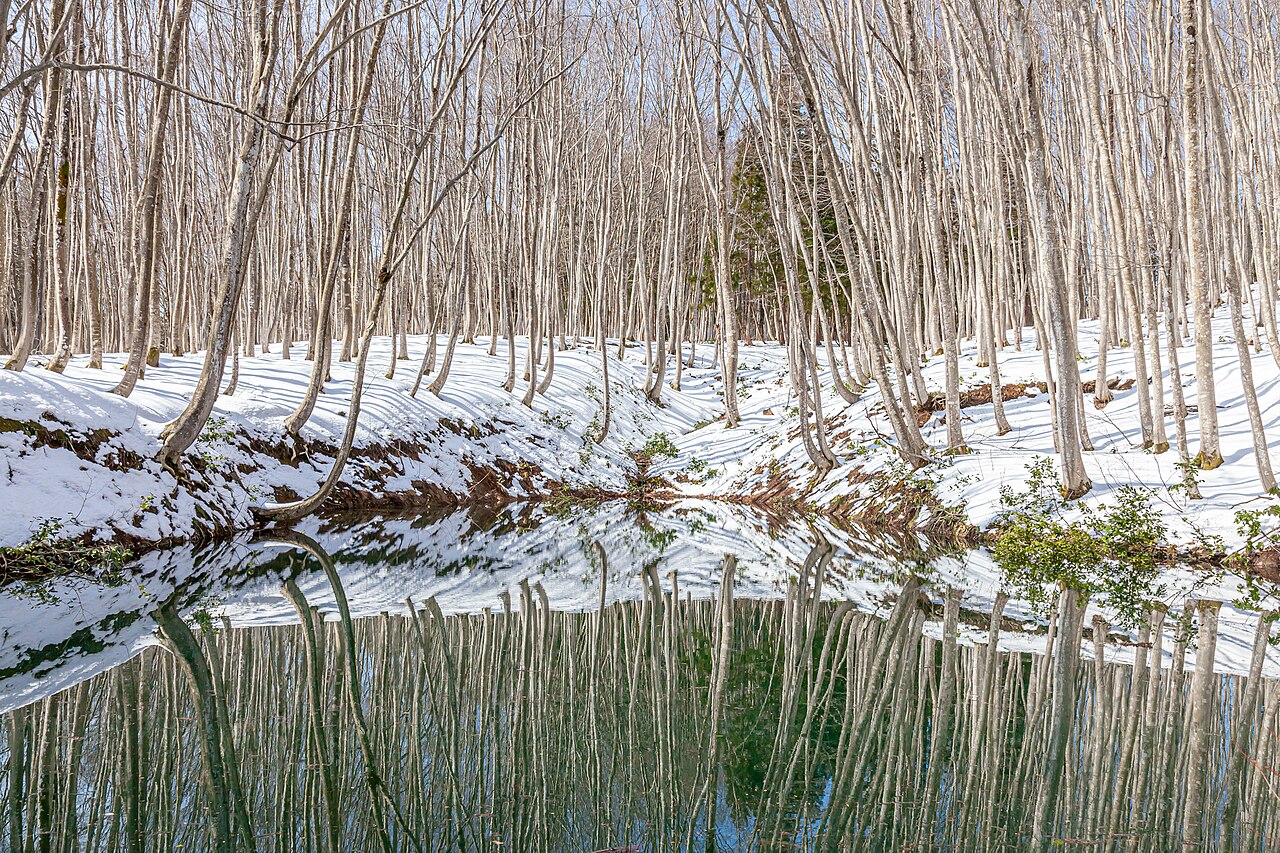
Beech trees about a hundred years old stand on a hilly area of about three hectares in Matsunoyama. The name Bijinbayashi, meaning forest of beauties, was inspired by the tall, elegant silhouettes of the trees. In the late Taisho period, every beech on the hill was cut down for charcoal and the ground was left bare.
The following year the trees sprouted all at once. Thousands of saplings grew straight up toward the sun. Inside, you can walk freely over soft leaves, and the ground has little slope. There is a pond at the center of the forest. Many wild birds live among the trees.
In spring of a heavy-snow year, young leaves bud amid the remaining snow. The newly budded soft leaves are still yellow-green. In summer the forest turns vivid green and wind blows through the beeches. In autumn the leaves turn a warm orange rather than a flashy colour like maple, so the forest suits a slow walk over the soft ground.
Frost or a strong wind can bring all the leaves down overnight. On sunny winter days the snow lit by sunlight sparkles. Beeches on the slopes are often bent into odd shapes by the weight of the snow. The snow melts in rings outward from around the tree roots.
Salt Springs and Hot-Spring Pork in Matsunoyama Onsen
The spring water of Matsunoyama Onsen tastes salty when licked. The salt is so concentrated that crystals can form at the spout. The component content is stated to be fifteen times the standard level required for a hot spring. The sodium is attributed to fossilized seawater trapped underground for over ten million years.
A legend says that about seven hundred years ago a woodcutter saw a falcon resting an injured wing and found the spring welling up there. The majority of the sources come out at around ninety degrees Celsius. It is a chloride spring, expected to have sterilizing and warming effects.
The spring cooks, too. Touji Pork is aged Tsumari pork vacuum-cooked at a low temperature with the heat of the Matsunoyama Onsen spring. Touji Tamago is an egg boiled in the hot-spring water for a whole day. It carries a faint saltiness from the spring.
The restaurant inside Hinano-yado Chitose serves lunch menus that include Toji-buta, the hot-spring pork, and Niigata wagyu steak grilled on an iron griddle. The restaurant lists the wagyu steak as its recommended dish. Anyone short of time can skip the chemistry and simply try the hot-spring pork.
Hegi Soba and Other Local Tables
Hegi soba is soba served on a hegi, a vessel made from a peeled wooden board. Its firmness comes from the seaweed funori, used as a binder. Funori was originally used to twist thread when making textiles. The soba is rolled into bite-sized portions and arranged neatly on the hegi.
Echigo-Matsudai Satoyama Shokudo serves a lunch of home cooking handed down in Echigo-Tsumari. It uses fresh vegetables from nearby farmers, terrace-field rice and Tsumari pork. The interior is light blue, and mirror tables reflect the four-season views from the windows of local homes. The cafe adds desserts and drinks.
A tonkatsu shop serves a thick cutlet of two hundred and fifty grams of pork on rice. A hand-made ramen shop keeps its soup light and mild in the old-fashioned way. Matsunoyama hot-spring water is kneaded into its hand-made curly noodles, which cling well to the soup.
A yakitori shop does a yakitori bowl of teriyaki chicken in a special soy-sauce glaze that goes well with rice. For a first meal, start with hegi soba; the ramen suits anyone who wants a mild soup, and the tonkatsu bowl suits a large appetite.
Art Works and a Guided Walk to a Closed-Off Viewpoint
The Matsunoyama area has many art works that stay on view year-round, including after the festival period ends. One large-scale work uses a former elementary school that shut its doors when its pupils dwindled. Inside, a heartbeat sound resounds through the building.
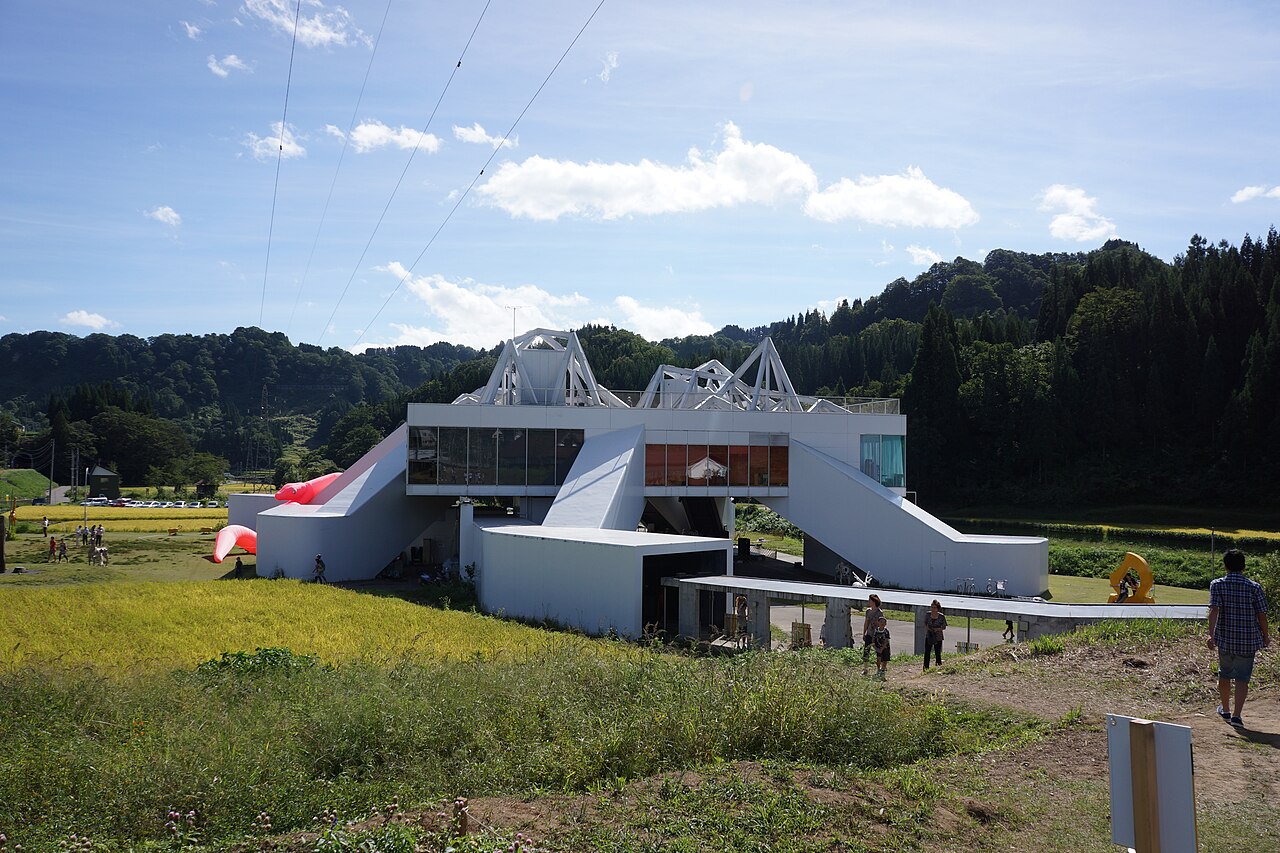
At Kyororo, a thick acrylic window gives a direct look at a cross-section of accumulated snow. A house a hundred and fifty years old was restored as Australia House. MonET displays works that let viewers perceive changes in the space and time of the place. Its shop sells Triennale goods, artist items, terrace-field rice, original-design sake and sweets.
The guided walk starts from the Hokuhoku Oshima railway stop and follows an old unpaved mountain road toward the Hoshitoge terraces. From a small hill above the settlement, terraced fields and satoyama scenery spread out with the Echigo Sanzan mountains in the background.
Along the way a local outdoor guide explains satoyama and snow-country life. The walk reaches an area tourists normally cannot enter, so it suits anyone who wants a view from somewhere other than the viewing platform. Anyone content with the platform view can leave it out.
Getting to Matsunoyama and Hoshitoge
| Leg | How | Time |
|---|---|---|
| Tokyo to Matsunoyama | Car, via the Kan-etsu Expressway Shiozawa-Ishiuchi Interchange | About 3 hours |
| Niigata to Matsunoyama | Car, via the Echigo-Kawaguchi Interchange | About 1 hour 40 minutes |
| Kanazawa to Matsunoyama | Car, via the Joetsu Interchange | About 3 hours |
| Nagoya to Matsunoyama | Car | About 4 hours |
| Echigo-Yuzawa Station, Joetsu Shinkansen to the local train | Standard transfer | 6 minutes |
| Matsudai Station to the Hoshitoge rice terraces | Taxi | About 20 minutes |
| Matsudai Station to Matsunoyama Onsen | Bus | About 30 minutes |
| Matsudai Station to Matsunoyama | Taxi | About 20 minutes |
| Matsudai Station to the Matsudai field museum | On foot | 3 minutes |
IC cards such as Suica and PASMO cannot be used on the Hokuhoku Line, so check official information before visiting.
New to rural buses and one-man trains? See how to ride them, step by step.
Hours and Fees
| Place | What | Hours or fee |
|---|---|---|
| Hoshitoge parking lot and viewing platform | Winter | Not cleared of snow and cannot be used, with reopening possibly after Golden Week |
| Guided terrace trekking tour | Fee per person | 8,250 yen |
| Guided terrace trekking tour | Duration | About 3 hours |
| Matsunoyama Onsen center bath | Hours | 11:00-20:00, last entry 19:30 |
| Matsunoyama Onsen center bath | Closed day | Thursday (the day before if Thursday is a public holiday) |
| Matsunoyama Onsen center bath | Adult admission | 600 yen |
| Restaurant inside Hinano-yado Chitose | Lunch hours | 11:30-14:00, last order 13:30 |
| Restaurant inside Hinano-yado Chitose | Closed day | Monday (the following Tuesday if Monday is a public holiday) |
| Restaurant inside Hinano-yado Chitose | Lunch | Advance booking by telephone |
| Echigo-Matsudai Satoyama Shokudo | Hours | 10:00-17:00, cafe last order 16:30 |
| Echigo-Matsudai Satoyama Shokudo | Closed days | Tuesday and Wednesday |
| MonET | Hours | 10:00-17:00, last admission 16:30 |
| MonET | Permanent exhibition | 1,000 yen general, 500 yen elementary and junior high school students |
| Echigo-Tsumari Art Triennale | Scheduled dates | 17 July to 7 November 2027 |
Inns and hot-spring facilities adjust the water to a temperature that suits their guests. Anyone who would rather not hurry back after a bath can compare places to stay in Tokamachi.
Where to stay
Places to stay near Tokamachi, Niigata, Japan →
Disclosure: This post may contain affiliate links. If you book through them, we may earn a commission at no extra cost to you.