Fukaura, on the Sea of Japan side of Aomori, pairs the lake walks of Juniko with a port that lands about half of the prefecture's bluefin tuna. Behind the lakes stands the beech forest of Shirakami-Sanchi, a primeval wood that has never been logged or developed. In it lies Aoike, the Blue Pond, whose surface looks as if blue ink had been poured into it, and not far away erosion has laid bare a wall of white tuff rock called the Japan Canyon. Down on the coast, the Senjojiki rock shelf reaches out into the sea and can be walked across.
The Blue Pond and Its Wooden Boardwalk
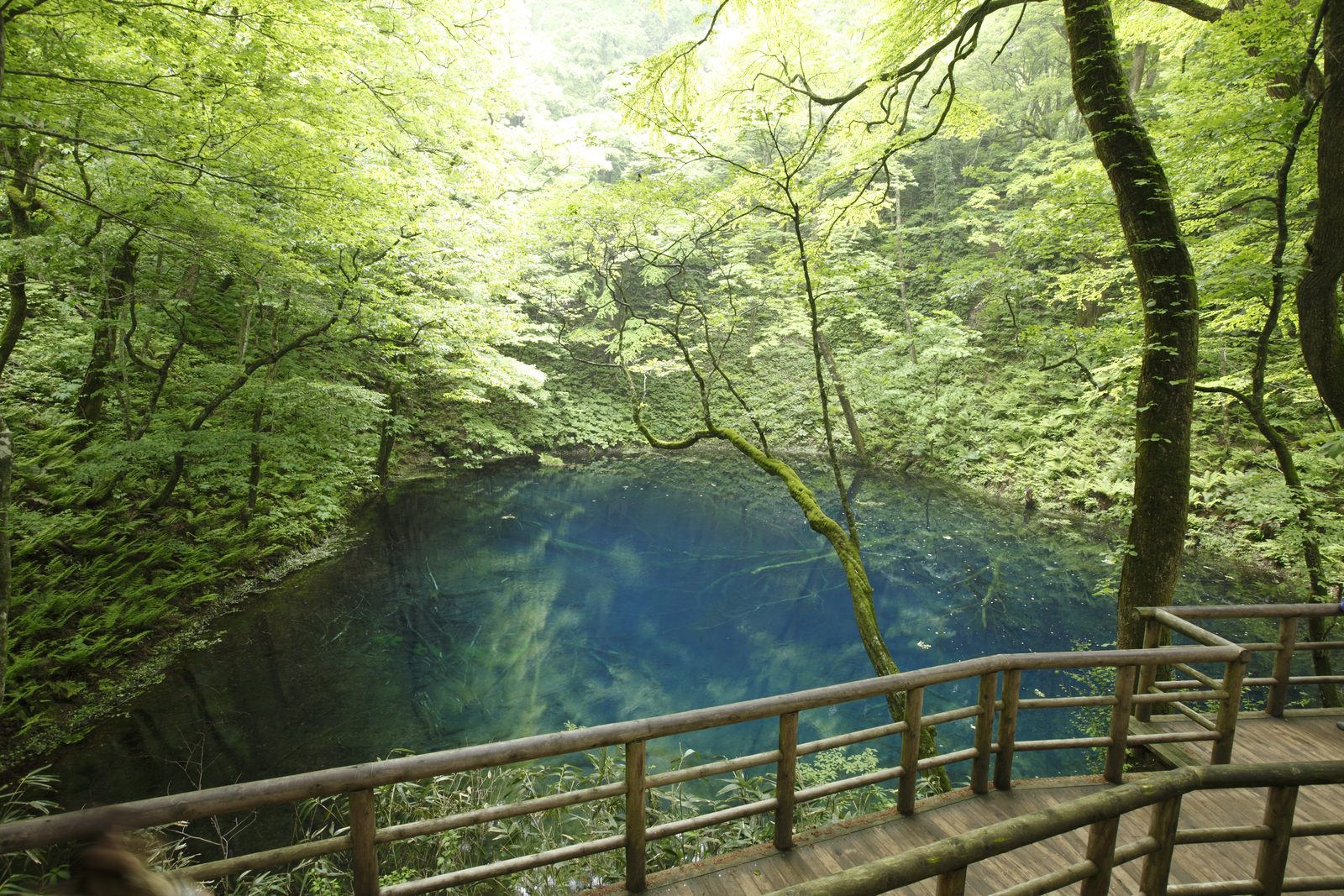
Walk the wooden deck at Aoike and the water below reads as a deep cobalt, as though someone had tipped blue ink into a pool where beech trees grow at the edge. The trunks and leaves around the pond are mirrored on the surface, so the colour of the forest sits on top of the colour of the water. The deck is there for looking, so stand still rather than pass straight through.
The pond holds at nine degrees Celsius throughout the year and never freezes, which is said to keep the water clear and lend it that blue look. Autumn colour differs from lake to lake, with Aoike, Ochiguchi no Ike and Oike each turning in their own way, so a visit at this time of year rewards walking on past the first pond.
The Primeval Beech Forest and a Long, Narrow Pond
The Shirakami-Sanchi beech forest is said to have begun about eight thousand years ago, and it has stood ever since without being logged or developed. The walking course threads past a long, narrow pond that stretches about half a kilometre from east to west.
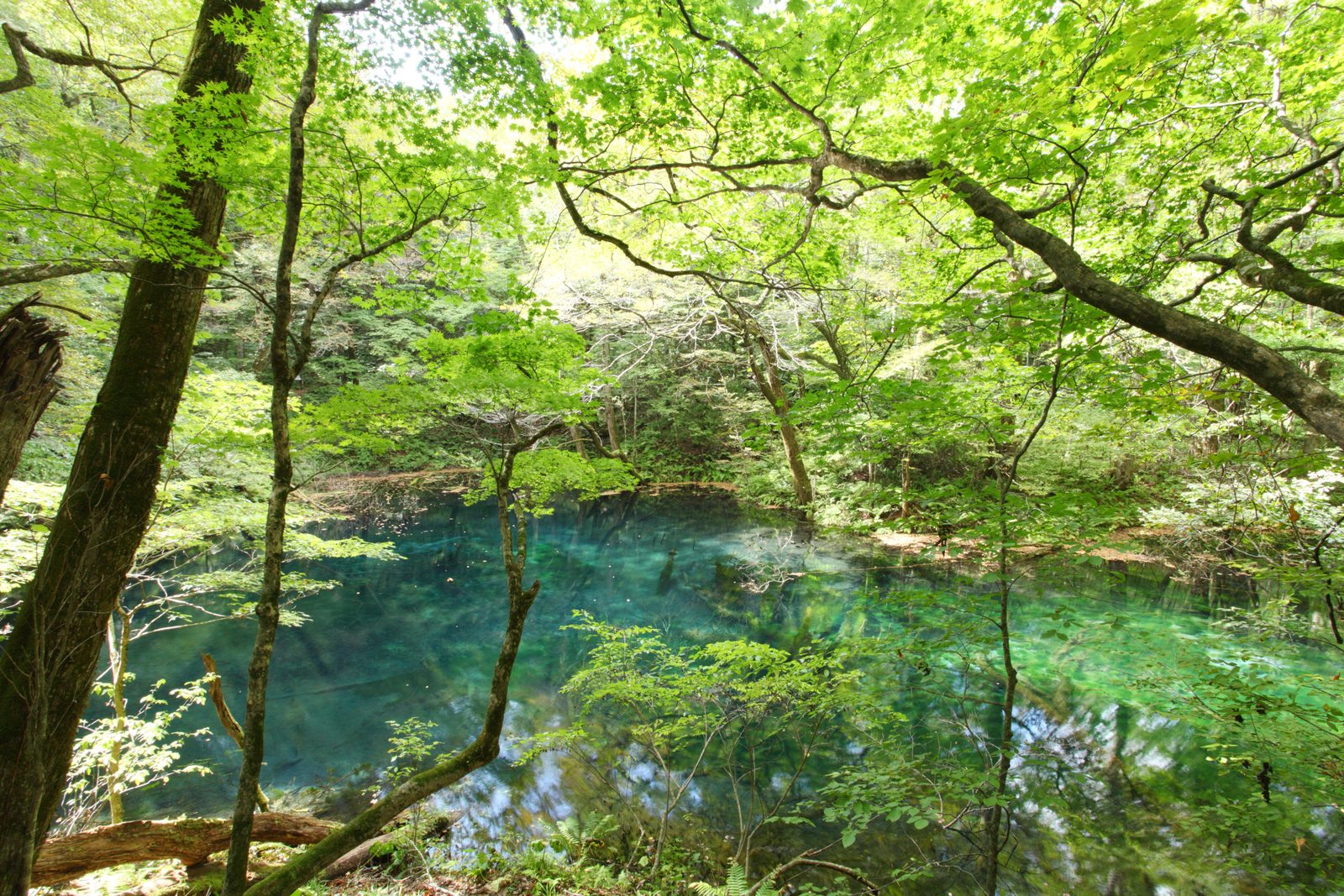
In season this long pond is a place to see and hear wild birds, kingfishers among them, so it repays a slow pace. If time is short, treat the forest itself rather than any single pond as the reason to walk here.
Kanayama Pond, the Oike Lakes and Their Waterfalls
Go beyond the busier ponds to Kanayama pond, the lake at the back of Juniko, and the tourists thin out until the shore is quiet. The short course to it passes two ponds on the way before reaching Kanayama pond. On the path along its shore a natural hiba cypress forest forms a deep green wood, and the scent of hinokitiol hangs in the air there.
That short course is currently suspended, and some trail restrictions left by heavy rain in the Reiwa era mean the published course plans may change. If it is still suspended when you go, the quiet of Kanayama pond will have to wait, and the path around Oike is the natural place to turn instead.
At Oike, the walking path along the shores of the east lake and the west lake is shaped like a gourd. Two waterfalls stand beside the path, and both are places to stop and listen to the water running. At the one that drops from Ochiguchi no Ike, visitors can get down and play in the water, a stop that suits anyone travelling with children.
The Japan Canyon and the Seasons of Juniko
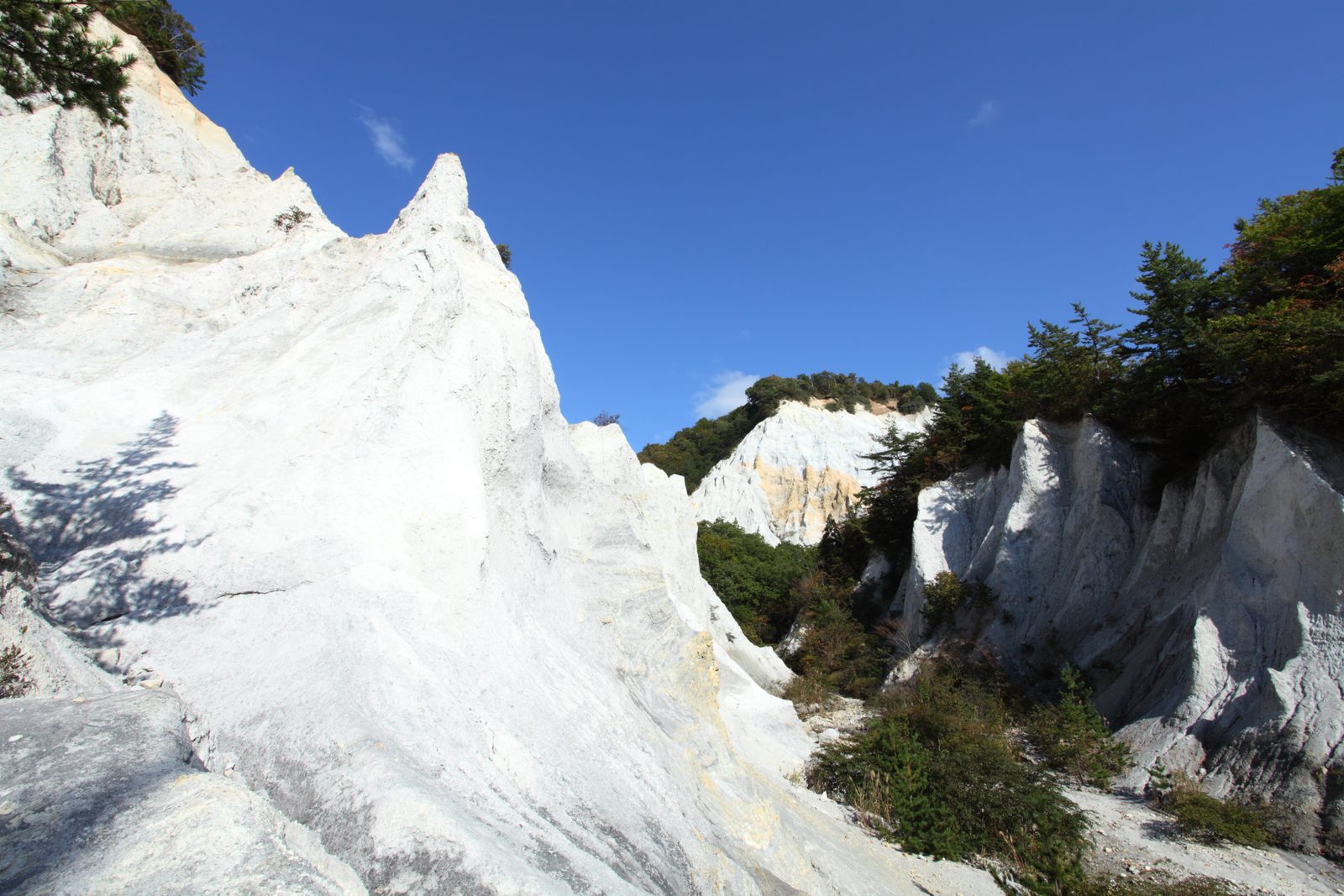
Visit the Japan Canyon, where erosion and collapse have laid bare a broad face of white tuff rock. An explorer named it in nineteen fifty-three because the scenery called the Grand Canyon to mind.
This is the season to be here: October turns the scenery to strong reds and yellows, and in November the blue surface of the lakes sets off the leaves floating on it. As leaves land on the water, the forest is coloured by beech and autumn leaves, and then it is covered in white snow. The deciduous broadleaf trees, mostly beech, drop their leaves all at once in winter.
Juniko can be visited year-round, and each season has its own draw. In April, once the snow has melted, dogtooth violets and new buds come out, and in July it is the calls of summer birds that you hear.
Senjojiki Coast, Engakuji and the Great Ginkgo of Fukaura
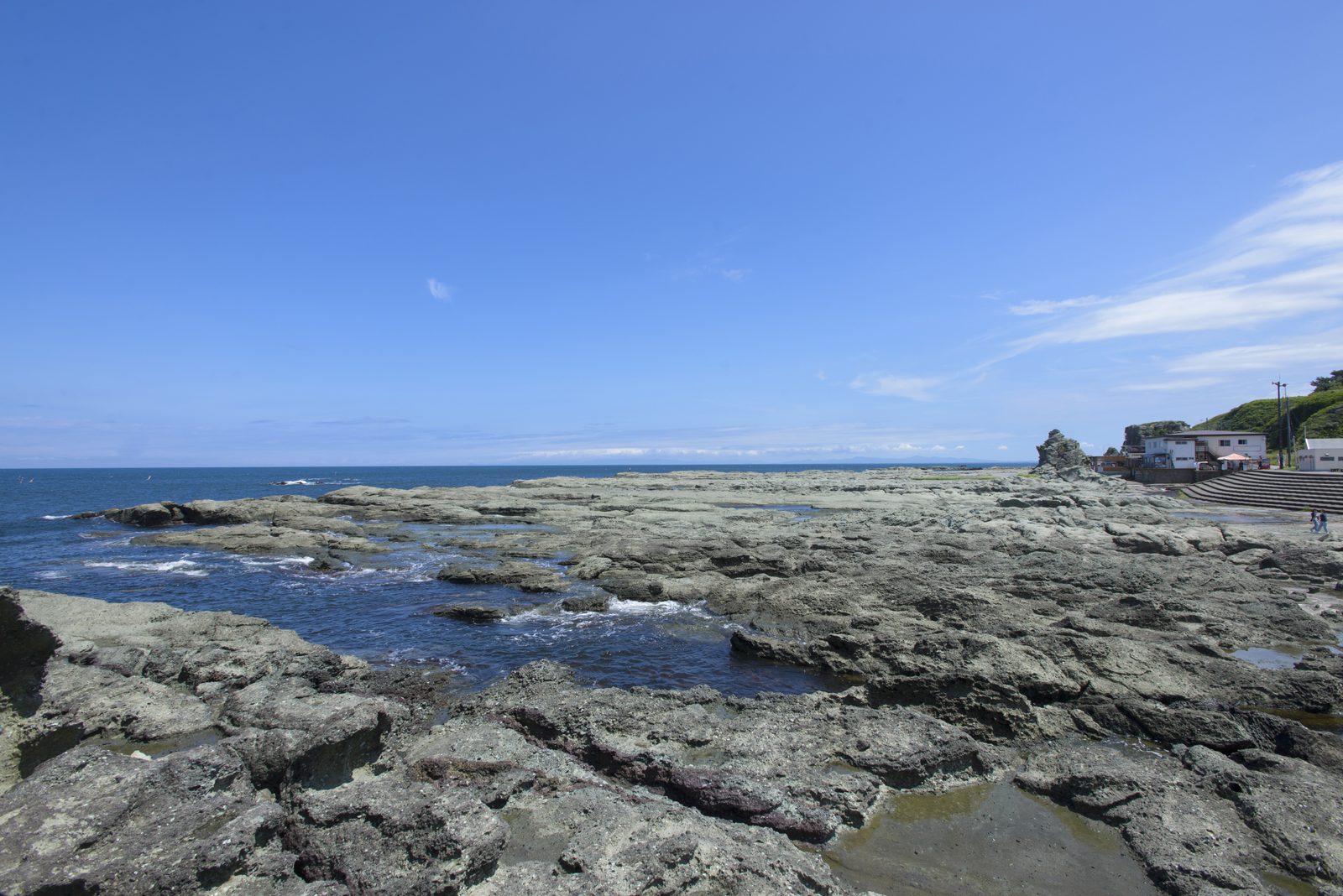
Step onto the rock shelf of the Senjojiki coast, a platform of rock raised by an earthquake in seventeen ninety-two. The shelf juts into the Sea of Japan and can be walked across at will, and going out to the water's edge brings a wide view of the sea. The coast has a place in Dazai Osamu's novel Tsugaru, and there are eateries nearby.
Back in town, Engakuji was founded by Sakanoue no Tamuramaro in the Heian period. Its main image, an eleven-faced Kannon, is said to be the work of Prince Shotoku. That image is shown to the public once every thirty-three years, so on an ordinary visit a guided explanation is the way to get close to the temple.
The great ginkgo of Kitakanegasawa, a national natural monument, turns golden from November into December and is lit up at night, with local businesses running stalls inside the illumination grounds. Because the lighting comes after dark, staying over turns the ginkgo into an evening outing rather than a stop on the way through; see places to stay in Fukaura.
The Fukaura Tuna Steak Bowl and Other Port-Town Food
Order the Fukaura tuna steak bowl and you are eating a local catch, since about half of the bluefin tuna landed in Aomori Prefecture comes in through Fukaura. Because the fishing season here runs longer than at the Tsugaru Strait ports, fresh tuna is on the table through the year, and tuna under twenty kilograms is young bluefin that goes by its own local name. The bowl dates from June of twenty thirteen and is served at six shops, each pairing the tuna with its own sauce, soup, pickles and dessert, so two bowls in two shops are not the same meal. For a short visit, the bowl is the straightforward way to taste the catch that Fukaura lands in such share.
The port's other signature is a fried minced-tuna sandwich: tuna mince coated in coarse fresh breadcrumbs, fried and tucked into bread with sanchu lettuce, with a sauce built on garlic miso on the side. It took the top prize at the first Fukaura tuna dish contest in twenty fourteen. The seasonal soft cream is loaded with Fukaura snow carrot paste and comes out carrot-coloured, which rounds off a port-town lunch.
Getting to Fukaura and Juniko
| Leg | How | Time and estimate |
|---|---|---|
| Shin-Aomori to Kawabe | JR Ou Main Line | About 35 minutes |
| Kawabe to Fukaura Station | JR Gono Line | About 2 hours 25 minutes |
| Hirosaki to Higashi-Noshiro | JR Ou Main Line | About 1 hour 30 minutes |
| Higashi-Noshiro to Juniko Station | JR Gono Line | About 1 hour 50 minutes |
| Fukaura Station to Juniko Station | JR Gono Line | About 30 minutes |
| Juniko Station to Oku-Juniko | Konan Bus route bus | About 15 minutes |
| Konan Bus route buses | Fares paid after riding | Cash and transport IC cards accepted |
| Oku-Juniko bus stop to Aoike | On foot | About 10 minutes |
| Japan Canyon stop to the viewpoint | On foot, up a walking path | About 15 minutes |
| Juniko Station to Shirakami Juniko Eco Museum | On foot | About 20 minutes |
| Fukaura Station to Engakuji | On foot | About 20 minutes |
| Kitakanegasawa Station to the great ginkgo | On foot | About 10 minutes |
| Noshiro-minami IC (Akita Expressway) to Shirakami Juniko Eco Museum | Car | About 1 hour |
| Oku-Juniko parking lot | Car | Space for 100 vehicles |
| Oku-Juniko parking lot, standard car | Fee | 500 yen |
Fukaura Station and Juniko Station are on the same JR Gono Line, so the port and the lakes combine in one trip.
New to rural buses and one-man trains? See how to ride them, step by step.
Hours and Fees
| Place | What | Hours or fee |
|---|---|---|
| Shirakami Juniko Eco Museum | Hours | 9:00-16:30 |
| Juniko Visitor Center | Hours | 9:00-16:00, April 1 to November 30 |
| Wakitsubo and Aoike course | Walking course | 2.5 hours |
| Kanayama pond short course | Walking course; currently suspended | 2.5 hr |
| Kanayama pond and Itobata pond long course | Walking course | 5 hr |
| Engakuji | Hours | 8:00-17:00; 8:00-16:00 from December to March |
| Engakuji | Admission for students | 250 yen high school; 100 yen elementary and junior high |
| Fukaura tuna steak bowl | Price at all shops, tax included | 1,500 yen |
| Fukaura tuna steak bowl | Extra tuna, 40 grams | 250 yen |
| Fukaura tuna steak bowl | Extra rice, small bowl | 100 yen |
| Fukaura tuna steak bowl | Booking | Reserve ahead; from one person |
| One of the six bowl shops | Hours | 11:00-14:00 and 17:00-20:00 |
| Fried minced-tuna sandwich | Price | 500 yen |
| Mono-kan Korobokkuru | Hours | 9:00-17:00 |
| Pizza&Bar Kadale | Hours | 12:00-23:00 |
| Wespa Tsubaki | Day-trip bath, hours | 6:00-22:00; 7:00-21:00 from November to March |
| Wespa Tsubaki | Day-trip bath, adults | 500 yen |
| Kitakanegasawa great ginkgo | Big Yellow illumination | 16:30-20:30 |
Where to stay
Places to stay near Fukaura, Aomori, Japan →
Disclosure: This post may contain affiliate links. If you book through them, we may earn a commission at no extra cost to you.