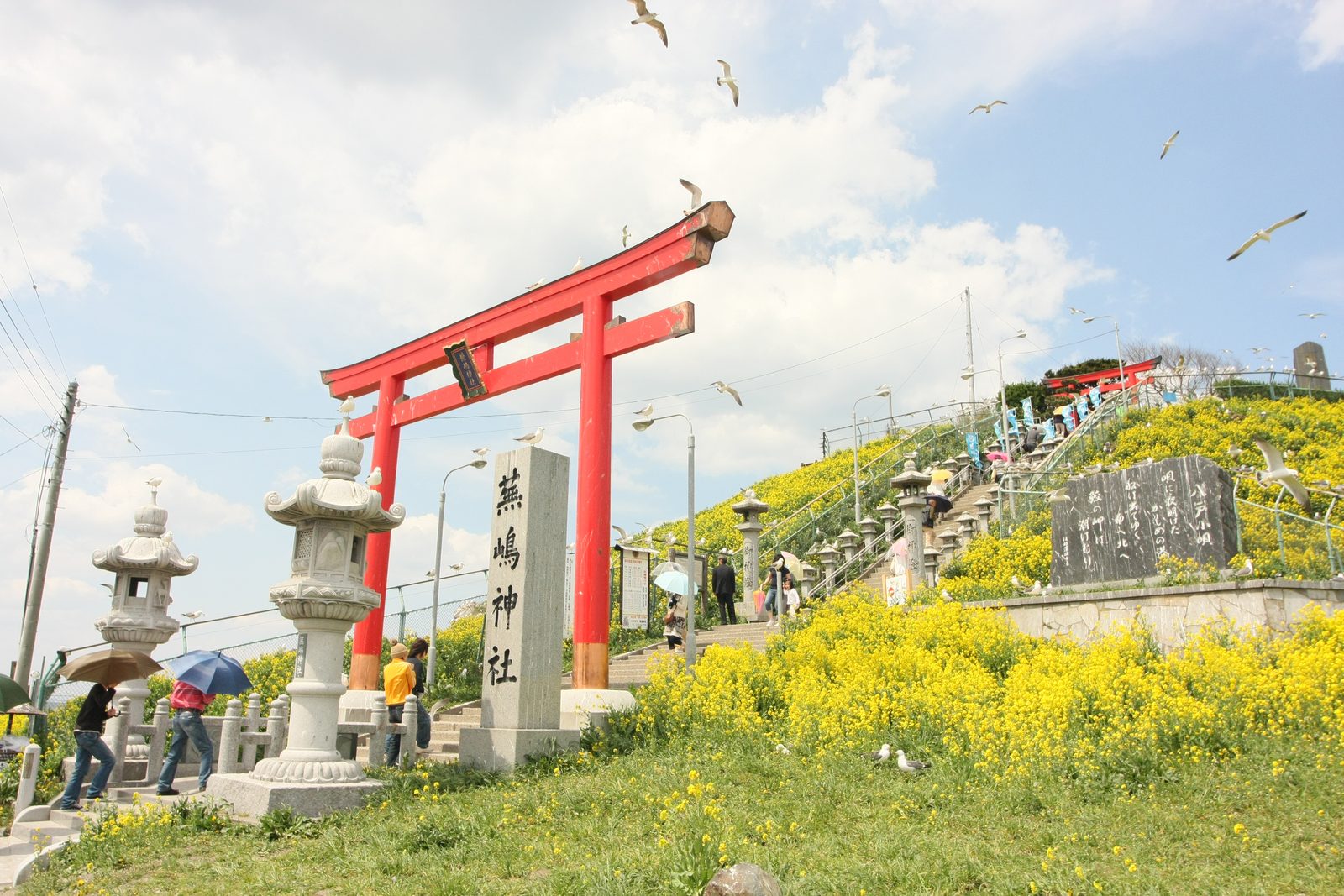
Hachinohe is a working port city on the Pacific edge of Aomori Prefecture, and the coast begins almost as soon as the streets end. A single day here can take in a shrine island alive with gulls, a green lawn that runs straight down to the surf, and a harbour market that starts before the sun is up.
This guide walks through the day in the order it tends to unfold: Kabushima and its shrine first, then the Tanesashi shoreline, with the Sunday quay market and Hasshoku Center as the food chapters. Each leg is set out step by step further down, and if you would rather stay the night, there are places to stay in Hachinohe.
Kabushima and the gulls of spring
According to a guidebook to the shrines and temples of Tōhoku, Kabushima Shrine stands on the island of Kabushima, at the northern tip of the Tanesashi Coast in Hachinohe's Same district. The same guidebook describes the shrine as standing on the island's summit, up a flight of stone steps. Its founding is said to date to the late thirteenth century.
The guidebook records the island as a national natural monument for its breeding colony of black-tailed gulls, and says that in the breeding season tens of thousands of birds wheel over it. The umineko, a kind of gull, is said to arrive in spring and nest through the summer, when the island all but vanishes beneath them.
The guidebook records the principal deity as Ichikishima-hime, with Amaterasu and two other gods enshrined alongside her, and notes that the shrine is prayed to for prosperity in trade and the protection of those who fish. The handwritten seal given to visitors is said to read Benzaiten.
Because kabu, the word for turnip, sounds like the word for shares, the shrine is said to raise share prices and personal standing. According to local tradition, being hit by a gull dropping during the breeding season is a stroke of good luck.
An old folk song is said to sing of golden flowers blooming on Kabushima, the turnip blossom set against the blue of the sea. In the season of spring winds, the island's turnip flowers and the blue waves are said to set each other off in a view that an old gazetteer called beyond words.
The Tanesashi shoreline on foot
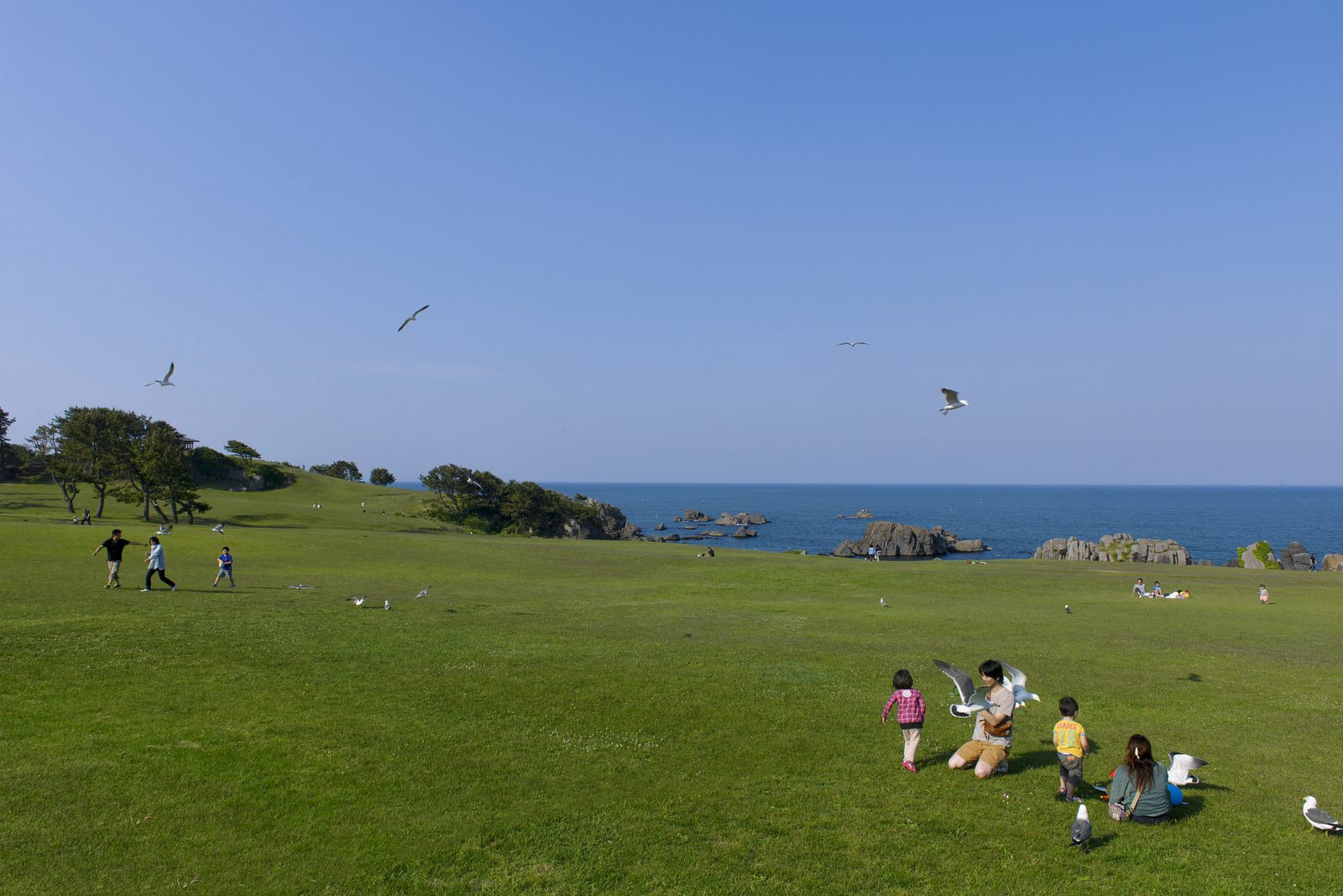
An old guidebook describes the Tanesashi Coast as a place of huge rocks and pounding surf, and notes it as known for lily of the valley. The same guidebook records an unbroken run of scenic coast from Shirogane through Same to Tanesashi, all of it within the city of Hachinohe, so the walk below never leaves the city limits.
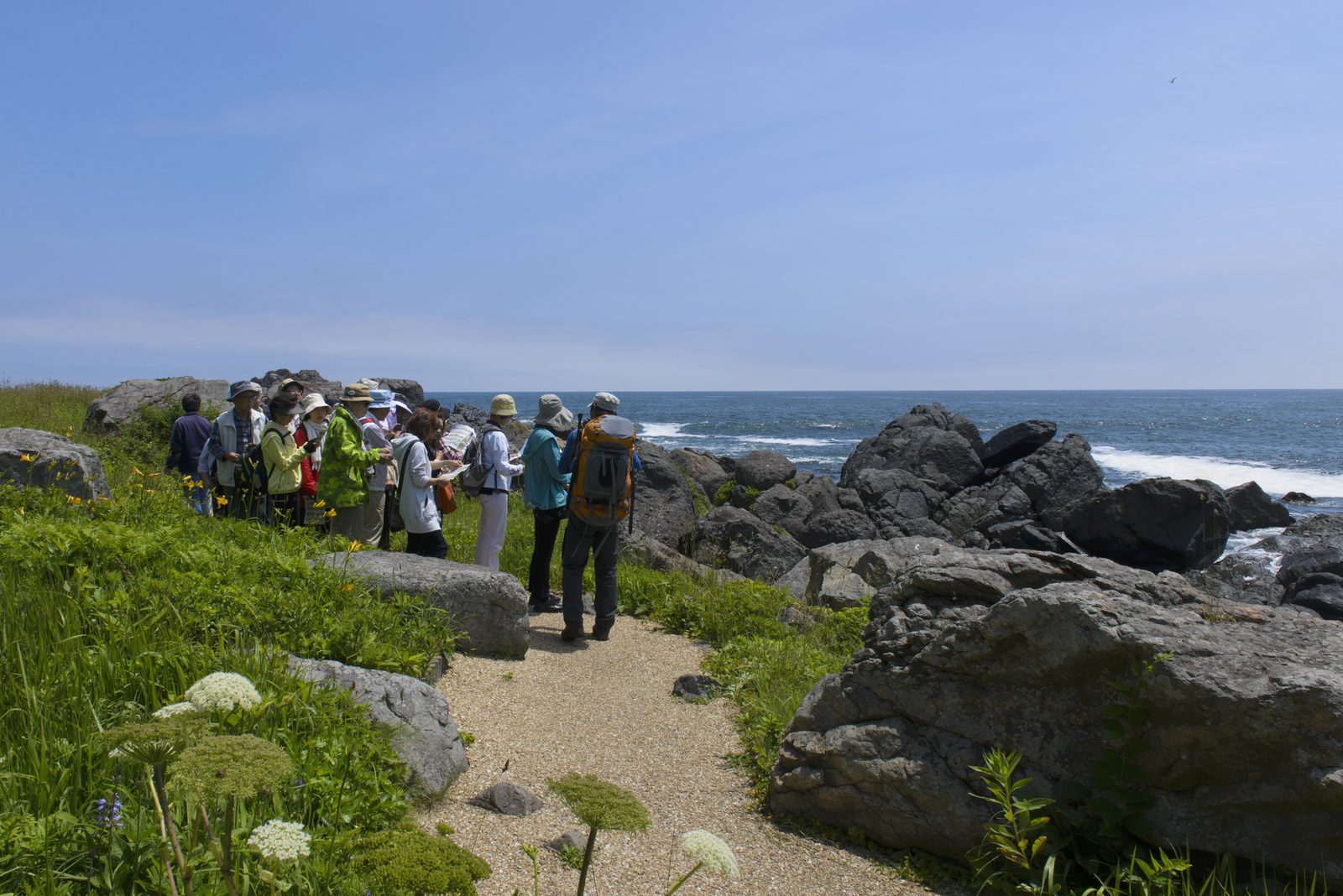
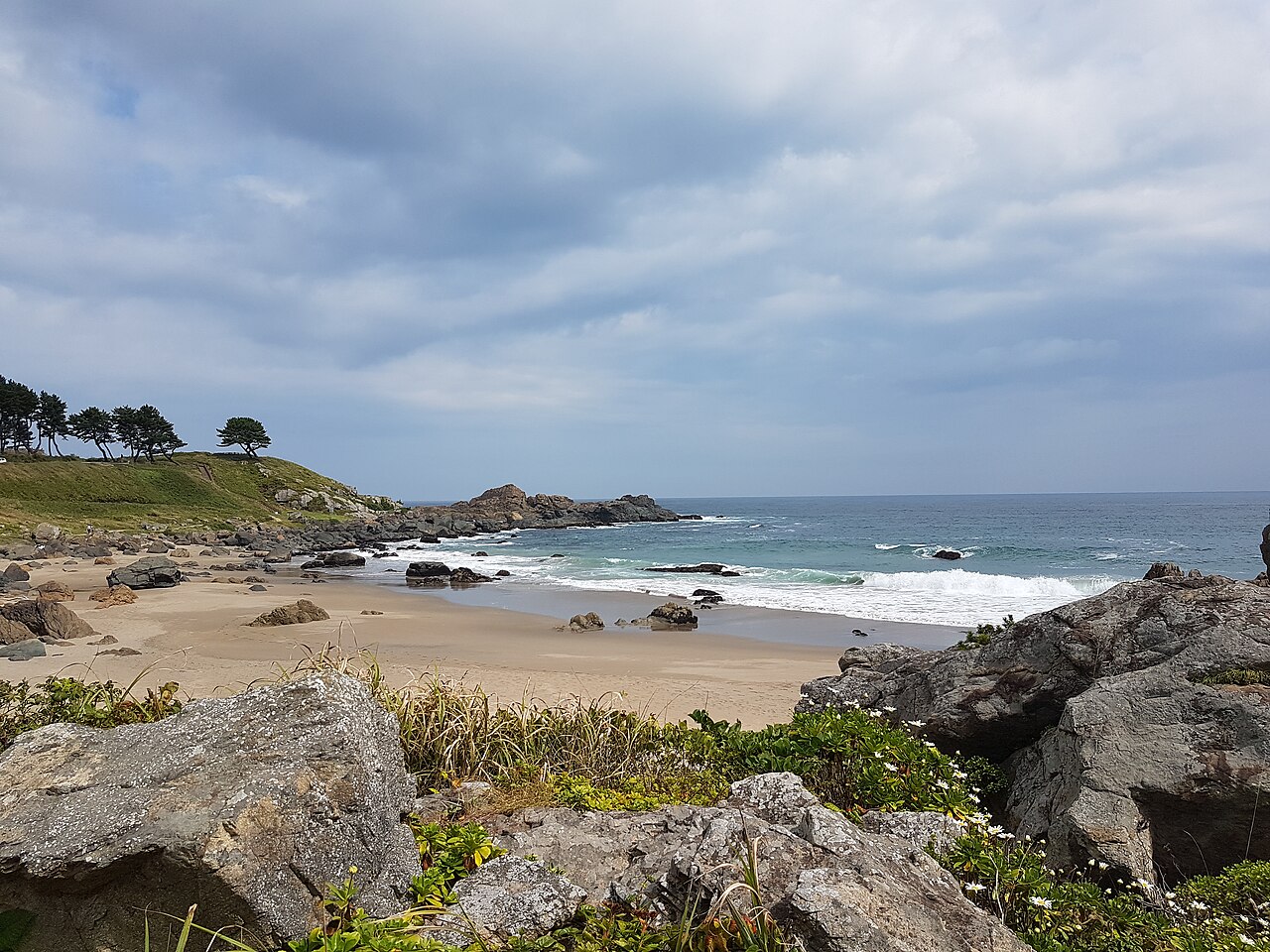
In the photograph above, the natural lawn at Tanesashi is a wide sweep of grass running down to the Pacific, with families sitting on the grass and gulls overhead. The photograph below shows walkers on a gravel path between grass and dark rocks on the Tanesashi shoreline, and that unhurried pace is the way to take this coast.
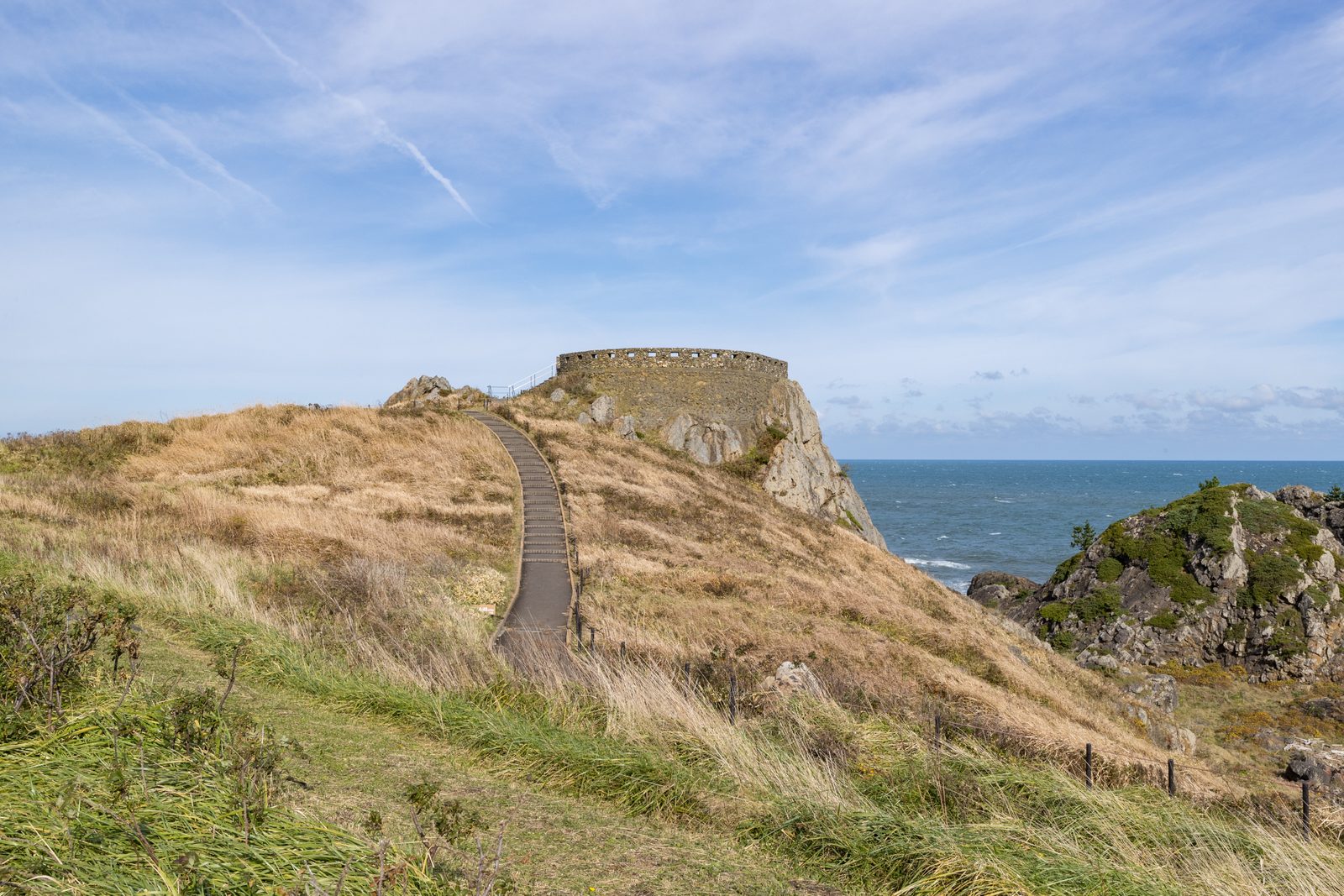
The photograph below shows a round observation platform on a grassy headland above the sea, reached by a narrow path, and the shoreline in these pictures is what the older descriptions promise: dark rock, white surf, and grass running down to meet them. It is a walk to take slowly, and the lawn is where to sit down afterwards.
Where to stay
Places to stay near Hachinohe →
Disclosure: This post may contain affiliate links. If you book through them, we may earn a commission at no extra cost to you.
Getting there, leg by leg
Each leg below is a single stretch with its own figure, so the day can be strung together in whichever order suits: out to Kabushima first and the lawn second, or the reverse. The market legs come last, and the fares and times follow below.
- At Hachinohe Station, board a JR Hachinohe Line train bound for Kuji or Same; for the lawn first, stay on, as the JR Hachinohe Line ride from Hachinohe Station to Tanesashi-kaigan Station takes about 30 minutes.
- For Kabushima first, leave the train at Same: it is about a 15-minute walk from JR Hachinohe Line Same Station to Kabushima.
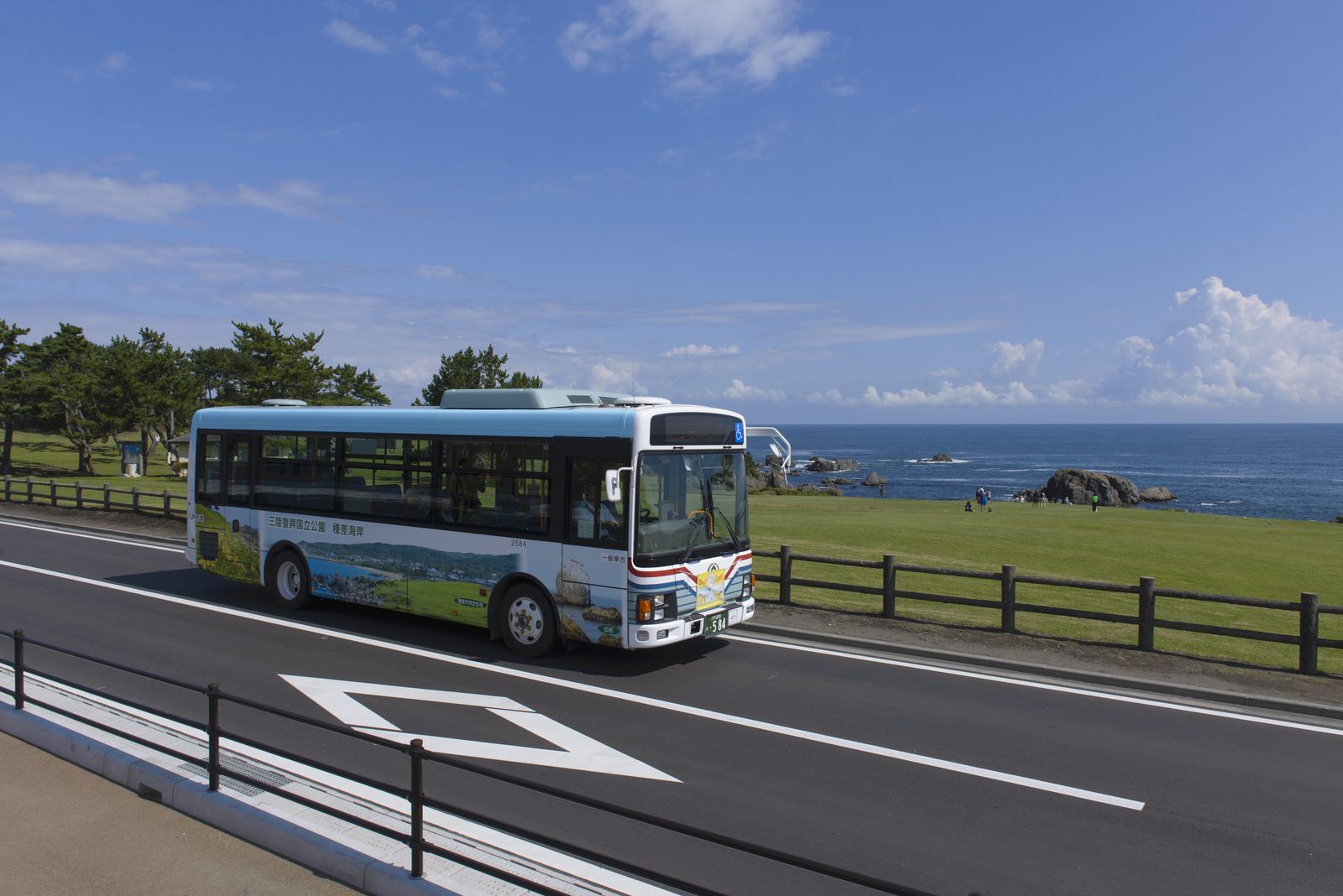
- From Same Station, the Umineko-go bus makes the one-way trip to Tanesashi-kaigan Station in 28 minutes.
- From Tanesashi-kaigan Station it is about a 3-minute walk to the Tanesashi Natural Lawn.
- On a Sunday, it is about a 10-minute walk from JR Hachinohe Line Mutsu-Minato Station to the Tategahana quay morning market.
- The Isaba-go bus takes about 16 minutes from Jusanichi-cho to Tatehana Gyoko-mae, the stop for the Tategahana quay morning market.
| Service | What it costs |
|---|---|
| Umineko-go (Same Station to Tanesashi-kaigan Station) | 150 yen for an adult at the initial fare (up to 200 yen); 80 yen for a child (up to 100 yen) |
| Isaba-go (Sunday morning market loop) | Listed adult base fare 150 yen (upper limit 200 yen); child base fare 80 yen (upper limit 100 yen) |
| Hachishoku 150-yen bus (Hachinohe Station to Hasshoku Center) | 150 yen no matter how far you ride |
| Hachishoku 250-yen-or-less bus (Hon-Hachinohe Station to Hasshoku Center) | 250 yen or less no matter how far you ride |
| Route bus bound for the city centre | 370 yen one way |
| Place | Times |
|---|---|
| Tanesashi Coast Information Center, April to November | 9:00 to 17:00 |
| Tanesashi Coast Information Center, December to March | 9:00 to 16:00 |
| Kabushima Rest Area | 9:00 to 17:00; closes at 16:00 from December to March |
| Hasshoku Center market building | 9:00 to 18:00 |
Sunday morning at the Tategahana quay
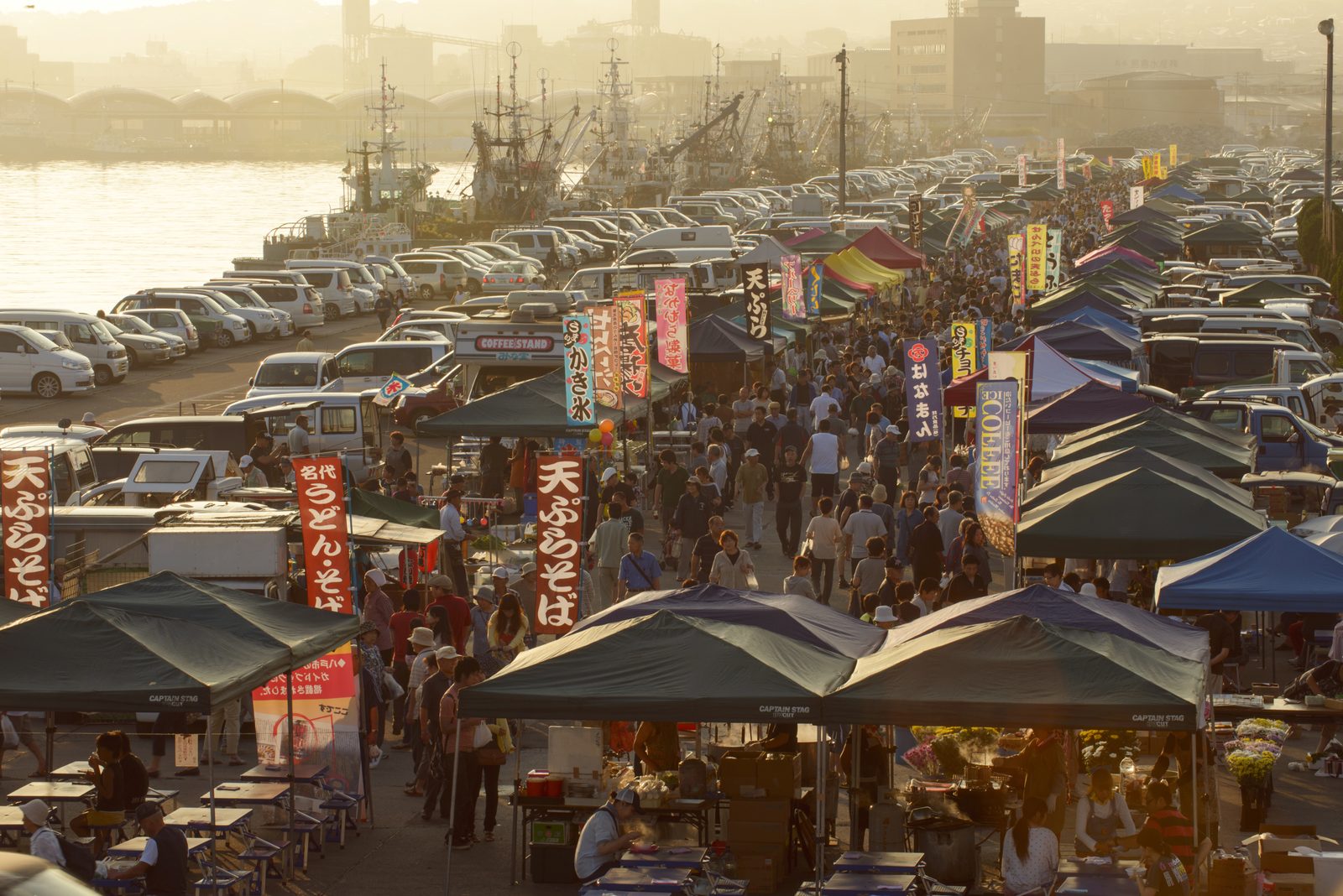
Hachinohe's Sunday market sets up along the Tategahana quay; in the photograph above, rows of tents and stalls run beside the water with fishing boats moored behind them. It is held every Sunday from mid-March to late December, from around three in the morning, at sunrise, until around nine, so the early start is the whole point.
An old gazetteer records a small shrine dedicated to Empress Jingū on the hilltop of the Tatehana headland, from which the quay takes its name. The outlook from the cape is said to be a fine one, with the Pacific horizon in full view and Mount Hashikami to the south.
Hasshoku Center and the taste of Hachinohe
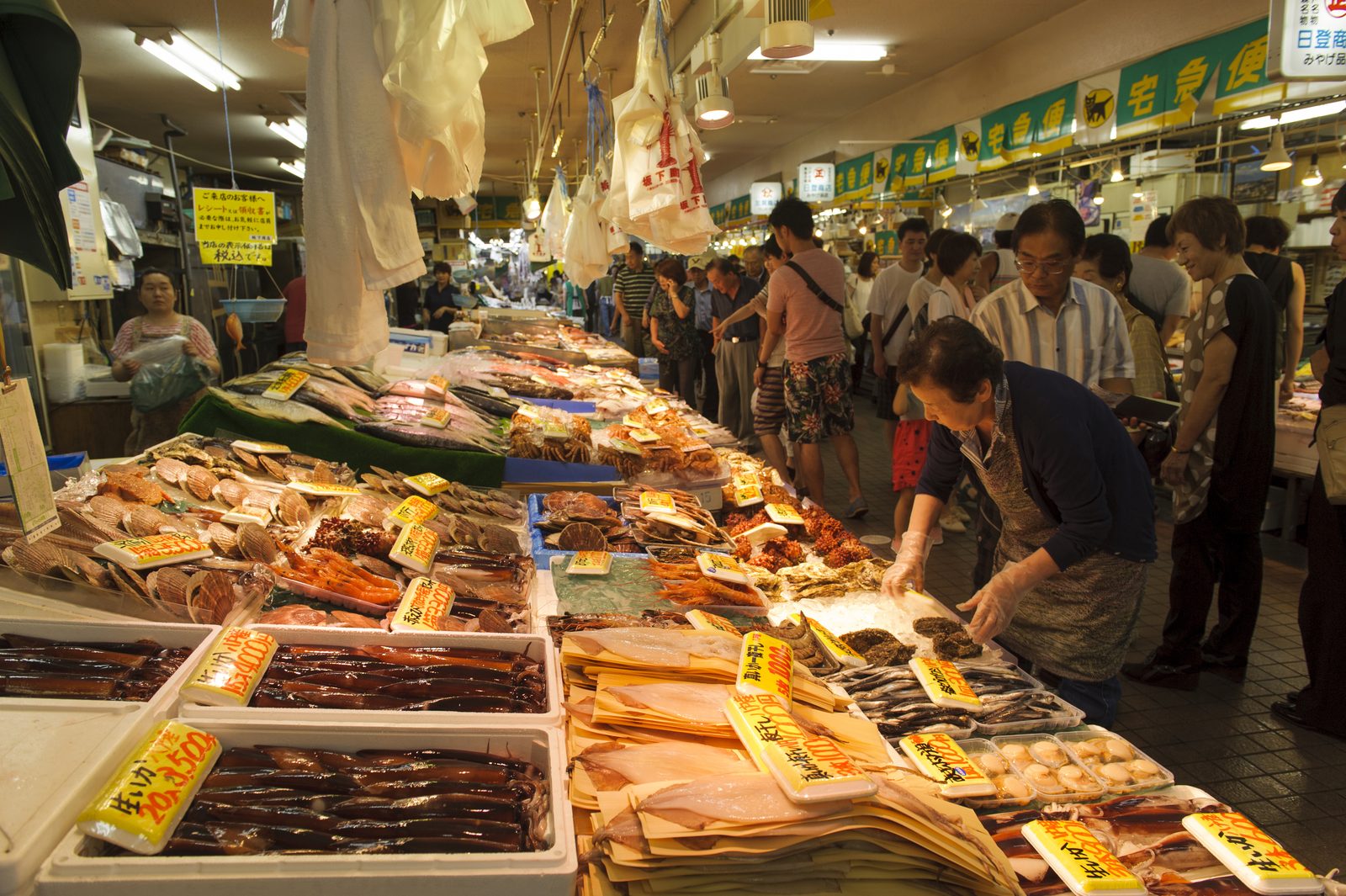
Hasshoku Center is the city's indoor market, and the photograph above shows one of its stalls, where shoppers browse trays of dried and salted fish. It is the natural place to end the day with something to carry home, and both ways of reaching it are listed with the fares above.
Nanbu senbei is the wheat cracker of the old Nanbu domain, which stretched from south-eastern Aomori into northern Iwate: flour, salt and water, baked round in an iron mould. In a region prone to cold-weather damage, where rice grew badly, these crackers served as an important preserved food for farming households.
Senbei-jiru, the soup made with them, only came by its now-familiar name in the Heisei era; before that it was plain home cooking without a label. The wartime requisition of iron pans for the military ended farmhouse baking, and after the war makers developed and sold a chewy senbei that holds together in broth.
Ichigo-ni is the other dish to know: a soup of nothing but sea urchin and abalone, in which the abalone turns the broth a milky white and the golden urchin floats on top. For something to carry home, chrysanthemum yokan and the Yawata-uma, a carved wooden horse, are said to be the city's specialities, by an old guidebook's account.
Hachinohe in the old guidebooks
The town is said to have taken shape in the Kanbun era of the seventeenth century, when the lord Nanbu Naofusa had his retainers fill in marshland to lay the ground for the streets, and an old gazetteer takes the lakes still lying nearby, Ogawara among them, as support for the story.
The town's prosperity is said to have rested on the fishing and salt ports of Same and Minato close by and on the ease of moving goods by water, and the gazetteer rates Hachinohe a centre of trade for the Mutsu region from the days of the shogunate onward.
The same gazetteer records Miyagi Shrine on the old castle site in Hachiman-chō, where Nanbu Mitsuyuki and Nanbu Naofusa are enshrined together. From its hilltop grounds the view is said to run on every side: the Pacific and Matsugasaki's pines to the north, the Hakkōda and Towada ranges to the north-west, and the Mabechi River through the fields below.