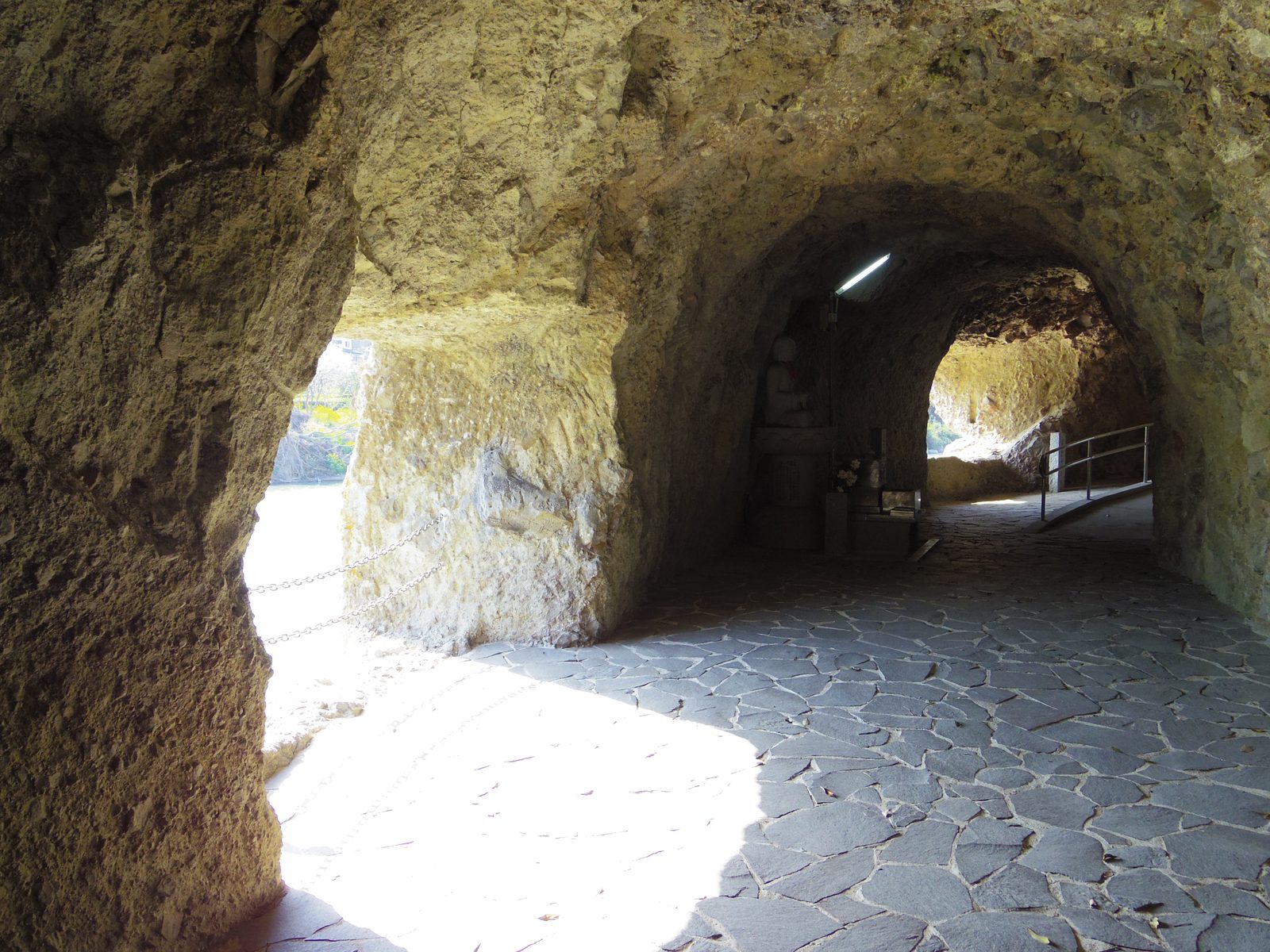
Yabakei, in Nakatsu, Oita Prefecture, is counted among the three great autumn-leaf areas of Japan, alongside Nikko and Arashiyama. In its Hon-Yabakei area, strangely shaped rocks line up, starting with Aono Domon and Kyoshuho. A tunnel that one monk dug by hand, a gorge you can walk through in shallow water, and autumn leaves across the area give a visit here more than one reason. The city of Nakatsu, which Yabakei is part of, adds karaage, hamo and soba made with wild yam.
Aono Domon, the Tunnel Zenkai Dug by Hand
The tunnel at Aono Domon exists because a monk named Zenkai began digging into the rock wall by himself. He was a travelling monk, and he kept digging for more than thirty years until the tunnel went through. Before the tunnel, travellers crossed on a path built onto the high rock wall of Kyoshuho, with an iron chain as a lifeline.
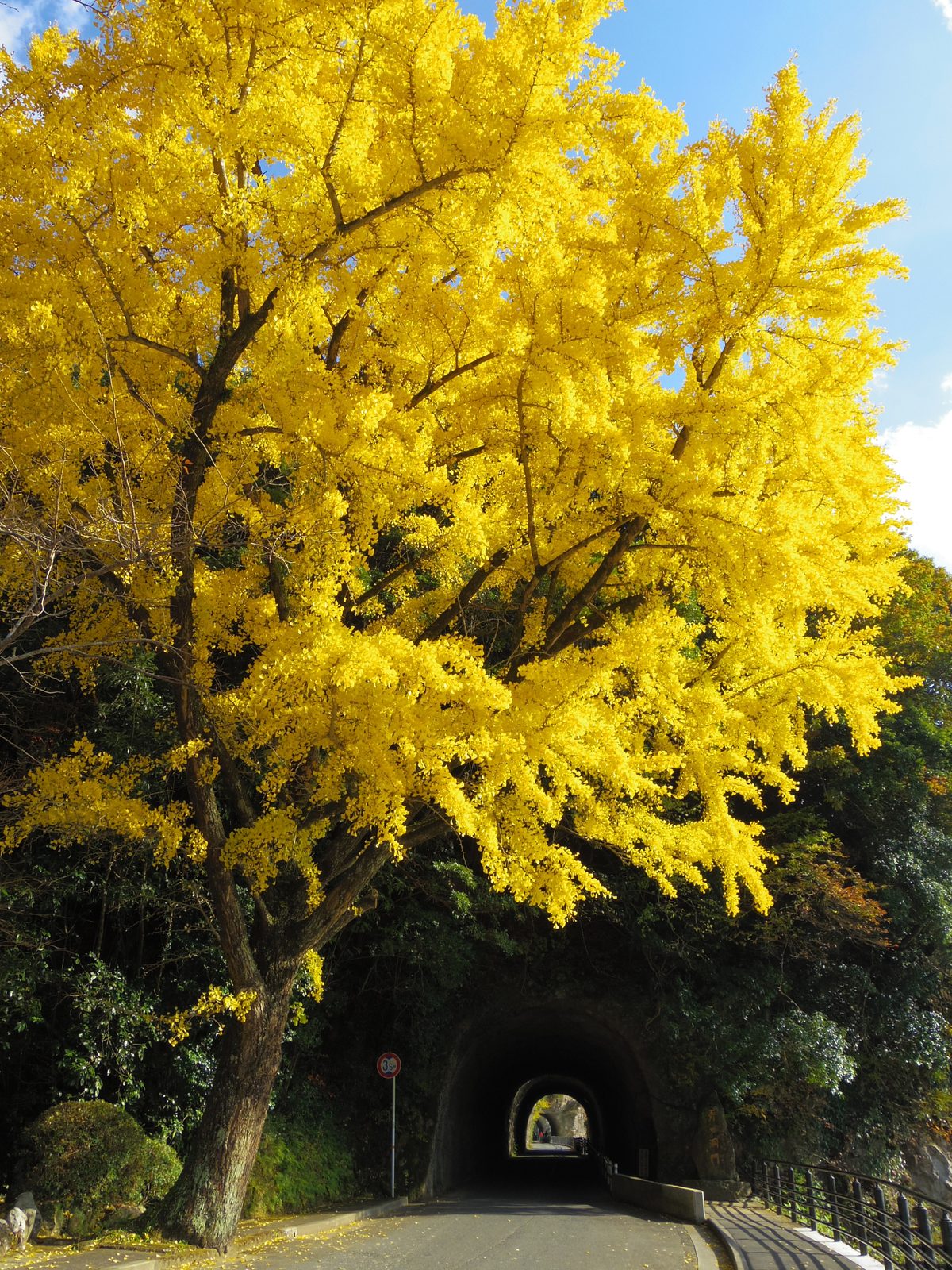
Much of the original form was lost in an extensive renovation in the Meiji era, so the tunnel is not entirely as Zenkai left it. Even so, part of the inside and the light-collecting windows still keep hand-dug sections with the look of his time. Those are the places to slow down and look for the surfaces worked by hand.
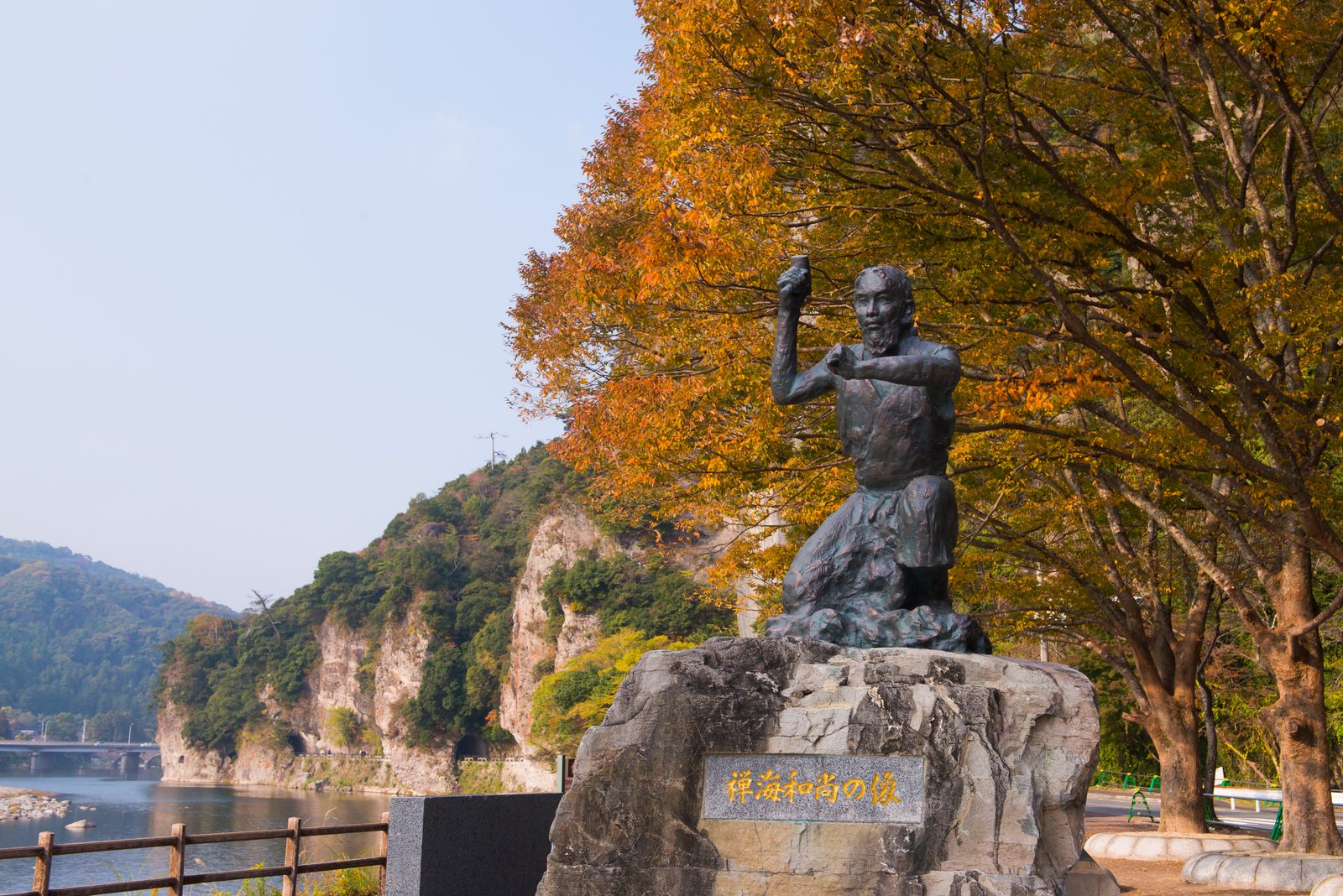
If you like places with a story behind them, Aono Domon rewards a slow look rather than a quick glance. The digging began with one travelling monk working alone and went on for more than thirty years, and the proof is still in the rock wherever the hand-dug sections remain.
Strange Rock Peaks and a Gorge Walk in Shallow Water
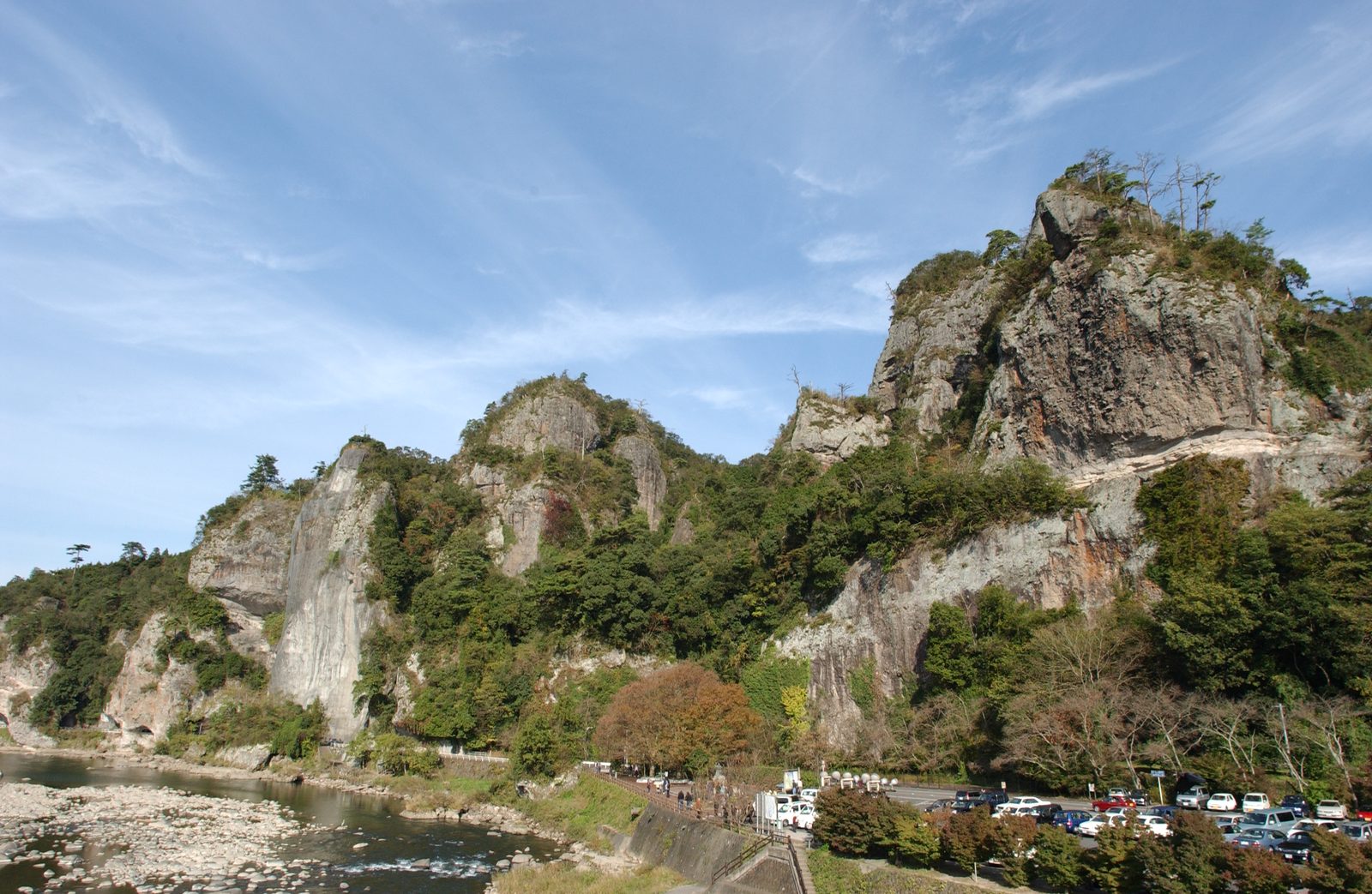
Around Aono Domon and Kyoshuho, the rock surfaces have been eroded over a very long time, leaving a row of peaks with distinctive silhouettes. This corner of Hon-Yabakei is where the strange-rock landscape of Yabakei begins.
Elsewhere in Yabakei, a gorge where the water flows clean and nature is rich lies near a second gorge with a maintained walking path. Along that path, powerful strange rocks and the contrasting nature around them can be seen together.
Otani Gorge, in Shin-Yabakei, is different again: a single natural rock continues along the gorge, and visitors can walk in the shallow water that runs over it. Walking on one continuous piece of stone is a different experience from looking at peaks from a distance.
If you want to walk rather than just look, put Otani Gorge and the walking path near the clean-water gorge first: one lets you wade over a single natural rock, and the other sets powerful strange rocks beside a maintained path.
Autumn Leaves around Shin-Yabakei
Yabakei divides into two areas, Hon-Yabakei around Aono Domon and Shin-Yabakei. The center of Shin-Yabakei is Hitome Hakkei, vivid through the year from the fresh green of young maple leaves to the brocade of the autumn-leaf season. The name means that the surrounding eight rock peaks can be taken in at a glance.
The Hitome Hakkei viewpoint stands among soba shops and inns, and the scenery is viewed from there. Across the river, a footpath gives a view different from the one at the viewpoint, so it is worth seeing both.
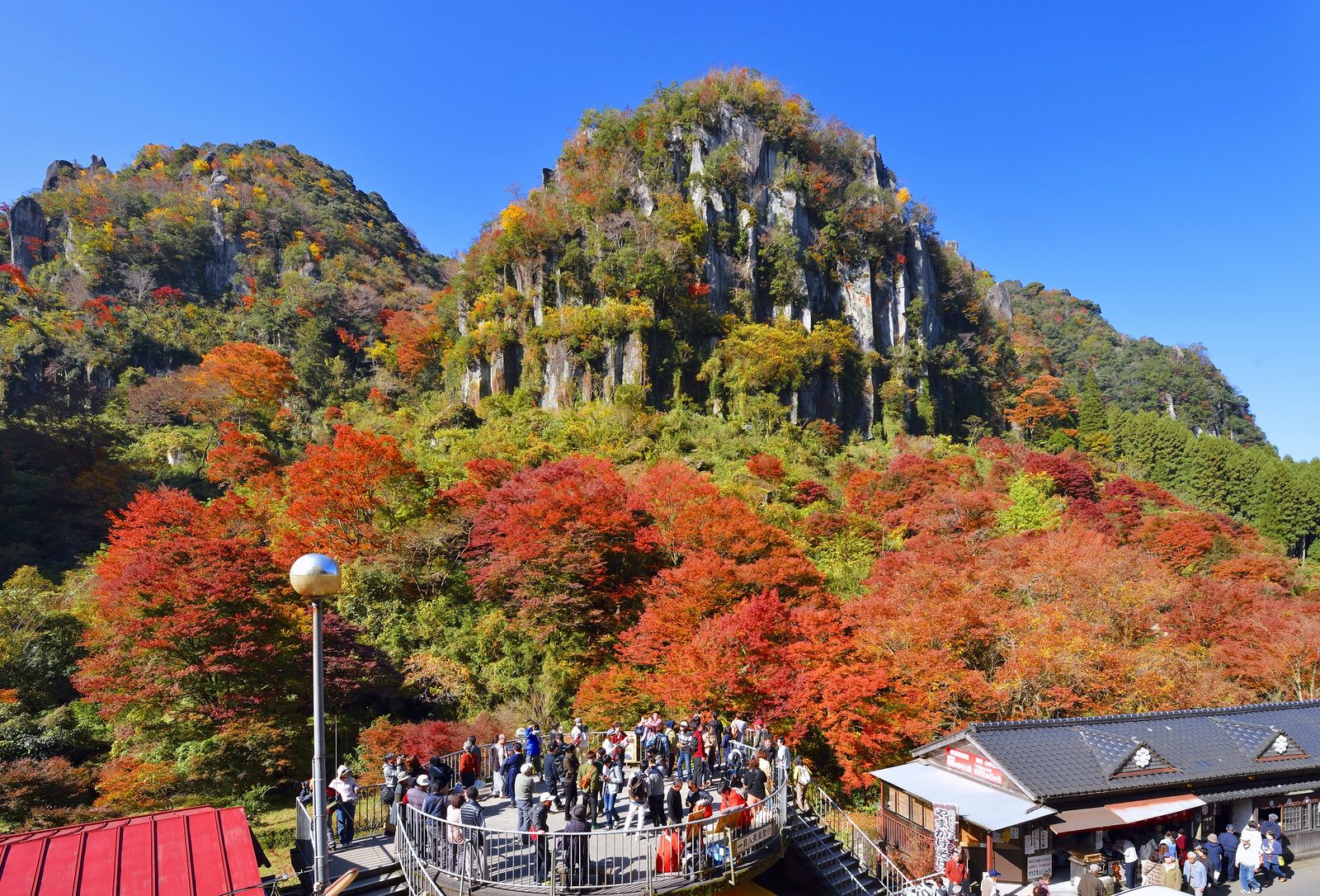
Also in Shin-Yabakei, a shrine's maples have their own story. Villagers grafted saplings of five colors onto a maple tree in the shrine's temporary hall and planted them at the main hall, and that planting began the shrine's autumn leaves. Today fallen leaves of many colors lie over the approach like a carpet, and many photographers come each year to capture it.
A stretch of maples on a prefectural road reaches over the roadway like an eave and is lit up during the autumn-leaf season, and the garden of Keisekien is lit up every autumn. Orido Gorge, near Hitome Hakkei, is another autumn-leaves spot, with rest facilities set up at various points.
If you are visiting for the leaves, start at Hitome Hakkei for the eight peaks, give the shrine approach time for the carpet of fallen leaves, and end at Orido Gorge, where rest facilities are set up.
Karaage, Hamo and Yam Soba in Nakatsu
Nakatsu karaage is marinated in a soy-sauce-and-salt marinade and fried only after the order is placed. It comes as thigh and breast cuts as well as rarer cuts, so there is a reason to order more than one plate.
Hamo, a conger eel with many small bones, needs a special bone-cutting technique. That technique is said to have been born in Nakatsu in the Edo period and spread across the country. Those who know hamo seek the autumn one, when the fish is in season.
Buckwheat grows even in cool regions and has been cultivated in Yabakei since long ago, so soba belongs on the table here. The local dish is soba made with locally grown wild yam, valued for the yam's stickiness, its firmness and a rich flavor.
Nakatsu's izakaya serve many small dishes from local ingredients, among them fresh seafood from the local waters and chicken and black pork from Yabakei, with a local shochu poured alongside.
If you want a taste of the area, start with karaage, add hamo if you are here in autumn, and finish with the wild-yam soba as the dish that belongs to Yabakei.
To stay overnight in the area, browse places to stay in Nakatsu.
Getting to Yabakei
| Leg | How | Time or cost |
|---|---|---|
| Nakatsu Station to the Hon-Yabakei area, where Aono Domon is | Route bus | About 700 yen one way, about once an hour |
| Nakatsu Station toward Aono Domon, on the bus bound for Morizane Onsen | Route bus | About 25 minutes |
| Expressway IC (Toyomae, Joge Smart or Nakatsu) to the Hon-Yabakei area | Car | 15 to 20 minutes |
| Nakatsu Station to the Shin-Yabakei area | Route bus with a transfer | About 1,200 yen one way, four trips a day on weekdays only |
| Aono Domon tunnel | Vehicles | Cannot pass on and after April 1 |
New to rural buses and one-man trains? See how to ride them, step by step.
Hours and Fees
| Place | What | Hours or fee |
|---|---|---|
| Nakatsu Yabakei information center | Hours | 8:30 to 17:00, closed December 30 to January 2 |
| Shin-Yabakei information center | Hours | 9:00 to 17:00 from March to November, 9:00 to 16:00 from December to February |
| Public parking lot near the tunnel | Cost | Free |
Where to stay
Places to stay near Nakatsu, Oita, Japan →
Disclosure: This post may contain affiliate links. If you book through them, we may earn a commission at no extra cost to you.