This day plan is written from a Meiji-era gazetteer of Rikuchū Province (新撰名勝地誌), together with the admission fees, closing days and bus access published by the City of Tōno and Denshoen.
Where Tōno sits, and how the day falls into place
Tōno sits deep in the Kitakami mountains, and in the Meiji-era gazetteer it is described as the meeting point of the highways from Morioka and Hanamaki bound for the Pacific coast, and as the foremost market town of the Kamihei district. That crossroads position is why so many travellers' tales gathered in this one valley.
The distances are described as eighteen ri and eleven chō to Morioka, about eleven ri to Hanamaki, and eight ri and seven chō to Kamaishi. You do not need the old measures to plan anything, but they tell you how deep in the hills this valley has always sat, and why its stories stayed its own for so long.
The day builds outward from the middle of town, and the order matters less than the rhythm. Spend the morning at the two museum stops near the centre, ride the bus out to Denshoen and the stream at Kappa-buchi around midday, and keep the afternoon for the farmhouse country before drifting back through the streets toward the station.
Closing days do most of the deciding for you. The museums rest on set dates and, in the colder months, on Tuesdays, so read the closing notes below before fixing which morning to come. A quiet weekday that clears those windows will give you the exhibition rooms nearly to yourself for much of the morning.
The town museum, first thing
Begin at the Tono City Museum, the city's own museum and the easiest way to put names and places to the valley before you go out into it. Arriving first thing keeps the rooms unhurried, and it leaves the rest of the morning clear for the storytelling hall and the archive.
| Ticket at the city museum | Fee |
|---|---|
| Adults | three hundred and ten yen |
| High school students and younger | one hundred and sixty yen |
| Holders of eligible discount cards | fifty yen off admission |
The one date to watch is the inventory pause: the museum is closed for document inventory work from the twenty-fourth to the twenty-seventh of November and again from the twenty-eighth to the thirty-first of January. If your dates land in late November or late January, let the storytelling hall carry the morning instead.
The morning here works best as preparation rather than souvenir. The tales of this valley are tied to named streams, named houses and named hills, and putting names to them before the bus ride means the places you pass in the afternoon arrive already half-familiar, which is the particular pleasure of Tōno.
If you carry one of the eligible discount cards, admission drops by fifty yen, so have it ready at the desk. When you are done, walk back toward the centre of town: the next two buildings share one combined ticket and follow a different closing rhythm, set out below.
Tōno Monogatari no Yakata and the castle-town archive
Tōno Monogatari no Yakata, the storytelling hall, is ticketed together with the Tōno Jōkamachi Shiryōkan, the castle-town archive: the combined ticket is six hundred yen for adults and three hundred yen for high school students and younger, which settles the middle of the morning without any further arithmetic.
The closing rhythm runs by season: no closed days from April to May, the first Tuesday of each month from June to October, and every Tuesday from November to March, plus the year-end break from the twenty-ninth of December to the third of January. When a Tuesday lands on a public holiday, the hall stays open.
In planning terms that is simple. Spring needs no checking at all; in summer and autumn only the first Tuesday of the month matters; and a winter day in Tōno should simply avoid Tuesdays altogether. Set those rules beside the city museum's inventory dates and pick a morning that clears both calendars at once.
The pairing also gives the day its wet-weather shape. If rain moves in, the storytelling hall and the archive can absorb most of a morning between them, and the bus leg out to Denshoen keeps well for the afternoon, for the next morning, or for a drier day altogether.
Compare options
See partner pricing and availability →
Disclosure: This post may contain affiliate links. If you book through them, we may earn a commission at no extra cost to you.
Out to Denshoen, and the stream at Kappa-buchi
From JR Tōno Station, the Hayachine bus runs out along the valley, and the ride to the Ashiaraigawa bus stop takes about twenty-five minutes. This is the leg to build the middle of the day around: the town halls behind you, the farm country of the tales opening ahead.
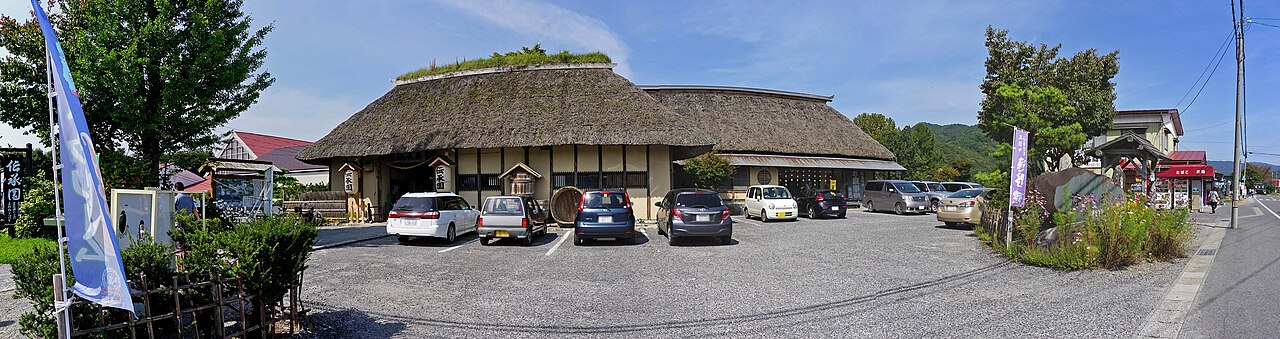
Denshoen's thatched main hall stands right by the roadside, a banner out front on a clear day.
Denshoen is the valley's folk village, its thatched main hall standing right by the road. Adults pay four hundred and fifty yen at the entrance. Elementary, junior high and high school students pay three hundred and fifty yen. Unhurried is the right speed here: this is a place for sitting with the buildings rather than ticking through them.
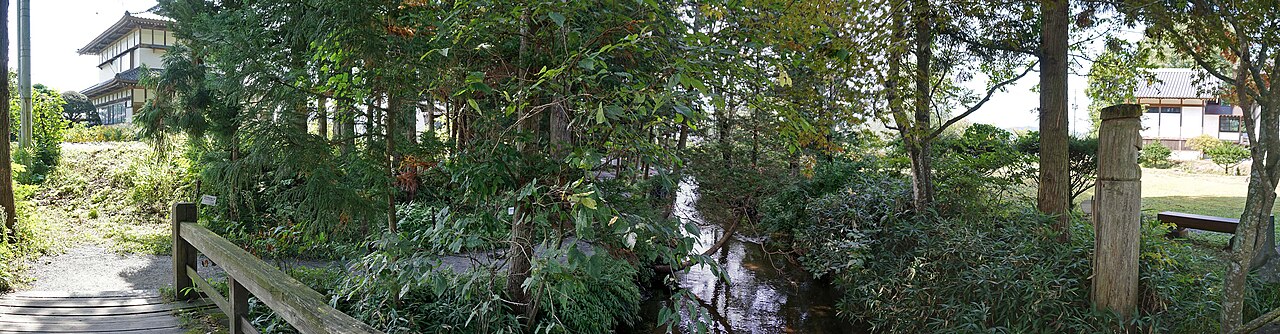
At Kappa-buchi the water runs shallow and clear beneath the cedars, seen here from the rail of the wooden footbridge.
Kappa-buchi, the stream pool of the kappa tales, is the other name that pulls visitors out this way. The scene is exactly what the photograph shows: shallow water threading between cedars and dense green undergrowth, a plain wooden footbridge to lean on, and shade deep enough that the stream seems to keep its own hours.
Give this stretch the heart of the day rather than a squeezed hour. The pleasure out here is slow — thatch, water, the sound of the valley — with nothing that needs to be raced except whichever bus back you decide on for yourself.
Browse guided folklore walks and day tours in Tōno
Out in the valley: the magariya farmhouses
The contrast is the point of the afternoon. In the Meiji records the town is described as holding about six thousand people and the serious institutions of the district — the district office, the middle school, the ward court, the police — making it the largest town in Kamihei. Everything around it was farm country.
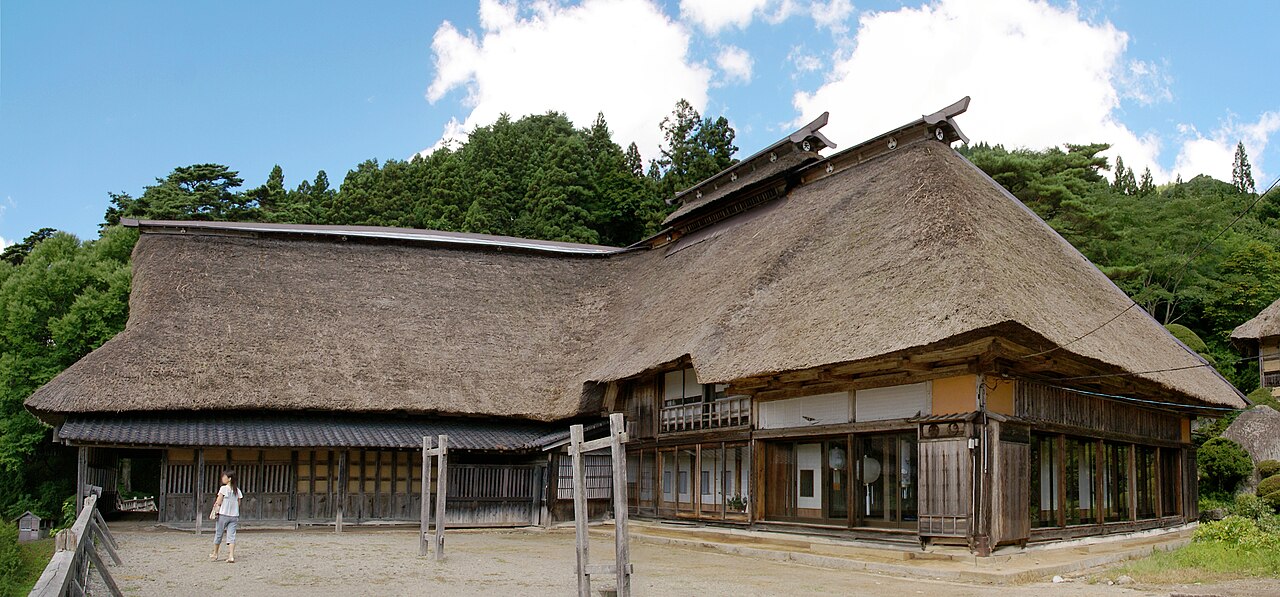
The Chiba family's magariya: one long thatched roofline over stable wing and main house alike.
The houses of that farm country are the magariya, the bent houses, built in an L like the Chiba family's farmhouse in the photograph: a single sweep of thatch running down over the stable wing at one end and the main dwelling behind it, horses and household once kept under one continuous roof.
This walk keeps to the outside of the farmhouses: long roofline shapes in the fields, at their best in the low afternoon light. If you hope to step inside one, check official information before visiting, and leave slack in the afternoon rather than building it around a single door.
As the light lowers, work back toward the centre of town at an easy pace. The contrast you read about in the morning is now something you have walked: the compact administrative town on one side, the farm valley of the tales on the other, and your whole day threaded quietly between the two.
The shrines of the town, and the mountain behind it
Back in town, the high places close the day. The Suwa shrine on Suwa hill is described as Tōno's guardian, the Nabekura shrine partway up Nabekura hill as another of the town's own. Behind them stands Hayachine, which is said to span three districts and rise six thousand five hundred and eighty-seven shaku, about five ri north of the town.
The climbing path is described as two ri and twenty chō or more, and Hayachine shrine is said to sit in a valley southwest of the summit, about five ri from Tōno. Its deity is said to be Seoritsuhime, its founding placed in the first year of the Daidō era. That is a journey of its own: let the mountain hold the horizon, and finish this day in town.