Nikko's fame rests on two shoulders: the temple district where the World Heritage shrines cluster on the lower slopes, and the high country of Oku-Nikko with its lake, waterfalls, and marshland beyond the winding road. The listing made at the end of the nineteen-nineties is described as taking in a hundred and three buildings across two shrines and one temple — Toshogu, Futarasan, and Rinnoji — together with outliers such as the Shinkyo bridge and the Takinoo Shrine. Most visitors walk the same few hundred paces of that district, which is exactly why its margins reward anyone willing to walk a little further.
The famous precinct, honestly
Toshogu is the reason most people come, and it charges one thousand six hundred yen at the door. Behind the innermost shrine, the sacred cedar called the Kanau-sugi — said to be some six hundred years old — draws wish-makers to its small altar, and in the busy seasons a waiting line is said to form there. Rinnoji receives visitors from eight in the morning to five in the afternoon — until four from November through March, with reception ending half an hour before the close — and asks four hundred yen for the Sanbutsudo hall, three hundred for the treasure house and Shoyoen garden, and nine hundred for a ticket that adds the Taiyuin mausoleum. None of this is a complaint; it is simply the busy half of the mountain.
The old approach to Takinoo
Even when the main precinct is at its fullest, the old road up to the Takinoo Shrine is said to hold almost no one, and guidebooks describe it as a genuinely quiet walk — while also warning that the way is easy to lose, so keep your eyes on the path. At the shrine stands a torii with a round opening in its upper beam, and a small stone thrown through the hole is said to grant a wish. The walk begins near the vermilion Shinkyo bridge, which is described as the old doorway into the sacred district, spanning the Daiya River where the pilgrim road arrives from the town. Guidebooks describe the crossing as stopping short of the far bank these days, with a small shrine on the near side for prayers and amulets. An older story is attached to it: when the monk Shodo Shonin could not ford the rapids on his way to Mount Nantai, two serpents are said to have laid themselves across the water and become the bridge.
Seventy Jizo by the river
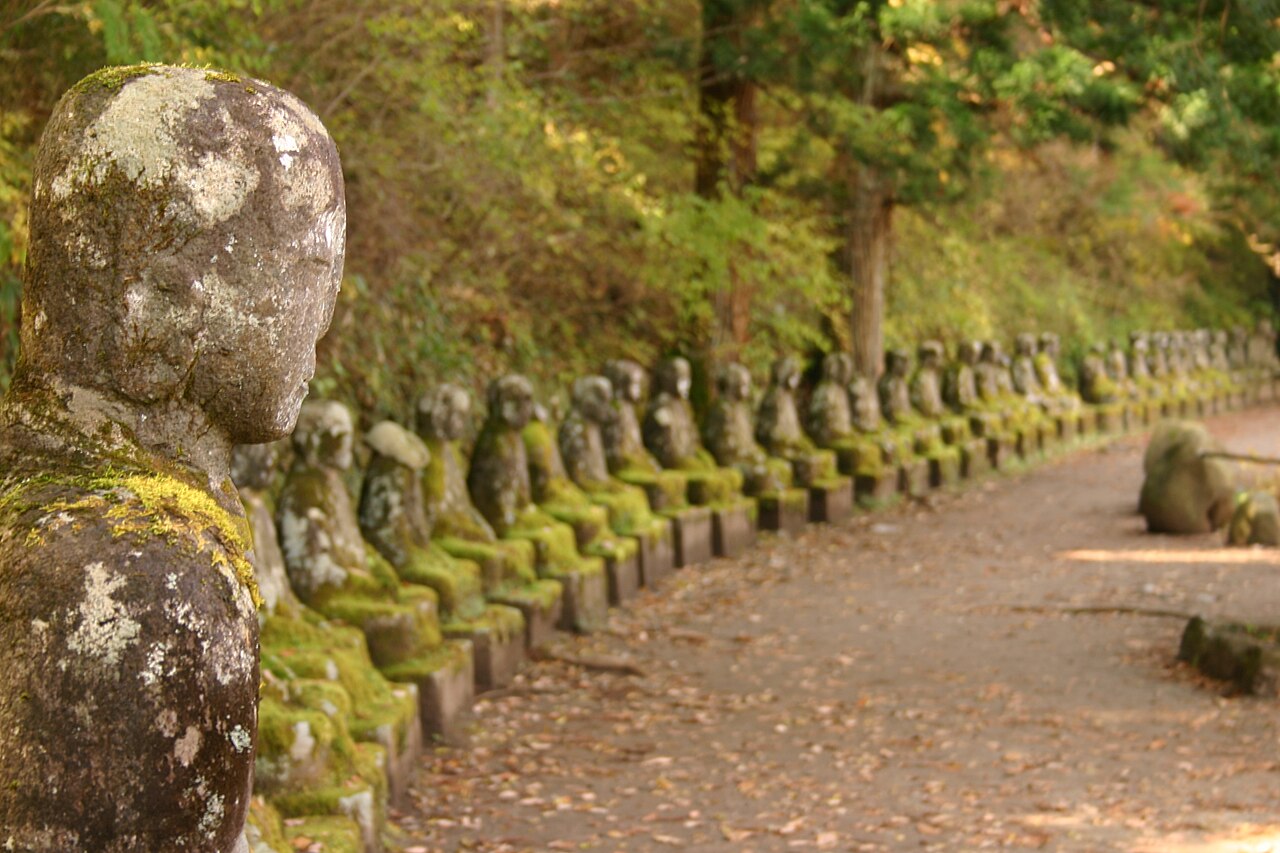
A short walk west along the Daiya brings you to Kanmangafuchi, a small gorge where some seventy stone Jizo are described as sitting in a long row above the current, on ground tied to Kobo Daishi, with Sanskrit letters cut into the rock face across the water. The name itself is described as coming from the closing words of a mantra of Fudo Myoo. They are known as the Bake-jizo — the ghost Jizo — because the count is said to come out different on the way in and on the way out.
The villa quarter
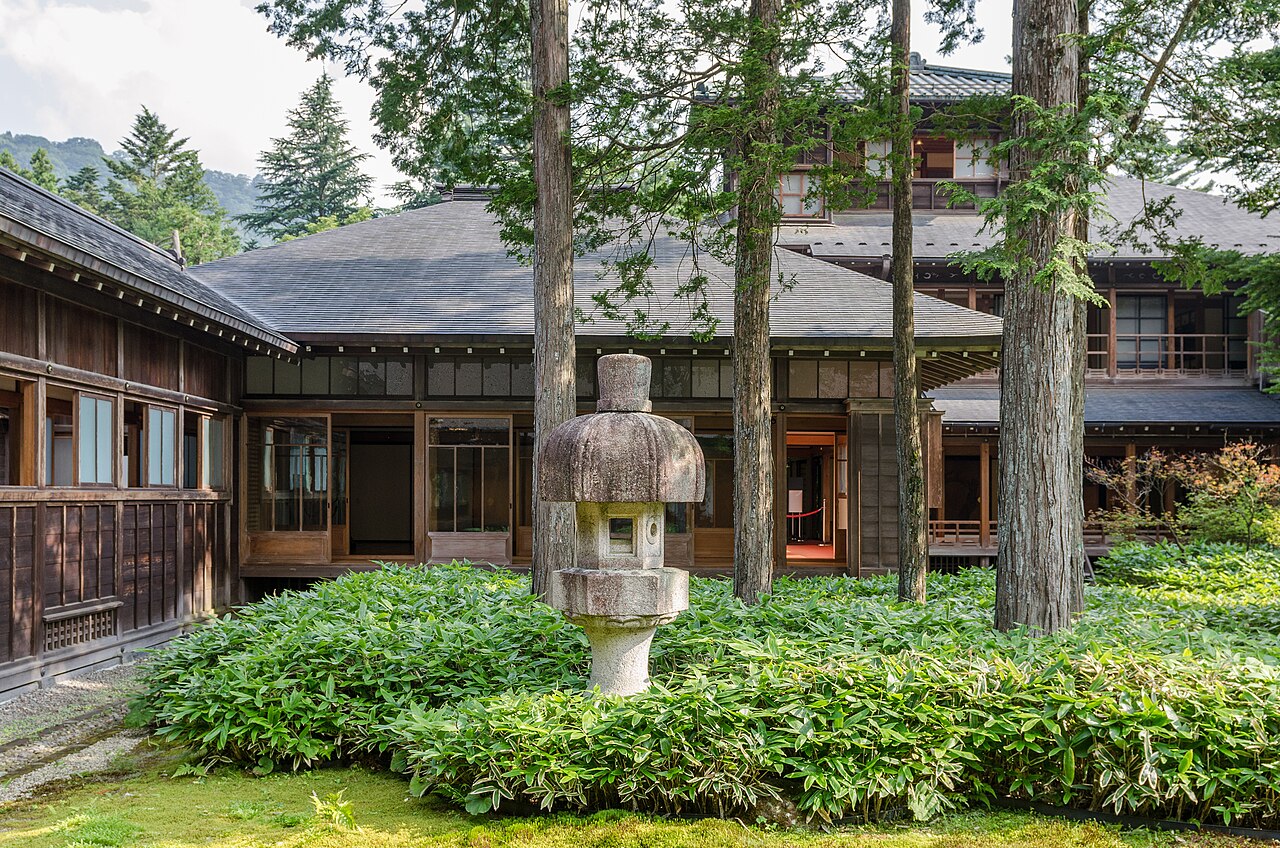
West of the shrines, the Tamozawa Imperial Villa Memorial Park is described as preserving the residence raised at the very end of the eighteen-hundreds as a retreat for the future Taisho emperor, folding part of the Kishu Tokugawa house's Edo mansion into its upper floor, with sliding-door paintings by Kano-school and shogunal painters and a weeping cherry in the garden said to be some four hundred years old. A few minutes away, the Kanaya Hotel History House is described as beginning in the early eighteen-seventies as a lodging for foreign guests — the Samurai House, as they called the old warrior residence it occupied — and the room where the traveller Isabella Bird stayed can be seen inside. The Nikko Botanical Garden, an outpost of the University of Tokyo, is described as spreading along the Daiya with more than two thousand kinds of plants, from cherries and azaleas to maples and rarities like the handkerchief tree. On the villa approach stands Watahan, a maker of Nikko yokan founded in the seventeen-eighties, and the shop is described as still presenting its bean jelly to the two shrines and one temple.
Getting there and what the buses charge
From JR and Tobu Nikko Station, the Tobu bus runs up the valley: two hundred and twenty yen to Shinkyo, three hundred and fifty yen to the Nishisando entrance for the western sights, three hundred and eighty yen out to Kirifuri Falls, eight hundred and fifty yen up to Kirifuri Kogen, and one thousand two hundred and fifty yen all the way to Chuzenji Onsen by the lake. A loop bus for the World Heritage district is described as circling the main sights from the same starting point, and as combining naturally with covering the district on foot. If you would rather have the day arranged for you, browse guided tours and day trips around Nikko and Tochigi.
Where to stay
Disclosure: This post may contain affiliate links. If you book through them, we may earn a commission at no extra cost to you.
If you continue to Oku-Nikko
The road up is described as a pair of one-way sweeps — forty-eight numbered curves in all, named after the old iroha syllabary. Partway down the descending sweep, a ropeway of about three minutes is described as lifting visitors from Akechidaira to a lookout over Lake Chuzenji, Mount Nantai, and Kegon Falls, with azaleas colouring the slopes in late spring. Kegon Falls itself is described as offering two viewing decks, an upper one that takes in the whole cascade and a lower one, reached by elevator, that is described as letting you look up at the water from below. The lake is said to have been found in the late seven-hundreds by the same Shodo Shonin on his push toward the summit of Mount Nantai, and the temple he raised by the shore — Chuzenji — is described as giving the lake its name. By the lakeshore, the prefectural Nikko Natural Science Museum receives visitors from nine in the morning to five in the afternoon — ten to four from mid-November through the end of March — rests on Mondays from December through April, and asks five hundred and ten yen.
A verse behind the waterfall
Urami Falls is described as standing with Kegon and Kirifuri among Nikko's celebrated waterfalls, and Matsuo Basho is described as having stopped here on his narrow road north, leaving a verse about sheltering by the water at the start of summer. Behind the curtain of water, an image of Fudo Myoo is described as keeping its long watch.
Make it a quiet day
See the famous precinct early if you need to, then give the rest of the morning to the Takinoo road and the river Jizo, keep the villa quarter for the afternoon, and let the buses carry you up the mountain only if the day still has room. If shrine roads in the hills suit you, our visit to Mitsumine Shrine, a quiet mountain shrine deep in Chichibu climbs in the same spirit. Museum days and timetables in a mountain town move with the year, so check official information before visiting.
Compare options and book: Tochigi tours and tickets.