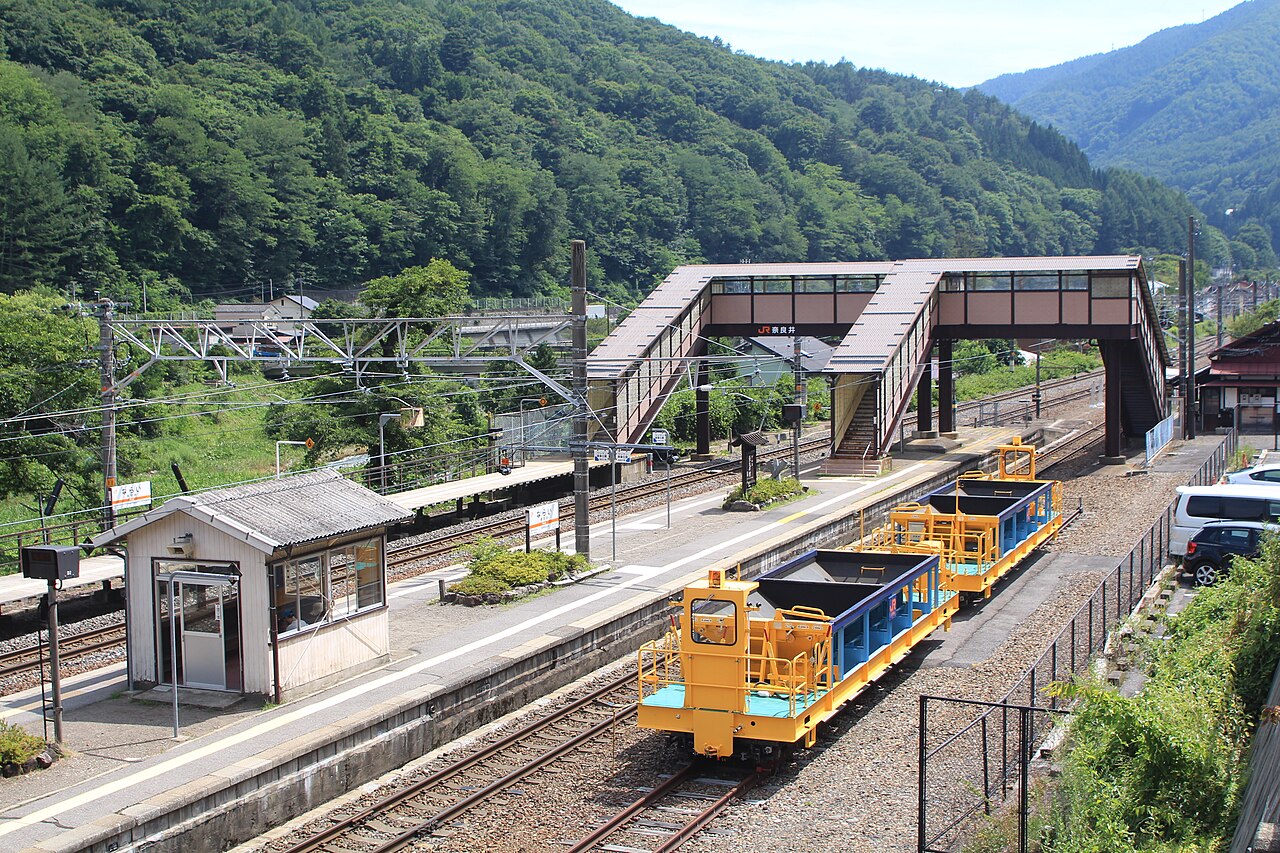
Narai-juku is a former post town on the old Nakasendo road, in Shiojiri, Nagano Prefecture. This guide walks it end to end: where to get off the train, which houses you can pay to enter, what the two shrines mark, why the street tilts toward the pass, and the details of water and fire that keep the townscape whole.
Arriving at Narai
Narai-juku is described as a post town you can cover entirely on foot from Narai Station, with the old street beginning as soon as you leave the platform. Everything in this guide is reached by walking from there, so there is nothing to arrange between the ticket gate and the first townhouses.
For the local bus option, Shiojiri City, which Narai belongs to, runs a community bus called Suteppu-kun, and the fare is a flat one hundred yen per ride for adults and children alike, or one bus coupon ticket per ride. If you plan to stay the night, look at places to stay in Narai before you set out.
Nakamachi, the oldest part of the post town
Walk to the middle of the town and the street opens out. This is Nakamachi, the central block, where the road is at its widest anywhere in Narai-juku and many of the buildings are larger than those elsewhere in the town. It is the natural place to slow down and look closely at the frontages.
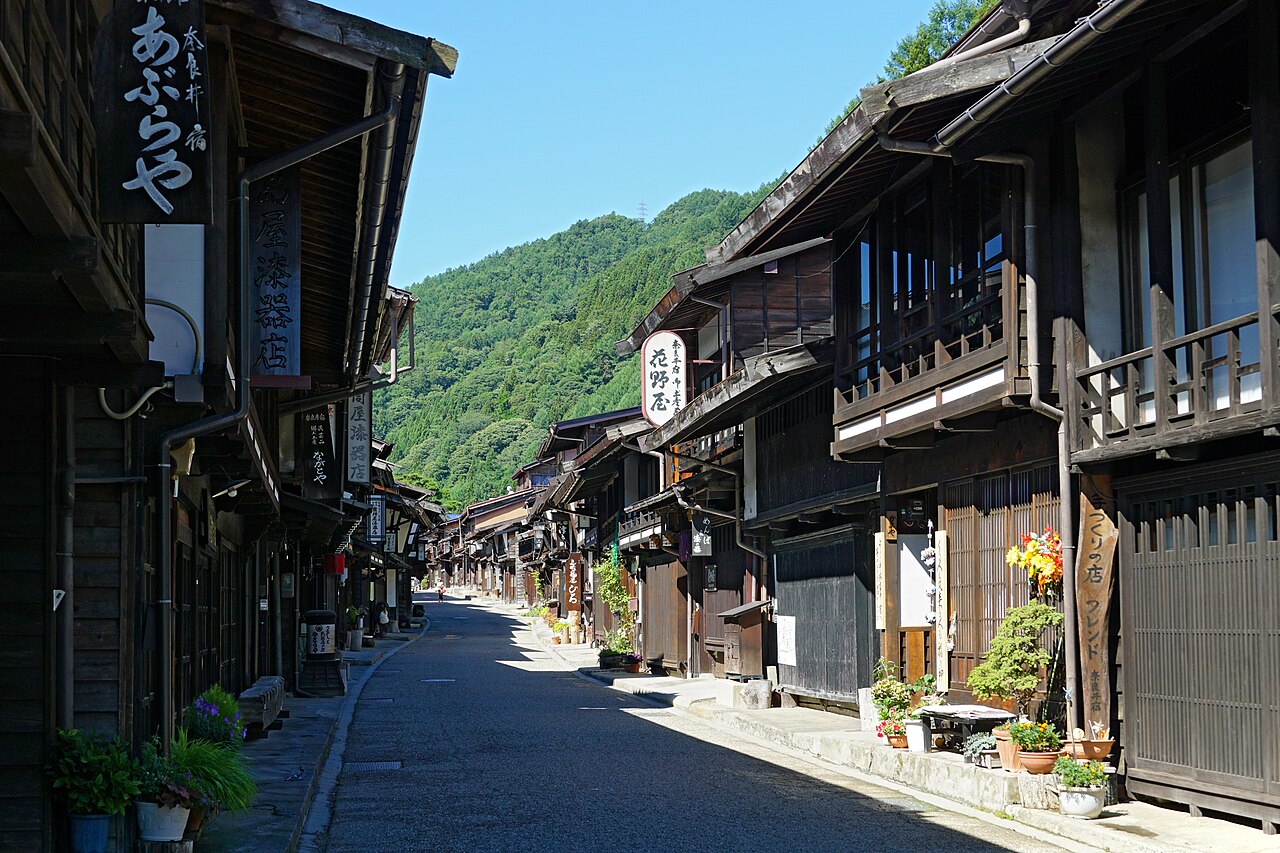
The width is put to use: the Kiso Odori national dance contest is held right on this stretch of road, which says something about how much room there is here. Partway along stands Taiho-ji Temple, where the visit fee is one hundred yen. It was originally called Koden-ji and is said to have been founded by the Narai clan.
Nakamachi is said to be the oldest settlement in Narai-juku, and the temple's origin is cited as evidence for that. The hall of the medieval Narai lords is said to have stood beside the block, with retainers and merchants living nearby, and Nakamachi stayed at the centre as the post town grew, which explains the wider road and bigger houses.
Two houses you can go inside
The Nakamura Residence is the townhouse to enter first. Admission is three hundred yen for adults. The house stops admitting visitors thirty minutes before closing time, so do not leave it for the very end of the afternoon. Prices and closing times can change, so check official information before visiting.
The other is the Narakawa Museum of History and Folk Customs. Admission is three hundred yen for adults and free for junior high school students and younger, which makes it an easy add-on for a family. It pairs naturally with the Nakamura Residence, so give both the time they deserve rather than a quick look from the doorway.
Where to stay
Disclosure: This post may contain affiliate links. If you book through them, we may earn a commission at no extra cost to you.
A shrine at each end of the town
The post town is bracketed by two large shrines, one at each entrance: Shizume Shrine at one end and Hachiman Shrine at the other. They mark where the townscape begins and ends, so walking from one to the other is the simplest way to be sure you have seen the whole street.
At Hachiman Shrine, take the stone steps. The line of cedars beside them is a surviving stretch of the old Nakasendo itself, the actual route that travellers walked in the Edo period. The precinct also holds a building called the maiya, a hall for dedicatory performances fitted with a revolving stage, and both buildings are Edo-period work.
Behind the main hall stand the stone figures known as the Two Hundred Jizo. They were gathered from the surrounding districts tied to the railway construction at the end of the Meiji era and enshrined here together, and despite the name the majority are actually images of Kannon rather than Jizo.
The placement is deliberate. Hachiman stands to the north-east, the direction called ushitora or the demon gate, of the hall of Narai Yoshitaka, the warlord who ruled the town in the medieval period, and it is said to have been enshrined to guard that unlucky quarter. His residence is thought to have stood above where Honen-ji Temple is today.
Where the daimyo stayed
Look for the plaza in front of the community hall. This is where the honjin stood, the inn reserved for daimyo on the alternate attendance circuit and other guests of rank. A gate faced the main street and the lodging building sat behind it, but nothing of it survives, so what you see is the space rather than the house.
The honjin was run for generations by a family that passed down the name Kuroemon. Backing it up were the waki-honjin, secondary inns that assisted the honjin. Two houses held that role in Narai, though the families changed along the way, and the building of the last family to serve as waki-honjin still stands today.
The forwarding station and the pass beyond
As you walk the length of the street, notice that it climbs. The road through Narai-juku rises gently toward Torii Pass, known as one of the hardest stretches on the whole Nakasendo, so the walk through town follows the lie of the land toward the pass without you having to leave the houses behind.
Partway along is the Kami-Toiya, which now serves as a museum of historical materials. It was never a shop; it was the forwarding office that arranged horses and oxen for the relay and collected the charges. Under that system, goods arriving from the neighbouring post town were unloaded here and reloaded onto other animals for the next stage.
The pass is why the office mattered. Torii Pass rises too sharply for carts, so freight went over on people's backs or in small loads on horses and oxen. The Edo-period Nakasendo is described as carrying not only daimyo processions and travellers but a constant flow of goods, doing the work that trunk roads and freight railways do today.
The pass has an older story too. Narai Jibu-no-sho Yoshitaka, the same medieval lord met at Hachiman Shrine, made his name on the Kiso side in the battle fought at Torii Pass between Kiso Yoshiyasu and Takeda Shingen, so the pass ahead of you has been fought over as well as walked over.
Water, fire, and the absence of power lines
Along the street you will keep passing water places, where stream water from the mountains is piped in. They run all year without stopping, and travellers on the Nakasendo once drank from them, so they are part of the road's working history as much as a feature of the modern townscape.
Fire is the other thing the town has built its street around. Look for the wooden boxes along the road: they hold the fire hydrants, and the plain timber casing is Narai's own design, unlike the red-painted boxes seen in nearby Hirasawa and Niekawa, and it disappears into the historic frontage.
At the boundary between Shimomachi and Nakamachi is an empty patch once called the hiyoke akechi, a firebreak left clear on purpose, where a water place, a large pine and a small shrine were set. The fire brigade's garage still sits beside it, so the gap continues to do the job it was left for.
Finally, look up: there are no power poles. The townscape has been maintained so thoroughly that the Edo-period frontage runs unbroken along the street, which is why almost any point on the road makes a clean photograph. To see it in early light rather than on a day trip, browse places to stay in Narai and give it a whole morning.