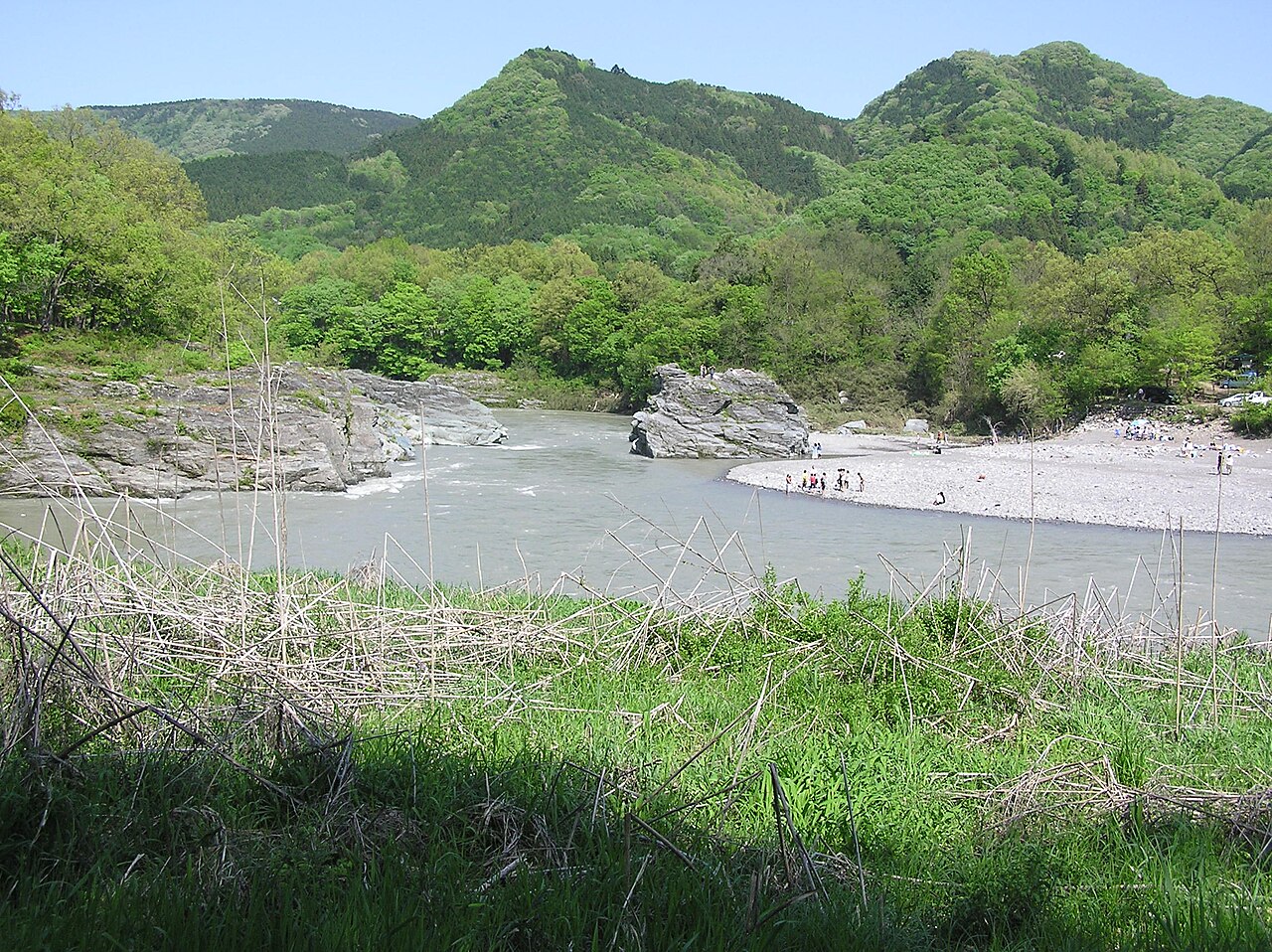
Most day-trip advice from Tokyo makes you choose: a river day or a mountain day. Nagatoro quietly declines the choice. Guidebooks describe it as a small town at the northern edge of the Chichibu basin in Saitama Prefecture, with the Arakawa River flowing north to south through its center. Nearly all of its main sights — the rocky terrace, the river-boat landing, and the start of the shrine approach up Mount Hodo — sit within a short walk of a single railway station. That geography is the whole trick: one unhurried loop, no car, no transfers, and two different kinds of quiet in a single day.
One station, one white torii
Nagatoro Station itself sets the tone: the building is said to keep its appearance from the line's opening days, and it is described in guidebooks as one of the Kanto region's celebrated stations. The railway is said to have reached Nagatoro in 1911, and the town has served as the main gateway to the wider Chichibu region ever since. Step outside and the approach greets you at once: guidebooks describe a large white torii at the intersection directly in front of the station, marking the entrance to the Mount Hodo pilgrimage route. If you plan to ride deeper into the valley, the Chichibu Railway's full-network one-day pass is described as running mainly on weekends, public holidays and steam-locomotive days, with a year-round digital version, and holders are said to receive discounts at partner facilities including the river descent.
Morning: walk out onto the Iwadatami
Start with the river. A short, flat walk brings you out onto the Iwadatami, described in guidebooks as a broad terrace of crystalline schist pushed up from an ancient seabed, its surface crossed by fault scarps, tiger-striped banding and potholes worn smooth by the current. The terrace is said to run roughly 600 metres along the Arakawa, holding a double national designation as both a scenic spot and a natural monument. There is a reason geologists treat this riverbank with reverence: the German geologist Naumann — later the first professor of geology at Tokyo Imperial University — is said to have come to study the exposed strata in 1878, and Nagatoro has been described as the birthplace of Japanese geology ever since.
Late morning: the boat descent
The wooden-boat river descent is said to have been operating since the Taisho era, and it is the signature way to see the gorge from water level. The boats are described as traditional flat-bottomed craft steered by boatmen with long poles, with two courses on the river: Course A takes the most turbulent stretch of rapids, while Course B drifts a gentler course past rock formations shaped like a camel and a frog. In January and February, a heated kotatsu-boat variant is said to run instead, drifting a quiet section of the river while passengers warm their legs under a low table.
On both Course A and Course B of the Nagatoro Line Kudari, the adult fare for riders of junior high school age and older is 2,000 yen, or 2,200 yen during the peak season. For children aged 3 and older, either course is 1,000 yen, or 1,100 yen at peak times. The boats depart at random intervals of 10 to 40 minutes. The heated kotatsu boats are 1,100 yen for adults. For children aged 3 and older, the fare is 700 yen.
Where to stay
Places to stay near Nagatoro →
Disclosure: This post may contain affiliate links. If you book through them, we may earn a commission at no extra cost to you.
Midday: cross under the torii
When the river has had its say, walk back past the station and under the white torii; the shrine approach rises gently toward the mountain. Mount Hodo is described as a 497-metre peak standing almost entirely alone, a rare landform in a region otherwise built of connected ridgelines. Hodosan Shrine sits at its base and is described as one of the three grand Chichibu shrines, together with Chichibu Shrine and Mitsumine Shrine. The present buildings are said to have been rebuilt between the late Edo period and the early Meiji era, and their eaves and railings carry vividly coloured sculptural carvings that reward a slow look upward.
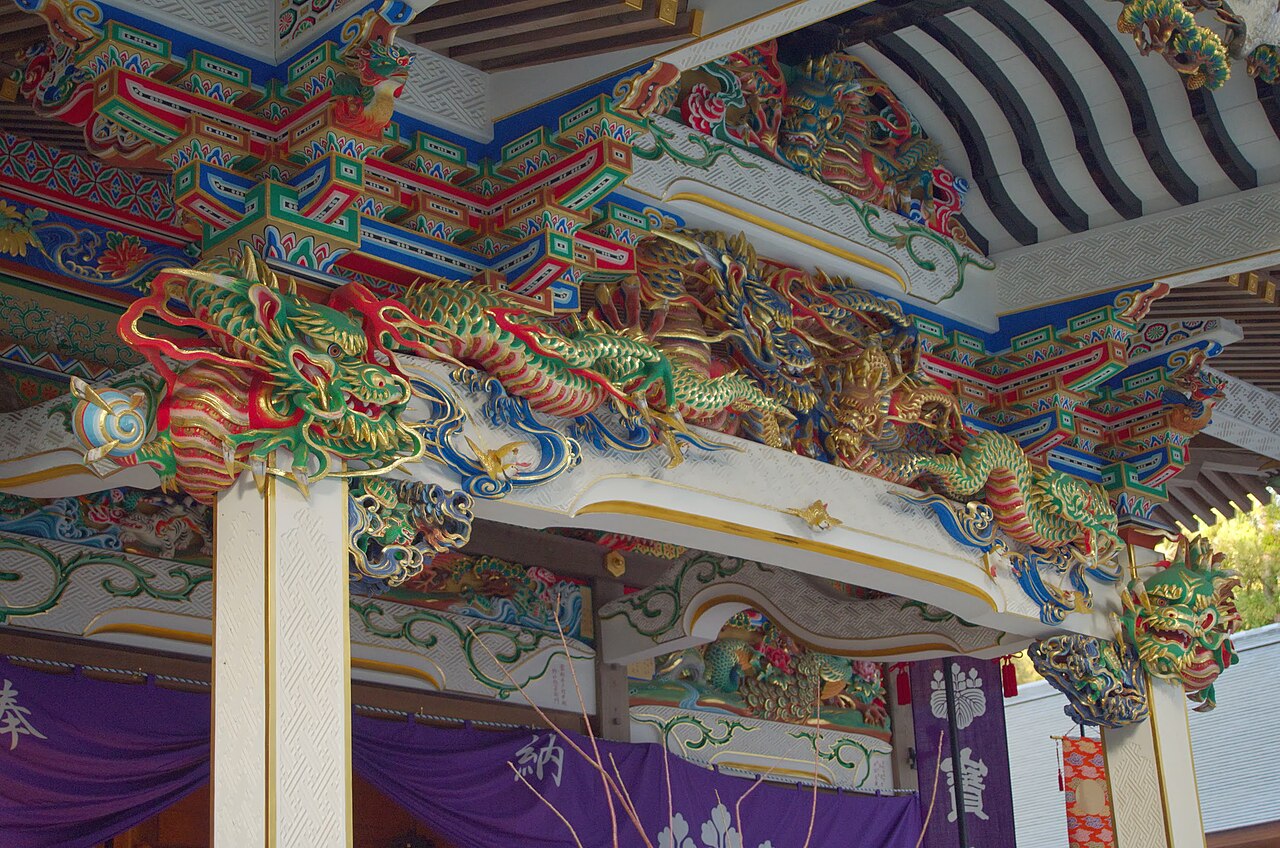
The shrine's founding is traditionally placed about 1,900 years ago: Yamato Takeru, the story goes, was caught in a wildfire on the mountain and guided safely to the summit by a divine dog, and the name Hodosan is said to derive from "fire-stopping mountain". Because of that legend, the shrine is said to have been venerated especially as a protector against fire and theft, a devotional identity of its own among the three Chichibu shrines. Behind the main hall, a natural spring called Misogi-no-izumi is said to still flow — the spot where, as the story goes, Yamato Takeru purified himself before his ascent — and visitors today view it through a latticed enclosure. Entry to the shrine grounds is described as free of charge.
Afternoon: the ropeway and the summit
From the shrine, a ropeway climbs the wooded slope; the inner shrine — the okumiya — is described as visitable at the summit after the ride up, the traditional end point of the pilgrimage. The reward is the view: guidebooks describe the Chichibu basin spread below, the distinctive silhouette of Mount Buko, and the surrounding ranges, with a sea of clouds sometimes filling the valleys on clear early mornings from autumn through spring. Near the top of the ropeway, a dedicated wax-plum garden is said to hold roughly 3,000 trees, one of the most celebrated early-spring flower spots in the Chichibu–Nagatoro district. The slopes are said to be planted for a long season — wax plum in late winter, plum and cherry blossoms in spring, azaleas in late spring, and rhododendrons from mid-May into late June. There is even a small animal park near the top, described in guidebooks as a place where llamas and rabbits can be hand-fed — a gentle detour if you have children along.
The ropeway fare is 700 yen one way for adults, or 1,200 yen for a round trip.
Why autumn is the quiet choice
Nagatoro is described as one of Japan's top 100 cherry-blossom sites, and the blossom weeks from late March through late April are described as the most crowded stretch of the town's year. The town is described as supporting outdoor and river activity across all four seasons, with a flower calendar running from plum and cherry through azalea, summer green, and autumn foliage. An autumn visit keeps every part of this day open — and leaves the blossom-season crowds in another month entirely.
The shape of the day
- Morning: walk the Iwadatami rock terrace, an easy stroll from the station.
- Late morning: ride the boat descent (in midwinter, the kotatsu boat).
- Midday: walk back under the white torii to the shrine approach.
- Early afternoon: Hodosan Shrine, then the ropeway up the wooded slope.
- Late afternoon: summit views and the wax-plum garden, then an easy walk back to the station.
Seasonal operations and opening details change; check official information before visiting.
If you want to go deeper on either half of the day, we cover both in detail: the Nagatoro riverside and Mount Hodo.
Compare options and book: Chichibu tours, Tokyo day trips.