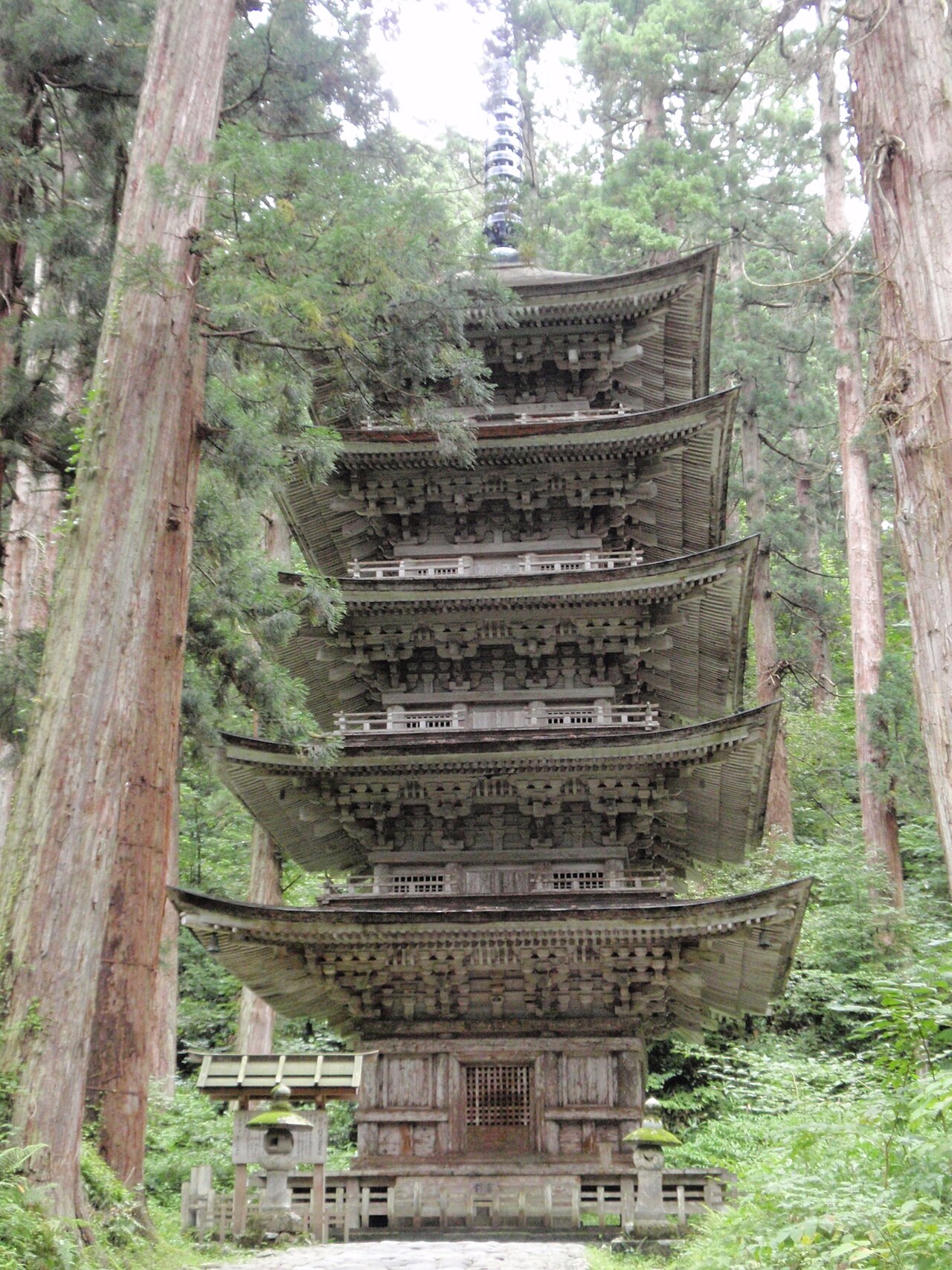
Travellers bound for the north of Japan tend to follow the same well-worn shortlist, and the Shonai plain in Yamagata is rarely on it. That is precisely its gift. Mount Haguro, the most approachable of the three holy mountains of Dewa, keeps a wooden pagoda alone in a forest of giant cedars, a stone stairway that climbs through green shade to a thatched hall at the top, and, at its foot, the old castle town of Tsuruoka, where moats, shrine groves and museum rooms sit in an unhurried calm. The two halves join into one unforced day, and the whole of it works without a car.
Why Mount Haguro stays quiet
In the old faith of the Dewa Sanzan, the three mountains are said to hold the three stages of a life's journey: Gassan for the world that has passed, Yudono for the world still to come, and Haguro for the living present. Haguro is spoken of as the gateway of the three, the mountain a pilgrim meets first, and the one whose sanctuary receives visitors in every season.
The calm here is structural rather than lucky. The Shonai plain faces the Sea of Japan, away from the routes most first-time visitors trace between the famous cities, and the mountain's treasures are reached on foot rather than by escalator and viewing deck. What you hear on the way up is wind moving through the cedar crowns, water in the valley, and your own footsteps on old stone. Even the pagoda, a National Treasure, stands alone in the forest with no gift stalls beside it — the trees are the architecture around it.
Getting there from central Tsuruoka
The connections are few and easy to remember, and every leg below runs on an ordinary local timetable.
- From Tsuruoka Station to the Zuishinmon stop at the mountain gate: 40 minutes by bus.
- The same ride to the Zuishinmon stop costs 900 yen.
- To the great torii on the approach road, for the garden temple below the mountain: 30 minutes.
- The fare to the great torii is 720 yen.
- Riding through to the summit stop, if you would rather walk the stairway downhill: 1,400 yen.
- To the Kyukamura lodge stop partway up the mountain road: 1,200 yen.
- A through ride from Tsuruoka Station to the eighth stage of Mount Gassan, for the higher pilgrimage: 2,550 yen.
- From the Zuishinmon stop it is a 5 minute walk to the gate itself.
- From the same stop, a 10 minute walk down among the cedars brings you to the five-story pagoda.
- From the great torii stop, the garden temple of Gyokusenji is a 15 minute walk.
The cedar stairway
At the Zuishinmon gate the ordinary world formally ends. The gate marks the doorway into the mountain's sacred ground, and the long stone stairway to the summit begins beyond it. The path first drops gently into the valley and delivers you to the mountain's most photographed secret: the five-story pagoda, built of plain unpainted wood, rebuilt in the middle of the Muromachi period, counted by some as the oldest of its kind in the northeast, and designated a National Treasure. It carries no ornament that the forest does not give it, and in the early morning you may share it with no one at all.
From the pagoda the stairway settles into its long work. The stone steps rise through a corridor of cedars so tall that the sky becomes a thin bright line overhead. The grade sharpens in stretches and eases again; the climb is honest effort, but it is the kind that empties the head rather than fills it. Small stone shrines appear at the margins, moss takes every surface the sun does not claim, and the crowds that gather at roadside temples elsewhere in Japan simply are not here.
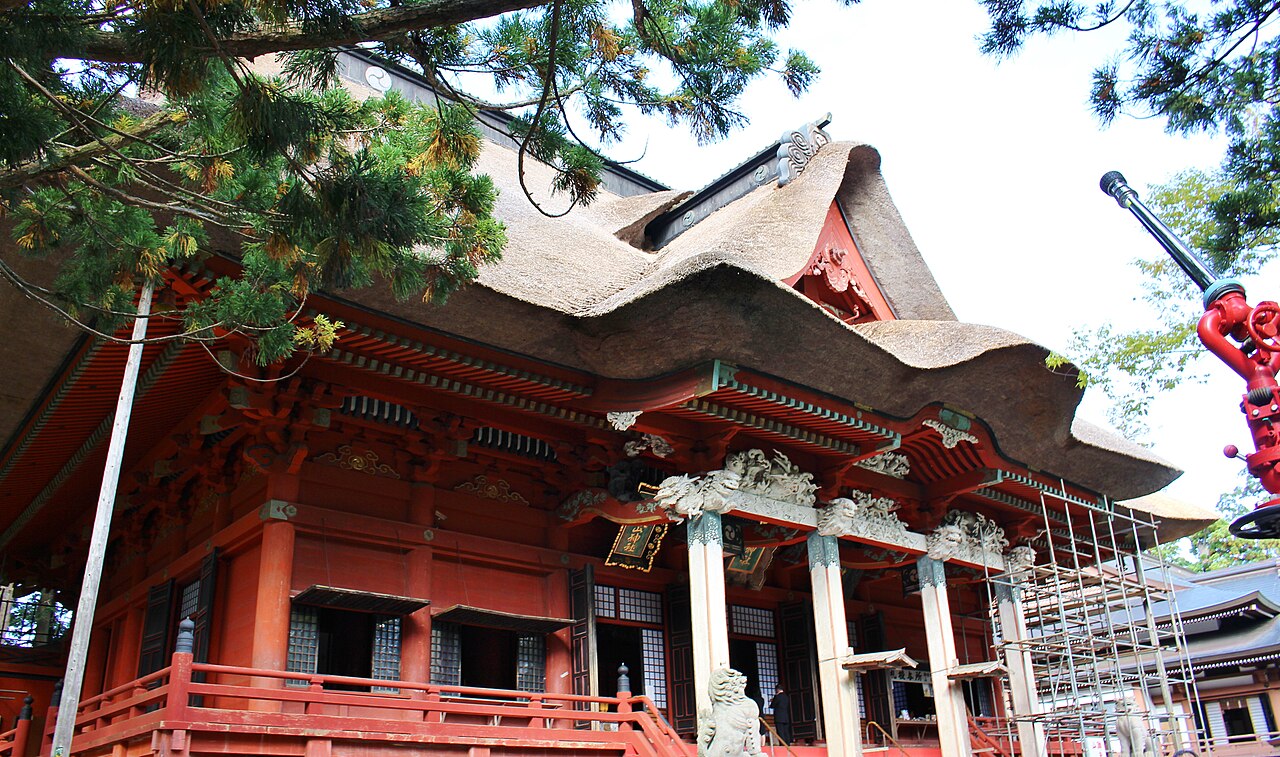
At the top stands the Sanjin Gosaiden, the great hall in which the deities of all three mountains are enshrined together beneath a thatched roof counted among the largest in Japan, and listed as an Important Cultural Property. Because the three mountains share this one altar, a visit here is traditionally treated as a greeting to all three — which is why pilgrims of every age, including those who will never walk the higher peaks, finish their journey in front of it.
Where to stay
Places to stay near Tsuruoka →
Disclosure: This post may contain affiliate links. If you book through them, we may earn a commission at no extra cost to you.
Down in the castle town
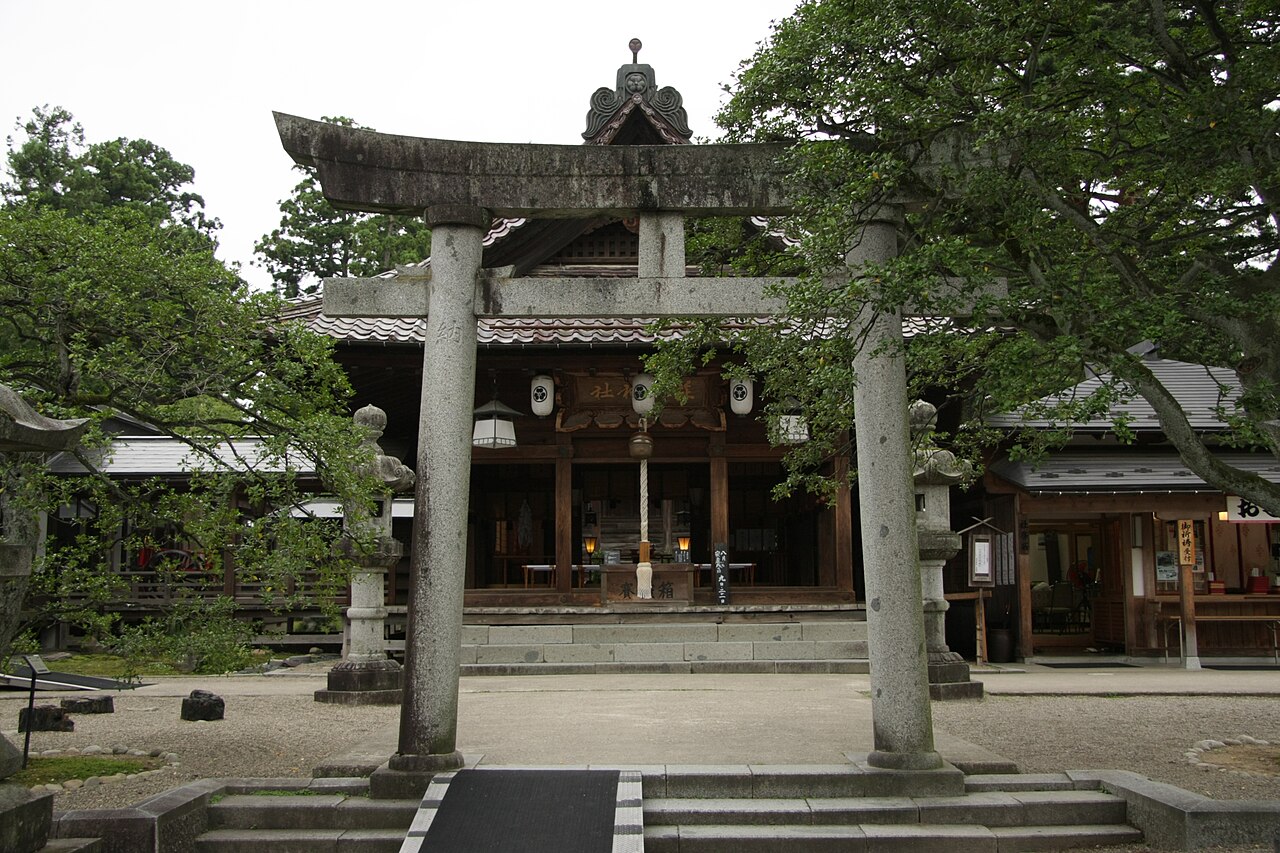
Back in Tsuruoka the pace stays low. The castle itself is gone, but Tsuruoka Park keeps its moats and stone walls, and Shonai Shrine now stands within the old grounds, so the shape of the vanished keep can still be read in water and stone. Close by, the Taihokan exhibition hall faces the park, and the Chidokan — the only school built by a feudal domain that still survives in the Tohoku region — keeps its gates, lecture hall and quiet courtyards in the middle of town. A few streets away, a Romanesque chapel listed as an Important Cultural Property holds an unusual black figure of the Madonna, a small strange treasure that most passers-by never suspect.
The Chido Museum
The Chido Museum gathers the region's architecture into one garden: the former district office, farmhouses of many storeys moved here from the mountain villages, three buildings listed as Important Cultural Properties in all, and a shoin-style garden to sit beside when your feet ask for mercy.
- Doors: 9:00 to 17:00 from March through November.
- From December through February the day shortens to 9:00 to 16:30.
- Last entry is 16:30 in the longer season.
- In winter, last entry comes at 16:00.
- Tickets are 1,000 yen, 400 yen, and 300 yen depending on age.
- The museum closes from December the twenty-eighth to January the fourth.
- Count 10 minutes by car from Tsuruoka Station.
- The silk-era settlement of Matsugaoka is another 20 minutes by car beyond the museum.
The old Endo family house, a many-storeyed farmhouse in the Tamugimata style, belongs to the same building tradition as the museum's relocated houses — high-roofed working architecture born of snow country, worth seeking out if farmhouses are what you came north to see.
Quiet tables
Food in this corner of Yamagata leans monastic in the best way. The temple lodgings of the Haguro area serve shojin cuisine — meals prepared without meat or fish, built instead from mountain vegetables and changing with the season — and eating one after the stairway feels less like a restaurant visit than a continuation of the walk. Down in town and among the rice fields, Chikeiken, Naa and Midori no Isukia are the names most often mentioned for a slow, homegrown lunch.
A day that fits together
- Morning: leave town on the mountain line — the ride from Tsuruoka Station to the Zuishinmon stop is 40 minutes.
- Give the pagoda and the lower forest a slow hour before you commit to the stairway.
- Take the climb unhurried; a generous half morning covers the ascent and the summit hall, with pauses to let the forest do its work.
- Early afternoon: ride back down and put about an hour into the Chido Museum — it is 10 minutes by car from Tsuruoka Station if you switch to a taxi.
- Keep the late afternoon for the park moats, the shrine and the old school, when the light lies flat on the water and the town is at its quietest.
Book a guided day around Tsuruoka
If you would rather have the connections handled for you, guided day tours pair the cedar stairway and the summit shrine with the castle town's museums in one arranged sweep, often with an English-speaking guide.
Compare tours and day trips around Tsuruoka
Disclosure: This site may earn a commission if you book through the link above, at no extra cost to you.
Before you go
- The cedar shade keeps the stairway green and dim even at midday, so photographers should come early or late for the slanting light rather than for the crowds, which do not come.
- Winter trims the museum day and buries the mountain approaches in serious snow country weather; the town half of this day is the better winter half.
- If flowers are your reason to travel, the pond-strolling garden of Gyokusenji — a nationally listed place of scenic beauty that locals call the flower temple — pairs naturally with the great torii stop, a 15 minute walk away.
- The shojin meals of the temple lodgings change with the season, so what you eat in June and what you eat in October are different arguments for coming back.