*This account draws on "新撰名勝地誌" (Izumo volume), a gazetteer compiled in the late Meiji era.*
Matsue is a town built around water. Lake Shinji spreads to the west, the Ohashi river cuts through the middle, and moats ring the castle hill. A day here has a natural shape: the black keep and its park first, then the old bridge, then the western shore for the sunset.
The pieces of that day are old ones. A gazetteer of Izumo Province from the late Meiji years walks through the same circuit — castle, parks, bridge, lake — and much of what it praises is still what a visitor comes for. This article follows its route to the water's edge.
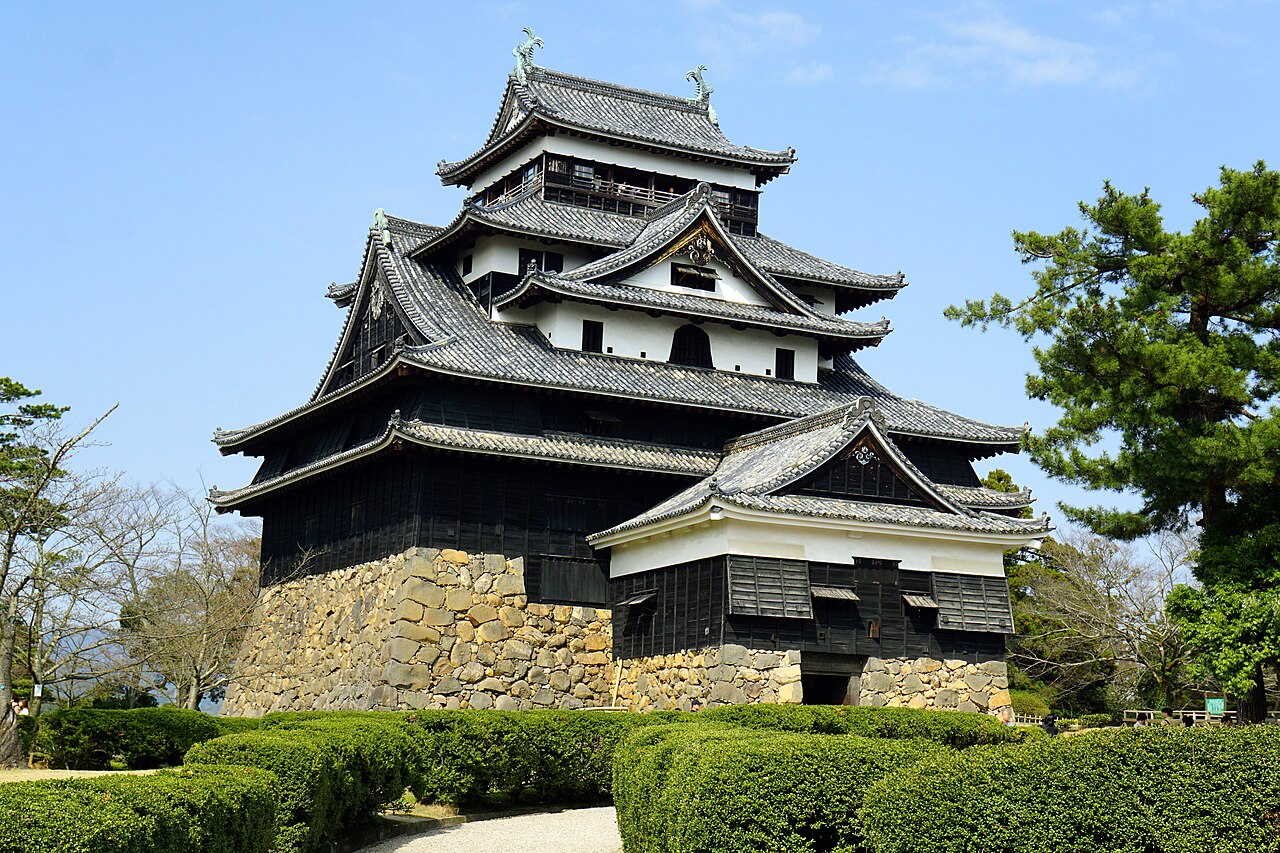
The Black Keep on the Castle Hill
In the Keicho era, Horio Yoshiharu was granted Izumo and took the mountain fortress of Gassan at Toda as his first seat. His son Tadauji judged that ground poor for a castle town and chose a new site north of the lake, but he died young, before anything could be built.
The elder Horio carried the plan through. Workers drew lake water into the moats, raised the walls, and finished the castle in the sixteenth year of Keicho. After the Horio line ended, the fief passed to the Kyogoku house, then to the Matsudaira, who held it until the Restoration.
The keep is also called Chidori-jo, the plover castle, and the hill it stands on is known as Joyama. After the Restoration the grounds went for a time to the army ministry and sank into neglect, until the Matsudaira family recovered them, repaired the keep, and laid out a garden.
The View from the Top, and the Park Below
The old gazetteer is blunt about the view from the keep: nothing in San'in compares. From the top floor, the roofs of Matsue and the surface of Lake Shinji lie in a single sweep, and across Nakaumi the green cone of Mount Daisen stands up like a distant Fuji.
Below the walls, Jozan Park fills the hillside with several hundred plum, cherry, willow, and peach trees, white sand set off by green moss, and was counted the first pleasure ground of the town. In summer, the account adds, lotus flowers crowd the waters of the castle moats.
The Great Bridge
Down in the town, the Ohashi bridge was the hinge of Matsue's life. The gazetteer describes a span of a little over a hundred ken in the old measure, with travelers and carts crossing without pause from morning to dark, the busiest point in the whole castle town.
The reward is the view from the middle. West, the lake opens wide; east, beyond the Ohashi river, Daisen shows the same Fuji-like profile; and the houses of the south bank hang upside down in the water. One account ranks the scene with the Mont Blanc bridge in Geneva.
The bridge foot was also the town's harbor. Highways ran out toward Hiroshima, Iwami, and Mihonoseki, but the heavy traffic went by water, with small steamboats carrying travelers east and west from the landing at the foot of the span.
Yomegashima and the Sunset Shore
Sunset belongs to the southwestern shore. Sodeshi-ura runs along the lake below Enjoji hill, a stretch of white sand and clear shallows ending at a great rock crowned with stone images of the Buddha. The gazetteer counts it among the rare corners of the town with real atmosphere.
Its picture of the place is all evening: gulls dozing on the water when the wind is down, and fishing boats racing one another home as the sun goes low. That is still the hour to come, when the light lies flat and gold across the whole width of the lake.
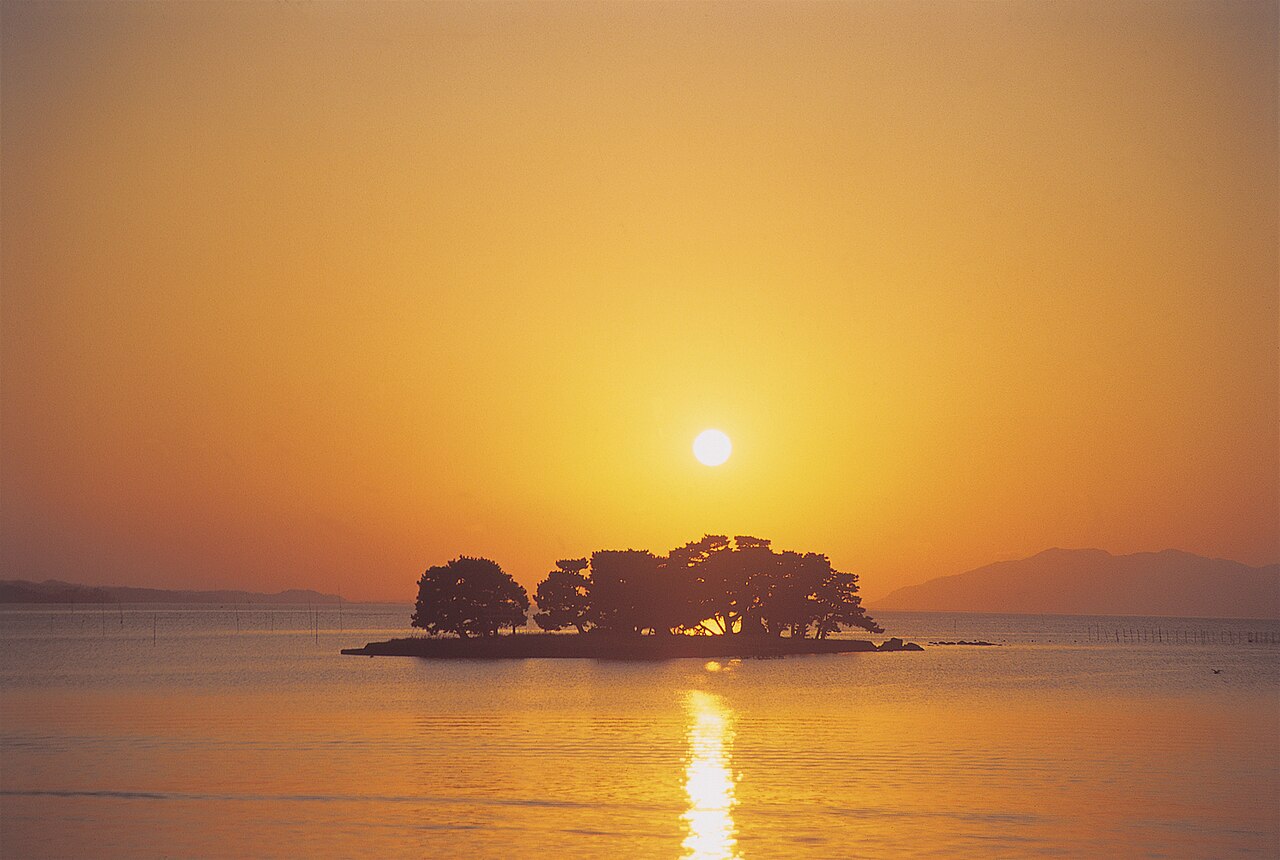
Offshore lies Yomegashima, the bride's island. On paper it belonged to a village across the water, the gazetteer notes, but Matsue has always been the nearer shore. The island is far older than the town: the Izumo Fudoki records it as Kashima, a tiny islet with a single tree and shellfish on its rocky rim.
By the Meiji years the islet carried two or three pines and a small shrine, and a boat trip out to it counted as a half day's quiet pleasure in the summer heat. Seen from the shore at dusk, its pines stand black against the western sky, which is the picture most people carry away.
Compare options
See partner pricing and availability →
Disclosure: This post may contain affiliate links. If you book through them, we may earn a commission at no extra cost to you.
Tenjin Park and the Shrine of the Young Pines
South of the bridge, Tenjin Park sits on the lakefront facing Sodeshi-ura, with Yomegashima lying directly before it and old pines shading the shrine. In its heyday it was the liveliest summer ground in Matsue, lined with a theater, pleasure houses, and rows of stalls along the shore.
The shrine is Komatsubara Tenmangu, moved here from Toda when the castle came. The shore was then a wild moor where young pines grew beside the lake, and the name — shrine of the little pine field — followed from that landscape and stayed after the moor became a town.
The halls were rebuilt in grand form in the fifth year of Enpo, once the Matsudaira had put the town in order. The gazetteer calls its summer festival, held on the twenty-fifth of July, the busiest of all Matsue's observances, drawing worshippers from the neighboring provinces.
Just south again rises Shogi-yama, the hill of the camp stool, its name traced to an episode from Horio Yoshiharu's move of the castle. Paths and plantings turned the little rise into a lookout, and from the top the whole town, the lake, and the hills beyond lie in one view.
What Travelers Once Took Home
The old guide ends its Matsue chapter at the shops. Agate work from Tamatsukuri, west of the city, led the list — the blue agate of that district was said to come from nowhere else in the country — alongside lacquer of the Yakumo style and the local weaves.
Tea people sought out Rakuzan ware, a kiln begun in the Enpo years by a potter trained in the Hagi tradition. The kiln lapsed for a time, then revived under the retired lord Matsudaira Harusato, better remembered by his tea name, Fumai, whose taste still colors the town.
Fees and Opening Times
Two tickets cover the article's indoor pieces: the castle keep, and the memorial museum devoted to Lafcadio Hearn, the writer known in Japan as Koizumi Yakumo. The rates below are the current ones.
- The Matsue Castle keep entrance fee for an adult is twelve hundred yen at the regular rate.
- The group entrance fee to the keep, for parties of thirty or more, is nine hundred and sixty yen for an adult.
- The individual adult admission ticket to the Lafcadio Hearn Memorial Museum alone costs six hundred yen.
- The individual child admission ticket to the museum, for elementary and junior high school students, costs three hundred yen.
- From April to September, the Lafcadio Hearn Memorial Museum is open from nine in the morning until six in the evening, with last admission at half past five.
- From October to March, the Lafcadio Hearn Memorial Museum is open from nine in the morning until five in the evening, with last admission at half past four.
Getting There and Around
Two short rides from the rail gateway cover everything in this article, and the loop route makes the day's sequence easy to string together.
- From JR Matsue Station, the Gurutto Matsue Lakeline bus takes about sixteen minutes to the Koizumi Yakumo Memorial Museum-mae stop.
- From JR Matsue Station, the Matsue City Bus takes about fourteen minutes to the Shiomi Nawate stop.
- A single ride on the Lakeline costs two hundred and fifty yen for an adult and one hundred and thirty yen for a child.
- A Lakeline one-day pass costs seven hundred yen for an adult and three hundred and fifty yen for a child.
The Shape of the Evening
Put together, the old circuit still works: the keep and its park in the afternoon, the great bridge as the light begins to slant, then Tenjin Park or Sodeshi-ura for the sunset over Yomegashima. None of it asks to be hurried, which is much of the point of Matsue.
If you would rather leave the logistics to someone else, browse bookable day tours around Matsue before you go — then keep the evening itself free, and let the lake close the day.