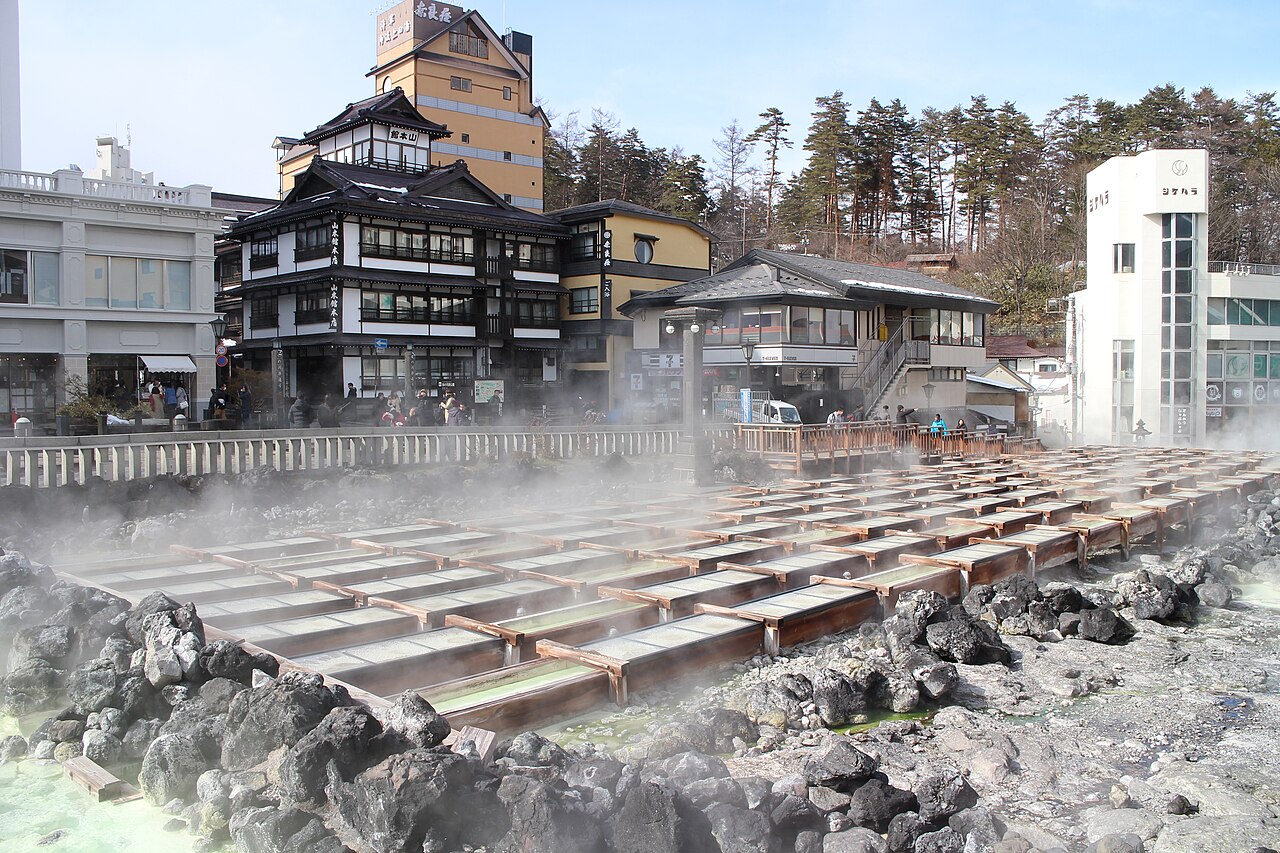
This article covers the way in from the Tokyo side, the Yubatake at the centre of town, the yumomi show at Netsunoyu, and what the bathhouses charge and when they take bathers.
Settle the way in first, then build the rest around the Yubatake, which is the reference point for most of the distances given further down. The numbers you need are kept to two tables, one for the way in and one for the bathhouses, so the text between them remains short.
Getting to Kusatsu Onsen
Two routes from the Tokyo side lead into Kusatsu Onsen, and each row of the table gives one leg with its start and end point.
| Item | Detail |
|---|---|
| The JR Limited Express Kusatsu-Shima, Ueno to Naganohara-Kusatsuguchi Station | About two hours thirty-three minutes |
| The JR Bus, Naganohara-Kusatsuguchi Station to Kusatsu Onsen | Twenty-five minutes |
| The Hokuriku Shinkansen, Tokyo to Karuizawa | About one hour ten minutes |
| Bus, Karuizawa to Kusatsu Onsen | One hour eighteen to fifty-five minutes |
| The Yubatake Sightseeing Parking Lot, regular car for under two hours | Seven hundred yen |
| The One-Coin Bus, one ride in town | One hundred yen |
If you would rather use ordinary trains, the Takasaki Line from Ueno to Takasaki takes about one hour forty-five minutes. From Takasaki, a local train on to Naganohara-Kusatsuguchi Station takes one hour thirty minutes.
The Yubatake: Source, Flumes and Steam
The Yubatake is a five-minute walk from the Kusatsu Onsen bus terminal, and the rest of this article is arranged around it.
According to one travel book, the source at the Yubatake comes up at about fifty-two degrees, and seven wooden flumes down the middle of the field cool the water before it goes out to the inns around it. According to one travel book, four thousand litres of hot water rise from the Yubatake every minute and flow off trailing steam.
The Yubatake Waterfall, Foot Baths and the Evening Light
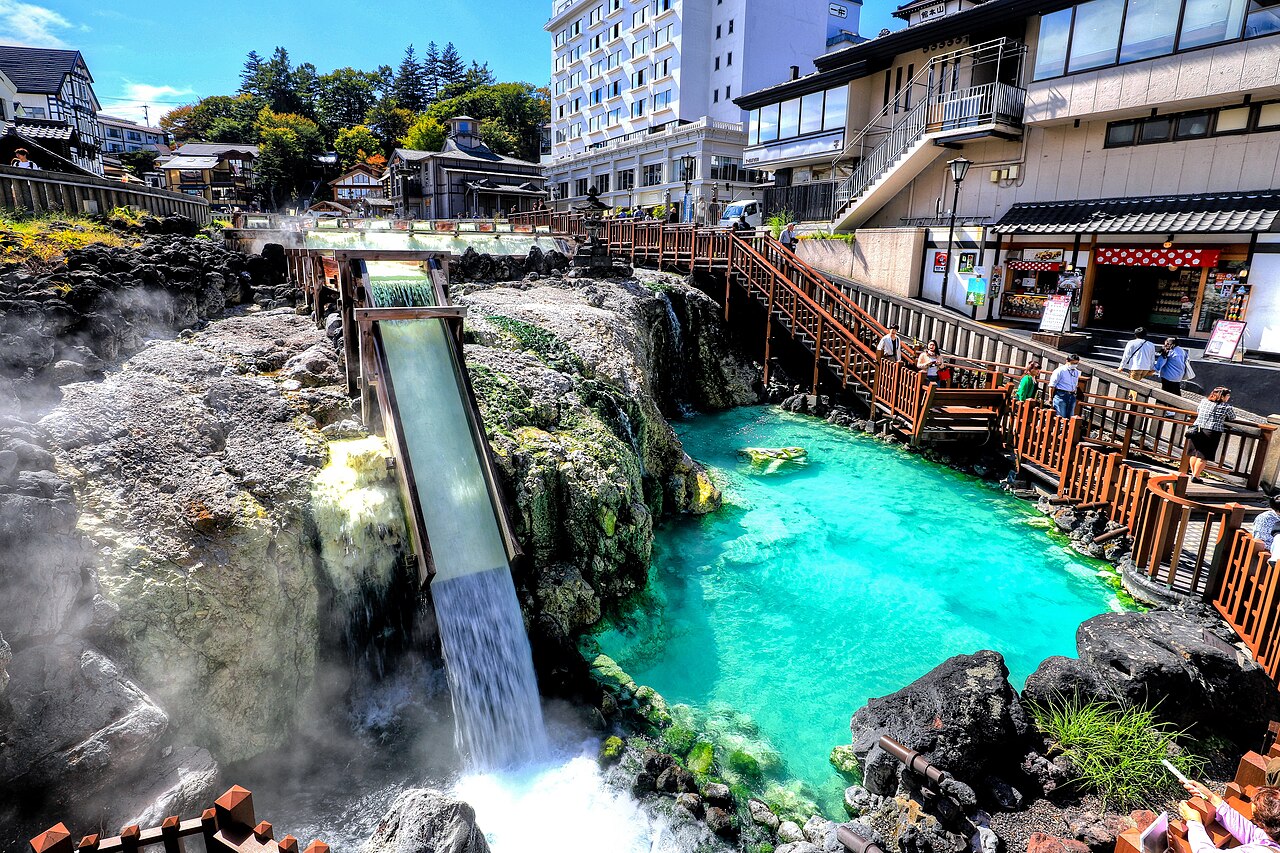
This section takes the Yubatake in three parts, the waterfall, the lights after dark and the foot baths. Guidebooks describe the Yubatake waterfall, where the water comes off the end of the wooden flumes, as emerald green at the surface and as the usual place for a photo once the evening lights are on.
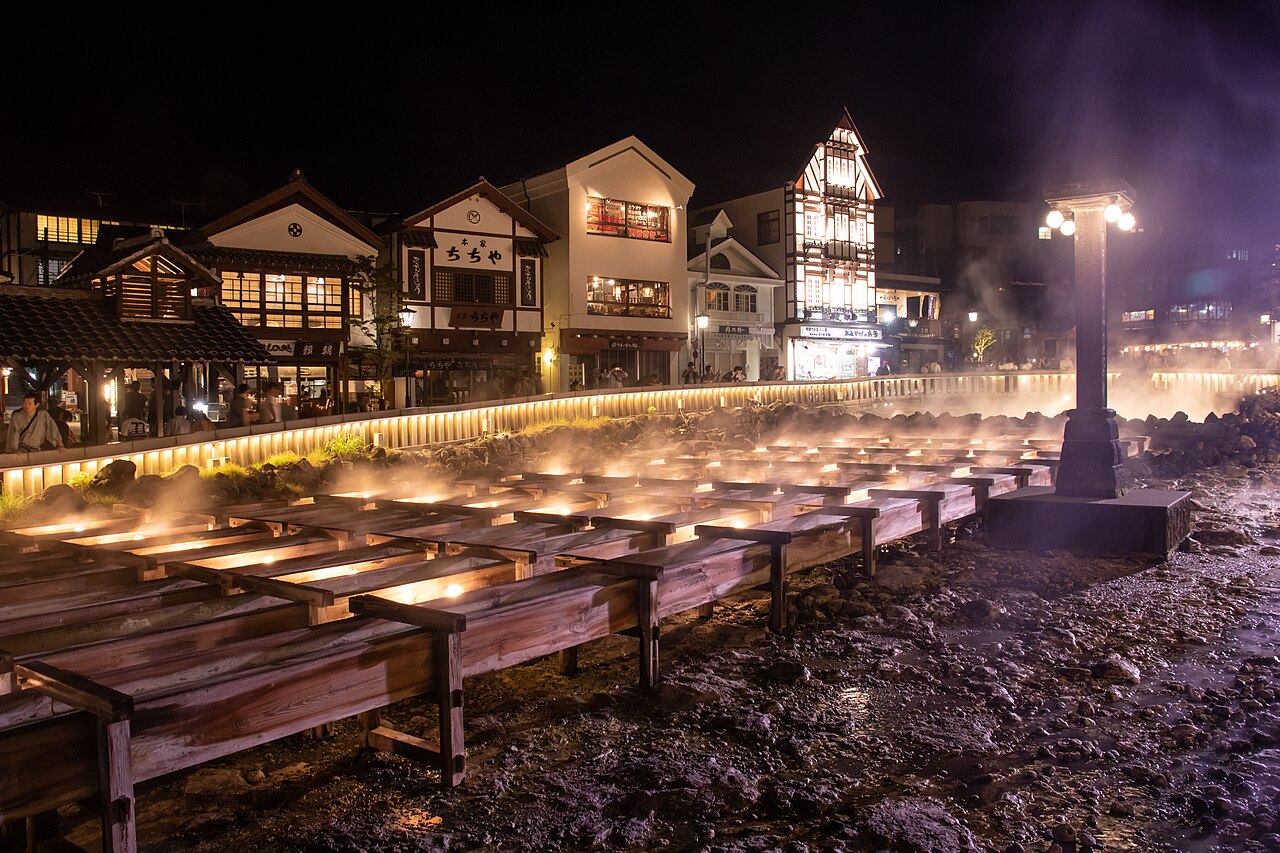
Guidebooks describe the Yubatake after dark as lit up, with the steam that keeps rising off the water becoming part of the night view.
The Yukemuri-tei foot bath at the Yubatake is open around the clock. Guidebooks describe Yukemuri-tei as roofed, so it can be used in the rain, and as free of charge. The foot bath in front of the bus terminal is a five-minute walk from the Yubatake.
Compare options
See partner pricing and availability →
Disclosure: This post may contain affiliate links. If you book through them, we may earn a commission at no extra cost to you.
Yumomi at Netsunoyu
Netsunoyu is a five-minute walk from the Kusatsu Onsen bus terminal. Guidebooks describe the show at Netsunoyu as a re-creation of yumomi, the Kusatsu Onsen way of paddling the bath water that goes back to the Edo period, and the hall also lets visitors try it for themselves.
Adult admission to the Yumomi and Odori show is seven hundred yen, tax included. In the morning the show runs at nine thirty, ten and ten thirty. In the afternoon it runs at three thirty, four and four thirty. Tickets go on sale thirty minutes before each performance, at the ticket office only.
The yumomi experience costs three hundred yen, tax included, for anyone of elementary school age or older. It runs from eleven thirty in the morning to one in the afternoon, with the last reception at twelve fifty. Payment is by cash or PayPay only, and credit cards and other QR payments cannot be used.
Three Bathhouses: Prices and Hours
Sai-no-Kawara Park is about a fifteen-minute walk from the Kusatsu Onsen bus terminal. Gozanoyu adult admission is nine hundred yen. The rest of the figures for the three bathhouses are in the table below.
| Item | Detail |
|---|---|
| The Sai-no-Kawara open-air bath, adult admission | Eight hundred yen |
| Otaki-no-yu, adult admission | One thousand two hundred yen |
| The Sai-no-Kawara open-air bath, April first to November thirtieth | Seven in the morning to eight in the evening, last entry seven thirty in the evening |
| The Sai-no-Kawara open-air bath, December first to March thirty-first | Nine in the morning to eight in the evening, last entry seven thirty in the evening |
| Otaki-no-yu, hours | Nine in the morning to nine in the evening, last entry eight in the evening |
Communal Baths near the Yubatake
According to one travel book, Shirahata-no-yu, Chiyo-no-yu and Jizo-no-yu are the three communal bathhouses in Kusatsu Onsen that visitors can use without paying. Shirahata-no-yu is open from eight in the morning to eleven in the evening.
Chiyo-no-yu is open from six in the morning to eleven in the evening. From the Yubatake, Chiyo-no-yu is a two-minute walk. Jizo-no-yu is open from eight in the morning to ten in the evening. From the Yubatake, Jizo-no-yu is a three-minute walk.
Yoritomo-gu, by the Shirahata spring, is a five-minute walk from the Kusatsu Onsen bus terminal.
If you want to add something to the day beyond the baths, take a look at options around Kusatsu Onsen.