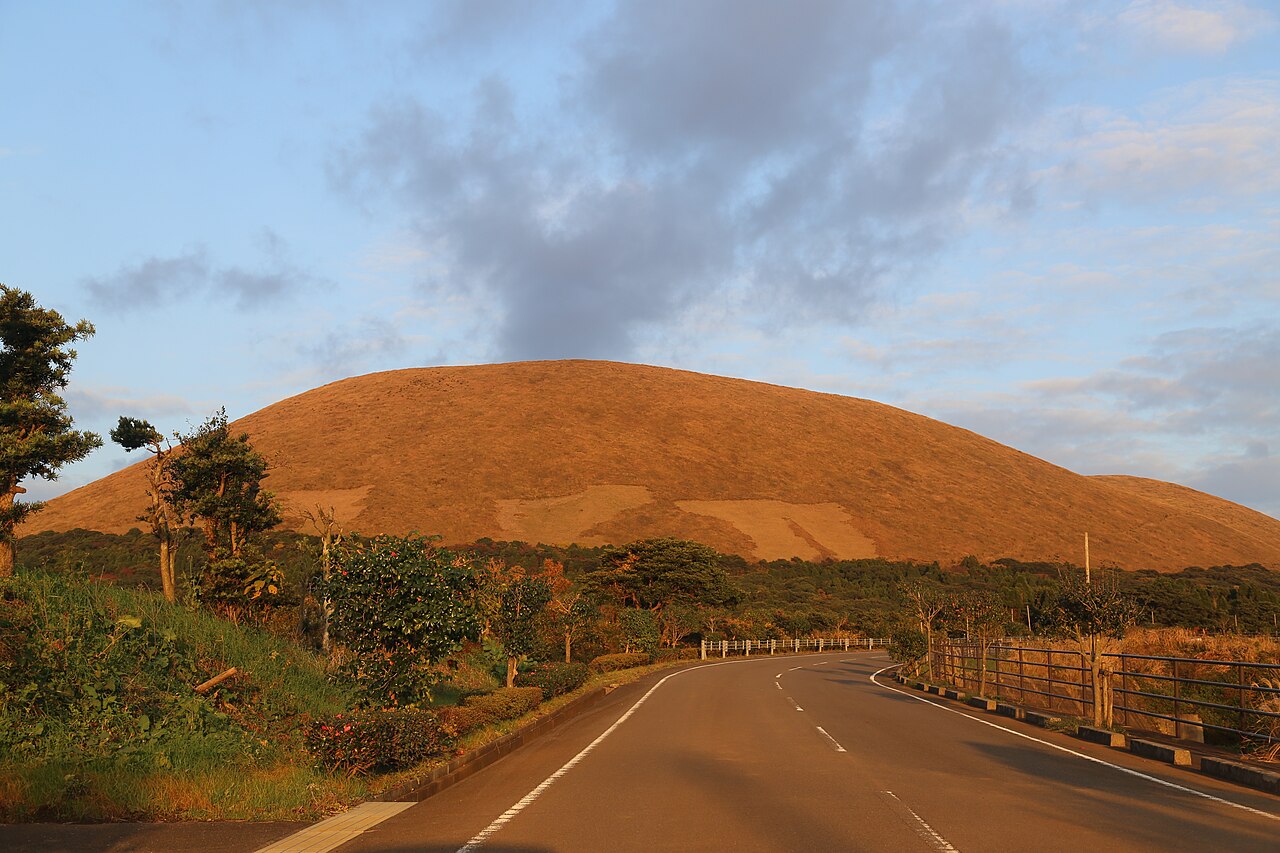
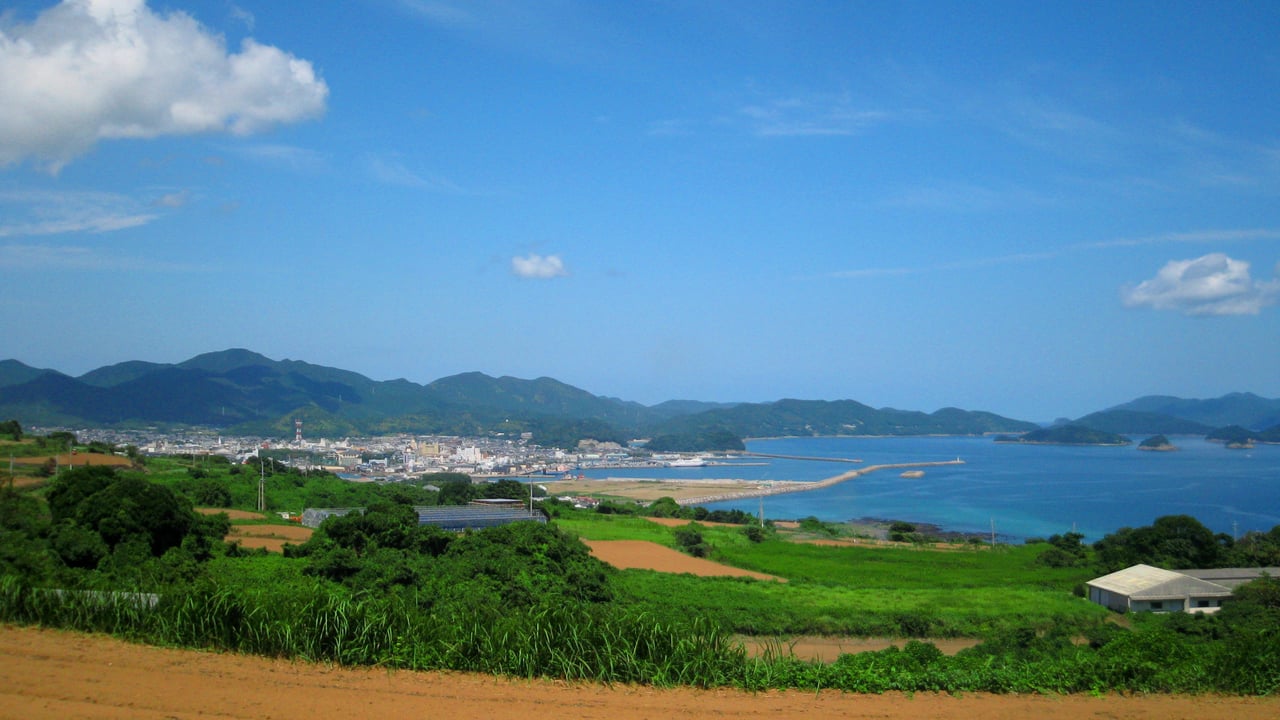
Far out in the East China Sea, at the western end of the Gotō chain, Fukue is where Nagasaki's island world gathers into a town. A boat carries you from the mainland to a harbour with a stone fort beside it, lanes of dark volcanic walls behind that, and a grass-covered volcano keeping watch over the whole arrangement. Nothing here asks to be rushed: the old quarter stands within a walk of the ferry terminal, the crowds are thin, and the day shapes itself around sailings, tides and the light on the water.
Why Fukue stays quiet
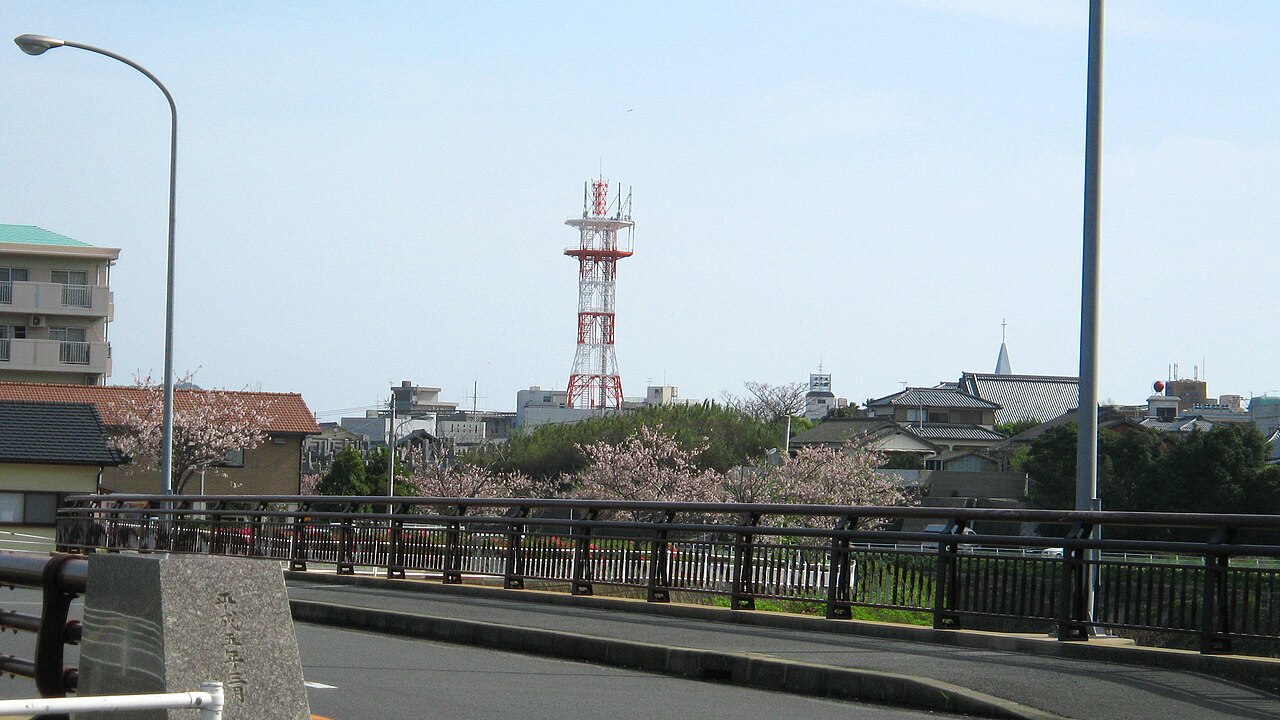
Distance does the filtering. Most travel through Japan never reaches this far west, and those who make the crossing tend to spread out across the whole island chain, so the castle town itself keeps an unhurried temper. What remains is a working harbour town that happens to hold its history close together: a moated fort by the sea, a merchant quarter that once traded with the continent, and samurai lanes whose walls were built from the island's own volcanic stone. You walk it in an afternoon, and the town lets you.
Getting there
Fukue is the main doorway to the Gotō islands, and both the sea and the air routes land you within easy reach of the old quarter.
- The jetfoil from Nagasaki reaches Fukue in about 1 hour and 25 minutes.
- The slower ferry from Nagasaki takes about 3 hours and 10 minutes.
- The long boat from Hakata port in Fukuoka takes about 8 hours and 30 minutes.
- Flights from Nagasaki airport reach Gotō Tsubaki airport in about 30 minutes.
- From Fukuoka airport, the flight is about 40 minutes.
- The ferry terminal building keeps long opening times, from about 6:30 to 20:30.
New to rural buses and one-man trains? See how to ride them, step by step.
A walk from the ferry terminal
The harbour quarter is compact enough that a whole afternoon of it unfolds on foot, one short leg at a time.
- Jōtōbana, the stone point that once served the harbour as breakwater and beacon, is described as standing about 5 minutes on foot from the port.
- The Meijindō hall and the hexagonal well of the old Chinese quarter are described as about 15 minutes on foot from the port.
- The Gotō tourism and history museum is about a 7 minute walk from the port.
- From the museum, the walls of Ishida castle stand about 8 minutes onward.
- The Gotō clan garden at the Hidden Residence, with its pond traced in the shape of the character for heart, is about 5 minutes further.
- Through the samurai lanes, the Furusato-kan visitor hall lies about 7 minutes beyond.
Where to stay
Disclosure: This post may contain affiliate links. If you book through them, we may earn a commission at no extra cost to you.
What the guidebook describes
The castle by the harbour is described as the last one built in Japan — raised as a defence against the black ships that had begun to appear off these coasts, and taken down again nine years after it was finished. The Meijindō, a small hall in the lanes east of the port, honours the Ming trader Wang Zhi, and the quarter around it was once the town of the Chinese merchants; the hexagonal well nearby is lined with flat stones set in a six-sided continental fashion. Jōtōbana, out on the water, was built to do two jobs at once, breaking the swell and carrying a light for boats coming into harbour. And in the samurai quarter, the lanes run between walls piled from blocks of lava stone, a century and more of island housekeeping written in dark rock.
Opening times and admission
- From June to September, the history museum receives visitors from 9:00 to 18:00, with final entry at 17:30.
- From October to May, its day runs from 9:00 to 17:00, with final entry at 16:30.
- It takes a New Year pause from December 29 to January 3.
- Adult admission to the history museum is 300 yen, or 240 yen for groups.
- Elementary, junior high and high school students pay 100 yen, or 80 yen in groups.
- A combined ticket with the Yamamoto Nizō art museum is 500 yen.
- The Yamamoto Nizō art museum receives visitors from 9:00 to 18:00.
- The Hidden Residence garden can be seen from 9:00 to 17:00.
- The Furusato-kan in the samurai quarter runs from 8:30 to 17:00, and until 18:00 in July and August.
- Its tearoom serves from 11:00 to 16:00.
Mount Onidake
The volcano on the town's shoulder is the island's gentlest landmark: a bowl-shaped dome covered in grass, with a crater that breaks toward the north. A walking route is described as reaching close to the summit, and the whole hill turns gold in the late light — the view many islanders would name first.
- The Onidake Shiki-no-Sato visitor lodge at the foot of the volcano receives visitors from 9:00 to 17:00.
- Elsewhere on the island, the foot bath at Arakawa hot spring runs from 9:00 to 17:00.
When it fills up
Even a far island has its seasons. Takahama, the celebrated beach on the western coast, is described as busiest in summer. In the weeks from late September into late October, the cape park at Gyōgasaki is described as filling with some three million cosmos flowers, and the local cars follow. Dondon-buchi, the waterfall pool in the island's interior, is said to draw families on summer weekends. The castle town itself belongs to none of these rhythms: its lanes stay calm while the beaches take the crowds.
Before you go
- The old quarter rewards the early light, when the lanes are empty and the walls hold their colour.
- Carry cash for the small admission counters; the museums and gardens are modest, staffed places.
- Sailing and flight timetables shift with the seasons, so it is worth checking the current one before you travel.
- The samurai lanes pass working homes: look, photograph gently, and leave gates and gardens to their owners.
Book an arranged day around Nagasaki and the Gotō islands
If you would rather have the crossings and the timings handled for you, you can compare tours and activities around Nagasaki, the usual gateway to the islands, and build the boat trip into a larger arranged journey.
Compare Nagasaki and Gotō island tours
Disclosure: This site may earn a commission if you book through the link above, at no extra cost to you.