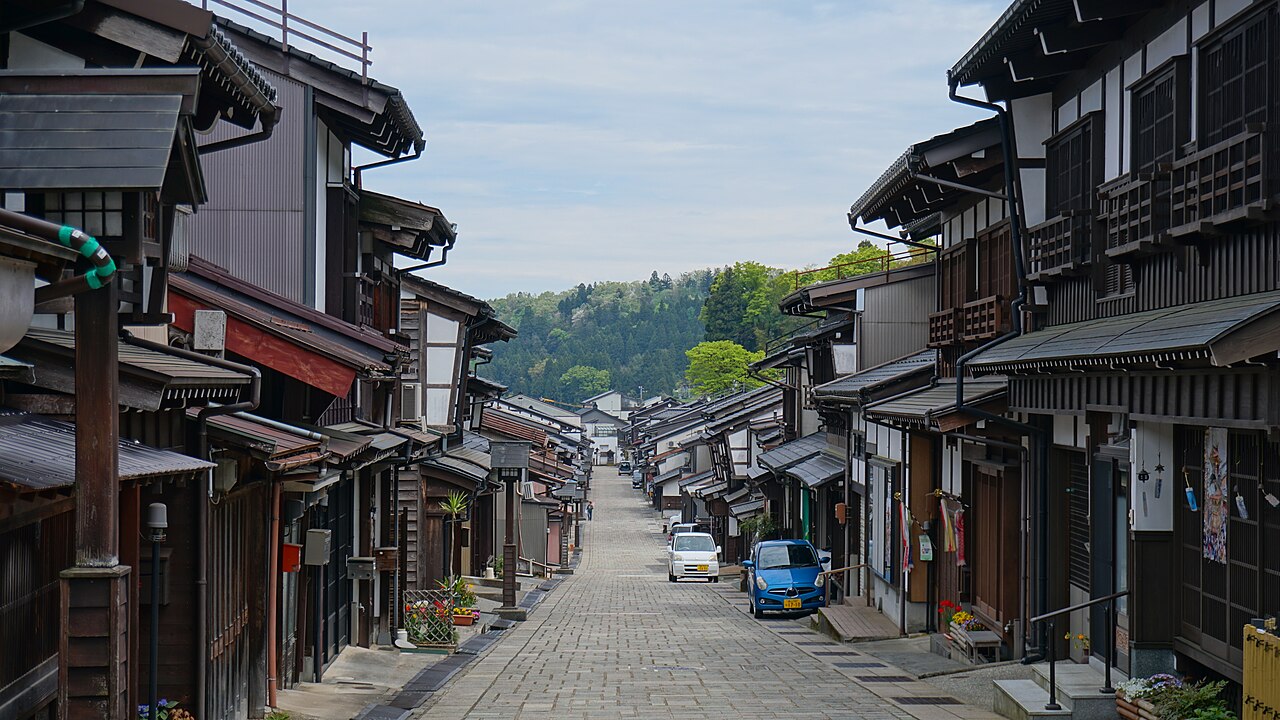
Yatsuo is a hillside town where stone-paved roads slope past rows of townhouses. Its Owara Kaze-no-Bon is a traditional festival with about three hundred years of history. After a dusk that turns the mountains red, bonbori lanterns lined along the houses glow with a pale light. For a base in the city, see places to stay in Toyama.
The Owara Songs: Shamisen, Kokyu and Voice
The festival is held from the first to the third of September. No clear document survives to show when the Owara began, so its start is uncertain; according to a local gazetteer, it began when townspeople celebrating the recovery of a charter granted by the Kaga domain paraded through town for three days and nights with song, dance and music.
The accompaniment is a singer, the hayashi, shamisen, drum and the kokyu fiddle. The shamisen plays the opening phrase and the kokyu follows; a light stroke of the drum lifts the tempo, and the hayashi invites the song. The voice enters high, its phrases undulating without a breath, song answering instruments and instruments answering song.
A tune completely different from the song's melody is said to be rare in folk songs. Dancers in matching yukata and happi coats show a little of their faces beneath woven sedge hats as they sing and dance through the streets; behind them, people drawn by the sorrowful tones follow one after another as orange lights appear in the darkness.
Dancing Through Eleven Neighbourhoods
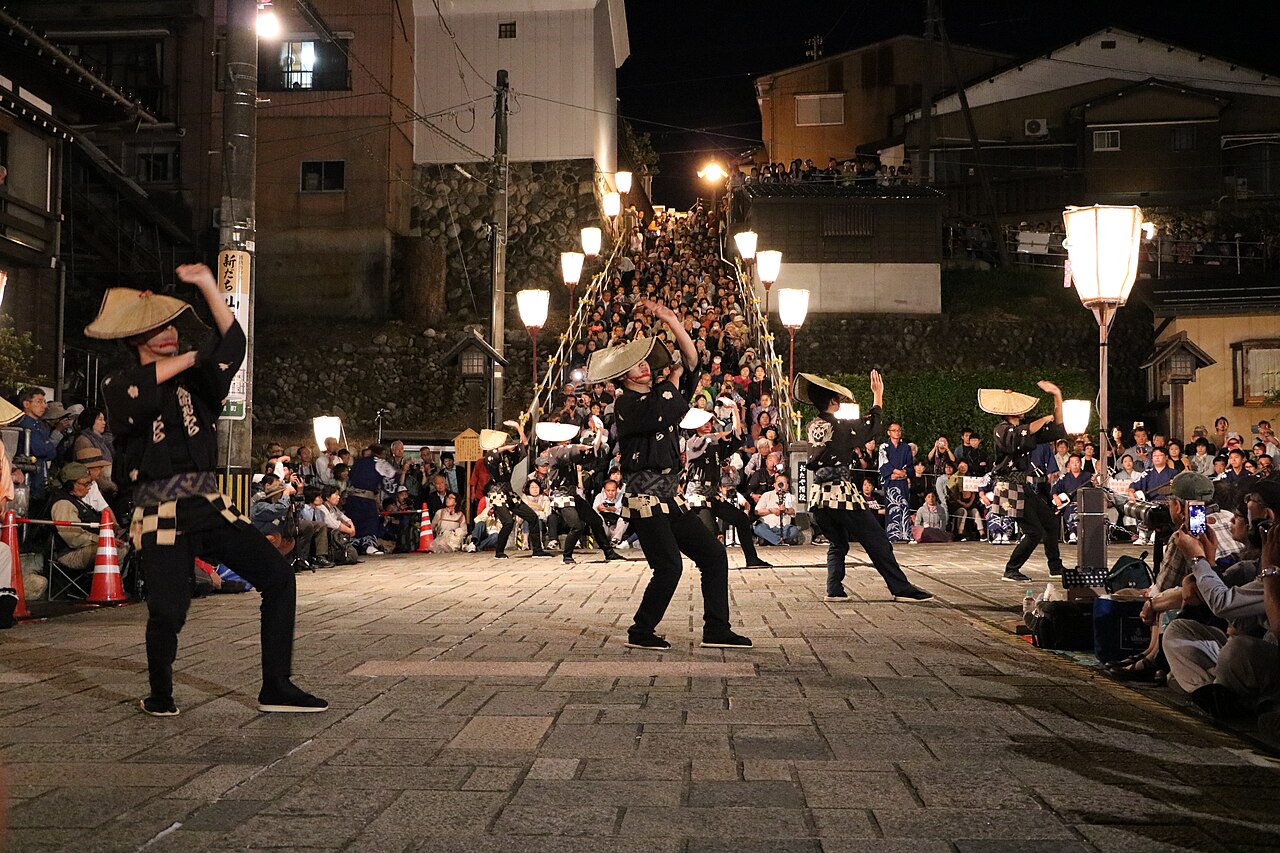
Three kinds of Owara are danced: the old dance, the men's dance and the women's dance. The old dance is a long-danced piece that expresses farm work such as sowing seeds and harvesting rice with turns of the hands and fingertips.
The Owara Kaze-no-Bon is danced in the eleven neighbourhoods of the old town, and steps, yukata colours and patterns, and lyrics differ by neighbourhood. In one, girls dance in special costumes and the Owara is performed in the precinct of a shrine that enshrines silkworms; another sings in a lowered pitch, with a call inserted midway through the song.
In one more, visitors may join the big circle dance that starts at ten at night. In late August, before the festival and after the Obon holiday, residents set up lanterns and the whole town becomes a scene of lanterns until the event ends.
The festival area is the residents' living space, and the executive committee asks visitors to respect it and keep good manners: the event takes place on slopes in the quiet of night, so bring a light for your feet, take care over the footing, and do not overuse your smartphone or shout.
A Hillside Town of Stone Streets
Yatsuo's townscape is wooden townhouses and stone-paved streets without overhead wires; the stone-paved street was selected as one of Japan's hundred roads. In the centre, wooden houses of matching colours and shapes line the street, and the streetscape stays clean because the electric wires run behind the houses.
Walking up the gentle slope and looking back, the view opens out like a scene from an old tale. The stone-paved alleys let you look into shops selling washi paper and sundries, cafes, Japanese sweet shops and the town's two sake breweries, whose sake is made with clear water and a climate of large temperature differences.
In one of the neighbourhoods, storehouse-style houses, sake breweries and lattice-doored inns remain. In the seasons without the Owara dance, Yatsuo is a town where a lingering sense of music hangs in the air.
Hikiyama: Two-Storey Floats With Puppets
The Yatsuo hikiyama is said to have begun when Kami-shinmachi built a hanayama for the Hachiman shrine festival and paraded a figure of Ariwara no Narihira. Its float carries Narihira and a female attendant as deity figures, and the Narihira doll, once a hina doll of the Maeda family, is older than the float.
The floats are two-storey stages with puppets: awnings bearing each neighbourhood's crest stretch across the four pillars of the upper level, where a deity puppet is enshrined. Metal fittings called yoraku hang at the roof's four corners and make a pleasant sound as the float moves.
The many carvings are all brightly coloured, and one carving on the Kami-shinmachi float depicts the legend of the dragon god presenting the tide-ebbing and tide-flowing jewels to Takeuchi no Sukune.
At the Hikiyama Exhibition Hall, three two-storey floats, seven and a half metres high and about four tonnes in weight, are on permanent view together with the sound of the float music.
The Owara Museum and the Silk-and-Paper Past
The Yatsuo Owara Museum recreates a traditional machiya townhouse, with lattice doors and an earthen-floor entrance, in a building of Japanese tile roofing and plaster finish, and a large screen inside shows video of the Owara circle dance.
The museum exhibits records of exchanges with many writers and artists, a painter and a poet among them, centred on the founding president of the society that preserves the Owara.
In the Edo period, Yatsuo prospered as a collecting and trading centre for mountain products such as silkworm eggs, raw silk, washi paper and charcoal. In the Meiji era, silk-reeling was especially active, and silkworm eggs, washi and persimmons counted among the main products.
Getting to Etchu-Yatsuo from Toyama Station
New to rural buses and one-man trains? See how to ride them, step by step.
| From | How | Time |
|---|---|---|
| Toyama Station to Etchu-Yatsuo Station | JR Takayama Line | about twenty-five minutes |
| Etchu-Yatsuo Station to the Hikiyama Tenjikan-mae stop | Toyama City community bus Yatsuo Loop Line (counterclockwise) | about eight minutes |
| Etchu-Yatsuo Station to the centre of the old town | walk | about thirty minutes |
| Etchu-Yatsuo Station to the Yatsuo Owara Museum | walk | about thirty minutes |
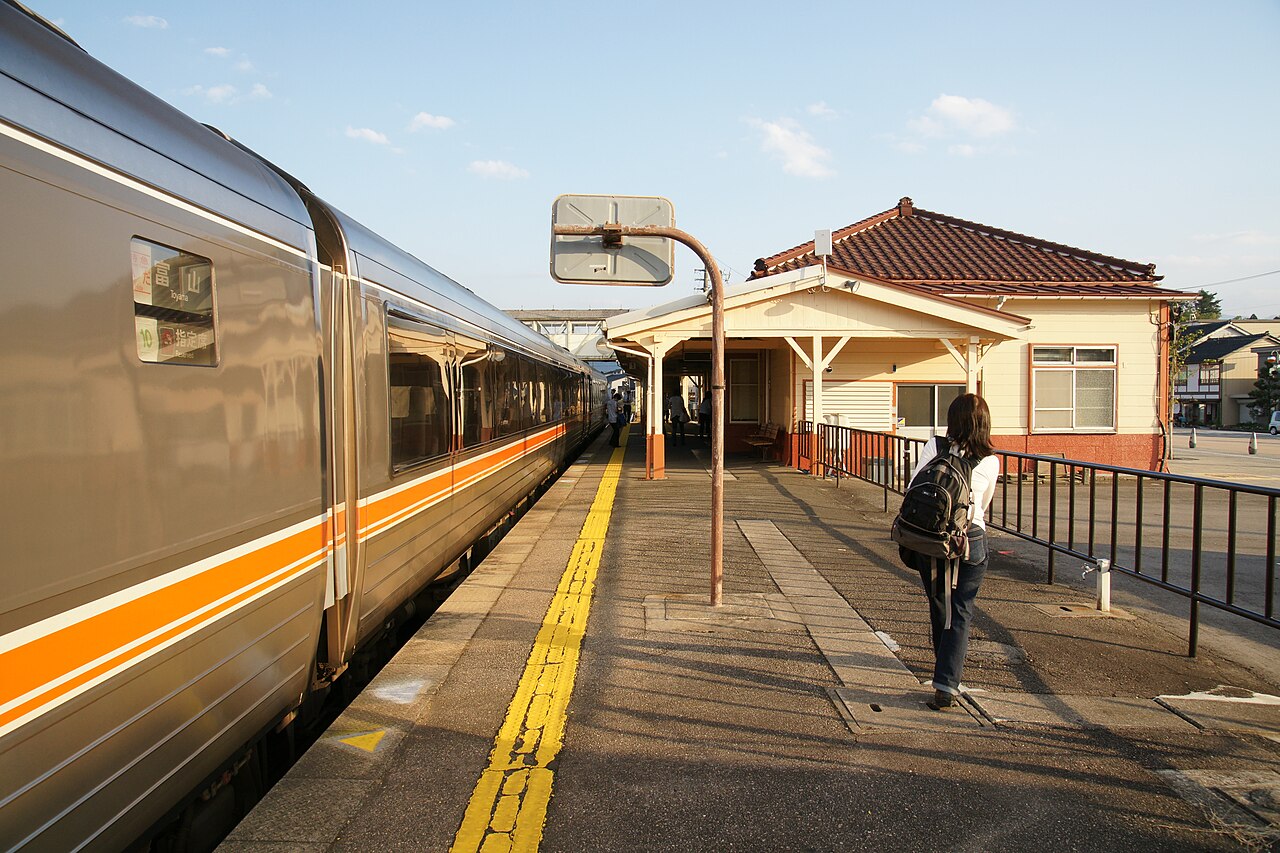
From Toyama Station the JR Takayama Line reaches Etchu-Yatsuo Station, where the loop bus and the walk into the old town begin.
Hours and Fees
| What | Hours or fee |
|---|---|
| Hikiyama Exhibition Hall | nine in the morning to five in the afternoon, admission until half past four in the afternoon |
| Hikiyama Exhibition Hall admission | adults five hundred yen, children (high school students and under) three hundred yen |
| Hikiyama Exhibition Hall closed days | the year-end and New Year period, from the twenty-ninth of December to the third of January |
| Yatsuo Owara Museum | nine in the morning to five in the afternoon, admission until half past four in the afternoon |
| Yatsuo Owara Museum payment | cash only, cashless payment not accepted |
| Paper museum | ten in the morning to five in the afternoon, last entry at half past four in the afternoon |
| Paper-making experience, reserve ahead | seven hundred and seventy yen |
Fees and hours were checked against official sources between 7 October 2026 and 11 November 2026.
Both halls keep the same hours, the Owara museum takes cash only, and paper-making needs booking ahead.
If you want to stay in the city the night before or after, see places to stay in Toyama.
Thinking of staying overnight?
Compare places to stay near Toyama, Toyama →
Disclosure: This post may contain affiliate links. If you book through them, we may earn a commission at no extra cost to you.