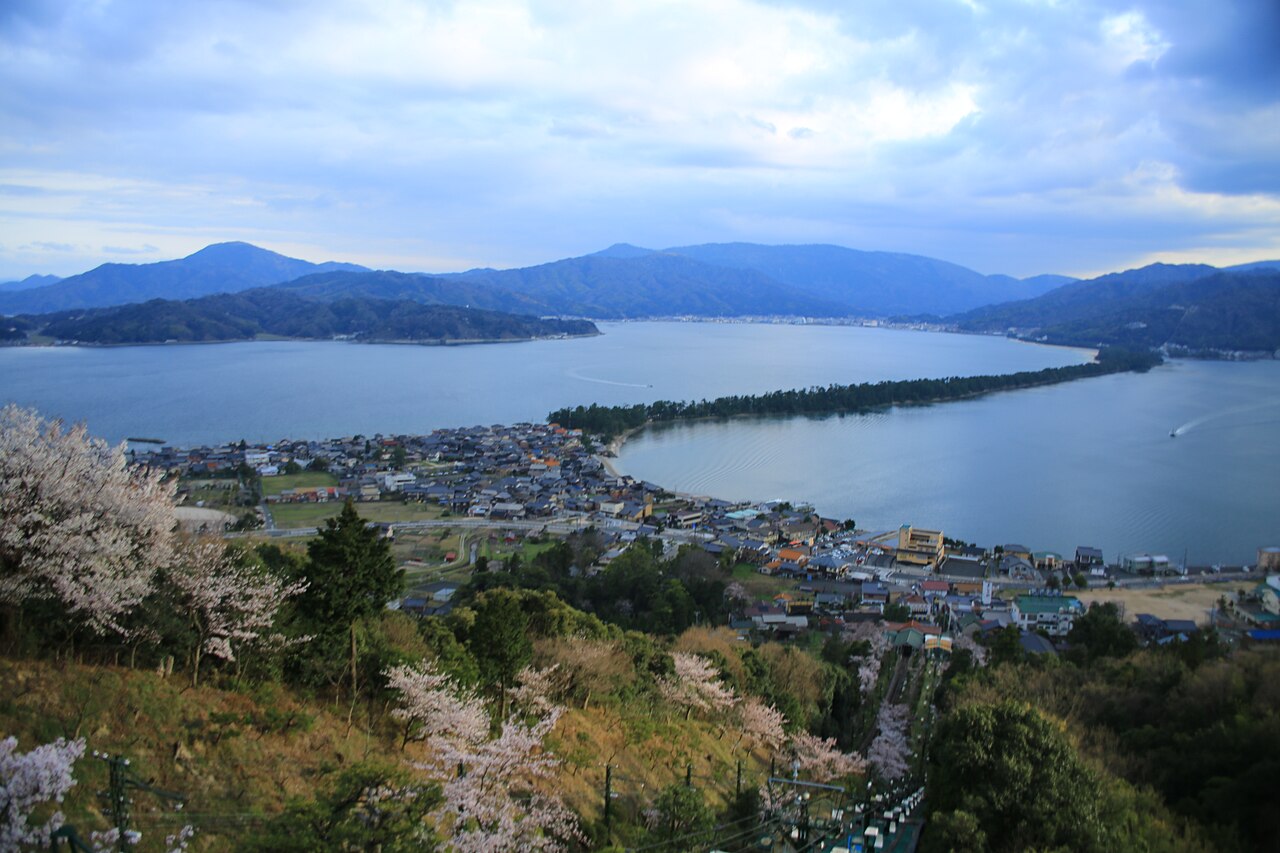
Amanohashidate is a long bar of sand and pines reaching across Miyazu Bay in Kyoto Prefecture. A day here means crossing the sandbar by boat or on foot, riding up to a hilltop park for the view, and fitting the temple and shrine visits around their closing times. Below are fares, times, places to eat, and tours around Amanohashidate.
The sandbar and its pines
Guidebooks describe Amanohashidate as one of the Three Views of Japan: a sandbar in Miyazu Bay, designated a Special Place of Scenic Beauty, with about five thousand pines along it. From the hills on either side it reads as one green stroke across the water, and a day here is built around getting onto it and then above it.
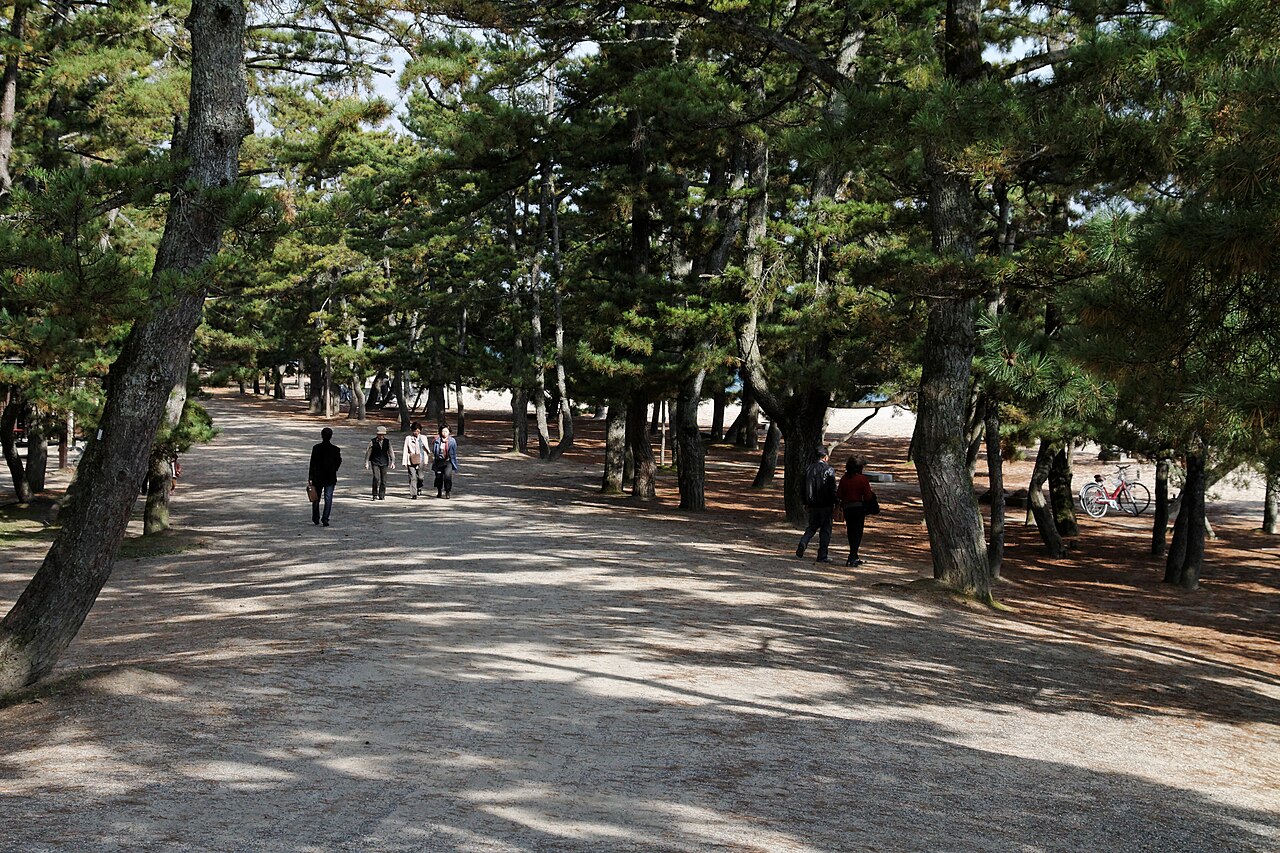
Guidebooks describe the grove as a mix of old pines and young ones growing side by side, and they say that from a boat the trees appear reflected in the water as if a second grove were growing beneath the surface. On foot you pass through the same grove at ground level, with the bay close on both sides.
The photograph above shows what that walk looks like from inside: a wide sandy path beneath tall pines, broad enough for people to spread out rather than file along it. The sandbar is long, so the crossing is a real piece of the day, and the next section sets the walk against the boat.
Walking the sandbar: shrine, spring and shore
There are two ways across. The sightseeing boat makes the crossing in twelve minutes, while the same stretch on foot takes about an hour. Doing one each way lets you see the pines from the water and then from beneath them, and the fares for every leg are listed in the final section of this page.
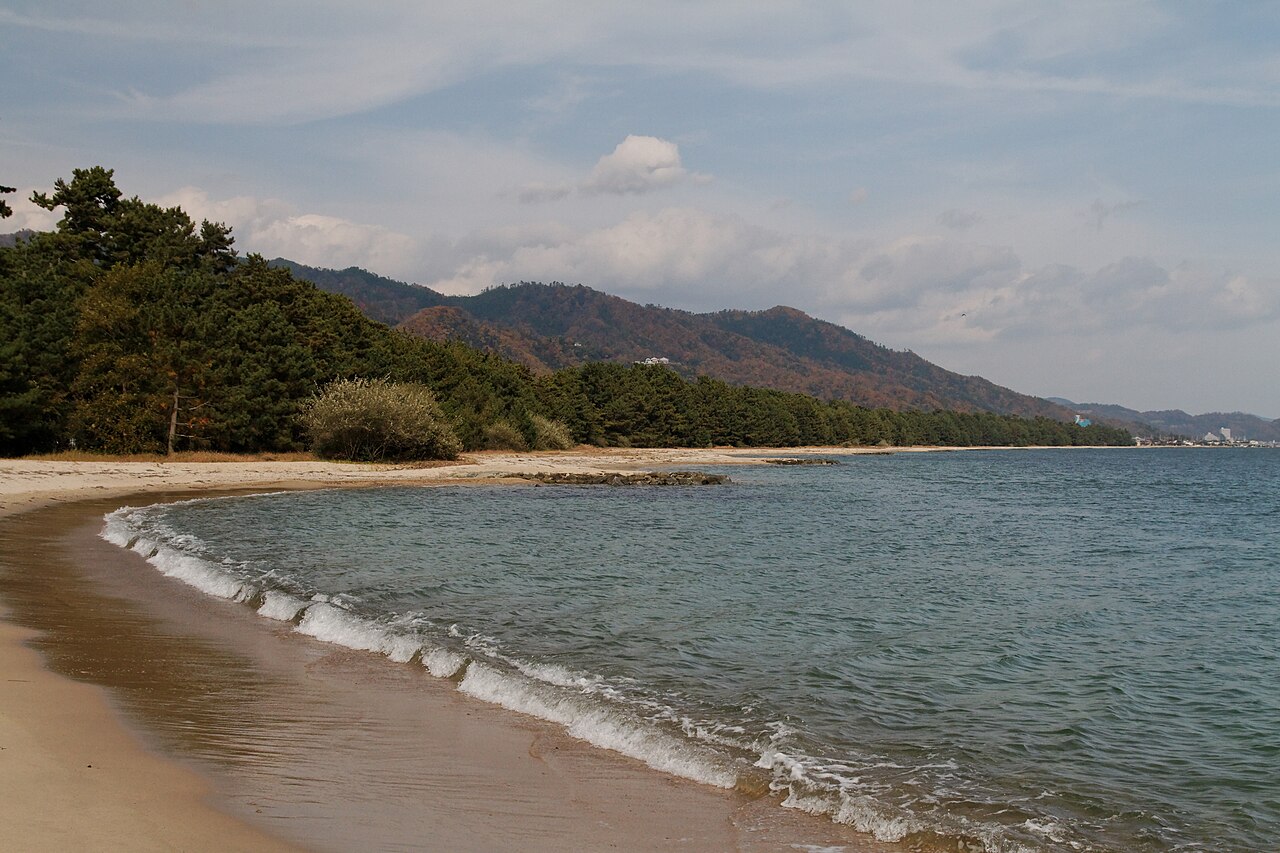
Partway along, Amanohashidate Shrine is described in guidebooks as the site of the sandbar's dragon legend, enshrining the Eight Great Dragon Kings. Beside it, a spring called Isoshimizu is described as giving fresh water even though the sea lies on both sides, and that water is used for the shrine's hand-washing basin.
Isoshimizu is described as one of Japan's hundred selected famous waters, though the same sources note that it is not for drinking, so treat it as something to look at rather than fill a bottle from. The photograph above shows the shore side of the sandbar, where a strip of sand and small waves run beside the pines.
Chion-ji and the sweets at its gate
At the southern tip of the sandbar, Chion-ji is described as one of the Three Monju of Japan, drawing many visitors who pray for success in study and entrance examinations. The swing bridge onto the sandbar is described as linking it with the temple's Monju-do hall, so for anyone arriving by rail the temple is the first stop.
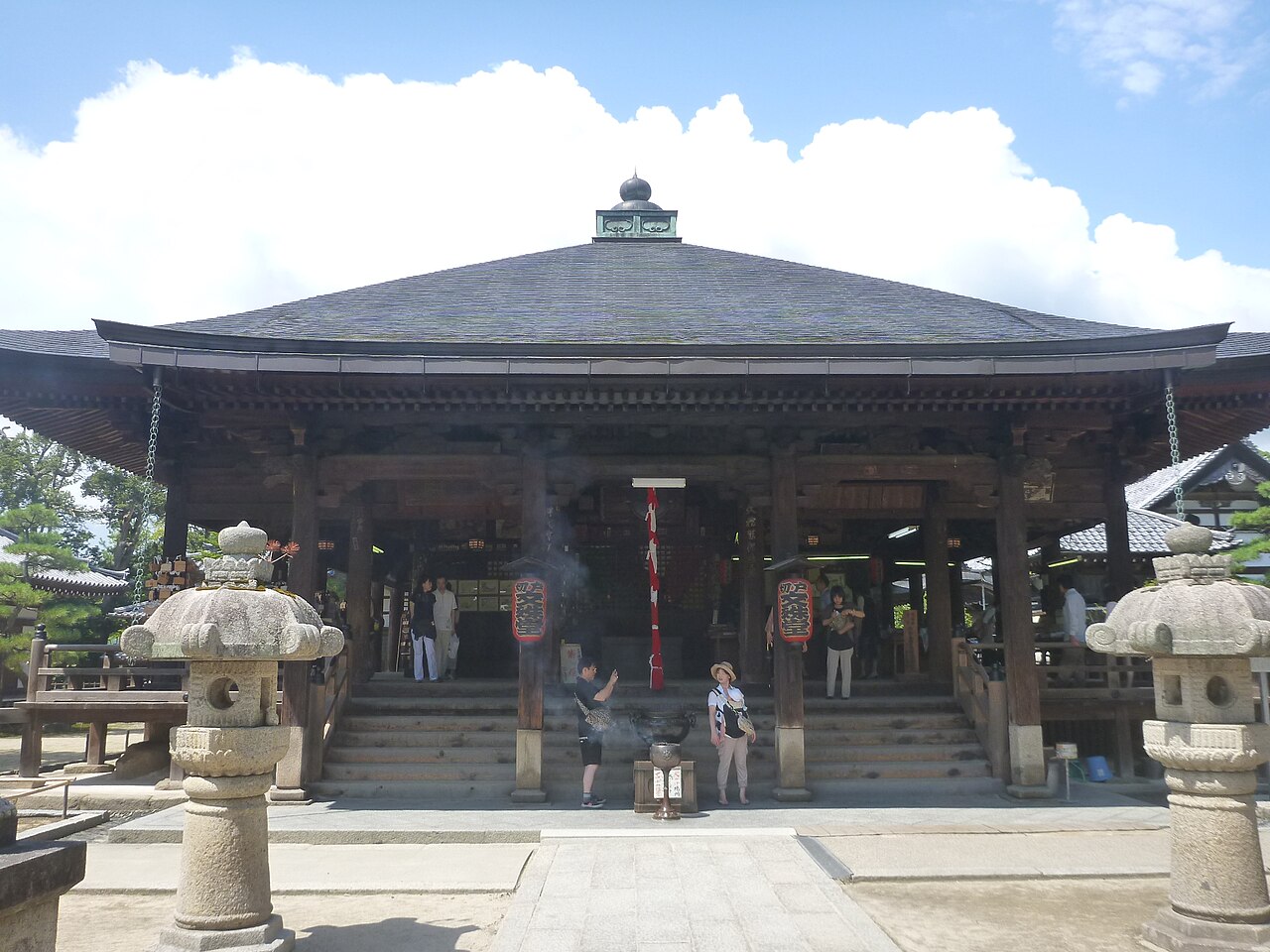
Its Tahoto pagoda is described as a Muromachi-period structure designated an Important Cultural Property, and its main gate, the Ogonkaku, as the largest in the Tango region. The photograph above shows the Monju-do hall itself, with stone lanterns in front and visitors on the steps, which gives a fair sense of the scale of the place.
Chie no Mochi, the sweet of the temple gate, is described as taking its name from the proverb that three heads together make the wisdom of Monju, and only four teahouses in front of the gate are said to make it. Matsuya Honten lists black chikuwa, a dark fish-paste tube, and roasted chestnuts; the prices are below.
| Item | Yen |
|---|---|
| Chie no Mochi at Bunjuso Kanpichi Chaya | 450 yen |
| Kuro-chikuwa, black fish-paste tube, at Matsuya Honten | 350 yen |
| Roasted chestnuts, yaki-kuri, at Matsuya | 600 yen |
Kasamatsu Park and Nariai-ji above the bay
Kasamatsu Park is described as a viewing park on high ground, and from there the sandbar is said to look like a dragon climbing into the sky, a view known as Shoryukan. It is the view in the photograph at the top of this page; the cable car and lift up to it are priced in the final section.
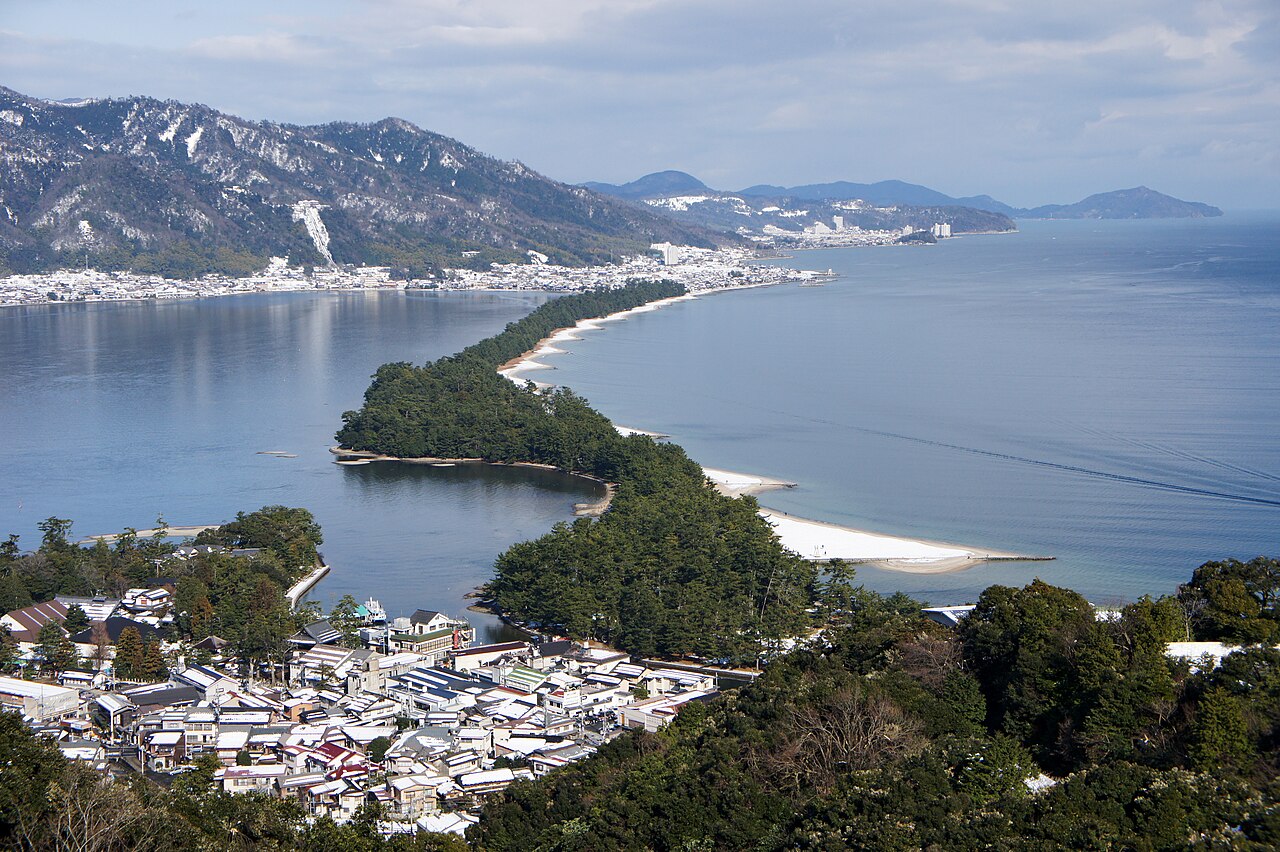
The same park is described as the birthplace of matanozoki, the custom of bending forward and viewing the sandbar upside down between your legs, so that it is said to look like a bridge arching up into the heavens. The photograph above shows the sandbar from the hilltop on the Monju side instead, for comparison.
Higher still, Nariai-ji is described as the twenty-eighth temple on the Saigoku pilgrimage of thirty-three temples, a mountain temple reached by taking the cable car and then a further ride uphill, with a panoramic lookout above that is said to take in the whole sandbar. The round-trip fare for that ride, temple entry included, is in the table below.
According to local lore, the view of Hashidate is on Mount Nariai, and a spot near Kasamatsu along the temple approach is described in guidebooks as the finest viewpoint, where the sandbar stretches lengthwise below you and merges into the sea of Yosa. Visitors who left without climbing are said to have missed the best of it.
Where to stay
Places to stay near Miyazu, Kyoto, Japan →
Disclosure: This post may contain affiliate links. If you book through them, we may earn a commission at no extra cost to you.
Kono Shrine and Manai Shrine
Kono Shrine is said to be called Moto-Ise, the original Ise, because Amaterasu and Toyouke, the deities enshrined at Ise, are held by tradition to have resided here before moving there. Its gate closes in the late afternoon, which matters if you spend midday up at Kasamatsu; the times are in the final section.
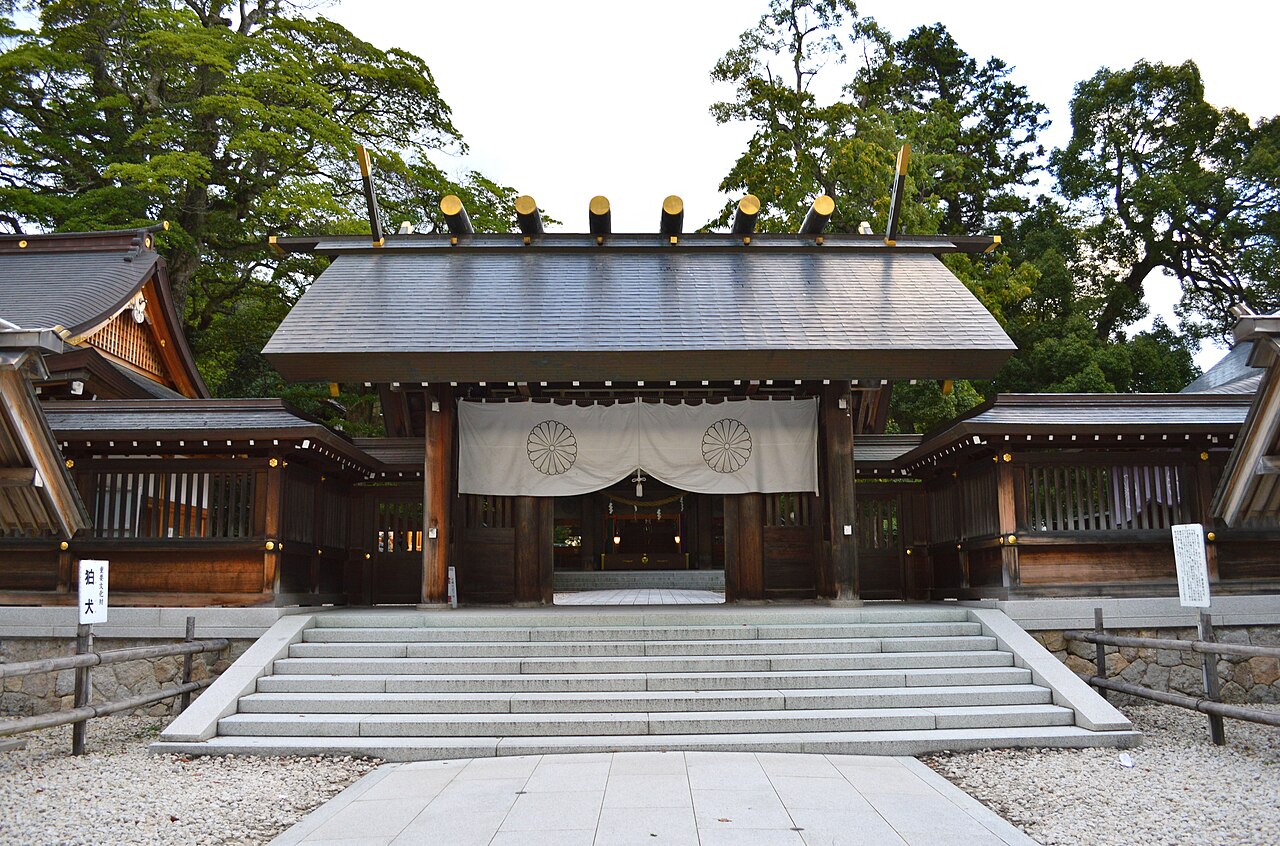
Manai Shrine's grounds are said to hold an iwakura, a rock where the gods are said to have descended, together with a spring that is described as still flowing there. The photograph above shows Kono Shrine's Shinmon gate and the shrine buildings, with a gravel forecourt in front.
If you come by car, Kono Shrine's conservation cooperation fee for parking a passenger car is eight hundred yen per vehicle for the whole day. The gate closing time differs between the warmer months and midwinter, and the shrine office and amulet counter keep their own opening time, so check the final section before deciding when to arrive.
Getting there, costs and where to stay
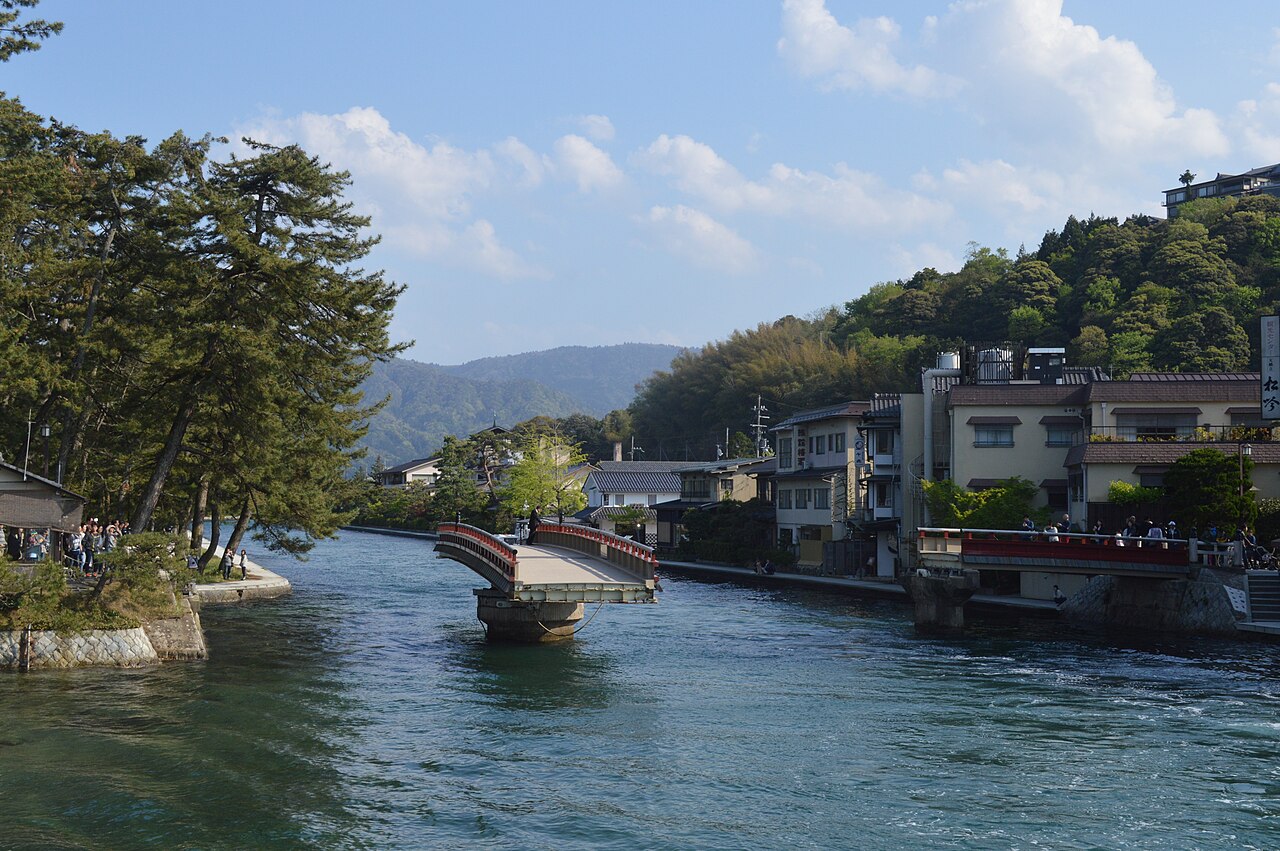
Guidebooks describe the swing bridge, which links Monju-do with the sandbar, as turning ninety degrees under electric power whenever a sightseeing boat passes, up to around fifty times on a busy day. The photograph below shows the red bridge turned aside, with pine-covered banks on either side; the numbered steps that follow give each leg with its fare.
- From Miyazu Pier to Amanohashidate Pier, the sightseeing boat is 600 yen one way for adults and 300 yen for children.
- From the railway stop at Amanohashidate, the swing bridge is described in guidebooks as about 5 minutes on foot, once turned by hand and since converted to electric power.
- To cross the sandbar itself, the sightseeing boat takes 12 minutes, while walking the whole length takes about 1 hour.
- Between Amanohashidate Pier and Ichinomiya Pier, the boat is 800 yen one way for adults and 400 yen for children. A round trip on the same stretch is 1,300 yen for adults and 650 yen for children.
- Up to Kasamatsu Park, the cable car and lift are 800 yen round trip for adults and 400 yen round trip for children. A one-way ride is 400 yen for adults.
- On Tango Kairiku Kotsu route buses using the area-fare system, the fare is capped at 200 yen for a ride within one area, however far you go. A section spanning two areas is capped at 400 yen.
| Other costs | Yen |
|---|---|
| Nariai-ji climbing bus, round trip including temple entry | 1,120 yen for adults (high school and older), 720 yen for junior high school students, 360 yen for elementary school students and younger |
| Kono Shrine conservation cooperation fee, passenger car, whole day | 800 yen per vehicle |
| Asari Tappuri Don, the recommended clam rice bowl at Kasamatsu no Sato | 1,200 yen including tax |
| Asari udon or asari soba at Kasamatsu no Sato | 900 yen including tax |
| Rental bicycle at Kasamatsu no Sato | 500 yen for 2 hours per bicycle |
| Place | Times |
|---|---|
| Kasamatsu Park | 9:00 to 18:00, varies by season |
| Nariai-ji Temple visiting | 8:00 to 16:30 |
| Kono Shrine gate, February to November | closes 17:00 |
| Kono Shrine gate, December to January | closes 16:30 |
| Kono Shrine office and amulet counter | from 8:30 until closing |
| Kasamatsu no Sato | 10:30 to 16:00, last order 15:00, no need to reserve |
Kasamatsu no Sato lists clam dishes, with a recommended Asari Tappuri Don, a clam rice bowl, alongside asari udon and asari soba. It also rents bicycles for two hours at a time. There is no need to reserve ahead, though last orders come an hour before it shuts, as the times table shows.
For a fuller meal, Totomaato is described as a tourism and commerce facility promoting the food of Miyazu and the Tango region, where fish you buy can be prepared on the spot as sashimi, a seafood rice bowl or a charcoal grill. It suits a day that starts or finishes in the town rather than on the sandbar.
Skip it if you will reach Kono Shrine after its gate closes at five in the afternoon, the closing time from February to November. Skip the Nariai-ji climb if you cannot arrive before visiting ends at half past four in the afternoon. For an early start on the boat and the cable car, compare places to stay in Miyazu.