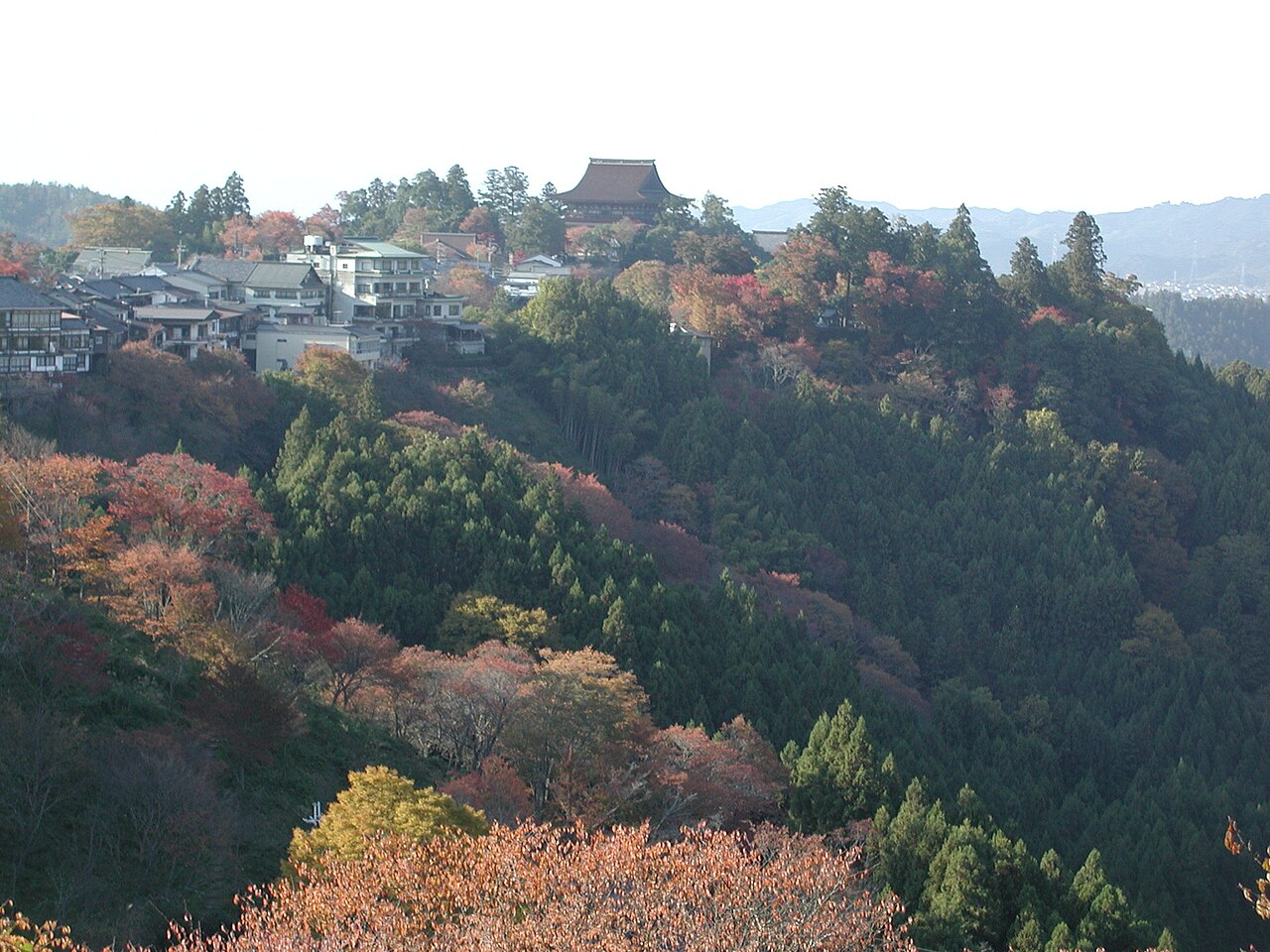
Yoshinoyama is a mountain in the south of Nara Prefecture where one ridge lane strings together temples, a shrine, inns and sweet shops. Old Japanese accounts give it a weight out of proportion to its size: it was counted among the celebrated scenic places from the age of Emperor Jimmu, who is said to have come here; Emperor Ojin is said to have kept a detached palace on the mountain; and during the struggle between the Northern and Southern Courts, the three emperors of the Southern line held their court on Yoshino.
The same accounts place Yoshino at the mouth of the Omine range, the training ground of Shugendo opened by the ascetic En no Gyoja, with the peaks running south and the long way through to Kumano beyond. A day visitor walks none of that, but the mountain still reads as a gateway: a line of gates, halls and lanes built for people on their way somewhere higher.
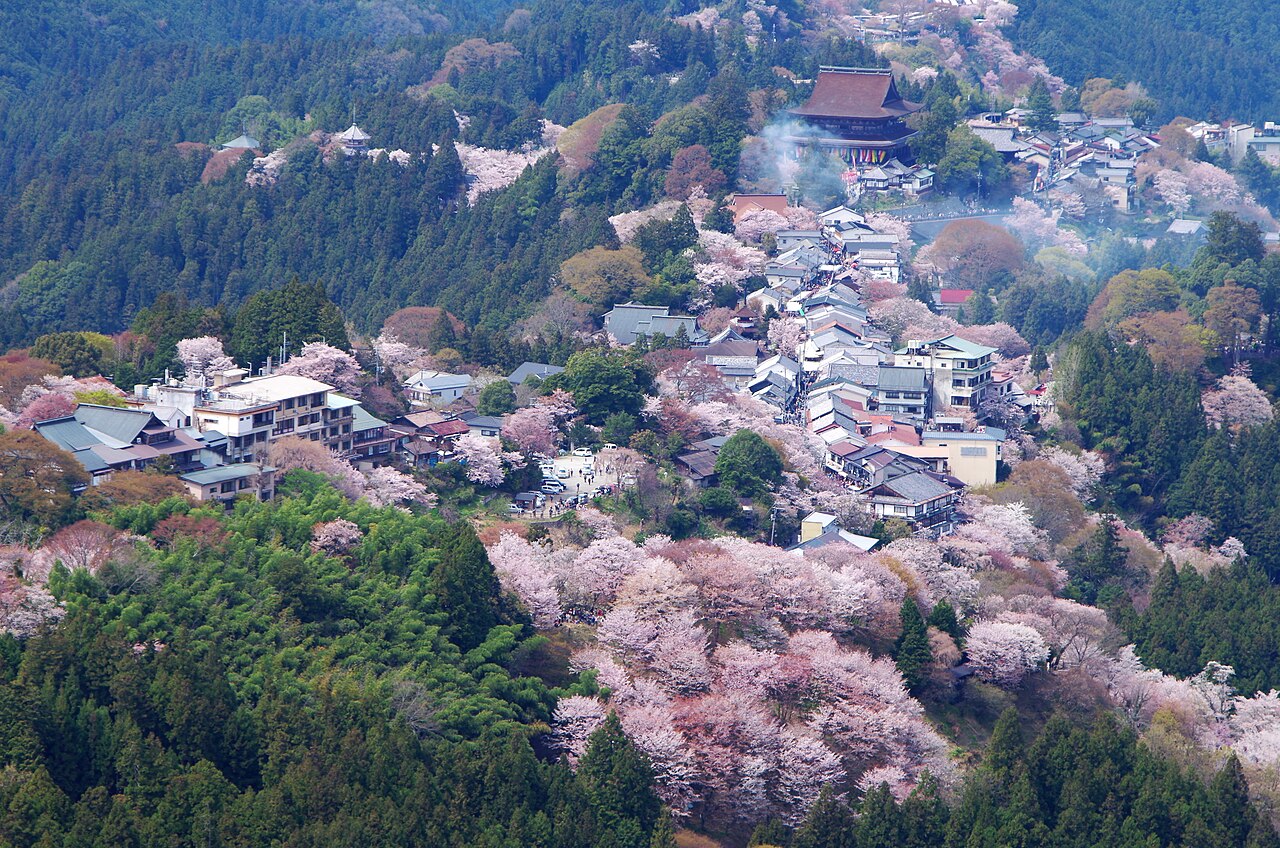
Rooftops of the Yoshinoyama village climb the slope toward the Zao-do, which stands out even from a distance.
Getting up to Yoshinoyama
The approach is simpler than the history suggests. Senbonguchi, the lower station of the Yoshino Ropeway, is less than a three-minute walk from Kintetsu Yoshino Station, and the cabin lifts you to Yoshinoyama Station at the foot of the village lane. One-way fares for adults and children are in the table at the end of this article.
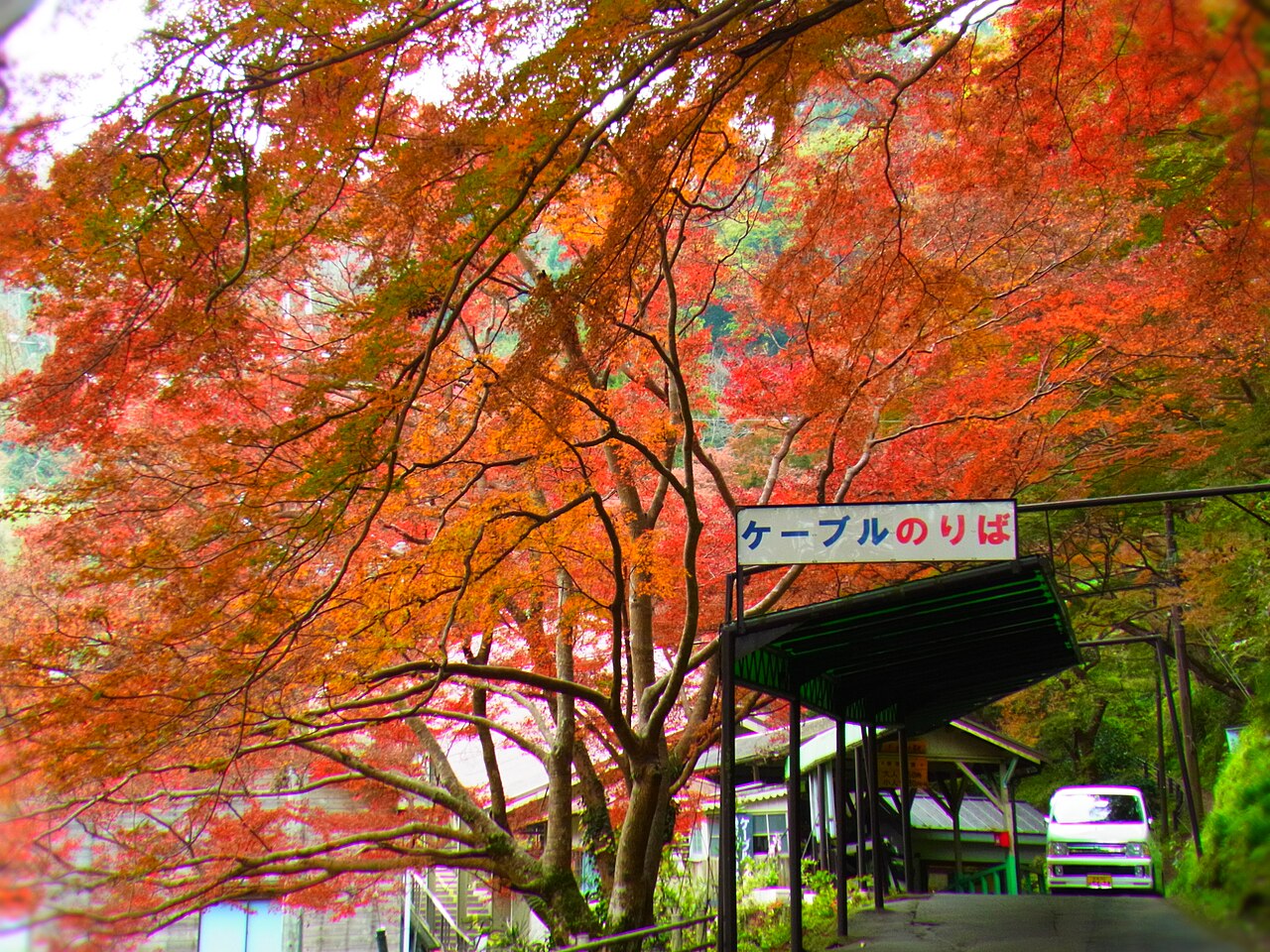
The Senbonguchi boarding area, with the station canopy and a sign reading Cable Noriba.
Abrupt terrain dominates the Yoshino district, and a distinctive building style grew up in answer to it: houses are set with their backs to the valley, pressed against the slope as if holding on to it. The style is known as Yoshino-date, and it gives the village its stacked, clinging look.
If you prefer to have the route arranged for you, browse guided outings to Yoshino before deciding how much to do on your own.
Kinpusen-ji and the Zao-do
The lane leads to Kinpusen-ji, the temple at the heart of Yoshino's Shugendo. Its main hall, the Zao-do, is traditionally said to have been founded by the monk Gyoki. The principal image is Kongo Zao Gongen, flanked by a Thousand-armed Kannon and a Miroku Bosatsu that tradition also credits to Gyoki's hand; the old descriptions dwell on their great size. The Kongo Zao Daigongen is a hidden image, normally not on view, shown only during limited special openings, so check whether one falls on your dates rather than assuming you will see it. Admission hours and fees are in the table below.
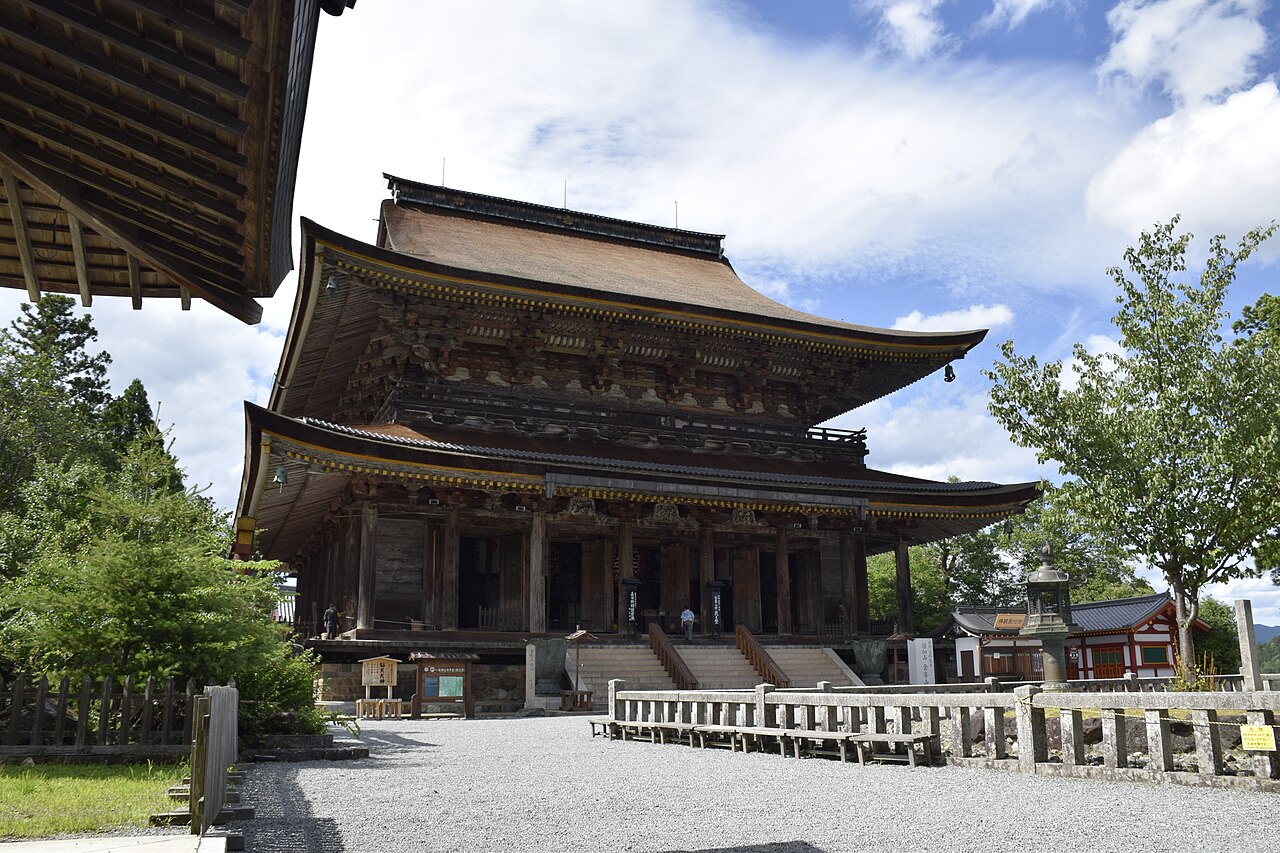
The Zao-do of Kinpusen-ji across its gravel courtyard.
Two gates mark the way. The Nio-mon, raised in the reign of Emperor Go-Hanazono, stands at the entrance to the approach to the Zao-do. Not far from the Kuromon stands a torii of cast copper, reckoned the first of the four gates on the ascetic's path to Omine, the Hosshin-mon or gate of awakening; it is said to have been cast from copper left over from the Great Buddha of Todai-ji in the time of Emperor Shomu, with the characters on its plaque attributed to Kobo Daishi.
Yoshimizu Shrine and Chikurin-in
A short way along the ridge is Yoshimizu Shrine, once the temple lodging Yoshimizu-in. It is recorded that when Toyotomi Hideyoshi held a cherry-blossom viewing at Yoshino, he took Yoshimizu-in as his temporary residence. Older Japanese guidebooks describe its precincts as preserving the throne room of Emperor Go-Daigo, the room where Yoshitsune hid and the room where Benkei sat in thought, with treasures that include a prayer text in Go-Daigo's own hand and the Shokugensho in Kitabatake Chikafusa's. The shoin, where these are shown, has its own fee and viewing hours, listed below.
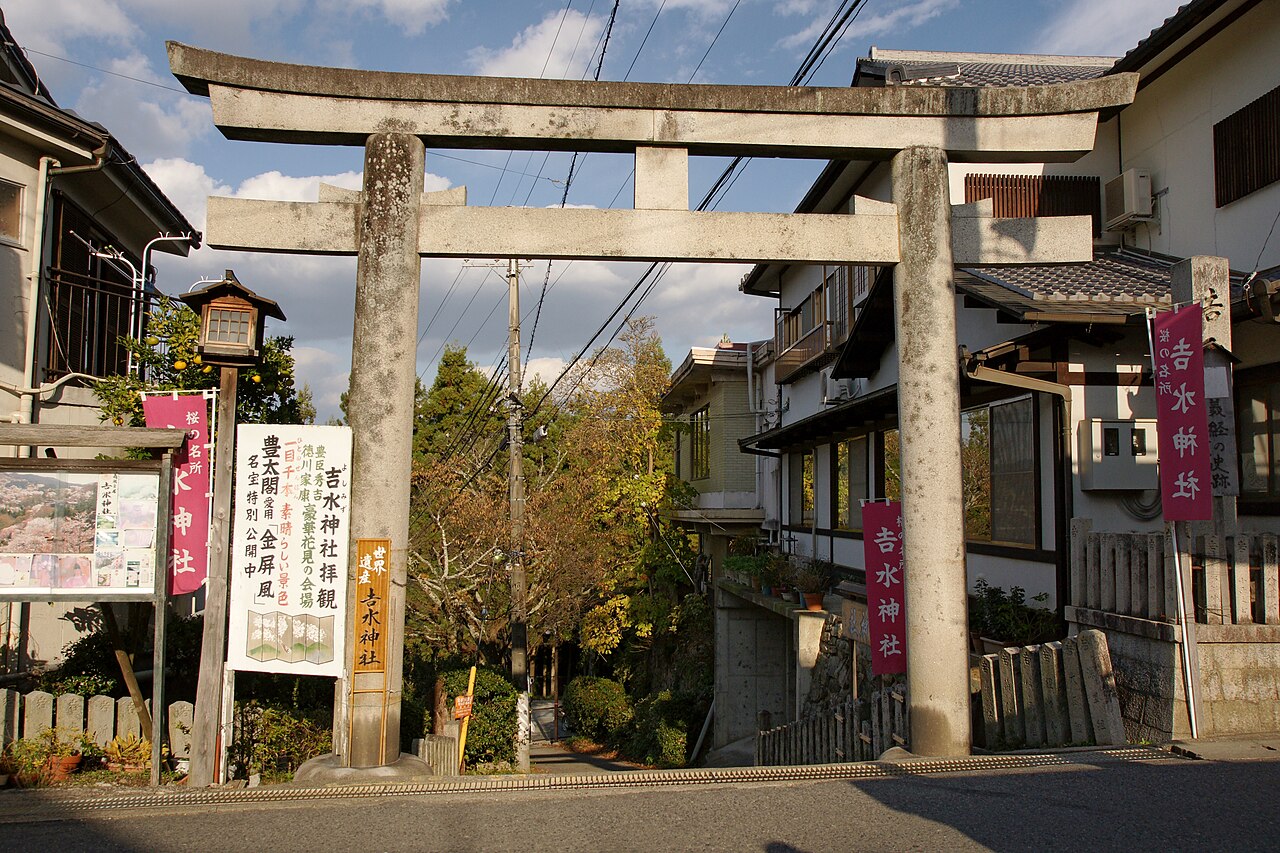
The stone torii at the entrance to Yoshimizu Shrine, with pink banners and old wooden houses along the lane.
Beyond it lies Chikurin-in, whose garden, Gunpoen, can be visited for a fee that also appears in the table. From Chikurin-in the older guides describe crossing Tenno Bridge and climbing to Saruhiki-zaka with the valley opening to the east: this is the Naka-no-Senbon, the middle thousand, where the writers compared haze and bright cloud catching the sunlight to a painting of the Tosa school, and noted the head mound of Sato Tadanobu and the lookout called Hanayagura in the Chuin valley.
Where to stay
Places to stay near Yoshino, Nara, Japan →
Disclosure: This post may contain affiliate links. If you book through them, we may earn a commission at no extra cost to you.
Walking the ridge lanes
Much of the pleasure of Yoshinoyama is the lane itself. The Kuromon, the outer gate of Kinpusen-ji, takes its name from its black-painted pillars; beyond it inns and shops line both sides of the street, and in the days of the feudal lords even daimyo and high-ranking families lowered their spears and dismounted to pass through.
Spring is the season the mountain is known for. The lower slopes, the Shimo-no-Senbon, were described a century ago as spreading like white cloud in blossom and drawing visitors in large numbers, and the guides of that time advised walking rather than riding so as to take in the sights along the road. Higher up, the Naka-no-Senbon grove runs from Katte Shrine to Nyoirin-ji against the green of Tonoo-san and was reckoned the finest view on the mountain; the same writers remarked that planting was increasing the trees year by year.
How the cherries came to be here is told as a story. En no Gyoja, it is said, planted cherries across Yoshino when he opened Omine, declared them the sacred trees of Zao Gongen and forbade the villagers to cut them; the faithful offered more trees until the whole mountain was covered in blossom. Some were felled after the upheavals that ended the feudal order, and protection by officials and townspeople together brought the groves back.
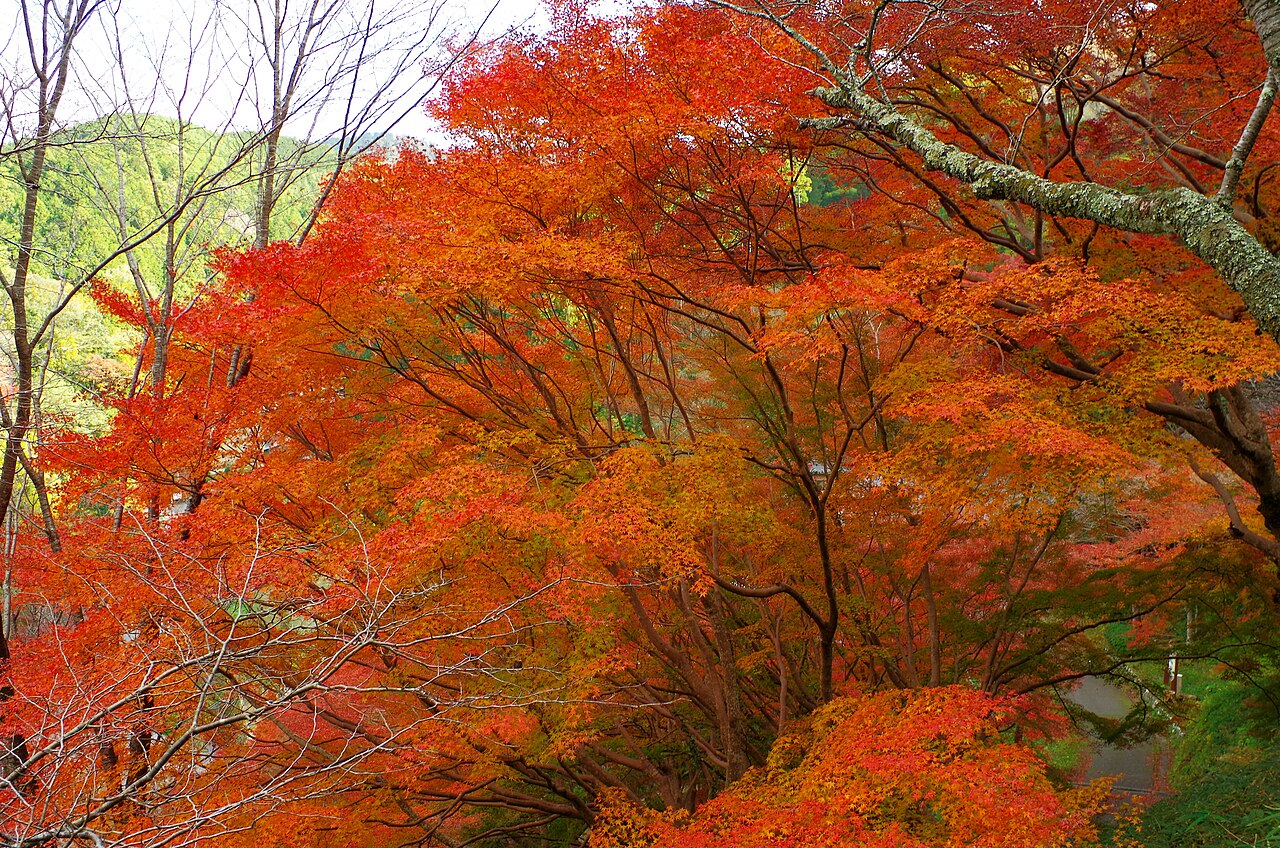
A maple in orange and red on Mount Yoshino, with green hills behind. Autumn, as these photographs show, brings its own colour to the same lanes.
Kudzu and persimmon-leaf sushi
Two foods belong to this mountain. The first is kudzu. Starch that is nothing but kudzu root is called Yoshino honkuzu: it is refined again and again using only midwinter groundwater, then dried over two to three months, with nothing added. Made into kuzumochi it becomes a clear, springy cake eaten with roasted soybean flour and dark sugar syrup, a Nara regional dish sold all year round. Kuzukiri, the same starch made into noodles, is the other way to try it; both are priced in the table below.
The second is kakinoha-zushi, the persimmon-leaf sushi of Gojo and the Yoshino district. Mackerel cured in salt is laid on vinegared rice, wrapped in the green leaf of an astringent persimmon and pressed; the leaf is rich in tannin, and leaf and vinegar together keep the fish and rice from spoiling. In the farming villages it was the feast of the summer festivals, made once the rice was planted, with children helping and mackerel counted as a food for celebrations. From the Boys' Festival into July the same method is used with the leaves of the wild magnolia, hoba, which lend their scent to the rice and give the dish its summer name, hoba-zushi.
Fares, admission and hours at a glance
Everything in this guide that costs money or keeps hours is gathered here; the figures are those published by each operator.
| Item | Figure |
|---|---|
| Yoshino Ropeway, Senbonguchi to Yoshinoyama, one way, adult | 500 yen |
| Yoshino Ropeway, one way, child | 250 yen |
| Kinpusen-ji, admission hours | 8:30 to 16:00 |
| Kinpusen-ji, admission (adult / junior high and high school student / elementary school student) | 800 / 600 / 400 yen |
| Yoshimizu Shrine shoin, admission, adult | 600 yen |
| Yoshimizu Shrine shoin, admission, junior high and high school student | 400 yen |
| Yoshimizu Shrine shoin, admission, elementary school student | 300 yen |
| Yoshimizu Shrine shoin, viewing hours | 9:00 to 16:30 |
| Chikurin-in Gunpoen garden, admission, adult (tax included) | 700 yen |
| Chikurin-in Gunpoen garden, admission, junior high and high school student (tax included) | 300 yen |
| Chikurin-in Gunpoen garden, admission, elementary school student (tax included) | 200 yen |
| Chikurin-in Gunpoen garden, admission, day-trip plan guest (tax included) | 300 yen |
| Chikurin-in Gunpoen garden, opening hours | around 8:00 to 17:00 (closing) |
| Yoshino honkuzu-mochi (kudzu cake), tax included | 900 yen |
| Yoshino honkuzu-kiri (kudzu noodles), tax included | 900 yen |
Where to stay on the mountain
Yoshinoyama has been a place of inns for as long as it has been a place of pilgrims. Government surveys of rural landscapes note that in settlements at the foot of Shugendo mountains, Yoshinoyama and the Dorogawa district of Tenkawa among them, an inn trade grew up to support ascetics, leaving a village in which mountain work and the functions of a post town sit side by side. Staying one night turns the day trip into an evening and a morning on that same lane.
Find a room among the inns of Yoshinoyama if you would like to see the lane at both ends of the day.