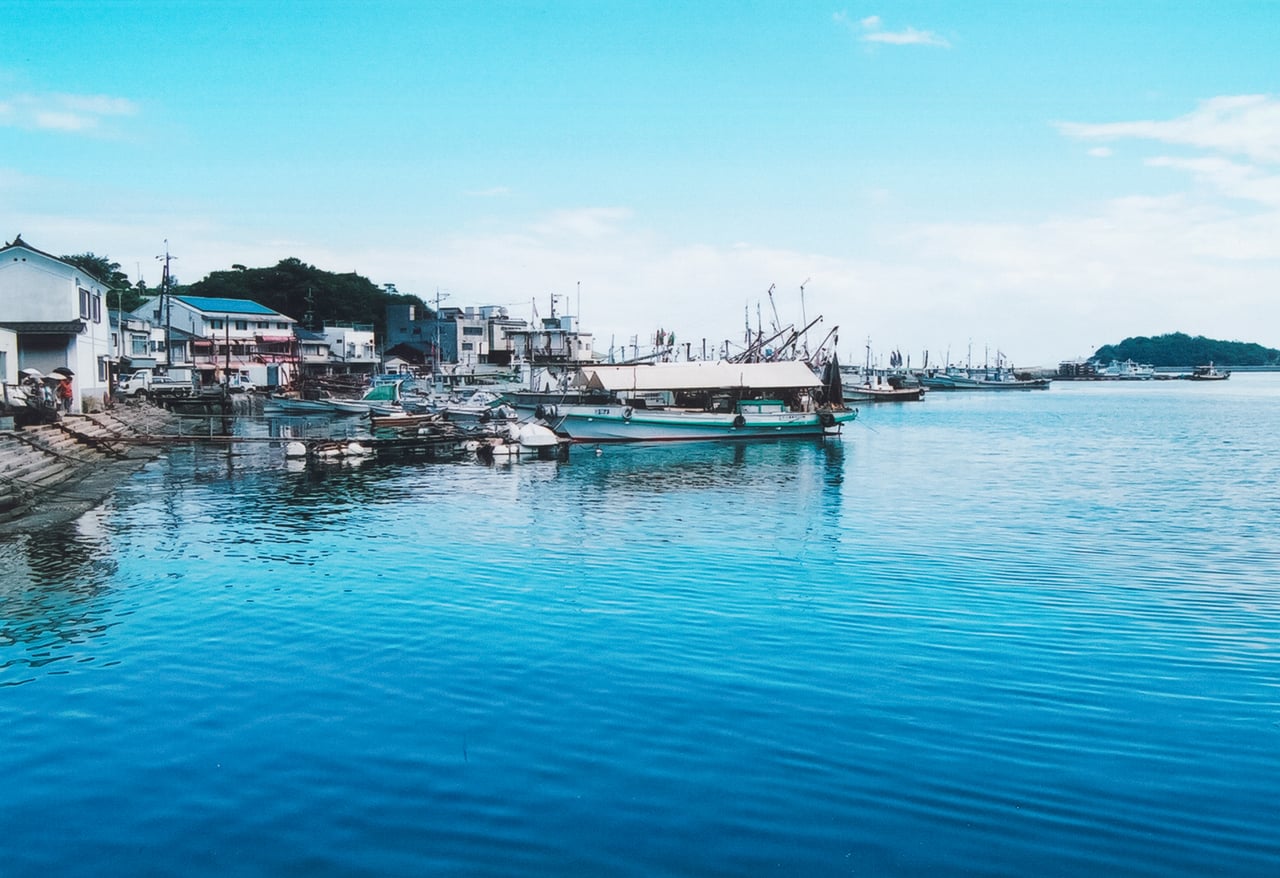
Tomonoura is a small harbour town at the seaward edge of Fukuyama, in Hiroshima Prefecture, and it wears its age lightly. In the Edo period it prospered as a port of call for the Kitamaebune trading ships, and it has long been known as a tide-waiting harbour, where crews idled until the currents of the Seto Inland Sea turned in their favour. Guidebooks like to point out that its streetscape has appeared in films from The Wolverine to Gintama, and that Hayao Miyazaki stayed here while turning over the ideas that became Ponyo. None of that has hurried the place up. The lanes are narrow, the harbour is small, and the best of it can be walked in one slow afternoon.
A stone lantern and a view praised across the sea
The symbol of the town is the great stone lantern at the harbour's edge, raised in the mid-nineteenth century and counted among the largest Edo-period harbour lanterns still standing. It is the kind of landmark that needs no explaining: you walk to the water, and there it is.
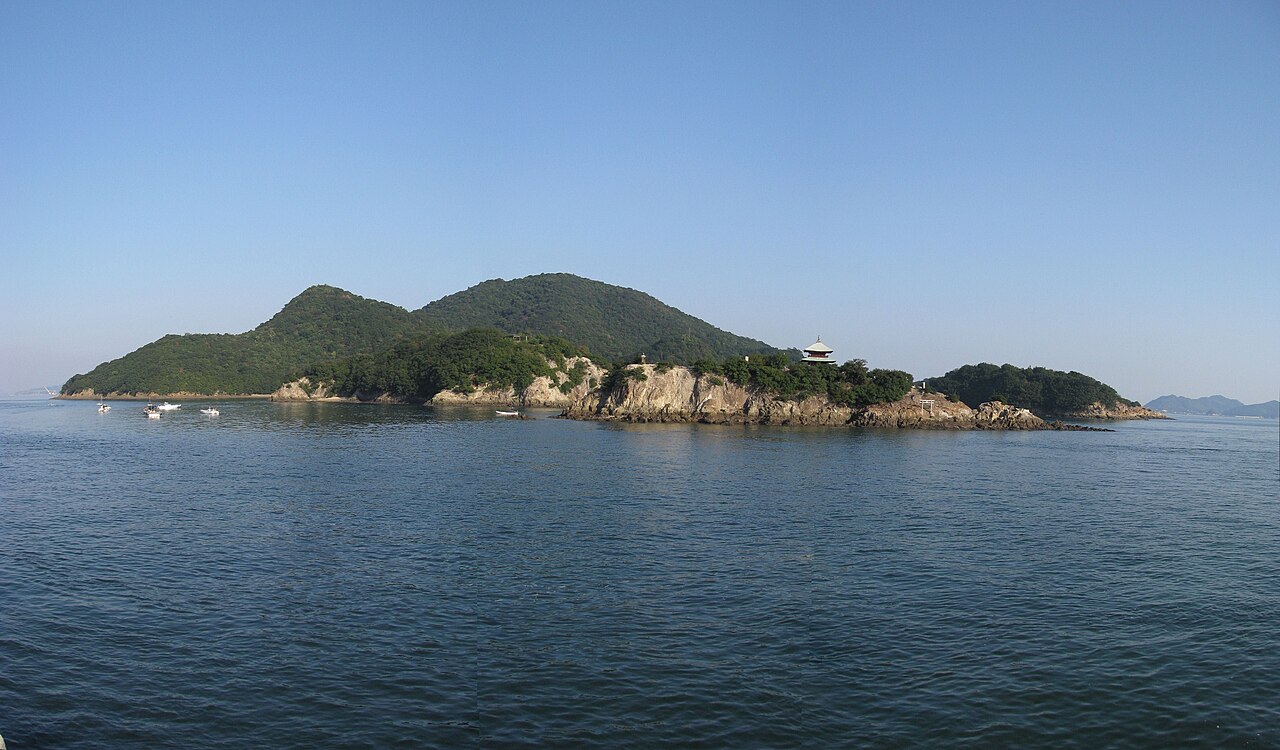
Taichōrō, a guest hall of the temple Fukuzenji built toward the end of the seventeenth century, frames Sensuijima and Bentenjima through its wide, room-length window. Korean envoys of the Joseon missions are said to have praised this view as the finest scenery east of their own country. It is still a view worth sitting down for.
Admission to Taichōrō costs 300 yen for adults. Junior high and high school students pay 150 yen. Elementary school children pay 100 yen.
Five minutes by ferry to an uninhabited island
From the harbour the ferry crosses to Sensuijima, an uninhabited island folded into the Seto Inland Sea National Park, the first national park Japan ever designated, back in the nineteen-thirties — and according to the guidebook, the crossing takes about five minutes on the water. The name is usually explained with an old legend — an island so beautiful that even a sage of the mountains would grow drunk on the sight of it.
The ferry fare is 240 yen for adults. Children of elementary school age or younger ride for 120 yen. For less than the price of a coffee you can look back at the whole town from the water, which may be the quietest view of all.
*Rather have the day arranged in advance? Compare tours and tickets around Tomonoura.*
Ryōma, a shipwreck, and a hidden room
In the closing years of the shogunate, the steamship Iroha Maru — run by Sakamoto Ryōma's Kaientai — collided with a Kishū domain vessel off Tomo and sank, and Ryōma came to Tomonoura for the compensation talks that followed. The Iroha Maru Exhibition Hall tells that story with exhibits on the collision and a life-size figure of Ryōma, inside an Edo-period storehouse that is now a nationally registered cultural property. Admission costs 300 yen.
Around the corner, the house of Masuya Seiemon — a shipping agent's home since the Edo period — hides an attic room where Ryōma is said to have lain low, and the room has been shown to visitors since the early twenty-tens.
Where to stay
Places to stay near Tomonoura →
Disclosure: This post may contain affiliate links. If you book through them, we may earn a commission at no extra cost to you.
The merchant houses and their medicine liquor
Tomonoura's signature taste is hōmeishu, a herbal liquor once presented to the Edo shogunate — it is said to have been served when Commodore Perry's ships arrived — and today it is made by just four shops in the town. One of them, Okamoto Kametarō Honten, inherited its signboard and tools from the Nakamura family, credited as the drink's originators, and trades from a building that survives from a gate of Fukuyama Castle, now a municipal cultural property. Another, Hatta Hōmeishu-ho, has been at it since the first decade of the twentieth century, and its liquor has been written up as a stand-in for vermouth in cocktails and once featured in a magazine as one of Japan's three great medicinal liquors. Guidebooks also note Irie Toyosaburō Honten, whose recipe blends sixteen botanicals, all of them plant-derived, and whose side project — a Tomonoura ramen — has been certified as a Fukuyama Brand product. And at Tomo Shuzō, a shop converted from part of the Ota Residence, the owner fires little pottery bottles on his own wheel and fills them with hōmeishu, with the lees sold for cooking as well.
For lunch, guidebooks single out Chitose, a local place known for its sea-bream sōmen — the whole head of the fish presiding over the noodles — whose tables look across the water toward Sensuijima and Bentenjima.
The Ota Residence itself can be visited. Admission costs 500 yen for anyone of middle-school age and above, with a rate of 400 yen for groups. Elementary school children pay 200 yen, with a group rate of 160 yen. It is open from 10:00 to 17:00, with last admission at 16:30 in the afternoon. It is closed over the New Year holidays, from the twenty-ninth of December through the first of January.
An art museum in a soy-sauce warehouse
The Tomonotsu Museum occupies a soy-sauce warehouse about a century and a half old, reborn in the early twenty-tens as a gallery for art brut — work by self-taught makers, shown without regard to fame, training, or disability. Guidebooks note that it rests on Mondays and Tuesdays, charges nothing at the door, and changes its shows with each exhibition, so a glance at its website before you go is worth it.
A little inland, Bingo Ankokuji keeps a dry landscape garden listed as a prefectural historic site and a Shaka hall designated an Important Cultural Property, and in cherry-blossom season the grounds are lit after dark. The temple began in the Kamakura period as Kinpō-ji, was rebuilt when the Ashikaga brothers ordered Ankokuji temples across the land, and was later revived by Ankokuji Ekei, the diplomat-monk of the Mōri clan.
Tomonoura asks very little of a visitor: a lantern, a window full of islands, a glass of something medicinal, and a ferry that takes its time. As one slow day out from Fukuyama, it gives back more quiet than towns twice its size.
*Prefer to have the day mapped out for you? Browse tours and tickets around Tomonoura.*