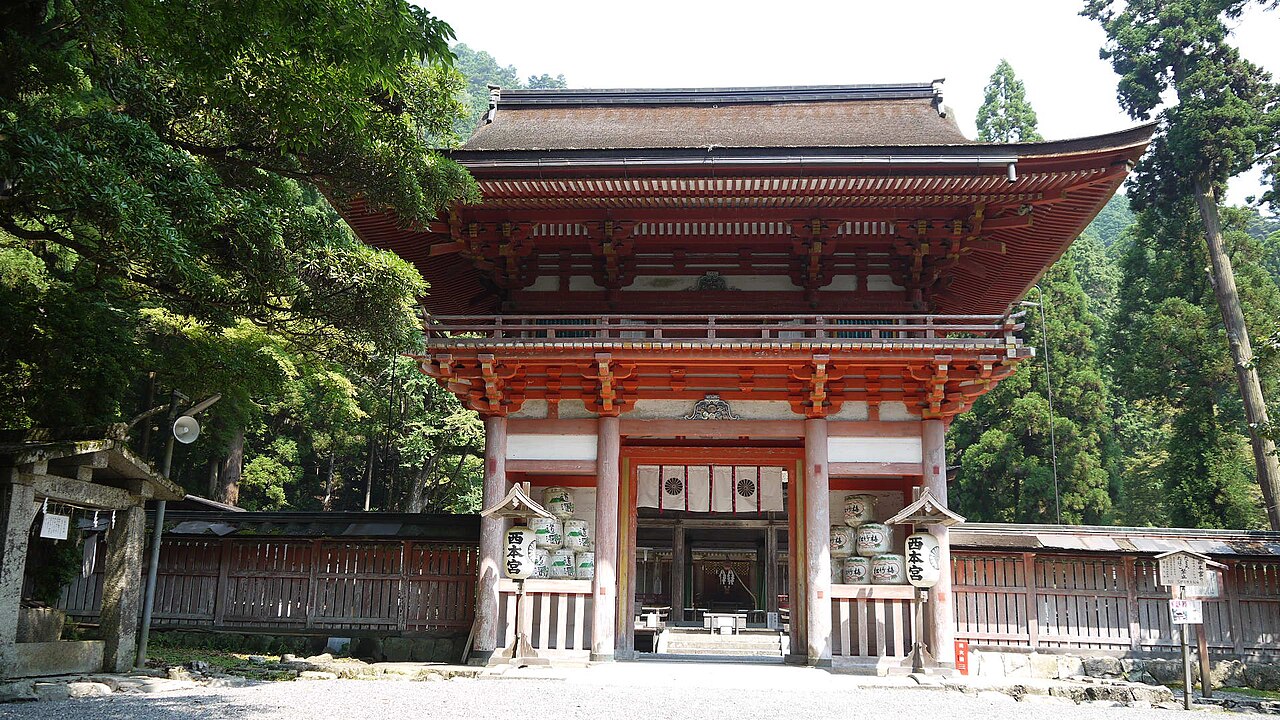
On the Shiga side of Mount Hiei, where the mountain runs down toward Lake Biwa, there is a town built out of monks' retirements. Sakamoto grew at the foot of the sacred mountain as the temple town of Enryakuji and of Hiyoshi Taisha, and the satobo — the lodges to which elderly monks withdrew — are still scattered through it behind walls of fitted stone. Kyoto lies just over the summit ridge, on the far side of the prefectural border; the crowds, for the most part, stay on that side.
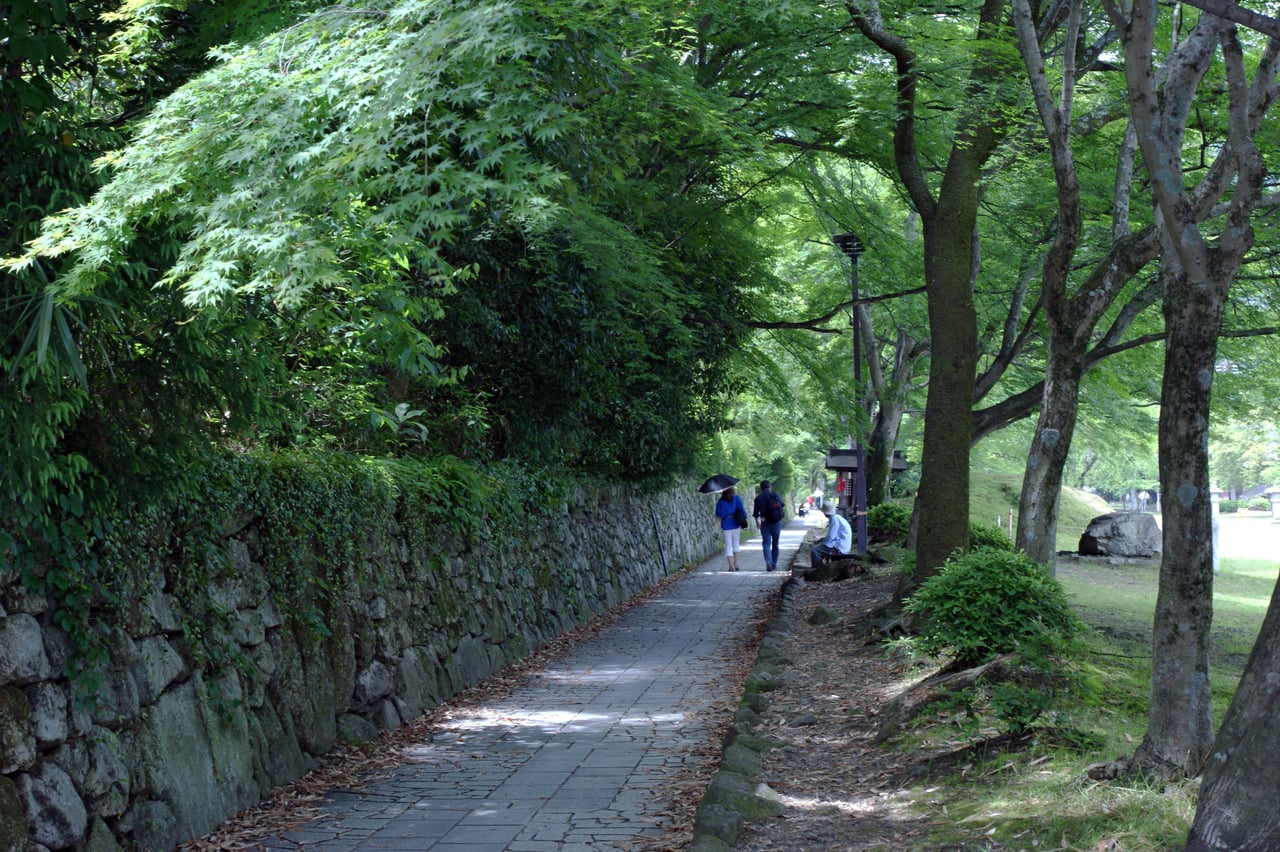
The walls are the first thing you notice. Rounded natural stones locked together without mortar, they are the signature of the Ano-shu masons, and together with the white plaster above them they have earned the town its designation as an Important Preservation District for Groups of Traditional Buildings. Walking these lanes, between garden walls and temple gates, is the pleasure Sakamoto offers.
The head shrine of three thousand eight hundred
At the top of the town, in old woods, stands Hiyoshi Taisha, the head shrine of some three thousand eight hundred Hiyoshi, Hie and Sanno shrines across Japan. Its wooded precinct holds National Treasure buildings and many more listed as Important Cultural Properties. Tradition holds that the shrine's messenger is the monkey called masaru, said to guard against misfortune; you will find it carved and painted in odd corners once you begin to look.
Worship is possible from nine in the morning until four in the afternoon. The gates of the West and East main shrines are opened from six in the morning between April and September, and from seven between October and March. The amulet and goshuin office keeps a nine-to-four day, and prayer bookings are received from nine until half past three. Entering the garden precinct asks a contribution of five hundred yen for adults and three hundred yen for middle and high school students.
Lanes of the satobo
Of the satobo that admit visitors, Kyu Chikurin-in is the one to make time for. Its garden borrows Mount Hachioji as a backdrop, sets a waterfall arrangement and an artificial hill into the natural lie of the ground, and is designated a national Place of Scenic Beauty.
Nearby stands Hiyoshi Tosho-gu, founded by the monk Tenkai to enshrine Tokugawa Ieyasu: a gongen-zukuri hall dense with polychrome carving, gold leaf and metal fittings, and said to precede the great Tosho-gu at Nikko.
Kunin Yashiki, the old Okamoto residence, shows another side of the town. A kunin was a man in holy orders who was nonetheless permitted to marry and to carry a sword; the house he kept — main building, rice store and stable all surviving — is said to be the only one of its kind left.
Two of the town's tables are worth planning around. Tsuruki serves hand-cut soba as it has for three hundred and ten years, in premises that are themselves one hundred and thirty-eight years old and a Registered Tangible Cultural Property. Down the street, Seiyoken, a bakery founded in nineteen twenty-three, sells a stone-stacking bread modelled on the Ano-shu walls, with walnuts standing in for the pale stones and raisins for the dark.
If you would rather have the day arranged for you, browse guided tours and tickets around Shiga.
Where to stay
Places to stay near Sakamoto →
Disclosure: This post may contain affiliate links. If you book through them, we may earn a commission at no extra cost to you.
Up the mountain by funicular
From the upper edge of the town, the Sakamoto funicular climbs to Enryakuji: about two kilometres of track, a ride of about eleven minutes, and the longest line of its kind in Japan. Its two stations are Registered Tangible Cultural Properties, described as sights in themselves.
Enryakuji, the mother mountain
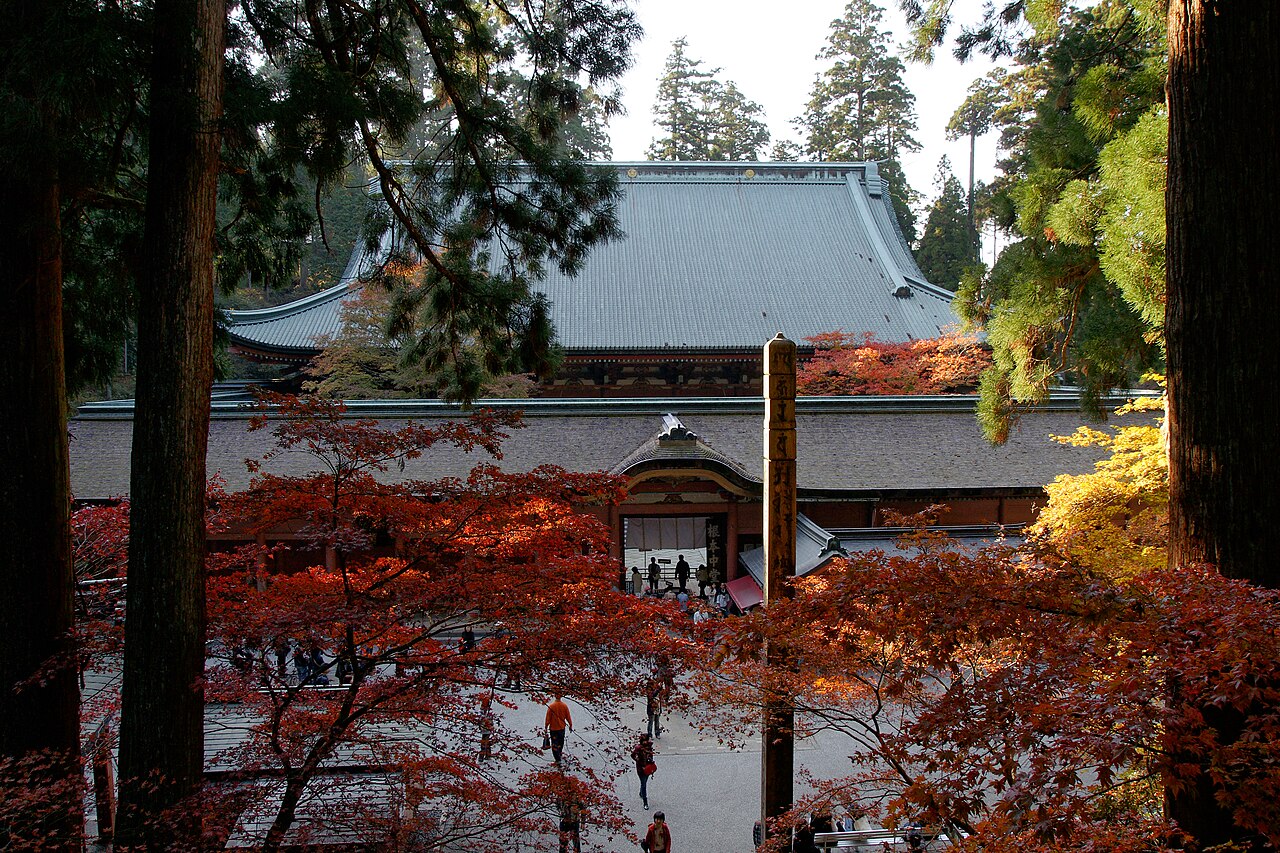
At the top is Enryakuji, which takes the whole of Mount Hiei as its precinct: head temple of the Tendai school, opened in the early Heian period by the monk Saicho, called the mother mountain of Japanese Buddhism, and inscribed as a UNESCO World Heritage property, its summit ridge riding the border of Shiga and Kyoto.
Its grounds divide into three areas — Todo, Saito and Yokawa — with more than one hundred halls scattered across the mountain. The areas lie far apart, and walking the whole precinct takes at least half a day.
The Konponchudo, the central hall and a National Treasure, is partway through a restoration begun in the mid twenty-tens and reckoned at roughly fifteen years, running into the late twenty-twenties. A viewing stage lets you watch traditional-method repair work as it happens — worth the ride up in its own right.
Admission to the three precincts is by a combined pilgrimage ticket at one thousand yen; the treasure hall asks a further five hundred yen.
For the slowest visit of all, Enryakuji Kaikan, a modern temple lodging near the Konponchudo, takes bookings for zazen and sutra-copying from guests who are staying or dining there.
How long to give it
Give Sakamoto and its mountain a full day rather than an afternoon. The walk through the three precincts takes at least half a day on its own. The funicular adds about eleven minutes each way, and the town below is what the rest of the day is for. A workable shape:
- Morning in the town: the shrine from its nine o'clock opening, then the satobo lanes and an early soba lunch at Tsuruki.
- Midday and afternoon on the mountain: Todo first for the Konponchudo, then as much of Saito and Yokawa as the half-day walk allows.
- Late afternoon back below: stone-stacking bread from Seiyoken and the long walled street in the last of the light.
Kyoto's famous temples will still be there tomorrow. Sakamoto asks for a different pace — masonry fitted stone by stone, gardens kept by monks in retirement, a mountain climbed slowly and on purpose since the early Heian period.
If a guided day suits you better, see what is on offer around Shiga.
Prices and opening arrangements shift with the seasons, so check official information before visiting.