Kishiwada lies on the Nankai Main Line south of Osaka. According to the guidebook it was the seat of a domain rated at fifty-three thousand koku, and the old townscape along the former Kishu Kaido road still survives. The rebuilt keep with its raked-gravel garden, the hall where the town's festival floats are kept, and a former businessman's villa whose garden anyone can stroll all sit within a short walk of two neighbouring stations, which is what makes it a quiet day out that can be done on foot. Below is the walking order, what each place costs and when it opens.
Getting there from Namba on the Nankai Main Line
From Namba in central Osaka, take the Nankai Main Line heading south. Two neighbouring stations serve the castle area, Kishiwada Station and Takojizo Station, and the venues publish their own walking times from each:
| From | To | On foot |
|---|---|---|
| Kishiwada Station (Nankai Main Line) | Kishiwada Danjiri Kaikan | about 13 minutes |
| Takojizo Station (Nankai Main Line) | Kishiwada Danjiri Kaikan | about 7 minutes |
| Takojizo Station (Nankai Main Line) | Gofuso | about 3 to 5 minutes |
| Kishiwada Station (Nankai Main Line) | Gofuso | about 10 minutes |
Gofuso stands, according to the guidebook, on the site of the castle's former second enclosure, so the simplest loop is to get off at Takojizo Station, see Gofuso and the castle first, carry on to the Danjiri Kaikan, and finish at Kishiwada Station. The guidebook also notes that the Takojizo Station building carries a stained-glass window on the theme of the Octopus Jizo legend, a story you will meet again later.
Kishiwada Castle and the Hachijin no Niwa garden
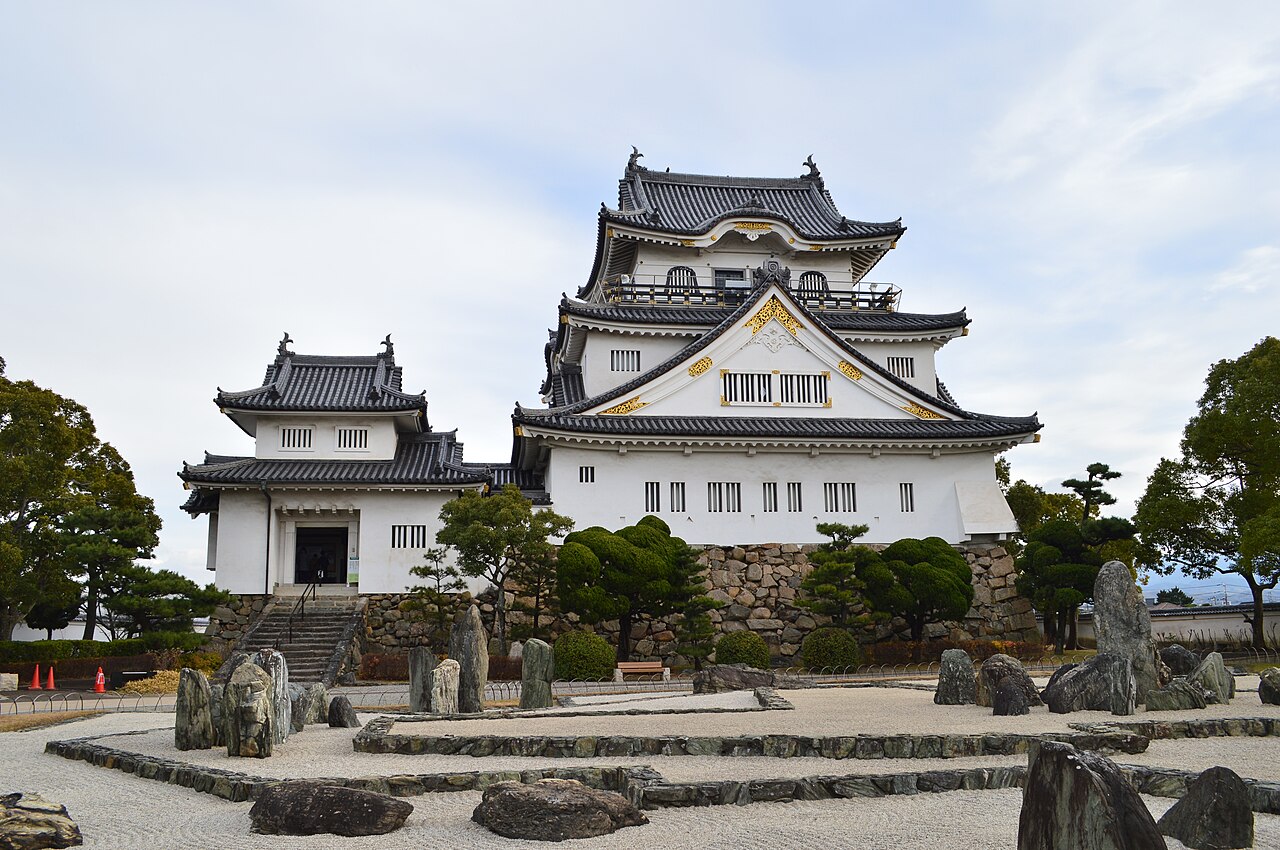
The keep of Kishiwada Castle seen across the stones and gravel of the Hachijin no Niwa.
The white keep standing today is, the guidebook explains, a mid-twentieth-century reconstruction with three tiers, and the castle is listed among the Continued One Hundred Famous Castles of Japan. The displays inside concern the Okabe family, who held the domain through the Edo period; pets, the guidebook adds, are not admitted. What rewards a slow visit, though, is the Hachijin no Niwa in the main enclosure, designed by Shigemori Mirei, a pioneer of the modern Japanese garden, and designated a national Place of Scenic Beauty.
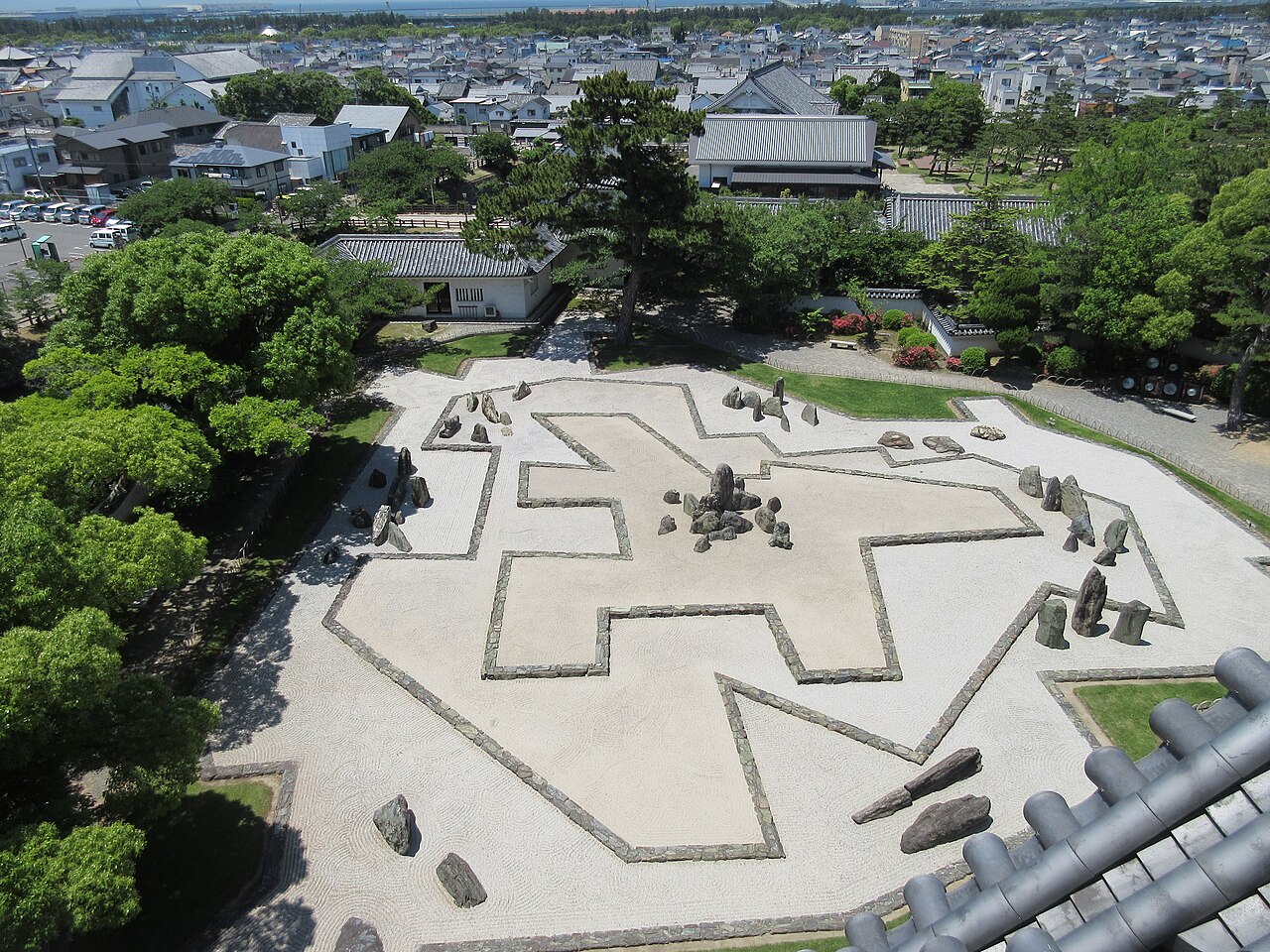
The Hachijin no Niwa from the keep, with the rooftops of the town beyond the pines.
Seen from the keep, the raked white gravel, the low stone edging and the groups of upright stones settle into one composition, with pines and the town's rooftops behind. Opening times and admission are in the table at the end; the castle shuts over the New Year period and during exhibit changeovers.
A castle with two names, and the octopus that saved it
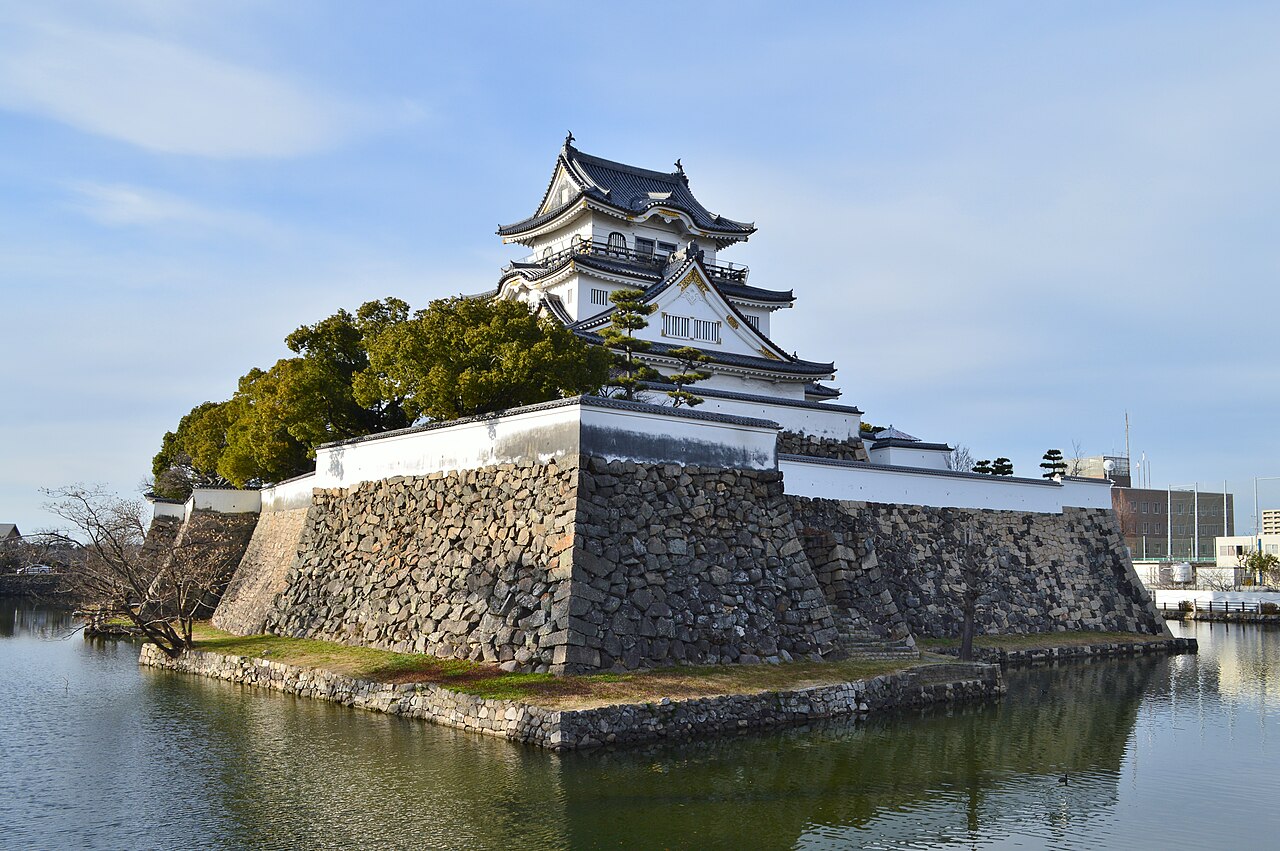
The guidebook relates that, by tradition, the castle was first raised in the Nanboku-cho period by Wada Takaie, a warrior of the Southern Court, and that in the Edo period it was the seat of the Okabe lords. Because the outline of the fortifications resembled a chikiri, the spool on which a weaver winds the warp threads, it also came to be called Chikiri Castle.
Its other story belongs to Tenshoji, the Jodo sect temple nearest Takojizo Station, said to date from the end of the Sengoku period or the start of the Edo era. As the temple's founding tale has it, a statue of Jizo appeared on the shore in the early fourteenth century riding on the back of an octopus; nobody in those troubled times believed it, and the image was thrown into the moat outside the castle. Later, when the forces of Negoro and Saiga attacked, an unknown great priest appeared inside the castle, fought with remarkable swordsmanship, drove the attackers off and vanished the moment the fighting ended. Afterwards octopuses were seen floating on the moat, and the wooden Jizo was found in the mud beneath. They concluded, so the tale goes, that the priest had been Jizo himself, and the statue has been called the Octopus Jizo ever since.
The temple's Jizo hall is described as one of the largest in Japan, and the statue is shown only during the Sennichi great service on the twenty-third and twenty-fourth of August. Tradition also holds that a wish made here is granted if you give up eating octopus entirely and dedicate a votive tablet.
Where to stay
Places to stay near Kishiwada, Osaka, Japan →
Disclosure: This post may contain affiliate links. If you book through them, we may earn a commission at no extra cost to you.
Kishiwada Danjiri Kaikan: the festival floats, up close
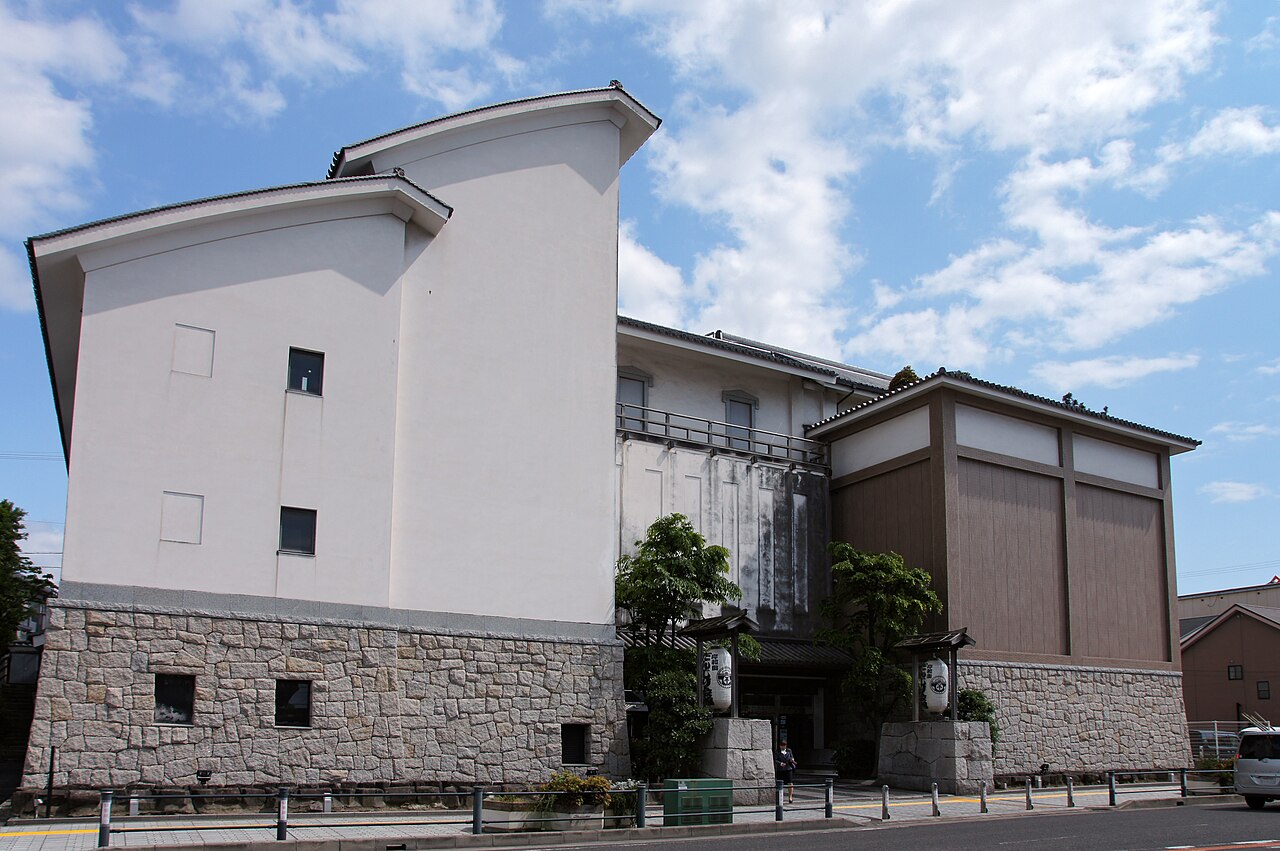
The entrance of the Kishiwada Danjiri Kaikan, with paper lanterns under the curved eaves.
The danjiri are the carved wooden festival floats for which Kishiwada is known, and the custom, the guidebook explains, is not confined to the city: more than two hundred neighbourhoods across the Senshu region own a float, and from September into October there is a festival somewhere almost every week, so the whole area takes on a festival mood. Outside those weeks, this hall is where the floats can be seen. Three genuine danjiri are on display, among them the former float of Kamiya-cho, built in the Edo period and pulled through the streets until a few decades ago, and the exhibits explain the carving, the decoration and how the festival organisations work.
Two things lift it above a static display: a hands-on corner where you can try the role of the daikugata, the carpenter who rides on the great roof of the float, and strike the instruments used for the festival music; and a photo spot where you stand before a float that once took part in the festival, with Kishiwada Castle as the backdrop. Opening hours, the weekly closing day and admission are in the table below.
Lunch at Gofuso, or kashimin-yaki in the back lanes
Gofuso, the guidebook explains, is a formal Japanese restaurant in a villa that an industrialist built in the early Showa era on the site of a tea house in the castle's second enclosure; the main house and its stroll garden are registered as tangible cultural properties of the city. You can eat looking out over the garden, and the garden itself can be entered free of charge, a natural pause even if you are not eating. Lunch sets and courses are priced in the table; reservations are required, and the Kobe beef shabu-shabu course has its own booking deadline, also noted there. The guidebook lists the restaurant's days off as irregular.
For something more local, the guidebook points to Yamato, a small place in a tangle of alleys where everyone eats around one large iron griddle; it is held to be the originator of kashimin-yaki, a griddle dish born in Kishiwada that uses chicken and minced beef fat, and has fed local people for many years. Two other names to look for are shirasu, the whitebait landed at Kishiwada's fishing port, and the Kanechika peach, which the guidebook says is sometimes called the sweetest in the world.
Hours, admission and a one-day plan
The figures below are as published by each venue; check official information before visiting.
| Place and item | Detail |
|---|---|
| Kishiwada Castle (keep), adult admission | 300 yen |
| Kishiwada Castle, opening hours | 9:00–17:00, admission until 16:30 |
| Kishiwada Castle, closed | from December twenty-ninth to January third, and during exhibit changeover periods |
| Kishiwada Danjiri Kaikan, adult admission | 600 yen (400 yen each for groups of 25 or more) |
| Kishiwada Danjiri Kaikan, elementary and junior high school students | 300 yen (200 yen each for groups of 25 or more) |
| Kishiwada Danjiri Kaikan, opening hours | 10:00–17:00, admission until 16:00 |
| Kishiwada Danjiri Kaikan, closed | Mondays (open if the Monday is a holiday) and from December twenty-ninth to January third |
| Common ticket for castle, Danjiri Kaikan and Natural History Museum, adult | 700 yen, valid for one month from the date of sale |
| Gofuso, business hours | 11:00–22:00 |
| Gofuso, last order | 21:00 |
| Gofuso, reservations | required; phone bookings accepted 10:00–18:00 |
| Gofuso, 彩御膳 lunch set | 3,080 yen incl. tax |
| Gofuso, 季節御膳 seasonal lunch set | 4,400 yen incl. tax |
| Gofuso, 秋実会席 autumn kaiseki lunch | 6,050 yen incl. tax |
| Gofuso, Kobe beef shabu-shabu course | 5,500 yen incl. tax |
| Gofuso, Kobe beef shabu-shabu course, booking deadline | by 18:00 two days before the day of use |
| Gofuso, tecchiri (fugu hot pot) full course | 11,000 yen incl. tax |
The third venue on the common ticket, the Kishiwada Natural History Museum, is where, the guidebook says, the main exhibits are the skull of the Kishiwada crocodile, thought to have lived some six hundred thousand years ago, and a complete skeleton of a Naumann's elephant.
A workable order: leave Namba on the Nankai Main Line, get off at Takojizo Station, walk to Gofuso and stroll its garden, go on to the castle for the keep and the Hachijin no Niwa, and continue on foot to the Danjiri Kaikan before finishing at Kishiwada Station. If lunch is to be at Gofuso, book ahead. For a guided option, you can compare guided tours and activities around Kishiwada; and if the festival season tempts you to linger beyond a single day, look for a hotel or inn in Kishiwada and make the castle town a base instead.