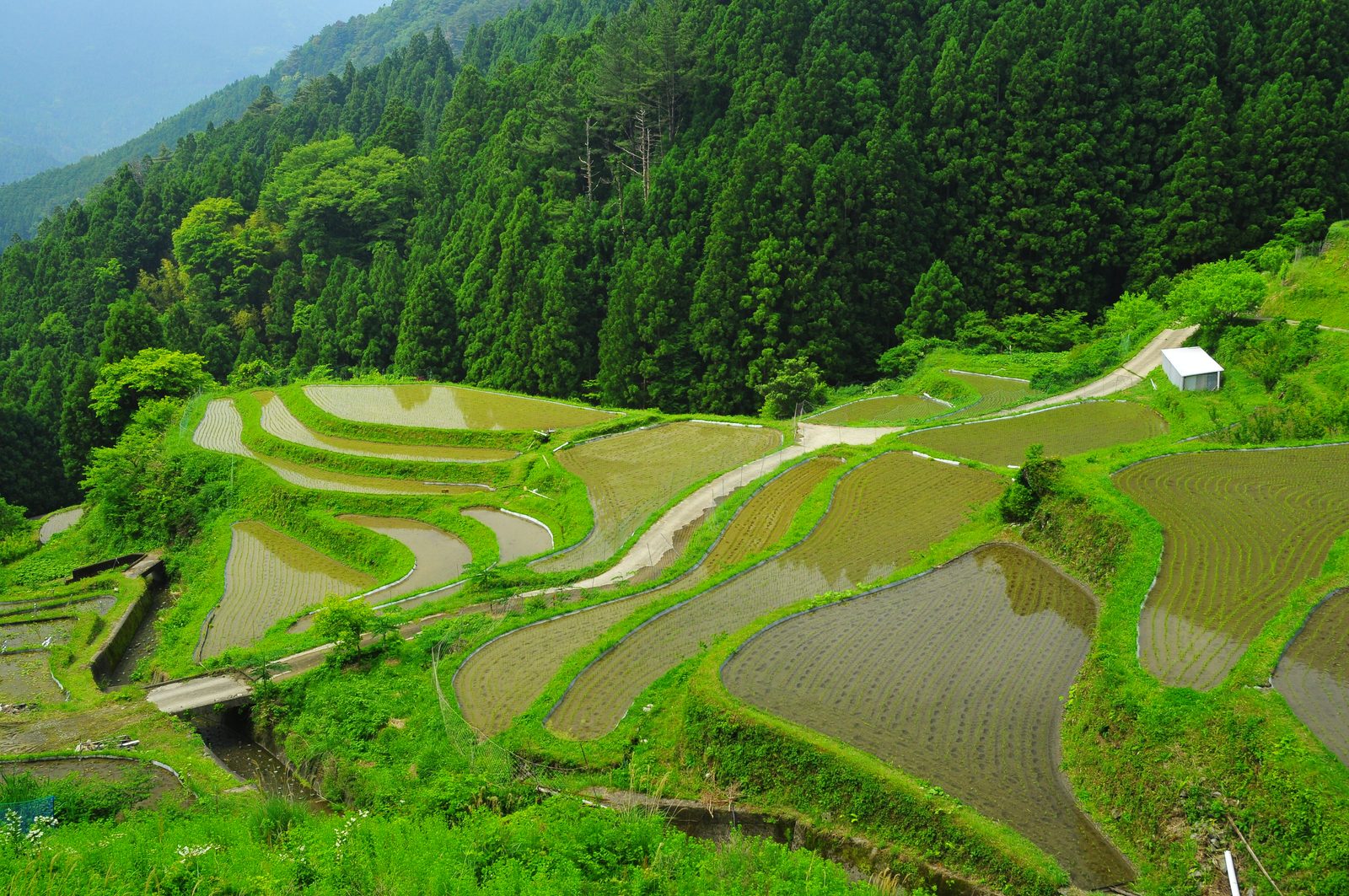
Kamikatsu was the first town in Japan to make a Zero Waste declaration, and a visit here means being guided through the roots of that decision and the site where residents sort their waste today. The Kashihara terraced rice fields are spread between the five-hundred-metre and seven-hundred-metre contours of the mountainside. In the same small town you can compare bancha teas that change character from farmer to farmer and eat Amago trout whose refined taste spreads softly the moment it is in your mouth. In summer there is also a gorge where you can put your feet in the mountain stream.
Zero Waste Life at Center WHY and Kuru-kuru Kobo
At the town's waste collection point, residents bring their own waste and sort it into fourteen types and forty-four categories. Because everyone living in Kamikatsu sorts waste every day, the town keeps a recycling rate of over eighty percent. The Kuru Kuru Shop is a space where townspeople bring items that are still usable and anyone can take them home. When you take something, you weigh it and write the weight in a notebook. If you want to understand how the town's zero waste works, start with the waste collection point and the Kuru Kuru Shop, because that is where the sorting and the reuse actually happen.
The Zero Waste Center WHY dates from May two thousand and twenty and is built from Kamikatsu cedar together with waste materials and construction waste collected within the town. On the laboratory wall, the bookshelf is an upcycled vegetable harvest basket. The STUDY WHY program also presents partnership projects with outside organisations, so the visit reaches beyond the town itself.
Staying at HOTEL WHY turns the visit into practice. Guests join a staff-led tour of the facility and sort the waste they produce during their stay. There is no trash can in the room; instead, a hand basket holding six containers is provided so you do the sorting yourself. The rooms are all wooden two-storey maisonettes, with a sofa, desk, bathroom, washbasin and closet on the first floor and a toilet and reading space on the second. The interior is Kamikatsu cedar, soft light enters the whole room through the double-height living room, and the windows reaching the ceiling reuse old shoji and glass-door fittings. The handles your hand closes around are Kamikatsu river stones, and the rooms are wrapped in a warm touch.
Kuru-kuru Kobo started when a grandmother made a drawstring pouch from a discarded carp streamer. Today the workshop makes original items from rice straw and palm leaves. You can try the hands-on making yourself: buttons from scraps of carp streamers, a palm-leaf fly swatter, or sakiori weaving with torn cloth and yarn. It suits anyone who would rather take home something they made than something they bought.
The Kashihara and Ichiu Terraces
Kamikatsu has fifty-five settlements, large and small, scattered between the one-hundred-metre and seven-hundred-metre contours. The Kashihara terraced rice fields sit in the upper part of that range, between the five-hundred-metre and seven-hundred-metre contours. Their ridges are not straight lines but curves that follow the contour lines of the mountain, which is why the fields read as part of the slope rather than something laid over it.
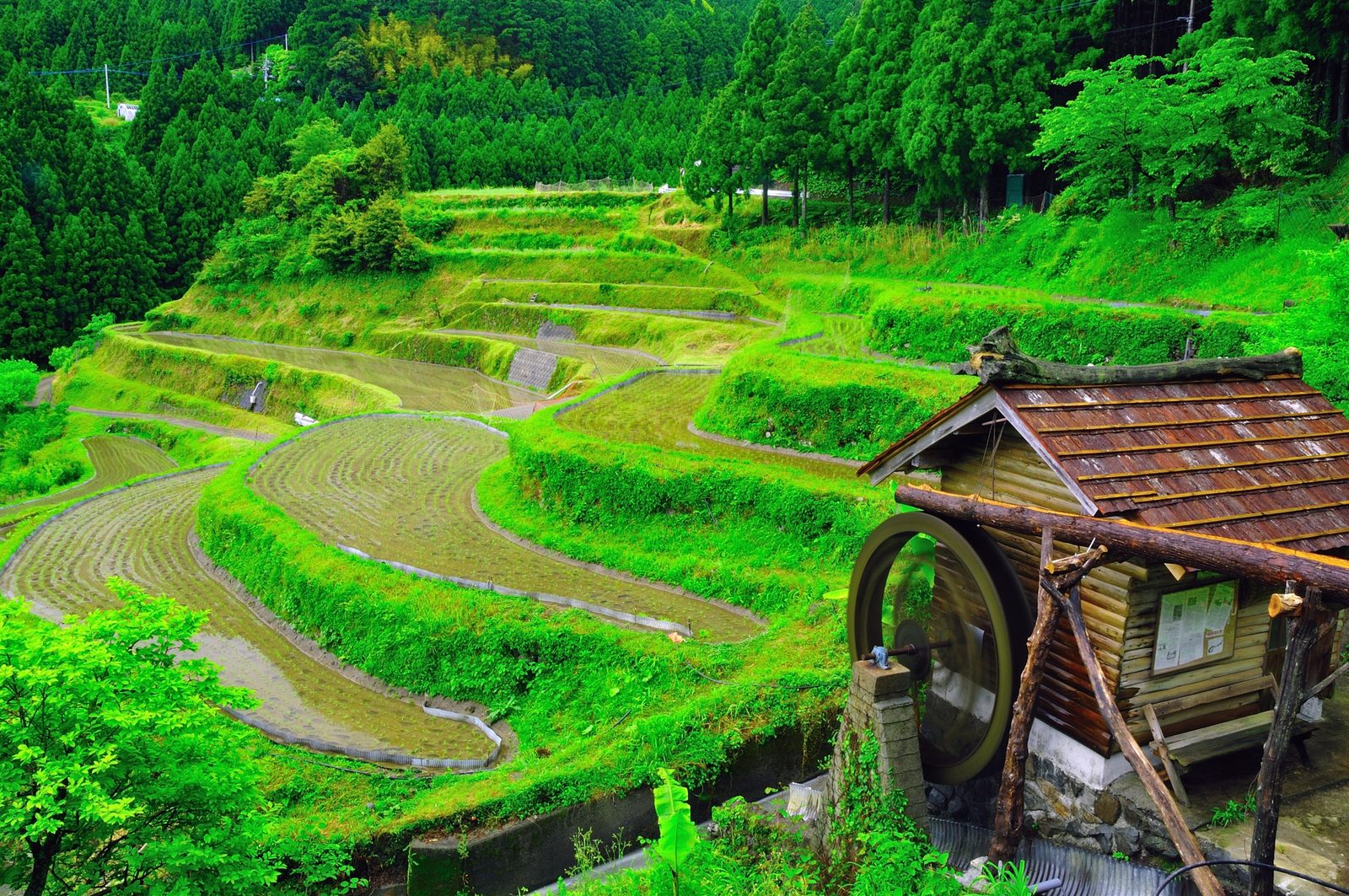
A second set of terraces lies at Ichiu, around the six-hundred-metre contour, where buckwheat is grown as well as rice. When the buckwheat flowers bloom, the Ichiu terraces become a field of flowers. Near the Ichiu terraces a drinking fountain provides drinking water, so you can pause there and drink before going on.
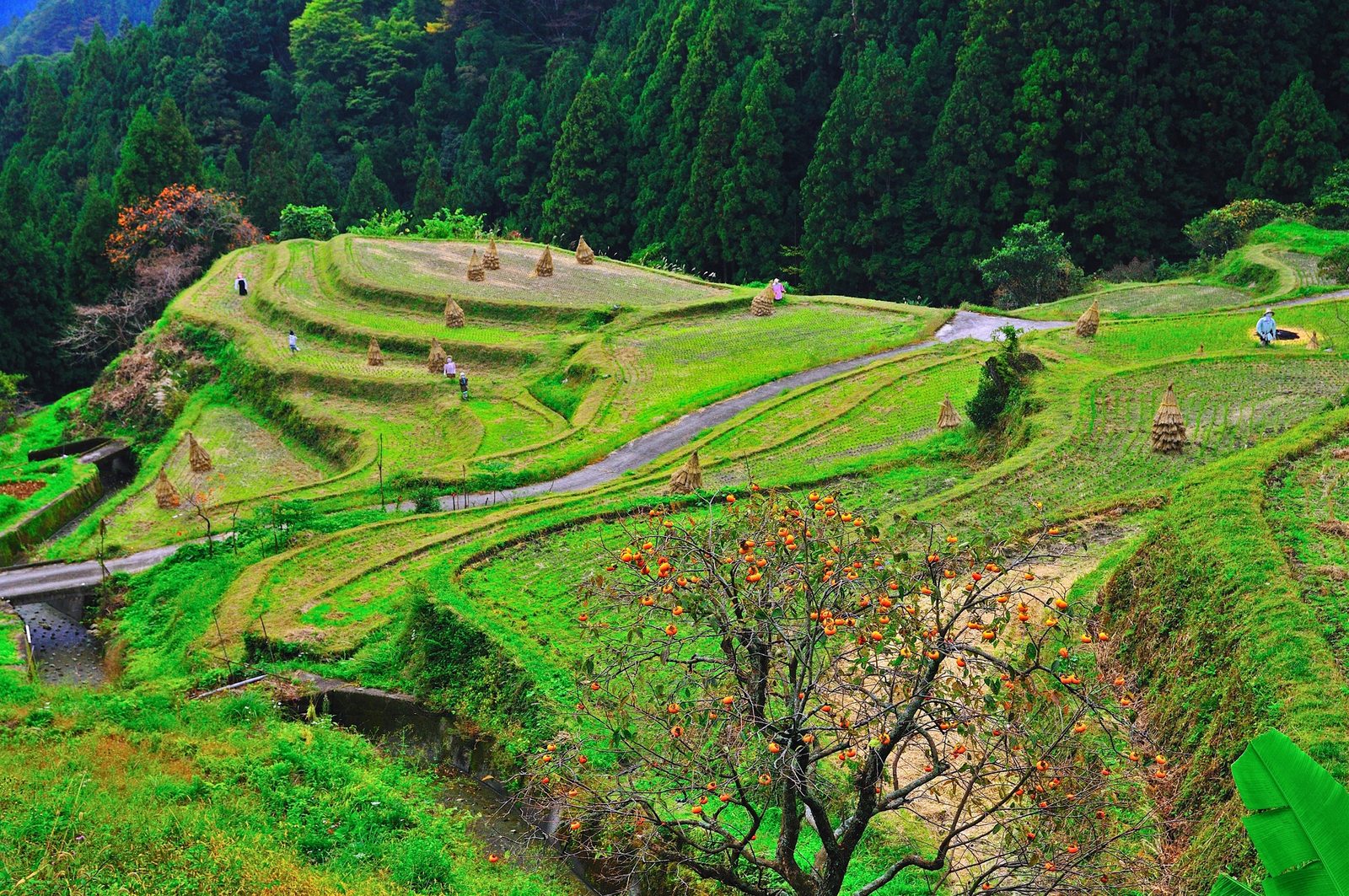
The terraced fields are private land, and you must not enter them without permission, so keep to where you are permitted and treat the fields as the working farmland they are. Every year a music festival is held in the terraced rice fields of Kamikatsu, so the terraces are a place to listen as well as to look.
Mt Yamainu-dake and the Mountain Streams
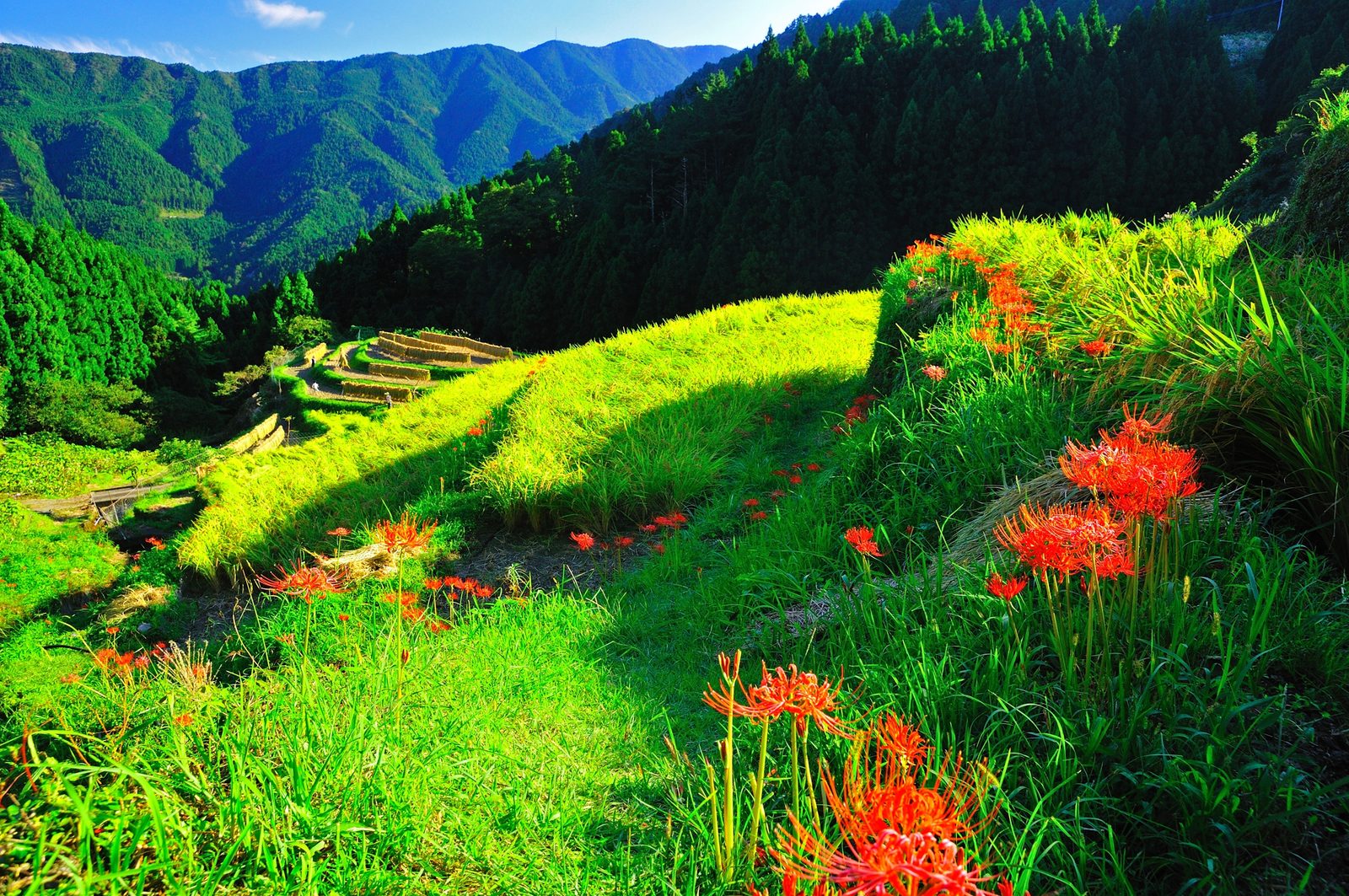
Mt Yamainu-dake has eighty-eight stone Buddhas in its deciduous primeval forest. The name of the mountain derives from a legend that a mountain dog fought a wolf. Beech forest spreads along the way up, and after rain the moss covering the ground forms a green carpet. A walk through the moss colony is a recommended point of the climb. After a mountain path through the primeval forest, a Daishi hall stands among giant cedar trees.
In summer, the water is as much a reason to come as the forest. At a gorge in the town, you can put your feet in the mountain stream. At a pair of pools, you can hear the sound of water. If what you want from the mountains is water rather than moss, come in summer; for the moss, come after rain.
Bancha Tea, Amago Trout, Citrus and Beer
Bancha grown in the Kanda settlement is sold as Kanda-cha and is designated a Tokushima Prefecture traditional specialty product. You can compare Kamikatsu bancha teas from different farmers, each with its own character, in a tasting comparison. The tasting can be arranged at various places within the town by consultation, so it fits into a day built around the terraces or the mountain.
Amago trout carries vermilion spots along its sides, except on the head and back, which is how you tell it from yamame. Its flesh is faintly pink, and its refined taste spreads softly the moment you put it in your mouth. The bones are so fine and small that you can eat the fish as it is with hardly any bother.
Yuzu and sudachi are produced here in large amounts, each with its own distinctive taste and aroma, and they are used in Japanese and Western dishes and drinks alike. Setsuragi Shokudo has three to five parking spaces, and in the autumn rice-drying season there are fewer still.
At the Kamikatz brewery, the tour lets you taste malt, the raw material of beer, and smell hops. The brewery uses the Kamikatsu specialty citrus yuko and Kamikatsu bancha in its beer, and in the barrel room it ages barrel-aged beer in wooden casks that previously held wine or whiskey. Visitors can also view the equipment that produces liquid fertilizer. Anyone who wants the town on a plate can build a short tasting from tea to trout to beer, and the beer is where the yuko and the bancha meet.
Getting to Kamikatsu
| Leg | How | Time and estimate |
|---|---|---|
| Tokushima Awaodori Airport to Tokushima Station | Tokushima Bus | About 28 minutes |
| Tokushima Station to Yokosenishi | Tokushima Bus Katsuura line | About 1 hour 15 minutes |
| Yokosenishi to Kamikatsu | Kamikatsu town bus | Listed as 30 minutes |
| Yokosenishi to the stop for Kamikatsu Town Office | Town bus with a transfer | About 35 minutes |
| From that stop to Kamikatsu Town Office | On foot | About a 5-minute walk |
| Tokushima Station to the Zero Waste Center WHY | By car | 55 minutes |
| Tokushima Awaodori Airport to the Zero Waste Center WHY | By car | 80 minutes |
| Tokushima Station to Kamikatsu Town Office | By car | Around 1 hour |
| Tokushima Station to Kamikatsu Town Office | Kamikatsu volunteer taxi | About 45 to 60 minutes |
| Tokushima Awaodori Airport to Kamikatsu Town Office | Kamikatsu volunteer taxi | About 60 to 90 minutes |
| Town bus stop in front of the Zero Waste Center to HOTEL WHY and Kuru-kuru Kobo | On foot | 1 minute to each |
Because public transport in Kamikatsu is limited, renting a car makes it easier to move around town, and a car from Tokushima City reaches Kamikatsu in about an hour.
New to rural buses and one-man trains? See how to ride them, step by step.
Hours and Fees
| Place | What | Hours or fee |
|---|---|---|
| STUDY WHY individual tour | Fee, adults | 1,650 yen (tax included) |
| STUDY WHY individual tour | Fee, junior high school to university students | 1,100 yen (tax included) |
| STUDY WHY individual tour | Time | 16:30-17:00; not held at other times |
| Zero Waste Center WHY | Visiting hours | 9:00-17:00 |
| Zero Waste Center WHY | Closed | First Tuesday and from 12/31 to 1/2 |
| HOTEL WHY | Reception | 9:00-17:00 |
| Facility tour led by staff | Time | Every day at 16:30; book ahead |
| Kuru-kuru Kobo | Workshop hours | 9:00-17:00 |
| Kamikatz brewery tour | Fee, 1 to 3 people | 5,500 yen per person |
| Kamikatz brewery tour | Fee, 4 or more people | 4,500 yen per person |
| Kissa Ikumi | Stone-grilled yakiniku | Every day 12:00-15:00 and 18:00-21:00; book ahead |
| RISE & WIN Brewing Co BBQ & General Store | Shop hours | 9:00-16:00; last order 15:00 for food and 15:30 for drinks |
| Cafe polestar | Cafe hours | 11:00-17:00; last order 16:00 |
| Restaurant and Bar IRORI | Bar hours | 18:00-23:30 |
| Ristorante pertornare | Lunch and dinner | Lunch 12:00-15:00 (last order 13:00); dinner 18:00-22:00 (last order 21:00) |
If you plan to start from the city, there are places to stay in Tokushima city.
Where to stay
Places to stay near Tokushima →
Disclosure: This post may contain affiliate links. If you book through them, we may earn a commission at no extra cost to you.