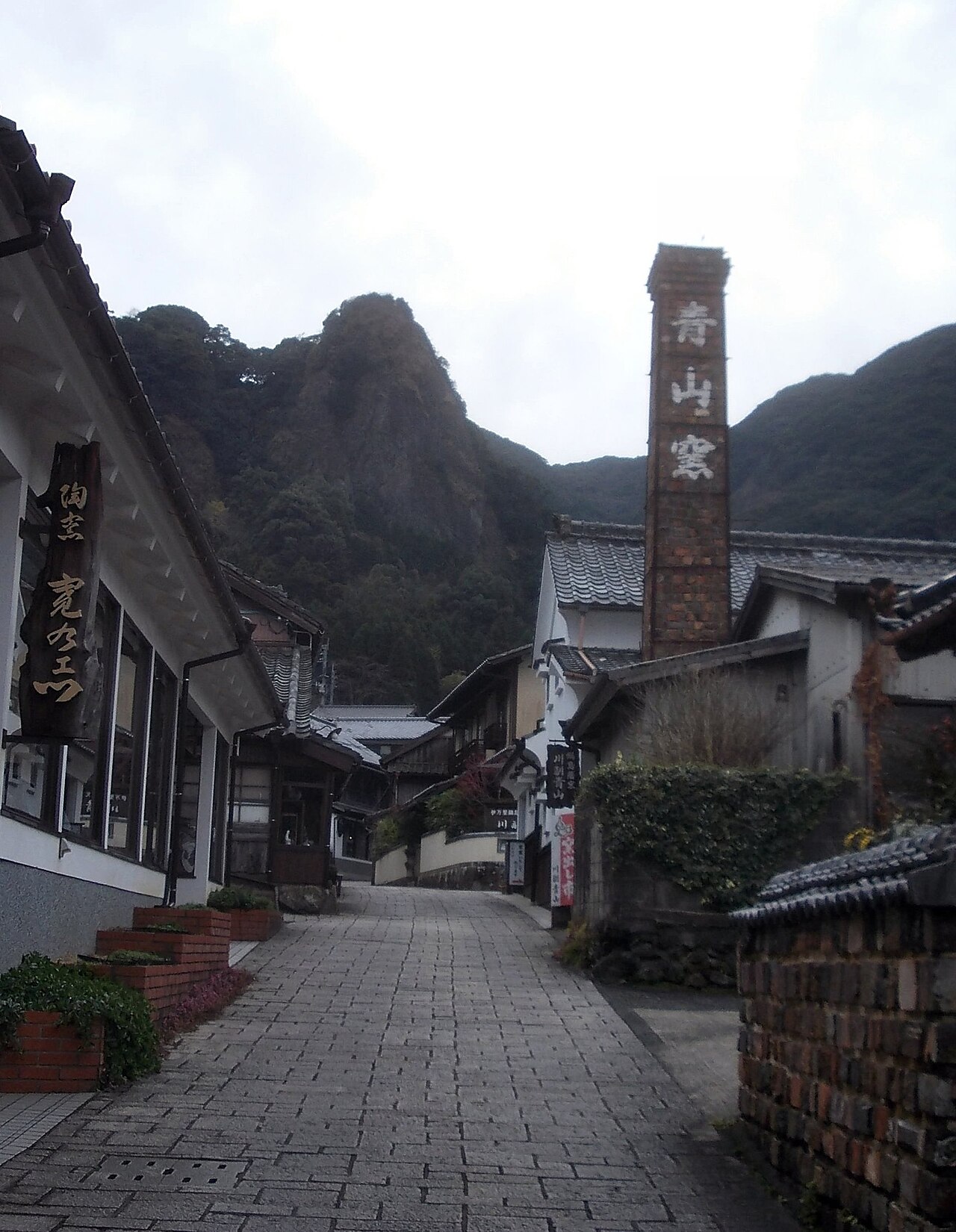
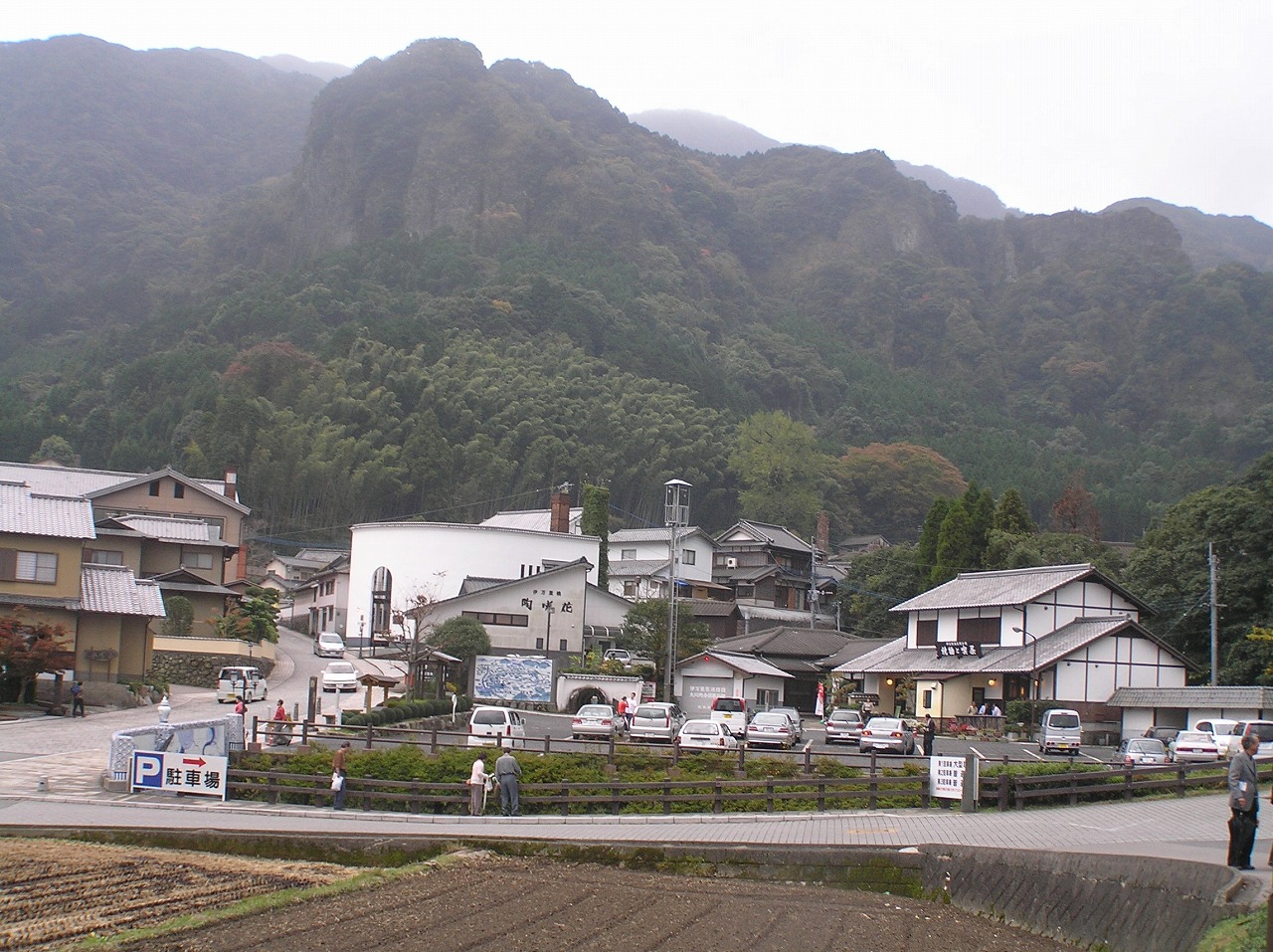
Okawachiyama is a porcelain village in Imari, Saga, where the welcome begins at the entrance: cross the bridge beyond the old barrier site and a bell of Nabeshima ware sounds. Beyond it, thirty-one kilns line both sides of the kiln lane. Along the river, a large water-powered mortar still moves with a loud sound, as the stone-crushing mills did in the domain kiln era. In summer, about two thousand porcelain wind chimes hang at the shop fronts, and their cool tones ring out across the dark-green mountains.
Crossing the Bridge into Okawachiyama
The village is entered from the monument at the old barrier site, which stands at its actual position with the Edo-period route still as it was. Crossing the bridge beyond it, visitors are greeted by a bell sound made of Nabeshima ware and by fired pieces hung like wind chimes that answer with a clear sound. This entrance sound is listed on a national list of one hundred soundscapes.
Past the bridge, thirty-one kilns line both sides of the kiln lane. Representative pieces from the village kilns are displayed and sold at a hall of Nabeshima ware, which also has a souvenir and cafe corner, a sensible first stop before the shops. Anyone with only a short stay can keep to the bridge and the lane, which hold the entrance bell and the thirty-one kilns.
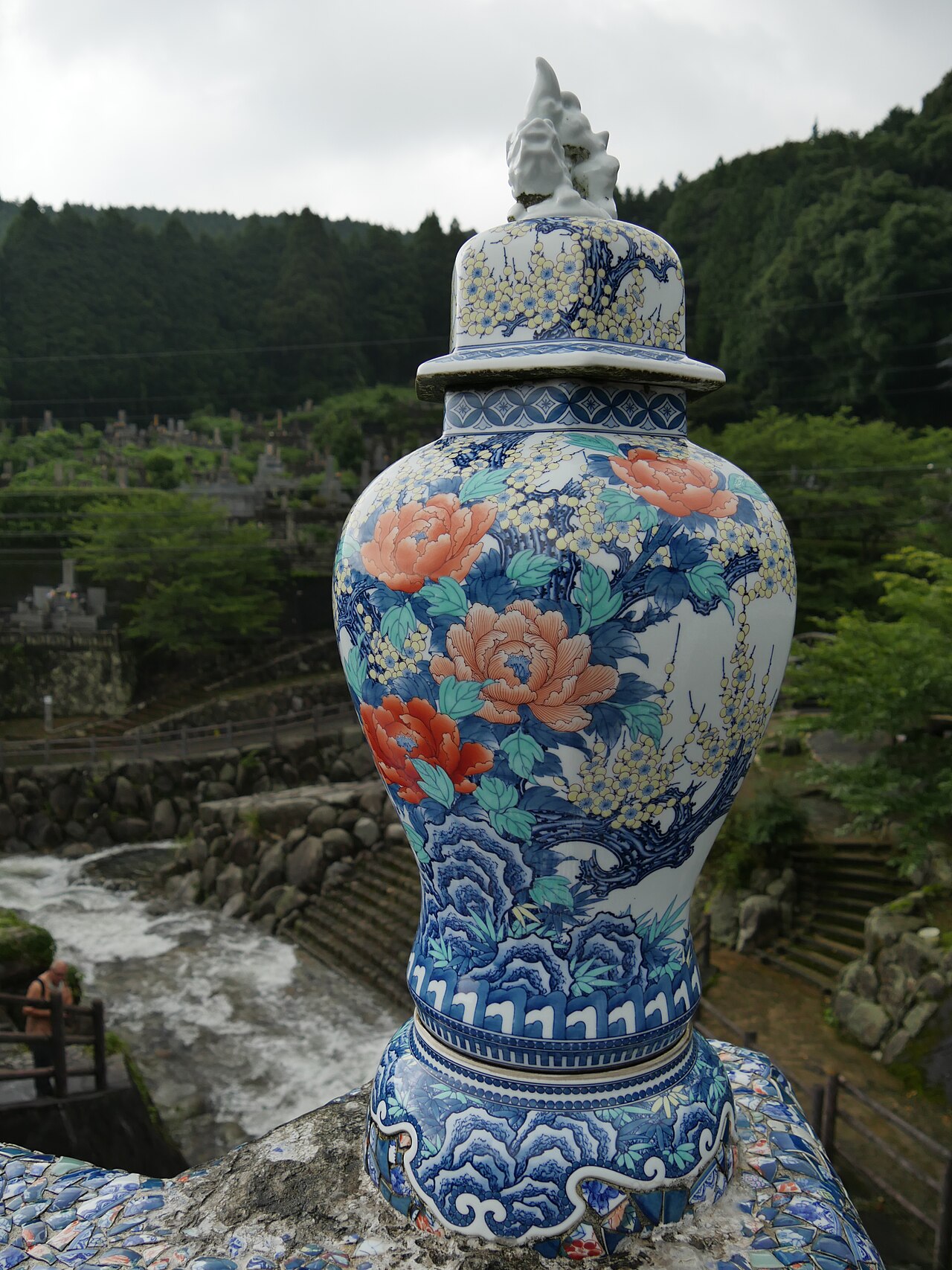
Further in, a bridge built of fire-resistant bricks from climbing kilns crosses the stream, with tiles of Imari ware embedded in its embankment. The sound of the stream at this bridge is described as pleasant. Another bridge is decorated with Nabeshima ware mosaic tiles and jars. Behind the chime, a sensor reacts when someone crosses the entrance bridge and an IC circuit produces the sound. A tower reproduces, with IC technology, the old technique of tapping pottery and sorting it by its tone, used since the domain kiln era.
The terrain explains the barrier: Okawachiyama is a large pouch-shaped valley surrounded by mountains on three sides, manageable just by placing a guardhouse at the entrance. The domain kiln first stood in Arita and was moved to this remote valley to prevent the leakage of advanced technique once exports of Imari ware grew.
The Water Mortar, the Mural and the Climbing Kilns
Along the river, a hut reproduces the Edo-period scene in which river water turned a wheel to crush pottery stone. Inside, a large water-powered mortar actually moves and makes a loud sound. In the domain kiln era, water-mill huts lined this riverside and the sound of crushing porcelain stone echoed here; the working mortar today recalls that row of mills.
A large mural is made in mosaic fashion from pottery shards and tonbai. A rest pavilion has a stone wall, stone steps, a small terrace and benches, and a potter's house recreates the home of an Edo-period potter who lived here. Partway up the slope of the park is the Yakimono Hiroba, where objects are made from pottery shards.
At a kiln site, the kiln floor and the excavated shards lie under a shelter so they can be seen as they are. The ruin is a connected-chamber climbing kiln of thirteen chambers, and many kiln tools and shards were excavated from it and its surroundings. Around the old Oko-ishi kiln site, the surroundings take on autumn colour. A climbing kiln reconstructed for sightseeing in the Heisei era is used jointly around September each year to teach young kiln masters the technique.
The potters gathered here perfected three styles of Nabeshima ware, which was designated a national traditional craft in nineteen seventy-five. The domain enforced strict quality control, barred outsiders, and smashed all failed pieces so the technique would not leak; selling one hundred pieces as Nabeshima ware meant making two to three hundred. With limited time, the lane and the mortar hut are enough; with more, walk up the park slope to the Yakimono Hiroba and take in the kiln site.
Making, Painting and Browsing Porcelain
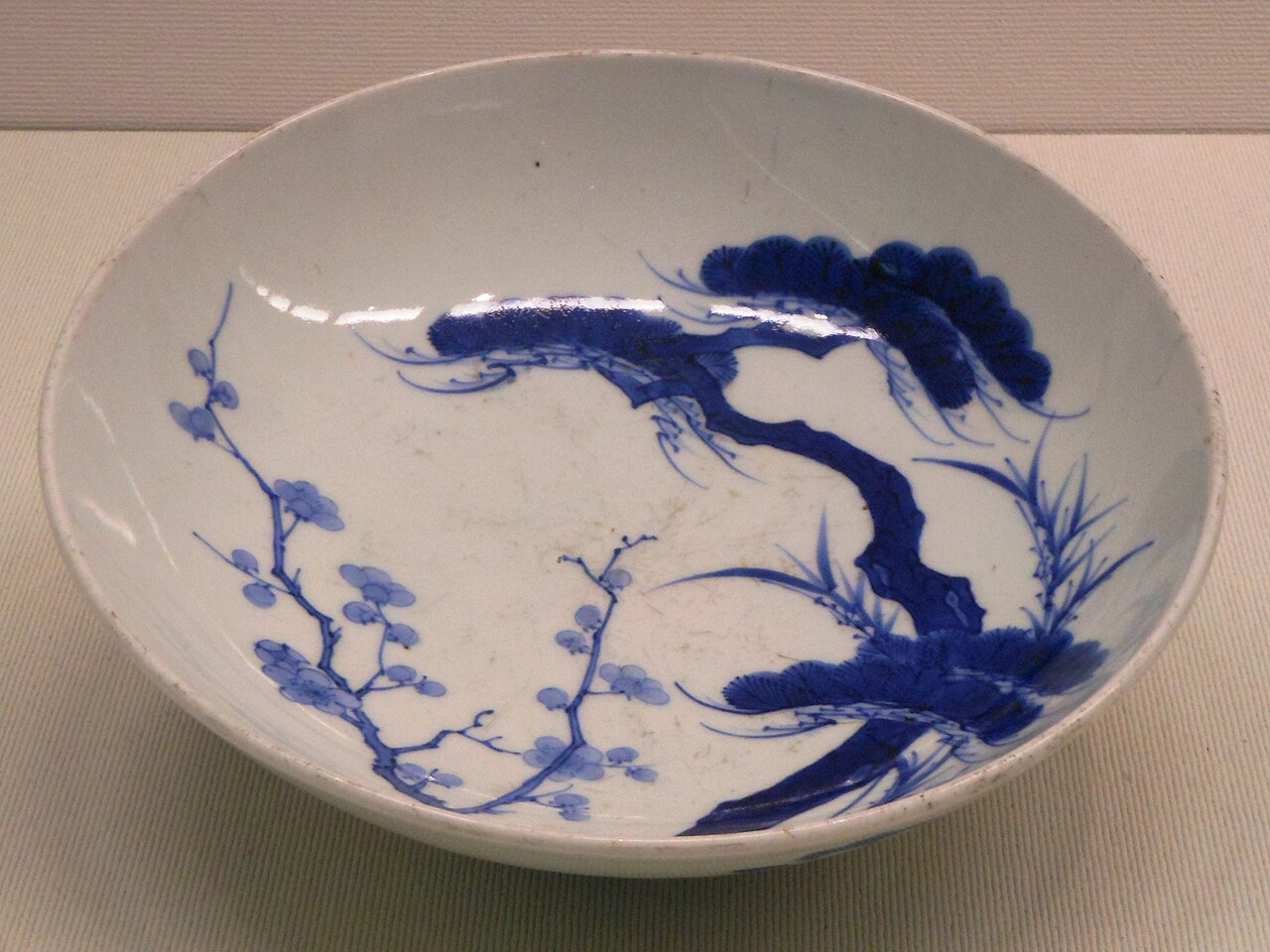
Those who want to bring home something they shaped can try the wheel at one kiln, where one portion of clay makes about three items such as a tea bowl or a cup. A painting experience at a hall is the other way to make something and starts from a lower fee than the wheel; both fees are in the table below.
At one kiln, the wheel-thrower shapes each wine cooler by hand and paints it in the traditional colours of old Imari ware. Another kiln has a factory and showroom where visitors can pick up the pieces in their own hands before buying, and factory visits are offered on request. A further kiln allows workshop visits on working days, so readers who want to watch the making rather than only browse should plan accordingly.
A special guided walk follows the old back roads of Okawachiyama, with a souvenir and an original map included, and rain or light rain does not cancel it; it suits readers who want to go beyond the kiln lane on foot.
Wind Chimes, Spring Market and Autumn Festival
Summer belongs to the wind chimes. About two thousand porcelain wind chimes made by the village kilns decorate the front of each shop, and their cool tones ring out across the dark-green mountains. Each porcelain chime has a different tone, and each kiln displays and sells its own, so walking the lane becomes choosing one by ear. The wind-chime fair began in the year two thousand four and is now a summer feature of Okawachiyama in Saga, and a summer exhibition at the painting hall gathers cool-looking vessels.
In spring the village holds a kiln market, listed as running from the end of April into the start of May, and carp streamers flutter in the wind. Stamp rally sheets are handed out at the car park, the hall of Nabeshima ware and each kiln, and customers who buy at five kilns enter a draw for gifts such as ceramic plates. During the market, restaurants and food trucks gather in the square in front of the hall.
Autumn has two fixed dates: a brush memorial service on November fourth every year, and the autumn kiln festival, whose listed schedule for twenty twenty-six runs from November twentieth to November twenty-fourth. Visitors who want to hear the chimes should come in summer, since they can be heard until August, while late-autumn visitors can plan around the festival days.
Getting to Imari and Okawachiyama
| Leg | How | Time and estimate |
|---|---|---|
| Tokyo to Hakata | Shinkansen | About 4 hours 56 minutes |
| Shin-Osaka to Hakata | Shinkansen | About 2 hours 25 minutes |
| Tokyo to Fukuoka | Flight | About 1 hour 55 minutes |
| Tokyo to Saga | Flight | About 2 hours |
| Hakata Station to Imari Station | Sasebo Line route via Arita | About 1 hour 51 minutes |
| Hakata Station to Imari Station | Chikuhi Line route via Karatsu | About 2 hours 19 minutes |
| Karatsu Station to Imari Station | Train | 48 minutes |
| Hakata Bus Terminal to Imari Station | Express bus, 17 round trips a day | About 1 hour 40 minutes |
| West Kyushu Expressway interchange to Okawachiyama | Car | About 20 minutes |
| Kyushu Expressway interchange to Okawachiyama | Car | About 30 minutes |
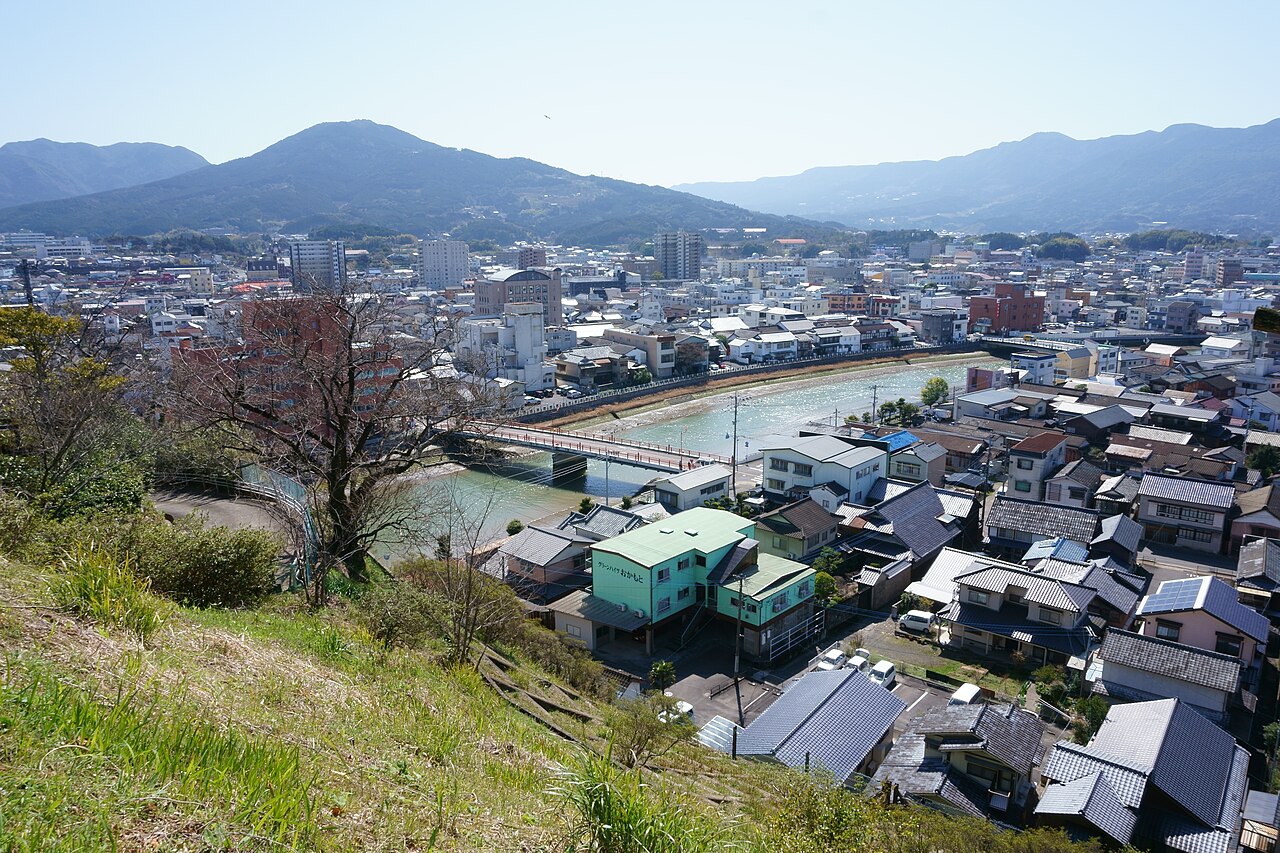
Imari Station is the rail gateway to the town.
New to rural buses and one-man trains? See how to ride them, step by step.
Hours and Fees
| Place | What | Hours or fee |
|---|---|---|
| Spring kiln market | Dates and hours | Listed as April 29 to May 5, 9:00-17:00 |
| Autumn kiln festival | Listed schedule for 2026 | November 20 (Friday) to November 24 (Tuesday) |
| Brush memorial service | Date | November 4 every year |
| Hall for the painting experience | Hours | 9:00-17:00 |
| Painting experience | Reception | 9:00-16:00 |
| Painting experience | Fee | From 800 yen, tax included |
| Wheel-throwing experience at one kiln | Fee | 5,000 yen per person |
| Guided walk on the old back paths | Hours | 13:30-15:00; rain or light rain does not cancel it |
| Guided walk on the old back paths | Fee | 2,000 yen per person, with a souvenir and an original map |
| Kiln shops | Hours | Many list 10:00-17:00 |
| A kiln shop with early hours | Hours | 8:30-17:00 |
| A kiln shop with late hours | Hours | 9:00-17:30 |
| One kiln shop | Closing days | Tuesdays and the New Year period |
| Another kiln shop | Closing day | Wednesdays |
The express bus from Hakata to Imari takes about one hour forty minutes, so readers planning a longer visit around the festival days may want to look at places to stay in Imari.
Where to stay
Places to stay near Imari, Saga, Japan →
Disclosure: This post may contain affiliate links. If you book through them, we may earn a commission at no extra cost to you.