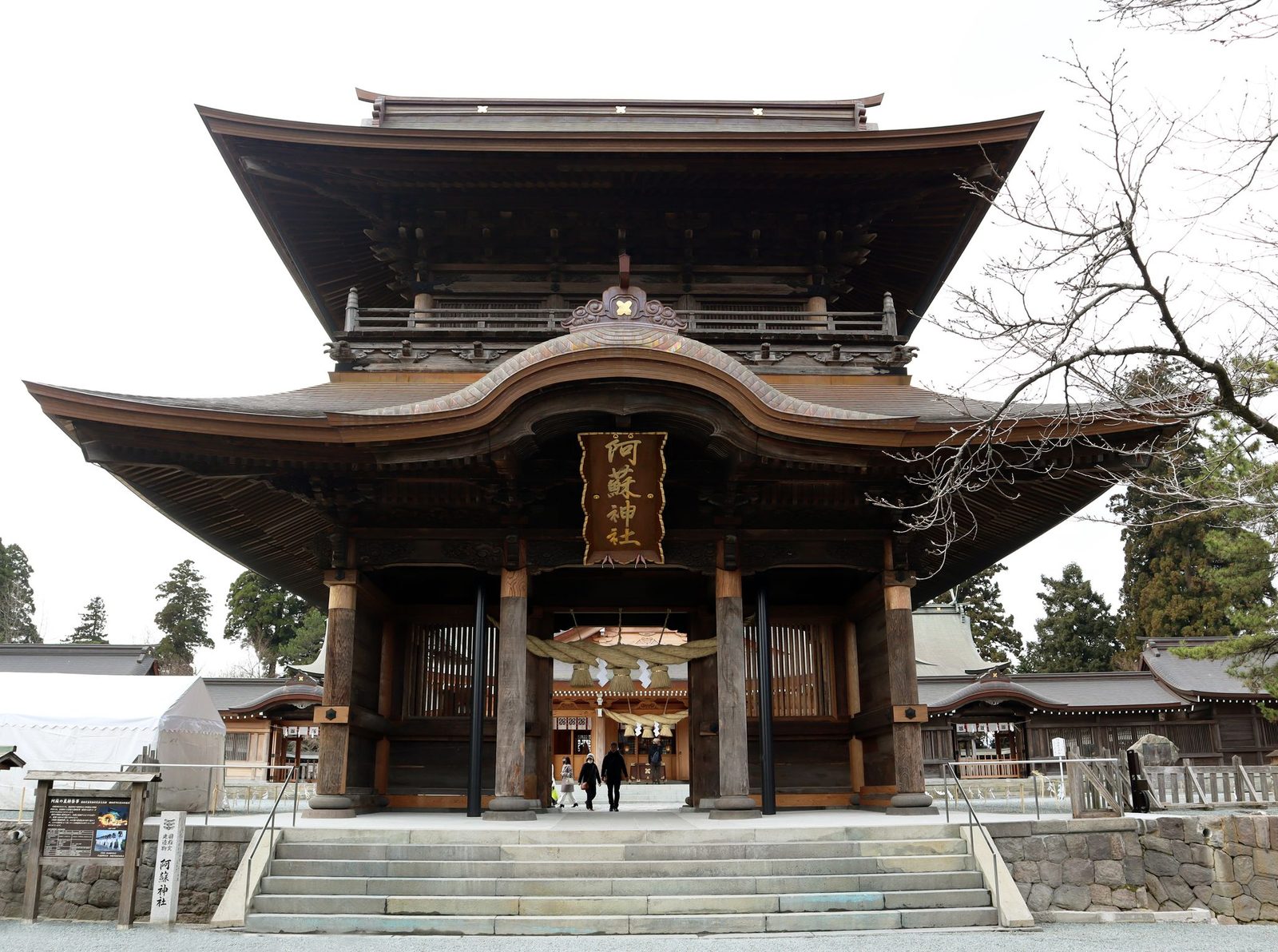
Aso Shrine is the head shrine of more than five hundred Aso shrines across Japan, and it stands in Miyaji, in the Ichinomiya district of Aso City, Kumamoto Prefecture. This is a plan for a single day out of Kumamoto: reach the shrine by late morning, spend the middle of the day between the great gate and the shop street in front of it, then finish with a soak at Uchinomaki before heading back.
The two-storey Romon gate of Aso Shrine, seen head-on from the approach.
The shape of the day is simple. The shrine is about fifteen minutes on foot from Miyaji Station on the JR Hohi Line. The grounds and the shop street take the late morning and lunch. In the afternoon, move on to Uchinomaki, where a day-trip bath at Daiaso Onsen costs three hundred yen for an adult, and if you would rather sleep in Aso than ride back the same evening, compare hot-spring inns and other places to stay in Aso City before you set out.
Getting there from Kumamoto
Everything below runs on the JR Hohi Line, either as a limited express in one go or as two legs with Higo-Ozu between them. Driving is also a straightforward option from the Kumamoto interchange.
| Leg | Means | Time |
|---|---|---|
| Kumamoto Station → Higo-Ozu Station | JR Hohi Line train | about 35 min |
| Higo-Ozu Station → Aso Station | JR Hohi Line train | about 50 min |
| Kumamoto Station → Aso Station | Kyushu Odan Limited Express 1 (Oita-bound), JR Hohi Line | 1 hour 33 min |
| JR Hohi Line Miyaji Station → Aso Shrine | on foot | about 15 min |
| Kumamoto IC → Aso Station-mae | car, National Route 57 | about 50 min |
The stop for the shrine is Miyaji Station, and the walk from there to the gate takes about fifteen minutes.
Through the gate and along the sideways approach
The approach is the first thing to notice. The layout is described as a yokosando, or side approach: rather than running straight at the main halls, the path crosses in front of them on a north–south axis pointed toward the crater of Mount Aso, which the shrine venerates as its sacred body, an arrangement said to be rare anywhere in the country. A Meiji-era gazetteer describes the Romon gate as built after the pattern of an empress's institution from Emperor Kanmu's reign, and remembers the shrine as a grand row of halls rich in antique colour.
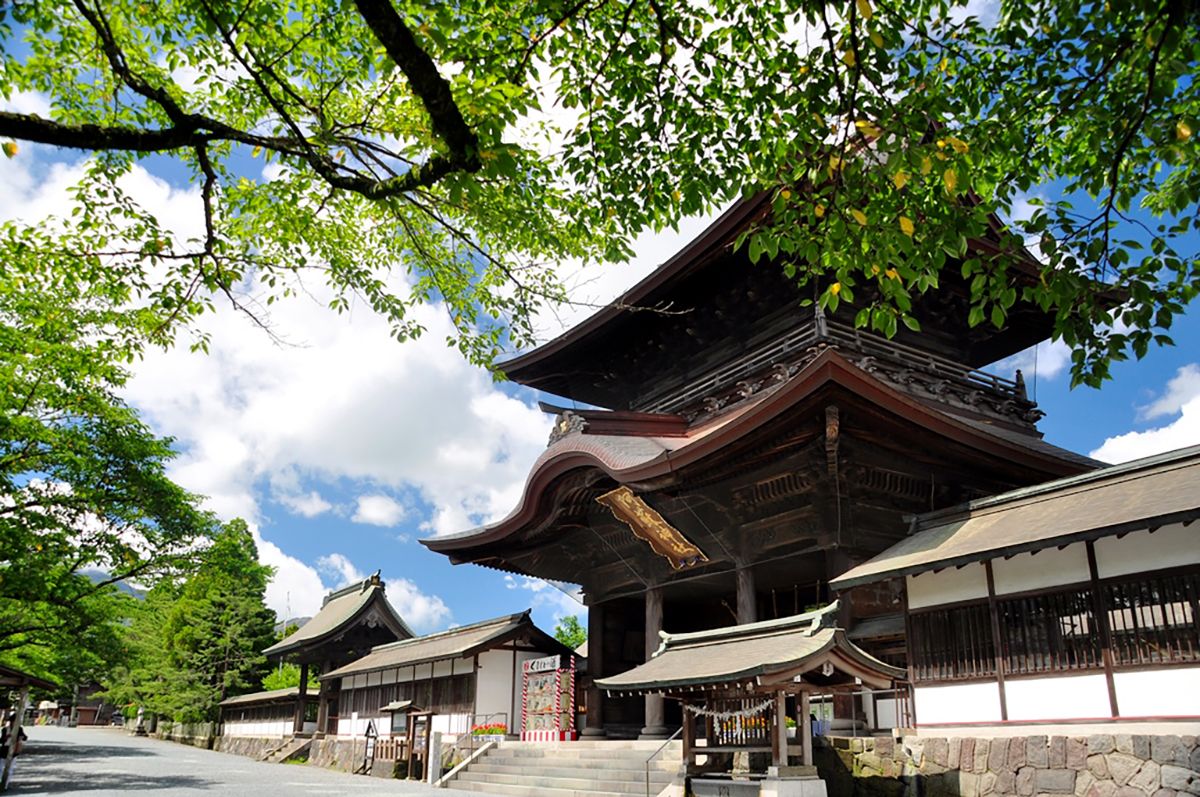
The gate from the side, with the white-walled corridors running off beside it.
The buildings damaged in the Kumamoto earthquake of two thousand sixteen have all been restored, and the repair work was completed in December two thousand twenty-three. Entry to the grounds is described as free of charge. The grounds and the amulet office keep the following hours.
| What | When |
|---|---|
| Worship (parking lot open) | 6:00–18:00 |
| Ofudasho (amulets and goshuin) | 9:00–17:00 |
What the old records say
The shrine is said to have been founded in the year two hundred and eighty-two before the common era. It is said to enshrine twelve deities led by Takeiwatatsu-no-Mikoto, described as a grandson of Emperor Jimmu and as the god who opened up the land of Aso, and he is held to be the principal deity.
Korehito, a son of Takeiwatatsu, is said to have begun the rites at Aso Shrine at the command of Emperor Keiko; the title of Aso Daiguji is then said to appear in the historical record generation after generation, and in the era of the Southern Court the family is said to have taken up arms for the imperial cause alongside the Kikuchi clan.
A Meiji-era gazetteer describes Miyaji as the central town of Aso district in its day, with a population of about fifteen hundred and the seat of the district office. The gazetteer places the shrine in the southern part of the town, calls it a kanpei-chusha, a shrine of the middle rank among those receiving state offerings, with a history said to stretch back more than two thousand years, and notes that worshippers came from near and far. The same gazetteer records that the flow of pilgrims never ceased and that the shrine was the busy heart of local faith.
Where to stay
Places to stay near Aso, Kumamoto →
Disclosure: This post may contain affiliate links. If you book through them, we may earn a commission at no extra cost to you.
Lunch on the shop street
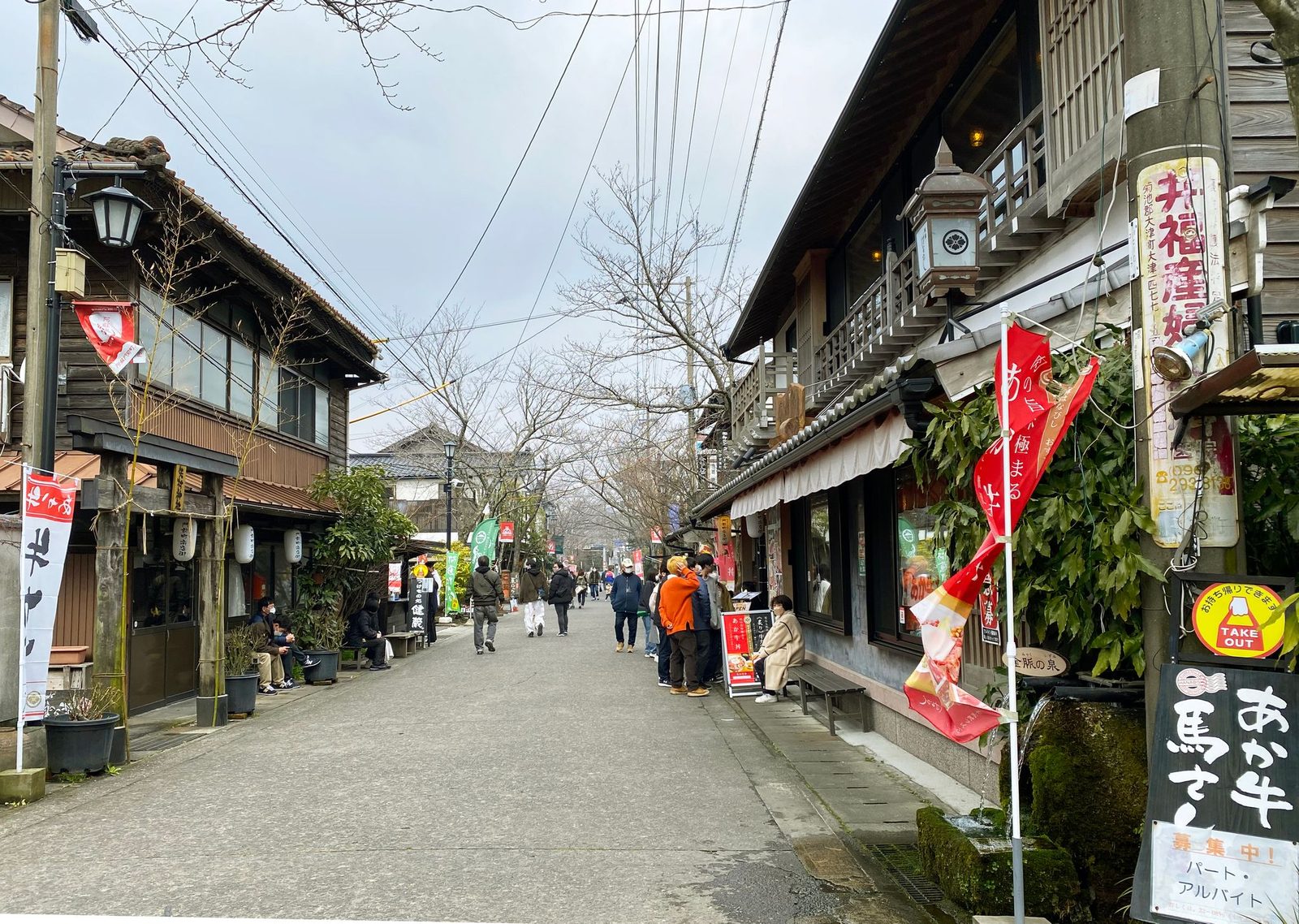
The shop street in front of the shrine, with wooden shopfronts and red banners on both sides.
The street in front of the gate is lined with old wooden shops, and lunch here means aka-gyu, the red beef of Aso, served over rice. The Monzenmachi branch of one rice-bowl restaurant lists its sets as follows.
| Set | Yen, tax included |
|---|---|
| Aka-gyu don set (with miso soup and pickles) | 2,300 yen |
| Aso specialty takana aka-gyu don set | 2,400 yen |
| Aka-gyu don set, large portion | 2,700 yen |
| Aso specialty takana aka-gyu don set, large portion | 2,800 yen |
| Aka-gyu don with original aka-gyu dago-jiru soup set | 2,500 yen |
| Monzenmachi branch | 11:00–16:00 (last order 15:30), closed every Tuesday and the third Monday |
Lunch is a mid-afternoon affair at the latest here, since the branch takes its last orders well before it shuts, and it is closed on Tuesdays and on the third Monday of the month.
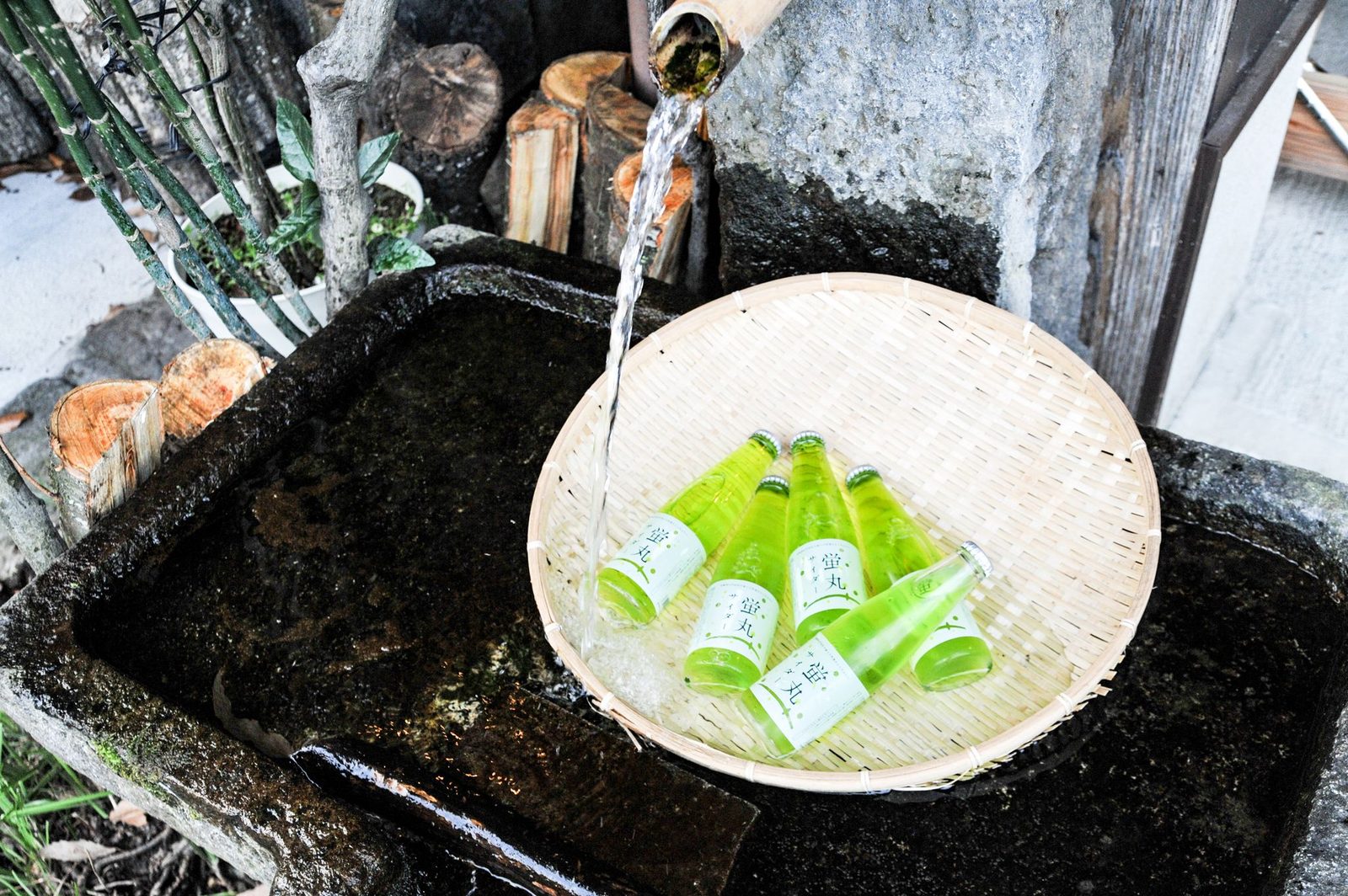
Bottles of cider cooling in a bamboo basket under water running from a bamboo pipe.
In one spot along the street, water runs from a bamboo pipe into a mossy stone trough, and bottles of cider sit cooling in a bamboo basket under the flow. It is a good place to pause before you decide whether to push on to Kokuzo Shrine or straight to the hot spring.
If you have time: Kokuzo Shrine
A Meiji-era gazetteer places Kokuzo Shrine about one ri, roughly four kilometres, to the north of Aso Shrine in the village of Teno, and gives it the same deity, Takeiwatatsu. The gazetteer describes it as built on a hillside, hemmed in on all four sides by old pines and giant cedars, with stone steps and a clear stream below, so that the grounds stay dim even at midday.
Finish at Uchinomaki hot spring
The Meiji-era gazetteer describes Uchinomaki as a town about two ri, some eight kilometres, from Miyaji on the north bank of the Kurokawa river, with a thousand-odd people, a police post and a post-and-telegraph office, serving as a stage on the Hita highway. The hot spring was there then too, and its water is said to carry sulphur and to have been prized above all for sword cuts and other wounds.
Today the day-trip bath at Daiaso Onsen in Uchinomaki costs three hundred yen for adults and one hundred yen for children. After a soak at Daiaso Onsen for three hundred yen it is tempting to stay the night, so look at hot-spring inns in Aso City if you want the morning there as well.
Heading back
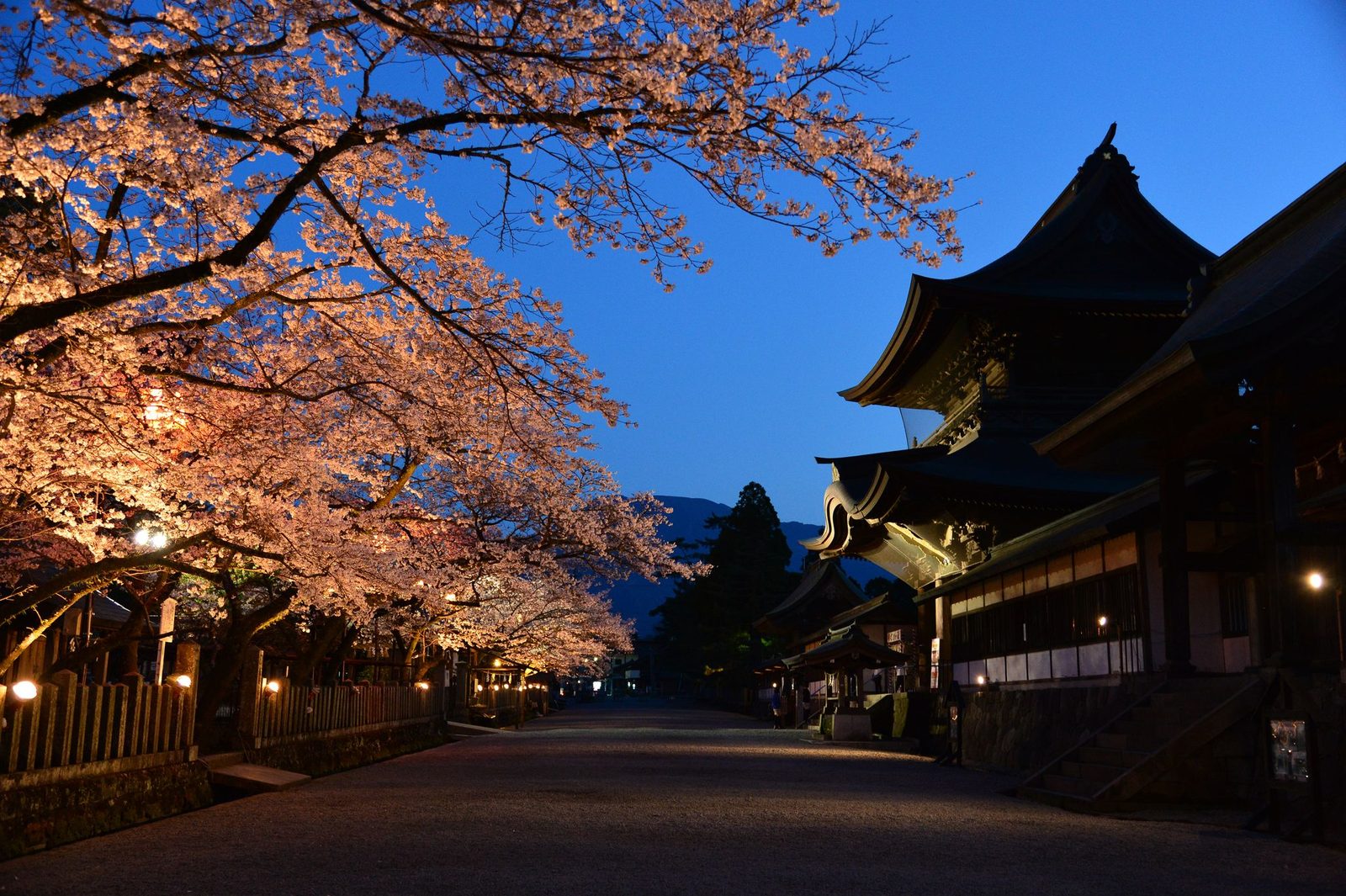
Cherry trees lit at dusk along the approach, with the gate and halls dark on the right.
From the shrine, a local route bus from the Aso Jinja-mae stop reaches Aso Station-mae in thirty-eight minutes. Or retrace the walk of about fifteen minutes to Miyaji Station and ride from there.
| From | To | Means | Time |
|---|---|---|---|
| Aso Jinja-mae bus stop | Aso Station-mae | local route bus | 38 min |
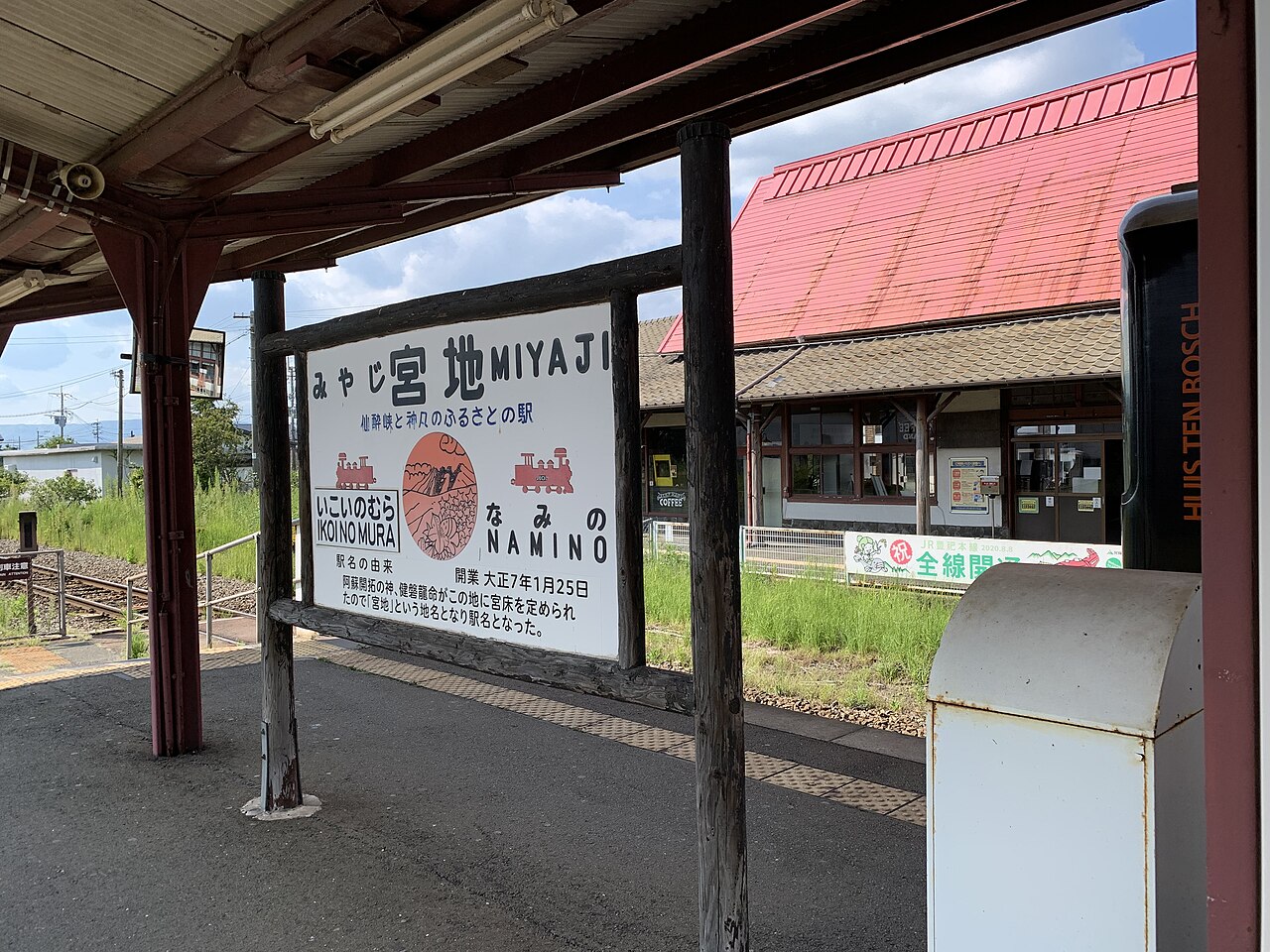
The Miyaji Station nameplate on the platform, with the red-roofed station building behind it.
That is the day: the gate, the sideways approach, a bowl of aka-gyu, a bath at Uchinomaki, and the ride back to Kumamoto. If you would rather not plan the connections yourself, see day tours around Aso instead.